

EU Rules for Balsamic Vinegar of Modena
The European Union has strict rules to protect the name "Balsamic Vinegar of Modena", ensuring it comes from Modena, Italy, and meets specific production standards. Two certifications govern its quality: PGI (Protected Geographical Indication) and PDO (Protected Designation of Origin). PGI allows for more flexible production methods, while PDO demands a rigorous process, including a minimum 12-year aging period and no additives. These rules safeguard the vinegar’s origin, production, and quality, helping consumers make informed choices.
Quick Facts:
- PGI: Shorter aging, blended with wine vinegar, more affordable.
- PDO: 100% cooked grape must, aged 12–25 years, premium product.
- EU labeling ensures authenticity and prevents counterfeiting.
Understanding these certifications helps you select the right balsamic vinegar for your needs, whether for everyday use or gourmet dishes.
How Certified Balsamic Vinegar Of Modena Is Made
PGI vs. PDO Certifications
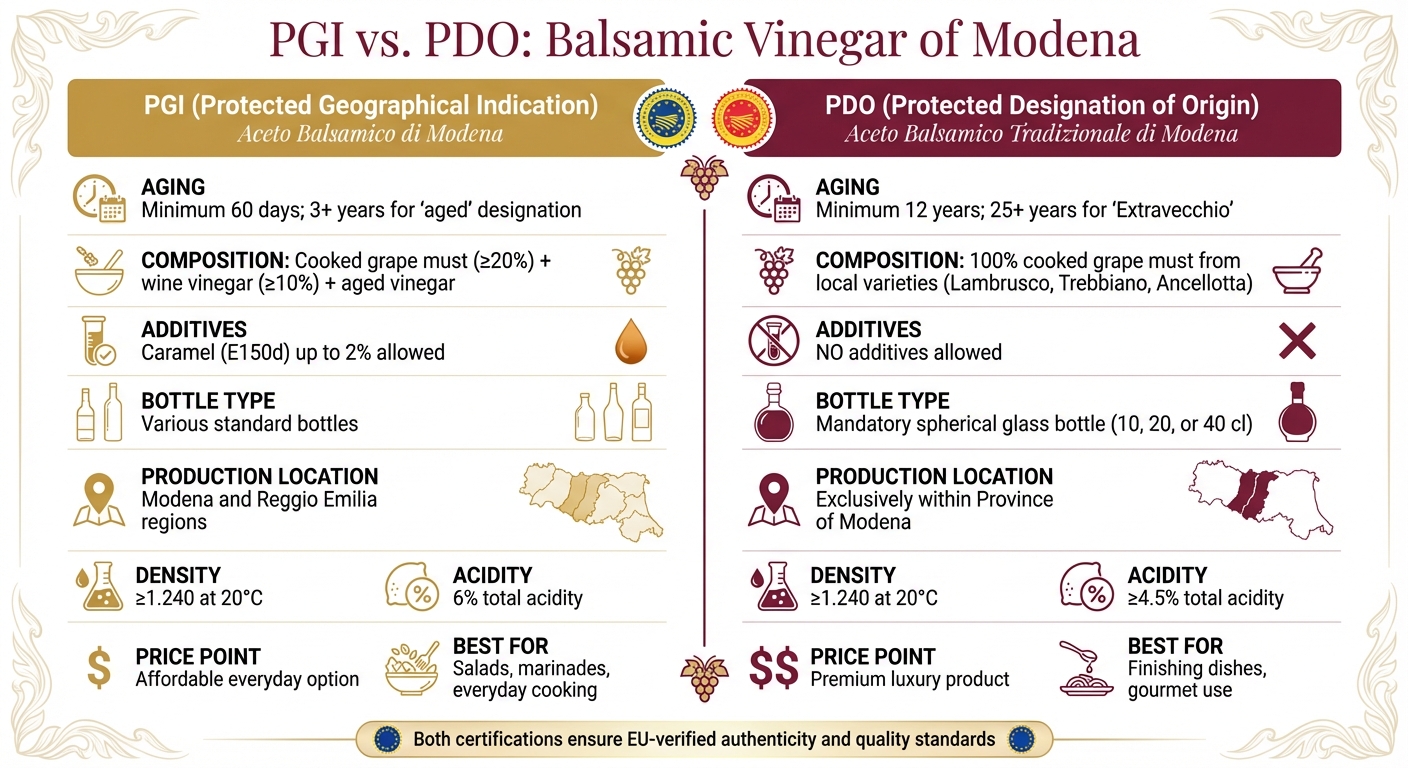
PGI vs PDO Balsamic Vinegar of Modena Comparison Chart
These certifications highlight the EU's dedication to preserving the heritage and ensuring the quality of Balsamic Vinegar of Modena. By adhering to rigorous production standards, the two certifications - PGI and PDO - help distinguish the unique characteristics and quality levels of balsamic vinegar.
When browsing for Balsamic Vinegar of Modena, you'll notice two key labels: PGI (Protected Geographical Indication) and PDO (Protected Designation of Origin). Each represents distinct production methods, aging requirements, and price ranges. Knowing the difference can help you pick the right option for your needs and budget.
PGI: Protected Geographical Indication
PGI certification applies to "Balsamic Vinegar of Modena" (Aceto Balsamico di Modena). This is the type of balsamic vinegar you’re most likely to find on grocery store shelves or in restaurants. While the full name "Aceto Balsamico di Modena" is protected, a 2019 European Court of Justice ruling clarified that the terms "aceto" (vinegar) and "balsamico" are considered generic and can be used freely across the EU.
"Individual non-geographical components of that term [Aceto Balsamico di Modena] may be used, even jointly and also in translation, throughout the European Union." - European Court of Justice
PGI standards are less restrictive compared to PDO, allowing shorter aging periods and more flexible production methods. This makes PGI balsamic a versatile and affordable choice for everyday use, perfect for drizzling over salads, enhancing marinades, or adding flavor to sauces.
PDO: Protected Designation of Origin
On the other hand, PDO certification is reserved for "Traditional Balsamic Vinegar of Modena" (Aceto Balsamico Tradizionale di Modena), a product steeped in centuries of tradition and craftsmanship. PDO balsamic is held to the strictest standards, from grape cultivation to bottling.
To qualify for PDO status, the vinegar must be made from 100% cooked grape must sourced from specific local grape varieties, such as Lambrusco, Trebbiano, and Ancellotta, with no additives allowed. The must is cooked at a minimum of 176°F (80°C) for 30 minutes in open vats. After fermentation, the vinegar is aged in traditional "acetaie" (vinegar lofts) for at least 12 years, passing through barrels made of different woods. Vinegar aged for 25 years earns the prestigious "Extravecchio" (extra-aged) designation.
"The use of preserved must and/or must containing any additives or additional substances is prohibited [for PDO]." - Consorzio Aceto Balsamico Tradizionale di Modena
Every step of PDO production - grape growing, cooking, aging, and bottling - must take place within the Province of Modena. The vinegar is sold exclusively in a distinctive spherical glass bottle with a rectangular base, available in 10, 20, or 40 cl (3.4, 6.8, or 13.5 fl oz) sizes. Each bottle is sealed with a numbered, tamper-proof cap to ensure authenticity.
How PGI and PDO Differ
The differences between PGI and PDO balsamic vinegar extend far beyond aging time. PDO balsamic must meet specific density and acidity levels - at least 1.240 at 68°F (20°C) and 4.5°, respectively. Additionally, grape yields are tightly regulated, with a maximum of 16 tonnes per hectare, and no more than 70% of the grape must may be used for concentration.
| Feature | PDO (Traditional Balsamic Vinegar) | PGI (Balsamic Vinegar of Modena) |
|---|---|---|
| Official Name | Aceto Balsamico Tradizionale di Modena | Aceto Balsamico di Modena |
| Aging | 12 years (25 years for "Extravecchio") | Typically much shorter |
| Composition | 100% cooked grape must; no additives | Cooked must blended with wine vinegar |
| Bottle Type | Mandatory spherical bottle (10, 20, 40 cl) | Various standard bottles |
| Production Location | Entire process in Modena province | Name protection only |
| Price Range | Premium luxury product | Affordable everyday option |
PDO regulations are so strict that even terms like "extra", "fine", "selected", or "reserve" are prohibited on labels. Additionally, labels cannot include the year of production. Before hitting the shelves, each batch undergoes rigorous testing by a sensory panel to ensure quality.
The 2019 EU Court of Justice ruling confirmed the distinct roles of these products. PGI balsamic is a versatile ingredient for everyday cooking, while PDO balsamic is a gourmet product, perfect for finishing dishes with just a few precious drops.
Production Requirements for Balsamic Vinegar of Modena
The European Union enforces strict guidelines to ensure the authenticity of Balsamic Vinegar of Modena. These regulations cover every step, from selecting the grapes to the fermentation process.
Ingredients and Composition Standards
PGI Balsamic Vinegar of Modena is crafted by combining cooked grape must (at least 20% of the total mass), wine vinegar (at least 10%), and vinegar aged 10 years or more. The grape must is concentrated to achieve a density of at least 1.240 at 68°F (20°C). The final product must contain at least 110 g/l of reducing sugars and a total acidity of 6%. The only approved additive is caramel (E150d), which can be used up to 2% of the finished product to stabilize color.
PDO Traditional Balsamic Vinegar of Modena has even stricter requirements. It must be made entirely from cooked grape must sourced from specific local grape varieties, with a minimum sugar content of 15°.
"The use of preserved must and/or must containing any additives or additional substances is prohibited."
– Consorzio Aceto Balsamico Tradizionale di Modena
For PDO production, the must is cooked over an open flame at a temperature of at least 176°F (80°C) for 30 minutes. After cooking, the must undergoes both alcoholic and acetic fermentation in traditional vinegar lofts, known as "acetaie." In some cases, "mother vinegar" bacteria are added to kick-start the fermentation process. The final PDO product must have a total acidity of at least 4.5% and a density of 1.240 or more at 68°F (20°C). These stringent rules ensure the vinegar’s strong connection to the Modena region, as PDO production is exclusively carried out in this province.
Once the ingredients are prepared, the aging process plays a critical role in shaping the vinegar's quality.
Aging and Quality Standards
The aging process is essential in defining the flavor and quality of Balsamic Vinegar of Modena. While PGI standards allow for some flexibility, PDO regulations are deeply rooted in traditional methods.
PGI balsamic must mature for at least 60 days in wooden barrels. To qualify as "aged" (invecchiato), the vinegar must spend at least 3 years in barrels, casks, or other wooden containers. However, PGI labels are limited to using the term "aged" without specifying the exact duration.
PDO Traditional Balsamic Vinegar of Modena requires a minimum aging period of 12 years in a series of wooden casks. For the "Extravecchio" (extra aged) label, the vinegar must age for at least 25 years. Before bottling, every batch of PDO vinegar undergoes thorough analytical and sensory evaluations by a specialized commission to ensure it meets the required flavor and aroma standards.
Additionally, PDO Traditional Balsamic Vinegar must be produced, aged, and bottled exclusively within Modena, while PGI Balsamic Vinegar of Modena can be made in the designated areas of Modena and Reggio Emilia.
sbb-itb-4066b8e
Labeling and Certification Rules
The European Union has set strict labeling rules to preserve the heritage and ensure the authenticity of Balsamic Vinegar of Modena. These rules work hand in hand with production and aging standards to protect the product's strong connection to its Modena origins. Here's a closer look at the terms and restrictions that govern these labels.
Protected Terms and Usage Restrictions
The names "Aceto Balsamico di Modena" (PGI) and "Aceto Balsamico Tradizionale di Modena" (PDO) are legally protected. For PDO labels, the phrase "denominazione di origine protetta" must appear in a font size at least 75% as large as the product name itself. Additionally, the use of qualifying adjectives like "extra", "fine", "select", "reserve", "superior", or "classic" is strictly prohibited on PDO labels.
A notable legal ruling came in December 2019 when the European Court of Justice clarified in Case C‑432/18 that while the full name "Aceto Balsamico di Modena" is protected, the individual words "aceto" (vinegar) and "balsamico" (balsamic) are considered generic. This allows other producers to use these terms separately - such as in "Deutscher balsamico" - provided they don't mislead consumers about the product’s origin. Furthermore, PDO labels cannot include references to specific production years. The term "Extravecchio" (extra aged) is exclusively reserved for vinegar aged 25 years or more.
Beyond these naming rules, labels must include specific details to confirm the product's authenticity.
Required Label Information
For PDO Traditional Balsamic Vinegar, the label must clearly and uniformly display the name "Aceto balsamico tradizionale di Modena". Each bottle is required to have a non-reusable seal with a serial number that breaks when opened, ensuring tamper-proof authenticity. Additionally, PDO products must adhere to specific packaging standards outlined in PDO regulations.
To avoid confusion, any processing or culinary details must appear on a secondary label, ensuring that claims about age or quality are clear and accurate. For PGI products, the certification mark (PGI logo) serves as a guarantee of authenticity, though the packaging requirements for PGI products are less stringent compared to those for PDO products.
The Role of Consortia in Regulation and Enforcement
A consortium plays a crucial role in protecting every genuine bottle of Balsamic Vinegar of Modena by ensuring compliance with EU standards. These organizations manage the Product Specifications (Disciplinare), which is a comprehensive rulebook detailing every step of production - from selecting the right grapes to aging the vinegar in wooden barrels. They also maintain producer registers to ensure full traceability of the product. This level of oversight reinforces the strict labeling and quality standards already established.
Quality verification is a key responsibility. For PDO products, consortia require that every batch undergo both analytical and sensory (organoleptic) evaluations before it can be sold. According to the Consorzio Aceto Balsamico Tradizionale di Modena:
"The evaluation of the analytical and organoleptic characteristics of the designation is performed, at the request of the interested parties, on all batches before the product is marketed for consumption."
Packaging and certification protocols are also tightly controlled. For PDO products, consortia enforce strict packaging rules, including the use of tamper-proof, serialized seals. They also mandate specific spherical glass bottles in volumes of 10, 20, or 40 cl. These measures ensure that every bottle aligns with the rigorous production and labeling requirements.
In addition to production oversight, consortia actively protect the product’s name through legal channels. They take action against misuse of the name, as demonstrated by previous legal rulings.
Through these comprehensive measures, consortia ensure that consumers receive authentic products that meet the high standards set by EU regulations. Their work preserves the reputation and integrity of Balsamic Vinegar of Modena on a global scale.
Conclusion
What Consumers Should Know
The European Union's framework provides clear guidelines to help consumers identify authentic balsamic vinegar, protecting them from counterfeit products. When shopping, check for the PDO (Protected Designation of Origin) or PGI (Protected Geographical Indication) labels. These labels confirm the vinegar adheres to strict EU standards for ingredients, aging processes, and production methods. Additionally, authentic products feature specific packaging details verified under EU regulations. These markers give consumers the confidence to choose products that meet high standards of authenticity and quality.
Big Horn Olive Oil's Commitment to Quality
Big Horn Olive Oil aligns its offerings with these stringent EU standards, ensuring every product reflects the hallmarks of quality. By working directly with certified producers in Modena, the company delivers balsamic vinegars that meet the EU's rigorous requirements. Products like the Traditional 18-Year Aged Dark Balsamic Vinegar and the Molto Denissimo 25-Year Aged Dark Balsamic Vinegar undergo thorough analytical and sensory evaluations mandated by EU regulations. This guarantees that customers enjoy genuine Balsamic Vinegar of Modena, complete with the rich flavors and complexity that define this prestigious designation.
FAQs
What’s the difference between PGI and PDO balsamic vinegar?
The main distinction between PGI (Protected Geographical Indication) and PDO (Protected Designation of Origin) balsamic vinegar lies in the level of production control and geographic specificity.
PDO balsamic vinegar is held to the strictest standards. Every step - production, processing, and aging - must occur in Modena, Italy. It also requires the use of specific grape varieties and traditional methods, guaranteeing an unmatched level of authenticity and quality.
PGI balsamic vinegar, though also linked to Modena, offers more flexibility. Only one part of the process, such as preparation or processing, must happen in the region. The rules around ingredients and methods are more relaxed, making it a more accessible option while still adhering to high-quality benchmarks.
What does the EU do to guarantee the authenticity of Balsamic Vinegar of Modena?
The European Union safeguards the integrity of Balsamic Vinegar of Modena through strict regulations designed to protect its quality and origin. These rules outline how the vinegar must be produced, labeled, and where it can be made, ensuring it qualifies for Protected Geographical Indication (PGI) or Protected Designation of Origin (PDO) certifications.
Producers are required to adhere to detailed guidelines, which include using specific ingredients and traditional production methods within the Modena region of Italy. These standards not only uphold the product's rich heritage but also guarantee that consumers enjoy authentic, high-quality balsamic vinegar.
What makes PDO balsamic vinegar a premium product?
PDO (Protected Designation of Origin) balsamic vinegar stands out as a premium product thanks to its adherence to strict European Union regulations. These rules ensure both its high quality and its genuine origins. Produced exclusively in Modena, Italy, this vinegar is made from carefully chosen grape must, which is naturally aged in wooden barrels for years. This aging process gives it a deep, rich flavor and a complexity that’s hard to match.
What makes PDO balsamic vinegar even more special is the dedication to traditional methods, passed down through generations of artisans. This combination of time-honored craftsmanship and rigorous standards has turned it into a true symbol of heritage and excellence.