

EVOO Certification Standards Explained
Extra virgin olive oil (EVOO) is often mislabeled or adulterated, making it essential to understand how certification ensures quality. Certification standards combine chemical testing and sensory evaluation to verify that the oil meets strict criteria for purity, flavor, and origin. Key organizations like the International Olive Council (IOC) and California Olive Oil Council (COOC) set benchmarks to help consumers identify genuine products.
Key Points:
- Chemical Standards: EVOO must meet limits for free acidity (≤ 0.8%), peroxide value, and UV absorbency to confirm freshness and prevent oxidation.
- Sensory Testing: Oils must have no detectable flaws and show measurable fruitiness, evaluated by trained tasters.
- Regional Authenticity: Certifications like the COOC seal verify the oil’s origin, such as being 100% California-grown.
- Labeling Requirements: Look for harvest dates, best-by dates within 24 months, and certification seals to ensure quality.
Quick Tip:
When shopping, check for certification seals (e.g., COOC or IOC) and avoid terms like "Pure" or "Light", which indicate lower-grade oils. Certified products provide transparency and meet higher quality standards.
How to Choose REAL Extra Virgin Olive Oil: A Practical Guide
What Qualifies as Extra Virgin Olive Oil
The "Extra Virgin" label isn't just a fancy term - it signifies a strict set of standards that olive oil must meet to earn the title. Extra Virgin Olive Oil (EVOO) is made using only mechanical methods, such as pressing or centrifugation, without any chemical processing. This ensures the oil retains its natural qualities and flavor.
One of the most important factors in determining EVOO is its free acidity, which serves as a key chemical marker. According to the International Olive Council, EVOO must have a free acidity level of no more than 0.8 grams of oleic acid per 100 grams (or 0.8%). A lower acidity level is usually a sign that the olives were fresh and handled carefully. For comparison, Virgin Olive Oil can have up to 2.0% free acidity, while Lampante Olive Oil starts at 3.3% or more.
But chemistry alone isn't enough. EVOO must also pass a sensory evaluation conducted by a trained panel. To qualify, the oil must have zero defects and a fruitiness score greater than zero. Even if the chemical composition meets the standards, an oil cannot be classified as Extra Virgin without passing this sensory test.
| Grade | Free Acidity (Max) | Median of Defects | Median of Fruitiness |
|---|---|---|---|
| Extra Virgin | 0.8% | 0 | > 0 |
| Virgin | 2.0% | ≤ 2.5 | > 0 |
| Lampante | > 3.3% | > 2.5 | - |
These rigorous standards are in place to protect consumers from low-quality or adulterated oils. They ensure that EVOO provides not only its signature flavor but also the health benefits that come with a truly authentic product.
Main Certification Standards for EVOO
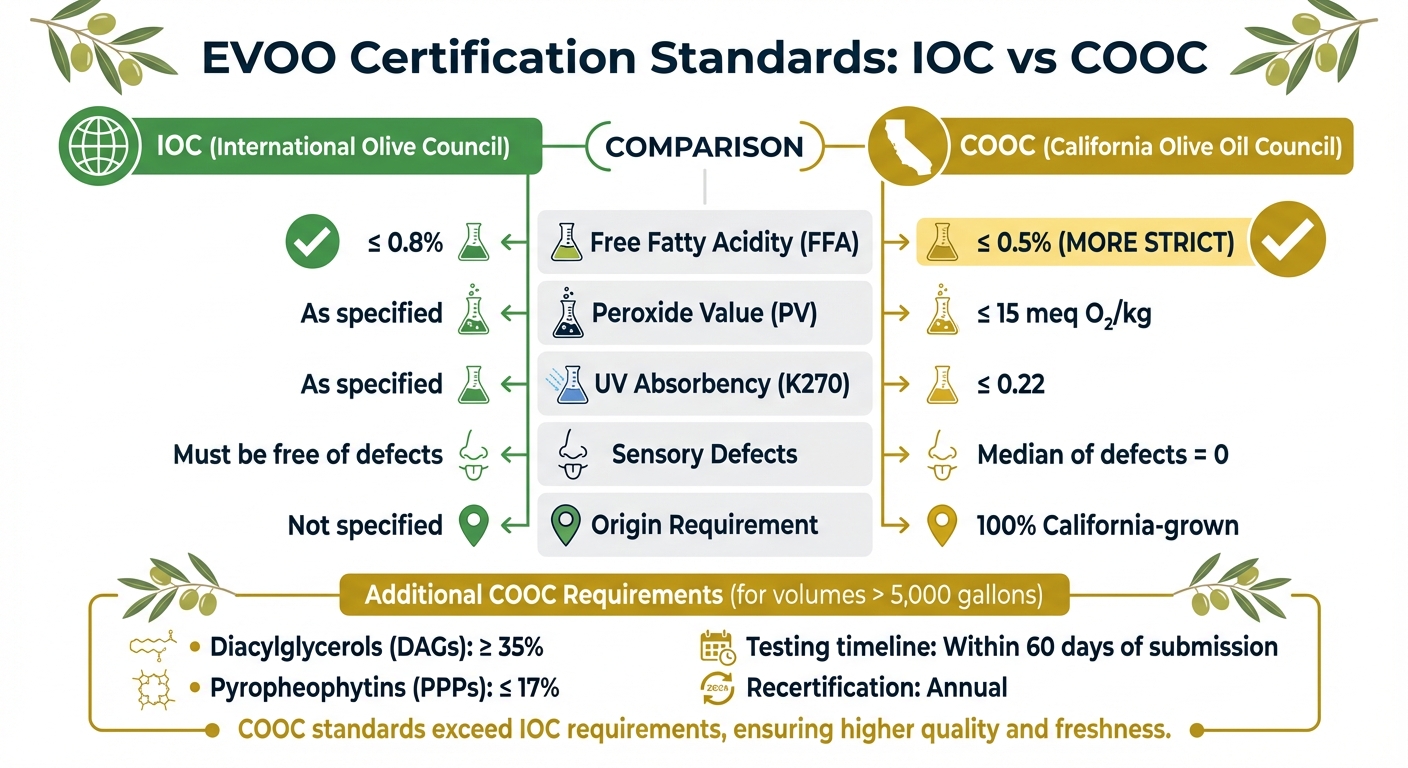
EVOO Certification Standards Comparison: IOC vs COOC Requirements
Extra Virgin Olive Oil (EVOO) must meet strict standards to ensure its quality and authenticity. Various certification bodies play a crucial role in maintaining these standards, protecting both the integrity of the product and the interests of consumers.
International Olive Council (IOC) Standards

The International Olive Council (IOC) sets the global standard for olive oil quality. EVOO certified under IOC guidelines must be extracted using mechanical methods such as washing, decantation, centrifugation, and filtration. To ensure quality and detect any adulteration or oxidation, the IOC employs chemical tests, including spectrophotometric UV analyses (K232 and K270). The current trade standard, COI/T.15/NC No 3/Rev.21/2025, also includes sensory evaluations based on COI/T.20/Doc. No 15. These benchmarks serve as the foundation for many other certification programs.
U.S. FDA Standards of Identity
In the United States, the Food and Drug Administration (FDA) enforces labeling rules to prevent misuse of the term "extra virgin." According to the FDA's Food Labeling Guide, "extra virgin" can only appear in the ingredient list for flavored oils or blends, ensuring transparency and authenticity.
California Olive Oil Council (COOC) Seal
The California Olive Oil Council (COOC) focuses on certifying olive oils that are 100% grown and harvested in California within the same season. The COOC's chemical standards are even stricter than those of the IOC. For instance:
- Free Fatty Acidity (FFA) must be 0.5% or less, compared to the IOC's limit of 0.8%.
- Peroxide Value (PV) must be 15 meq O₂/kg or less.
- UV Absorbency (K270) is capped at ≤ 0.22.
Producers with volumes exceeding 5,000 gallons must provide additional chemical data, such as Diacylglycerols (DAGs ≥ 35%) and Pyropheophytins (PPPs ≤ 17%). Beyond chemical testing, a panel of experts evaluates the oil to ensure it has no sensory defects and measurable fruitiness. Certification is specific to each harvest and must be renewed annually. Importantly, chemical testing must be conducted within 60 days of submitting the oil for certification. These rigorous criteria ensure that only authentic, high-quality EVOO carries the COOC seal.
| Standard | IOC Requirement | COOC Requirement |
|---|---|---|
| Free Fatty Acidity (FFA) | ≤ 0.8% | ≤ 0.5% |
| Peroxide Value (PV) | As specified | ≤ 15 meq O₂/kg |
| UV Absorbency (K270) | As specified | ≤ 0.22 |
| Sensory Defects | Must be free of defects | Median of defects = 0 |
| Origin Requirement | Not specified | 100% California-grown |
These stringent standards from organizations like the IOC, FDA, and COOC ensure that consumers can trust the EVOO they purchase, offering both quality assurance and transparency.
sbb-itb-4066b8e
How Certification Standards Protect Consumers
Certification standards play a crucial role in ensuring that consumers get what they pay for, especially in the olive oil market. By combining chemical analysis with sensory evaluation, these standards create a robust system that makes it nearly impossible for low-quality oils to pass as "extra virgin." For instance, chemical markers like ECN 42 triglyceride content and stigmastadiene levels can reveal contamination from seed or refined oils, signaling adulteration. Similarly, UV absorbency tests (K232, K270, and Delta K) are designed to detect oils that have been heat-treated or refined, exposing attempts to disguise inferior products as premium extra virgin olive oil (EVOO).
Another layer of protection comes from traceability requirements, which ensure an unbroken chain of custody from harvest to store. Documentation, like the Olive Oil Register Form, prevents deceptive labeling practices. For example, under COOC standards, if a label mentions "California", it must mean that 100% of the olives were grown in California. Additionally, at least 85% of the oil must originate from the region stated on the label.
To maintain consistent quality, producers must undergo annual recertification with testing conducted within 60 days. This ongoing process ensures that quality doesn’t decline over time and that producers remain accountable for their products.
Sensory panels provide an extra safeguard that chemical tests alone cannot. These panels, made up of at least 8 trained experts, evaluate oils to confirm they have a median defect score of zero and measurable fruitiness. This step is vital because panelists can detect subtle issues, like rancidity or fustiness, that might result from poor storage or processing. To ensure precision, panelists limit their evaluations to a maximum of 12 oils per session.
Finally, strict labeling rules help prevent misleading claims. For example, COOC certification mandates that "Best If Used By" dates cannot exceed 24 months from the harvest date, ensuring consumers purchase fresh oil. Together, these rigorous measures help consumers confidently identify and enjoy certified EVOO products.
How to Identify Certified EVOO Products
When you're shopping for extra virgin olive oil (EVOO), the label holds the key to ensuring you're getting a genuine, high-quality product. One of the most dependable signs is a certification seal from reputable organizations like the California Olive Oil Council (COOC) or the International Olive Oil Council (IOC). These seals act as a quick way to confirm that the oil meets strict quality and authenticity standards.
For example, the COOC seal guarantees that the oil is grown in California and meets rigorous chemical and sensory testing. This seal is a clear mark of quality assurance for buyers. You'll typically find the seal measuring at least 7⁄8 inch in diameter, presented in one of four approved color combinations: Green & Yellow, Green & White, Black & White, or Grey Scale.
Another essential detail to check is the harvest year, which is often printed on or near the seal. Make sure the "Best If Used By" date is no more than 24 months from the harvest date. The COOC uses two types of seals: a "Harvest Seal", where the year is integrated into the design, or a "Generic Seal", accompanied by the harvest month and year clearly stated on the label.
Regional claims on the label are also worth noting. If a bottle references a specific California region, such as Napa Valley, the COOC requires that at least 85% of the oil must come from that area. Similarly, if a specific olive variety like Arbequina is mentioned, the oil must consist of at least 85% of that variety. For extra assurance, you can cross-check certified products against the official registry maintained by the certifying organization. The COOC, for instance, provides a list of certified EVOO on its website.
Be cautious of terms like "Pure", "Light", or "Olive Pomace Oil" on the label - these indicate refined blends that don't meet the standards for extra virgin olive oil. Additionally, opt for oils packaged in dark glass or similar protective materials, as these help preserve the oil's freshness and quality.
For those seeking premium options, producers like Big Horn Olive Oil offer Ultra Premium Extra Virgin Olive Oils, which are cold-pressed within hours of harvest to ensure maximum freshness.
Conclusion
Certification standards play a vital role in ensuring that your extra virgin olive oil (EVOO) purchase meets the highest quality standards. By combining chemical analysis with sensory evaluation, these safeguards confirm that the oil you’re buying is genuinely extra virgin and not a lower-grade or adulterated product.
Organizations like the California Olive Oil Council set rigorous standards that emphasize freshness and quality. These benchmarks, including specific chemical limits, reflect proper harvesting and processing practices, ensuring the oil retains its nutritional benefits and rich flavor profile.
"To provide consumers and retailers with assurance that the oil they purchase is in fact extra virgin grade." – California Olive Oil Council
Certified EVOO also guarantees traceability and freshness by verifying recent harvests and maintaining regional authenticity. These standards are updated annually to comply with state, federal, and international regulations, shielding consumers from misleading claims.
For those prioritizing health, certified EVOO offers documented antioxidant and anti-inflammatory properties. Opting for certified options, like those from Big Horn Olive Oil, ensures you’re choosing a product that delivers on safety, authenticity, and exceptional nutritional value.
FAQs
What do certification standards do to prevent olive oil adulteration?
Certification standards are essential in ensuring olive oil remains pure and untainted. These standards rely on a combination of chemical tests and sensory evaluations to confirm the oil's quality. For extra virgin olive oil, this means meeting strict requirements like low acidity and specific chemical markers, ensuring it’s free from any contaminants.
Beyond quality, certification also confirms the oil's origin and that it’s produced following recognized practices. This process provides peace of mind for consumers, guaranteeing they’re purchasing genuine extra virgin olive oil that retains its flavor, nutritional properties, and health benefits.
Why is sensory evaluation important for certifying extra virgin olive oil (EVOO)?
Sensory evaluation plays a crucial role in determining whether olive oil earns the prestigious extra virgin label. This process involves a taste test carried out by trained professionals who meticulously assess the oil's flavor, aroma, and overall quality. Their expertise ensures the oil adheres to the rigorous standards required for extra virgin classification.
In these evaluations, experts focus on identifying any flaws, such as rancid or fermented notes, while highlighting positive attributes like fruitiness, bitterness, and a peppery kick. By upholding these strict criteria, sensory evaluation ensures that consumers enjoy a product that not only meets high-quality expectations but also stays true to its extra virgin designation.
Why does regional authenticity matter in extra virgin olive oil labeling?
Regional authenticity in extra virgin olive oil (EVOO) labeling plays a key role in building trust and ensuring quality. It confirms the oil’s origin, linking it to specific regions known for their distinct flavor profiles, production methods, and strict standards.
When labels clearly state where the olives were grown and processed, they provide transparency for consumers and help preserve traditional practices. This approach not only reassures buyers about the product’s quality but also celebrates the heritage of olive oil production and upholds time-honored standards.