

EVOO Polyphenols vs. Aging: What Science Says
Short answer: EVOO polyphenols may help with aging-related markers, but they have not been shown to slow aging itself in humans.
If I cut through the lab jargon, the science says this:
- High-polyphenol extra virgin olive oil (EVOO) is linked with lower oxidized LDL, malondialdehyde (MDA), and some inflammation markers.
- The clearest human data are in heart health and cognitive aging.
- The main compounds studied are hydroxytyrosol, tyrosol, oleuropein, oleocanthal, and oleacein.
- Refined olive oil does not look the same in research because it has far fewer of these compounds.
- Human evidence is moderate for biomarkers and weak for lifespan or direct anti-aging effects.
A few numbers stand out. In pooled trials, phenol-rich olive oil lowered ox-LDL by 0.29 U/L and MDA by 1.82 µmol/L versus low-phenol oil. In one long Spanish study, mild cognitive impairment occurred in 7.8% of the EVOO group, versus 19.3% in the low-fat diet group. And EFSA says 5 mg/day of hydroxytyrosol and related compounds from olive oil helps protect LDL from oxidation.
Here’s the simple takeaway: if you want the version of olive oil that best matches the research, choose extra virgin olive oil with higher polyphenol content, stored away from heat, light, and air. I’d treat it as a smart food choice within a healthy diet - not as a stand-alone anti-aging fix.
| Topic | What the research shows |
|---|---|
| Oxidative stress | Lower ox-LDL and MDA with higher-phenol EVOO |
| Inflammation | Some trials show lower CRP and IL-6 |
| Brain health | Some studies link high-polyphenol EVOO with better cognitive results |
| Lifespan | Human proof is still limited |
| Best oil type studied | Extra virgin, not refined olive oil |
That’s the core of the article: what EVOO polyphenols are, how they may act on aging-related pathways, where the human data are strongest, and where the gaps still are.
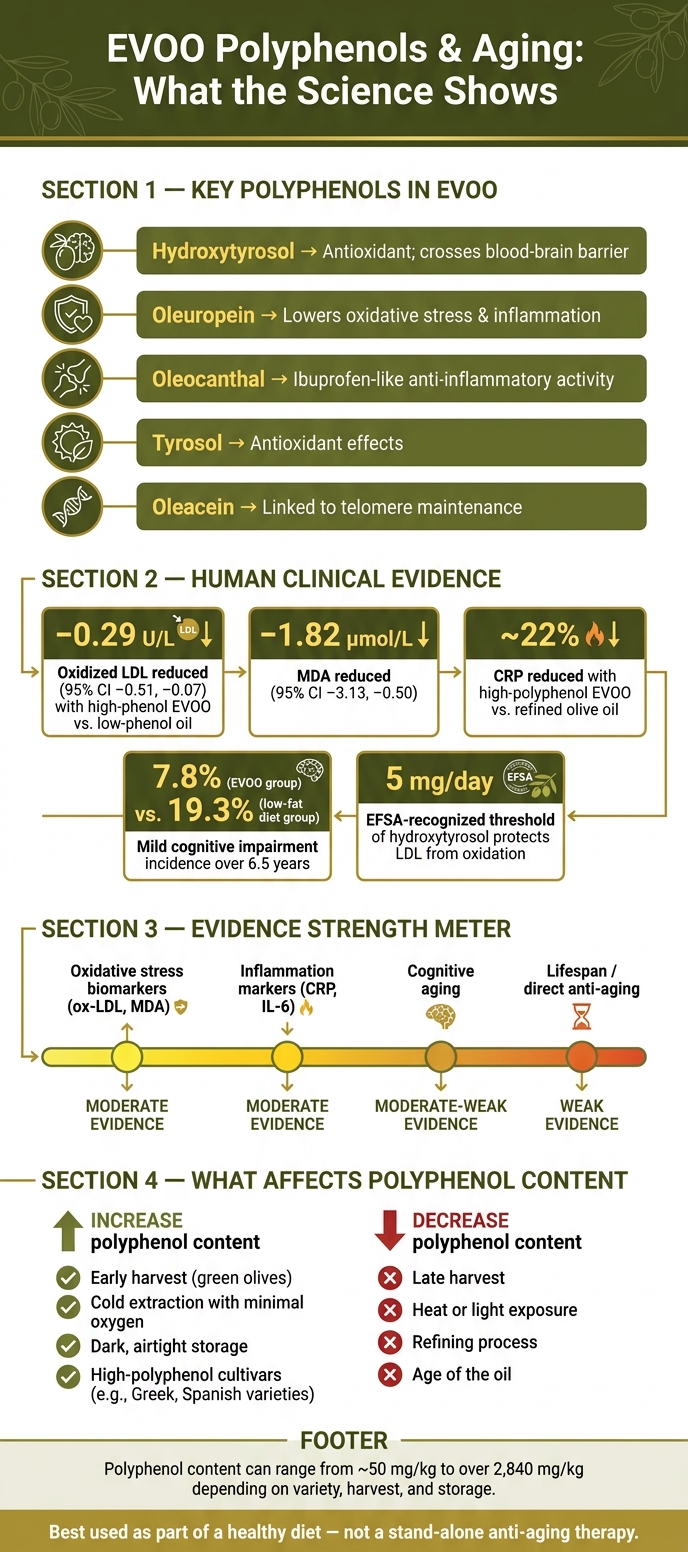
EVOO Polyphenols & Aging: Key Research Numbers at a Glance
The Main EVOO Polyphenols Studied in Aging Research
Hydroxytyrosol, Tyrosol, Oleuropein, Oleocanthal, and Related Phenols
Aging research most often looks at hydroxytyrosol, tyrosol, oleuropein, oleocanthal, and oleacein. These are the EVOO phenols that show up again and again because they act on several pathways tied to aging.
Hydroxytyrosol is a major antioxidant that can cross the blood-brain barrier, which means it may support antioxidant activity in the brain. Oleuropein has been shown to lower oxidative stress, lower inflammation, and protect neurons in lab and animal models. Oleocanthal - the compound behind EVOO's peppery throat bite - shows ibuprofen-like anti-inflammatory activity in experimental models. Tyrosol has similar antioxidant effects, while oleacein has been linked in some studies to telomere maintenance.
Taken together, these phenols may switch on Nrf2, which helps the body build up its antioxidant defenses, while also dialing down NF-κB, a main driver of chronic inflammation. That's a big part of why researchers pay so much attention to them: they may affect oxidative stress, inflammation, and other processes that tend to shift with age.
Why Polyphenol Levels Vary Across EVOO Products
Not all EVOO is the same. Two bottles can look similar on the shelf and still have very different phenolic profiles. Much of that comes down to olive cultivar, harvest timing, production method, and freshness.
Some Greek and Spanish olive varieties naturally produce higher amounts of hydroxytyrosol and oleuropein. Harvest timing also matters a lot. Early-harvest green olives tend to yield oils with much higher polyphenol levels than fruit picked later. Processing plays a big role too: rapid cold extraction with little oxygen exposure helps keep phenols in the oil, while slower or hotter processing can break them down.
After bottling, the clock starts ticking. Polyphenols drop over time, and heat, light, and air speed up that loss. That helps explain why storage conditions matter so much, especially if you're trying to keep the oil's active compounds intact.
The spread in polyphenol content can be huge. In one optimized early-harvest study, total polyphenols reached about 2,840 mg/kg, with oleacein at 1,120 mg/kg. That same study found a strong link between polyphenol content and oxidative stability (R² = 0.98). In plain English: the more polyphenols the oil had, the better it held up against oxidation.
A few factors help preserve these compounds:
- Early harvest
- Dark storage
- Minimal oxygen exposure
This variation is one reason study results can differ so much from one EVOO product to another. The amount and activity of these phenols can shape the oxidative and inflammatory pathways discussed next.
Why Extra Virgin Olive Oil Is One of the Most Powerful Anti Aging Foods
How EVOO Polyphenols May Affect the Aging Process
These pathways tend to show up in biomarkers first, and only later in a small number of human outcomes.
Reducing Oxidative Stress and Supporting Antioxidant Defenses
EVOO polyphenols can lower oxidative stress in two main ways: they cut down ROS and help the body build up its own antioxidant defenses. Hydroxytyrosol and related phenols reduce reactive oxygen species (ROS) and lower lipid peroxidation markers such as malondialdehyde (MDA) and oxidized LDL (ox-LDL).
That pattern shows up in pooled trial data too. A 2023 meta-analysis of randomized controlled trials found that phenol-rich olive oil reduced ox-LDL by a weighted mean difference of −0.29 U/L (95% CI −0.51, −0.07) and MDA by −1.82 µmol/L (95% CI −3.13, −0.50) compared with low-phenol oils. Another systematic review reported similar reductions and found a dose-dependent relationship, with higher phenolic content leading to larger drops in oxidative stress biomarkers.
This does not seem to be just a simple scavenging effect. EVOO phenols, especially hydroxytyrosol and tyrosol, also activate Nrf2, a transcription factor that helps switch on protective enzymes like heme oxygenase-1 and glutathione-related enzymes.
Lowering Chronic Inflammation and Influencing Cellular Aging Pathways
Chronic low-grade inflammation is one of the clearest features of aging. EVOO polyphenols may help blunt that process by inhibiting NF-κB, a transcription factor that pushes cells to make pro-inflammatory cytokines like TNF-α and IL-1β, along with enzymes such as COX-2.
Researchers saw this in human immune cells exposed to polyphenol-rich EVOO extracts. ROS went down, TNF-α and IL-1β dropped, and phosphorylated NF-κB decreased, while Nrf2 went up at the same time. That two-sided action helps explain why EVOO phenols keep showing up in aging research.
There may be more going on under the hood. Preclinical work links EVOO phenols to pathways such as AMPK and PPAR-α, and possibly SIRT1 and mTOR, which help govern how cells handle stress and use energy over time. Still, direct human evidence tying EVOO polyphenols to these longevity-linked pathways is limited. Much of the current picture comes from cell and animal studies.
Supporting Mitochondria, Brain Function, and Other Aging-Sensitive Tissues
Mitochondria sit at the center of aging because they make energy and also generate ROS. When they start to slip, cells become less efficient and more prone to damage. Animal and cell studies suggest that hydroxytyrosol can reduce mitochondrial oxidative stress and support Nrf2-dependent gene expression in brain mitochondria and other tissues. In aged mice, HT improved energetic metabolism and spatial working memory, which hints at a link between mitochondrial health and cognitive performance.
So far, cognition has the clearest human signal. That makes sense, since cognitive decline is one of the biggest aging-related outcomes people care about. A 6.5-year Spanish trial found that participants following a Mediterranean diet supplemented with high-polyphenol EVOO had a mild cognitive impairment incidence of 7.8%, compared with 11.8% in the nuts group and 19.3% in the low-fat diet group. In a separate trial, high-polyphenol EVOO rich in oleocanthal and oleacein, with approximately 1,200 mg/kg total polyphenols, reduced blood-brain barrier permeability and improved behavioral scores in people with mild cognitive impairment compared with refined olive oil lacking polyphenols.
For other tissues, the evidence is still much thinner and mostly preclinical. Human data are limited for skin, liver, and vascular tissue, and controlled trials have not yet shown meaningful outcomes such as reduced wrinkle depth or improved skin elasticity.
sbb-itb-4066b8e
How Strong Is the Human Evidence Right Now
The lab and animal data look promising. But in people, the signal is narrower and more practical. Right now, human evidence is moderate for aging-related biomarkers and weak for lifespan.
What Clinical Trials and Population Studies Have Found
The clearest human finding is a drop in oxidized LDL. In crossover trials, oxidized LDL fell as phenolic content increased. A meta-analysis found the biggest drop with high-phenolic EVOO, defined as at least 200 mg/kg of phenols. EFSA has also recognized that a daily intake of 5 mg of hydroxytyrosol and its derivatives from olive oil helps protect LDL particles from oxidative damage.
Inflammation markers show a similar pattern. Trials using high-polyphenol EVOO have reported CRP reductions of about 22% and lower IL-6 compared with refined olive oil.
The picture for cognition is encouraging too, even if it’s not dramatic. High-polyphenol EVOO has been linked with lower odds of mild cognitive impairment and modest gains on cognitive test scores across multiple trials. On top of that, observational cohort data suggest that virgin olive oil, but not refined olive oil, is tied to lower total and cardiovascular mortality.
That said, there’s a catch: these results mostly come from short studies and carefully selected oils. So the signal is there, but it’s not a blank check.
What Researchers Still Do Not Know
Most trials run only a few weeks to a few months. Sample sizes are often small. And polyphenol content can swing a lot - from about 50 mg/kg to more than 800 mg/kg depending on the olive variety, harvest timing, and storage. In plain English, the upside depends a lot on whether the oil is actually high in polyphenols.
The big unanswered question is still hanging there: do EVOO polyphenols slow biological aging itself, or do they just improve biomarkers that tend to track with aging? Current human evidence does not answer that yet.
Conclusion: What the Research Reasonably Supports
The Most Evidence-Based Conclusion from Current Research
When you put the studies side by side, the pattern is pretty clear: high-polyphenol EVOO is linked with healthier aging markers. The research keeps pointing toward aging-related pathways tied to decline, and that same biological pattern shows up most clearly in human data on heart health.
The strongest human evidence is in cardiovascular health. Daily virgin olive oil intake was linked to lower all-cause and cardiovascular mortality, which helps explain why oil quality and polyphenol content matter.
A similar pattern shows up in cognitive aging, though the case is more limited. A Mediterranean diet enriched with EVOO was associated with lower mild cognitive impairment risk over 6.5 years. That fits the broader pattern, but it doesn't prove that polyphenols were the only driver.
The practical takeaway is straightforward: polyphenol content matters. Fresh EVOO with a recent harvest date is the form that lines up best with the research. High-polyphenol EVOO makes the most sense as part of a healthy aging diet, not as a stand-alone anti-aging therapy. It's a supportive food choice, not a longevity treatment.
FAQs
How can I tell if an EVOO is high in polyphenols?
Look for a recent harvest date, not just a best-by date. That matters because antioxidants drop over time.
High-polyphenol oils often come from early-harvest olives. They’re also best sold in dark glass or tin, which helps shield the oil from light and heat.
You can often notice clues in the taste, too. A bold, peppery hit in the throat and a clear bitterness may point to phenolic compounds like oleocanthal.
If you want the health angle, focus on Ultra Premium EVOO. One example is Big Horn Olive Oil, which has lab-verified polyphenol levels of at least 250 mg/kg.
How much EVOO do I need for benefits?
Research suggests that 1 to 4 tablespoons of high-quality extra virgin olive oil per day - about 15 to 60 mL - may support health.
The European Food Safety Authority notes that 20 grams, or about 1.5 tablespoons, is an effective daily amount for oxidative protection.
Some benefits may start at just 0.5 tablespoons per day. But studies suggest heart-related benefits are strongest at around 1.5 to 2 tablespoons per day. Consistency matters, and so does choosing oils with a high polyphenol content.
Do cooking and storage reduce EVOO polyphenols?
Yes. Cooking and storage can lower polyphenol levels because heat, light, air, and time speed up oxidation and slowly break down these antioxidants.
Extra virgin olive oil can hold up well in cooking at temperatures up to 410°F. Still, the longer it faces heat, the more its nutrient content can drop. If you want to keep more polyphenols in the oil, use it raw when you can.
For storage, keep it in a cool, dark place between 57°F and 70°F. Use an airtight, opaque container to help limit exposure to air and light. And try to use it within nine months of harvest.