

EVOO vs. Animal Fats: Impact on Lipid Storage
Extra virgin olive oil (EVOO) and animal fats affect your body's fat storage and metabolic health in vastly different ways. EVOO, rich in monounsaturated fats and antioxidants, helps lower bad cholesterol (LDL), increase good cholesterol (HDL), and reduce fat accumulation. On the other hand, animal fats, which are high in saturated fats and cholesterol, are linked to increased fat storage, higher LDL levels, and greater cardiovascular risks.
Key Takeaways:
-
EVOO Benefits:
- Contains 55–83% monounsaturated fats (oleic acid) and 0 mg cholesterol.
- Lowers LDL cholesterol and total fat storage.
- Reduces risk of heart disease and metabolic disorders.
- Includes antioxidants like polyphenols and vitamin E, protecting against oxidative damage.
-
Animal Fats Risks:
- High in saturated fats (up to 70%) and cholesterol (66–322 mg per 100g).
- Increases LDL cholesterol and triglycerides.
- Promotes greater fat storage in adipose and liver tissues.
- Lacks protective antioxidants, making LDL more prone to oxidation.
Quick Comparison:
| Factor | EVOO | Animal Fats |
|---|---|---|
| Main Fat Type | Monounsaturated | Saturated |
| Cholesterol Content | 0 mg/100g | 66–322 mg/100g |
| Effect on LDL | Lowers LDL | Raises LDL |
| Fat Storage | Lower accumulation | Higher accumulation |
| Antioxidants | Present | Absent |
Switching to EVOO as your primary fat source can improve lipid profiles, reduce fat storage, and support better heart health. Aim for about 4–5 tablespoons daily, using it for cooking or as a dressing. Avoid saturated animal fats like butter, lard, and ghee to lower your risk of metabolic complications.
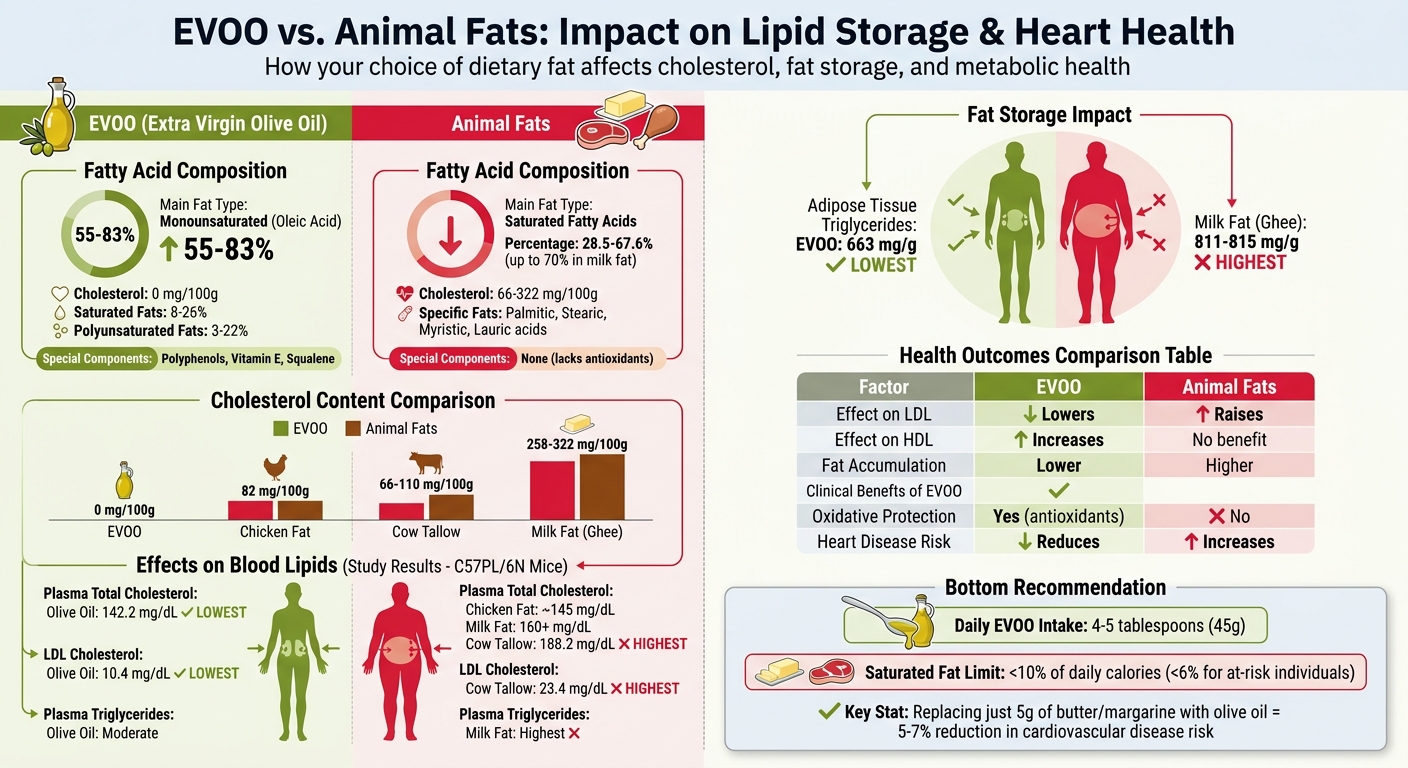
EVOO vs Animal Fats: Nutritional Comparison and Health Impact
How Lipid Storage Affects Metabolic Health
How the Body Stores Lipids
Your body has a clever way of storing dietary fats, primarily in adipose tissue, which acts as a reservoir for energy. When you eat fats - whether from sources like extra virgin olive oil or animal products - your body breaks them down and stores them in specialized cells called adipocytes. Interestingly, triglycerides account for about 99.5% to 99.7% of the lipids in this tissue.
On a cellular level, lipids are stored in tiny structures called lipid droplets, which originate from the endoplasmic reticulum. These fat reserves grow through two main processes: dietary fat absorption (via chylomicrons) and a process called de novo lipogenesis, where the body creates fat from other nutrients. The balance between storing fat (lipogenesis) and breaking it down for energy (lipolysis) is key to maintaining metabolic health.
The type of fat you consume plays a big role here. For example, saturated fats - commonly found in animal products like tallow and milk fat - have a rigid chemical structure and are linked to higher fat retention compared to other types of fatty acids. This means your diet’s fatty acid profile can directly influence how your body stores fat. When fat storage exceeds healthy levels, it can lead to metabolic complications.
Health Risks of Excess Fat Storage
Storing too much fat can throw your metabolism off balance. Excessive fat buildup is linked to issues like insulin resistance, type 2 diabetes, cardiovascular diseases, and even some forms of cancer. As Tama Horvath from the Department of Animal Physiology and Animal Health explains:
Imbalances in lipogenesis and lipolysis can lead to excessive fat accumulation and obesity, which is associated with various metabolic disorders including type 2 diabetes, cardiovascular disease, and certain cancers.
Adipose tissue isn’t just a passive storage site - it’s an active endocrine organ. It releases hormones like leptin, which help regulate energy balance. However, when overloaded with excess fat, particularly from saturated sources, this signaling can go haywire, increasing the risk of chronic diseases. To mitigate these risks, the American Heart Association advises keeping saturated fat intake below 10% of total daily calories - or under 6% for those with risk factors for heart disease.
sbb-itb-4066b8e
How EVOO Improves Lipid Profiles
What's in EVOO
Extra virgin olive oil (EVOO) stands out for its impressive fatty acid composition. It primarily consists of oleic acid (55–83%), a monounsaturated fatty acid that has been linked to raising HDL (good cholesterol) while lowering LDL (bad cholesterol), all without contributing any cholesterol itself. Beyond oleic acid, EVOO includes a small but powerful mix of bioactive compounds - polyphenols, tocopherols (vitamin E), squalene, and triterpenes like oleanolic and maslinic acid. It also contains 3–22% polyunsaturated fatty acids (PUFAs) and 8–26% saturated fatty acids, creating a well-rounded nutrient profile that supports metabolic health and promotes healthier fat storage.
EVOO's Effect on Fat Storage
The research on EVOO's impact on lipid profiles is both extensive and compelling. Animal studies have shown that diets enriched with olive oil result in the lowest plasma total cholesterol and LDL levels when compared to diets containing various animal fats. Additionally, olive oil consumption leads to reduced total fat accumulation in adipose tissue compared to milk fats. The oleic acid and phenolic compounds found in EVOO also play a protective role by shielding LDL from oxidation, which helps lower the risk of atherosclerosis.
Clinical trials further support these findings, revealing that olive-derived oils can significantly reduce Apolipoprotein B (Apo B) levels and improve the LDL/HDL ratio in both healthy individuals and those at risk for cardiovascular disease. Remarkably, replacing just 5 grams of butter, margarine, or mayonnaise daily with olive oil is linked to a 5–7% reduction in the risk of cardiovascular and coronary heart diseases. Dr. Marta Guasch-Ferré from Harvard T.H. Chan School of Public Health emphasizes:
"The data support existing recommendations to replace saturated fat and animal fat with unsaturated plant oils for the prevention of CVD."
These findings highlight why incorporating EVOO into your diet can lead to better lipid profiles and overall heart health.
How to Use EVOO Daily
Adding EVOO to your daily routine is both simple and beneficial. Aim for 4–5 tablespoons (approximately 45 grams) each day to unlock its full potential. Use it as your primary cooking fat, drizzle it over salads, or toss it with roasted vegetables. To maximize its health benefits, opt for cold-pressed EVOO, which retains the highest levels of bioactive compounds. For those looking for premium options, Big Horn Olive Oil offers Ultra Premium EVOO crafted to preserve these vital nutrients, making it an excellent choice for metabolic health.
How Animal Fats Affect Lipid Storage
What's in Animal Fats
Animal fats are quite different from extra virgin olive oil (EVOO) in terms of their nutritional makeup. They are rich in saturated fatty acids (SFAs), which can range from 28.5% to 67.6%, depending on their source. For instance, milk fat - like cow or buffalo ghee - contains about 70% saturated fats and 0.3% cholesterol. These fats include palmitic, stearic, myristic, and lauric acids, all of which are known to significantly raise LDL cholesterol levels.
Unlike EVOO, which contains no cholesterol, animal fats have cholesterol levels ranging from 66 to 322 mg per 100 grams. Buffalo milk fat (ghee) has the highest cholesterol content at 322 mg per 100 grams, while chicken fat is on the lower end with 82 mg. The saturated fats in animal products have a rigid chemical structure, which keeps them solid at room temperature - like butter or lard. Additionally, animal fats lack the antioxidants and polyphenols present in EVOO, making LDL particles more prone to oxidation. These differences in composition directly influence their metabolic effects.
Animal Fats and Weight Gain
The differences in composition between animal fats and EVOO translate into distinct impacts on the body. Animal studies have shown that mice fed milk fats, such as cow or buffalo ghee, had higher levels of triglycerides in their blood and fat tissues compared to those fed olive oil. These studies also observed greater weight gain and increased fat storage in the milk fat groups, suggesting that more of the calories consumed from these fats are stored as body fat.
Diets supplemented with olive oil consistently resulted in lower total cholesterol and LDL levels, while milk fats were linked to the highest triglyceride levels and less favorable LDL-to-HDL ratios. Saturated fatty acids with chains of 12–16 carbon atoms - like lauric, myristic, and palmitic acids - are particularly effective in raising plasma cholesterol levels.
The Mayo Clinic highlights this distinction:
"Eating fats found in seafood or from most plant sources is linked to lower risks of heart disease, diabetes and obesity when compared with diets high in fats from animal sources."
This evidence strongly supports swapping out animal fats like butter, lard, and ghee for healthier fat alternatives to promote better heart and metabolic health.
EVOO vs. Animal Fats: Side-by-Side Comparison
Nutritional Differences
When comparing extra virgin olive oil (EVOO) with animal fats, the nutritional differences are striking. EVOO stands out with its 55–83% oleic acid content and zero cholesterol per 100 grams. On the other hand, animal fats, such as chicken fat, cow tallow, and milk fat (ghee), contain 28.5–67.6% saturated fatty acids (SFAs) and cholesterol levels ranging from 66 to 322 mg per 100 grams. Milk fat leads the pack with approximately 70% saturated fats and a cholesterol content of 322 mg per 100 grams.
These differences in composition directly influence how the body metabolizes and stores fats. EVOO, rich in oleic acid, helps protect LDL cholesterol from oxidation. In contrast, animal fats, particularly those high in palmitic and myristic acids, tend to raise LDL levels, increasing cardiovascular risks. Additionally, the absence of antioxidant polyphenols and tocopherols in animal fats leaves LDL particles more susceptible to oxidative damage.
Comparison Table
A 2025 study published in Scientific Reports examined the effects of these fats on C57PL/6N mice. The mice consumed diets supplemented with 15% of various fats for five weeks, and the results revealed notable metabolic differences:
| Metabolic Marker | Olive Oil (EVOO) | Chicken Fat | Cow Tallow | Milk Fat (Ghee) |
|---|---|---|---|---|
| Plasma Total Cholesterol | 142.2 mg/dL (lowest) | ~145 mg/dL | 188.2 mg/dL | 160+ mg/dL |
| LDL Cholesterol | 10.4 mg/dL (lowest) | Higher than EVOO | 23.4 mg/dL | High |
| Plasma Triglycerides | Moderate | Moderate | Moderate | Highest |
| Adipose Tissue Triglycerides | 663 mg/g (lowest) | High | Moderate | 811–815 mg/g |
| Liver Triglycerides | Moderate | Moderate | High | Highest |
| Cholesterol Content | 0 mg/100g | 82 mg/100g | 66–110 mg/100g | 258–322 mg/100g |
EVOO-fed mice had the lowest plasma cholesterol (142.2 mg/dL) and LDL cholesterol (10.4 mg/dL), while the cow tallow group exhibited significantly higher levels, with total cholesterol reaching 188.2 mg/dL and LDL at 23.4 mg/dL. Milk fat resulted in the highest adipose tissue triglycerides (811–815 mg/g), compared to EVOO's 663 mg/g, indicating that more calories from milk fats were stored as body fat.
Human Studies Supporting EVOO
Animal research findings are consistent with human studies. For example, a 2017 randomized cross-over study involving 30 patients with impaired fasting glucose demonstrated the metabolic advantages of EVOO. Adding just 10 grams of EVOO to a meal significantly reduced post-meal glucose levels (p = 0.009) and increased insulin (p < 0.001) and GLP-1 (p < 0.001). The authors of the study stated:
"The meal containing EVOO was associated with a reduction of glucose (p = 0.009) and DPP4 activity (p < 0.001) and a significant increase of insulin (p < 0.001) and GLP-1 (p < 0.001) compared with the meal without EVOO."
- Roberto Carnevale et al., Clinical Nutrition
EVOO also reduced post-meal triglycerides (p = 0.002) and Apo B-48 (p = 0.002), a marker tied to fat absorption and cardiovascular risk. These results highlight EVOO's ability to improve lipid profiles and enhance how the body processes fat and sugar after eating.
If you're ready to incorporate high-quality EVOO into your diet, consider products from Big Horn Olive Oil, known for their Ultra Premium Extra Virgin Olive Oils and dedication to freshness and quality.
What makes olive oil better than other fats? | David Katz
Conclusion
EVOO stands out as a healthier alternative to animal fats when it comes to managing lipid storage and improving metabolic health. With its 55–83% oleic acid content and zero cholesterol, EVOO helps lower LDL cholesterol and reduces fat storage. On the other hand, animal fats - especially milk-derived fats like ghee - can contain up to 322 mg of cholesterol per 100 grams and higher levels of saturated fatty acids, which contribute to weight gain and increased triglyceride storage. This comparison highlights EVOO's clear metabolic edge over animal fats.
The monounsaturated fats in EVOO not only enhance lipid profiles but also offer protection against oxidative damage and inflammation, benefits that animal fats simply do not provide. The Mediterranean diet, which relies heavily on olive oil as its primary fat source, continues to be associated with better metabolic health and lower cardiovascular risks.
For those aiming to improve metabolic health, replacing animal fats with high-quality EVOO can make a significant difference. To maximize the benefits, look for Ultra Premium EVOO - cold-pressed within hours of harvest and rich in polyphenols. This type of EVOO delivers the full range of health advantages discussed.
Big Horn Olive Oil offers a curated selection of fresh, premium extra virgin olive oils. Sourced from quality olives and delivered within three months of harvest, their oils are packed with antioxidants and nutrients, making them a perfect choice for anyone looking to embrace the metabolic benefits of EVOO.
FAQs
Does cooking with EVOO reduce its health benefits?
Cooking with extra virgin olive oil (EVOO) at lower temperatures and for shorter durations helps retain its beneficial properties. On the other hand, high-heat techniques such as frying or microwaving can break down its phenolic compounds and antioxidants, reducing its nutritional quality.
How can I replace butter or ghee with EVOO in daily meals?
To swap out butter or ghee for extra virgin olive oil (EVOO), try these easy substitutions that enhance both flavor and nutrition. Drizzle EVOO over roasted veggies, use it as a base for salad dressings, or even incorporate it into baked goods. When cooking, replace each tablespoon of butter or ghee with about two-thirds of a tablespoon of EVOO. This simple adjustment lowers saturated fat, promotes heart health, and introduces antioxidants into your meals.
What should I look for when buying high-polyphenol EVOO?
When selecting extra virgin olive oil (EVOO) rich in polyphenols, look for labels that mention at least 250 mg/kg of polyphenols. Phrases like "early harvest" or "high-phenolic" often signal a good choice. To retain its natural qualities and health benefits, it's best to use it raw.