

EVOO and Heart Health: What Studies Show
Extra virgin olive oil (EVOO) is one of the most researched dietary fats for heart health. Here's what you need to know:
- Heart Disease Risk Reduction: Consuming just 7 grams of EVOO daily can lower cardiovascular disease (CVD) risk by 14% and coronary heart disease (CHD) risk by 18%. Higher intakes bring even greater benefits.
- Key Nutrients: EVOO is rich in monounsaturated fats and polyphenols like hydroxytyrosol and oleocanthal, which improve cholesterol, reduce inflammation, and support blood vessel health.
- Research Highlights: The PREDIMED trial found that a Mediterranean diet with 4 tablespoons of EVOO daily reduced major CVD events by 30%. Long-term studies link EVOO to lower mortality rates.
- Daily Recommendations: Aim for 2–4 tablespoons of high-quality, polyphenol-rich EVOO daily. Replace saturated fats like butter or margarine to maximize benefits.
High-quality EVOO is key - look for oils with low acidity and high polyphenol content. Store in dark bottles, away from heat and light, to preserve its health properties.
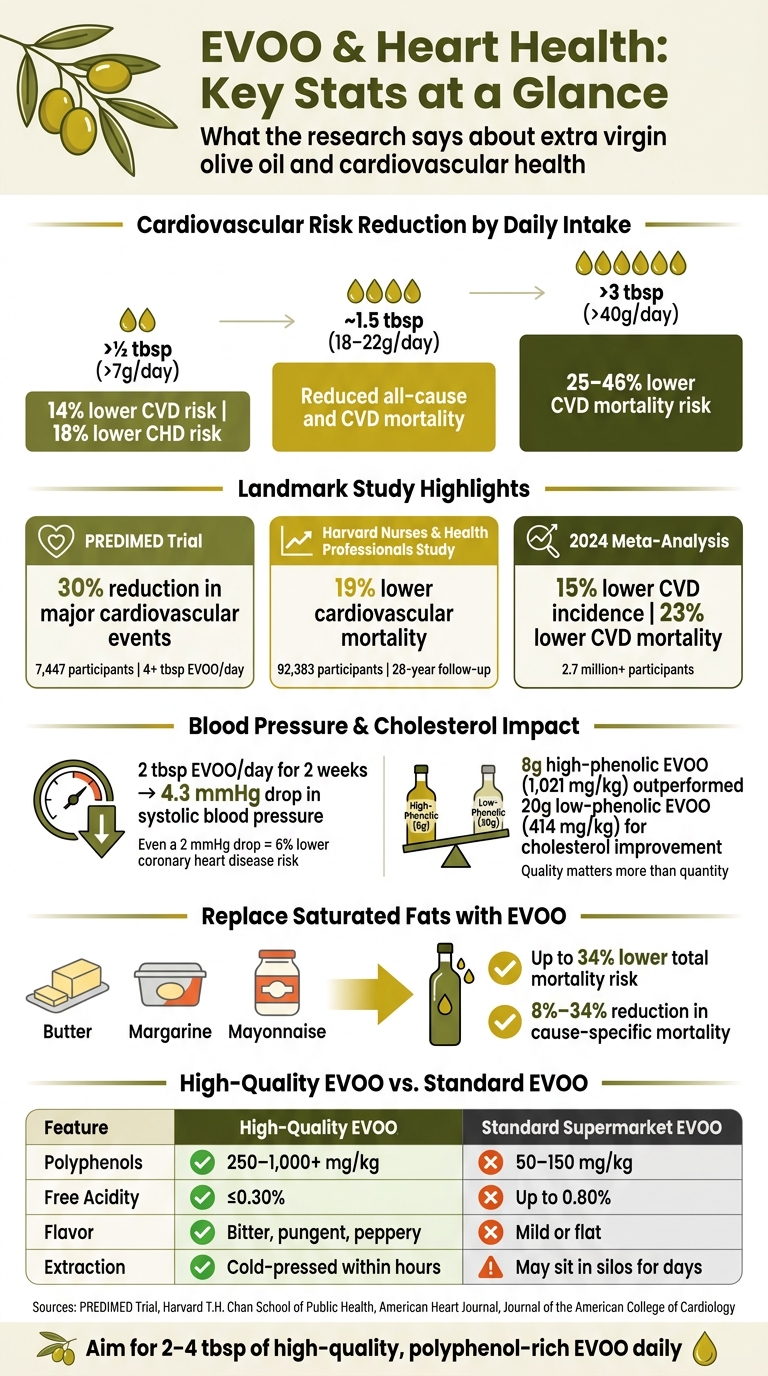
EVOO & Heart Health: Key Stats at a Glance
This Simple Habit Cuts Heart Attack Risk by 31% (Real Study)
sbb-itb-4066b8e
What Recent Studies Say About EVOO and Heart Health
Years of research have consistently highlighted the heart-health benefits of extra virgin olive oil (EVOO). Studies have directly linked its consumption to better cardiovascular outcomes. Let’s dive into some of the most impactful trials and analyses.
The PREDIMED Study and Mediterranean Diet Trials
The PREDIMED trial (Prevención con Dieta Mediterránea) is considered a landmark study in nutrition science. It involved 7,447 Spanish participants at high risk for cardiovascular disease. These individuals followed a Mediterranean diet, supplemented with either at least 4 tablespoons of fresh extra virgin olive oil per day or nuts, and were compared to a low-fat diet group. The results were striking: the EVOO group experienced a 30% reduction in the risk of major cardiovascular events like heart attacks, strokes, and cardiovascular-related deaths.
| Dietary Group | Major CV Events | Hazard Ratio (95% CI) |
|---|---|---|
| MedDiet + EVOO | 8.1 per 1,000 person-years | 0.70 (0.54–0.92) |
| MedDiet + Nuts | 8.0 per 1,000 person-years | 0.72 (0.54–0.96) |
| Control (Low-Fat) | 11.2 per 1,000 person-years | 1.00 (Reference) |
Source: PREDIMED Trial
The trial was halted early after a median follow-up of 4.8 years because the evidence in favor of the Mediterranean diets - especially the EVOO-supplemented one - was overwhelming. The protection against stroke stood out as particularly strong.
Long-term studies have since confirmed and expanded upon these findings.
Cohort Studies on EVOO and Mortality
A combined analysis of the Nurses' Health Study and the Health Professionals Follow-Up Study followed 60,582 women and 31,801 men over 28 years. It found that consuming more than 7 grams of olive oil daily was linked to a 19% lower risk of cardiovascular mortality compared to those who rarely consumed it.
"Higher olive oil intake was associated with lower risk of total and cause-specific mortality. Replacing margarine, butter, mayonnaise, and dairy fat with olive oil was associated with lower risk of mortality." - Marta Guasch-Ferré, PhD, Harvard T.H. Chan School of Public Health
Similarly, an 18-year study within a Mediterranean population in Spain found that consuming 2 or more tablespoons of olive oil daily reduced the risk of cardiovascular mortality by 46% and all-cause mortality by 31%. Italy’s Moli-sani Study echoed these results, showing that individuals consuming more than 3 tablespoons per day had a 25% lower risk of cardiovascular disease mortality.
Randomized Trials on Risk Factors
Randomized controlled trials (RCTs) have shed light on how EVOO impacts specific cardiovascular risk factors. For example, a 2025 pilot study revealed that consuming 2 tablespoons (30 ml) of EVOO daily for two weeks lowered 24-hour ambulatory systolic blood pressure by 4.3 mmHg. This is significant, considering that even a 2 mmHg reduction is linked to a 6% lower risk of coronary heart disease.
The polyphenol content of EVOO plays a key role in its benefits. A study at Messinia General Hospital in Greece showed that 8 grams per day of high-phenolic EVOO (1,021 mg/kg) improved cholesterol levels more effectively than 20 grams of low-phenolic EVOO (414 mg/kg) in patients with high cholesterol over a four-week period. These improvements in blood pressure and cholesterol directly reduce the risk of heart disease.
How EVOO Supports Heart Health
Recent studies highlight that high-quality extra virgin olive oil plays a key role in maintaining heart health. Its benefits include better cholesterol management, improved blood pressure regulation, and reduced inflammation. These effects collectively support cardiovascular health by enhancing blood lipid profiles, promoting arterial health, and reducing chronic inflammation.
Effects on Blood Lipids
EVOO helps manage cholesterol by increasing the activity of LDL receptors, which aids in clearing LDL cholesterol. Additionally, its polyphenols - such as hydroxytyrosol, oleuropein, and oleocanthal - protect LDL from oxidative damage, a major factor in the development of atherosclerosis. EVOO also improves HDL cholesterol by increasing particle size and fluidity, enhancing its ability to remove cholesterol efficiently. Clinical studies have shown that after just four weeks of EVOO consumption, HDL levels improved, while markers like Lipoprotein(a) and Apolipoprotein B decreased.
"EVOO polyphenols have shown to improve levels of serum HDL-cholesterol as well as the functionality of HDL by reducing HDL oxidative modifications and improving its physiochemical properties." - Katerina Sarapis, Department of Food, Nutrition and Dietetics, La Trobe University
These improvements in lipid profiles directly contribute to better vascular health.
Effects on Blood Pressure and Arterial Health
EVOO also supports vascular function by enhancing blood pressure and arterial health. Its polyphenols stimulate nitric oxide production, which relaxes blood vessels, and reduce endothelin-1, a compound that causes blood vessels to constrict.
"EVOO promotes endothelial function by increasing nitric oxide (NO) bioavailability, thus favoring vasodilation, lowering blood pressure (BP), and supporting vascular integrity." - Esposito Milena and Mandalà Maurizio
The CORDIOPREV Study, involving over 1,000 coronary heart disease patients in Spain, found that a Mediterranean diet enriched with EVOO resulted in a 2.63% greater improvement in flow-mediated dilation compared to a low-fat diet. This indicates enhanced arterial function and overall vascular health.
Anti-Inflammatory and Antioxidant Properties
Chronic inflammation is a major contributor to heart disease, and EVOO's polyphenols work to combat this. Oleocanthal, for instance, inhibits cyclooxygenase (COX) enzymes in a manner similar to ibuprofen, while hydroxytyrosol and oleuropein reduce adhesion molecules like VCAM-1 and ICAM-1. This limits the recruitment of inflammatory cells to arterial walls, lowering the risk of cardiovascular issues.
Consuming more than 40 grams (about three tablespoons) of EVOO daily has been linked to a 25% reduction in the risk of major cardiovascular events, such as stroke and atrial fibrillation. Oils with higher polyphenol content provide even greater benefits, even at smaller doses.
"High consumption of EVOO is associated with a substantial reduction in the risk of an outcome-wide composite of CVD events among high-risk individuals. In contrast, COO, which lacks polyphenols, showed weaker associations." - American Heart Journal
How Much EVOO to Consume Each Day
Recommended Daily Intake
Research provides clear guidance on how much extra virgin olive oil (EVOO) to consume daily to reap its heart-health benefits. Studies show that even a modest amount - just 7 grams per day - can reduce cardiovascular risk. Specifically, this amount is linked to a 14% lower risk of cardiovascular disease (CVD) and an 18% lower risk of coronary heart disease (CHD). Increasing your intake by 10 grams daily has been shown to lower CVD incidence by 7% and reduce CVD-related deaths by 8%. Consuming at least 2 tablespoons per day over 18 years has been associated with a 46% lower risk of CVD mortality.
Here's how the benefits stack up based on daily intake levels:
| Daily Intake | Approximate Amount | Key Benefit |
|---|---|---|
| Low | >½ tbsp (>7 g) | 14% lower CVD risk; 18% lower CHD risk |
| Moderate | ~1.5 tbsp (18–22 g) | Reduced all-cause and CVD mortality |
| High | >3 tbsp (>40 g) | Significant reduction in stroke and atrial fibrillation |
The key takeaway? Replacing saturated fats with EVOO is far more effective than simply adding it to your meals. For example, swapping 10 grams of saturated fat with EVOO has been tied to substantial reductions in mortality risk.
"The substitution of margarine, butter, mayonnaise, and dairy fat with olive oil could lead to lower risk of CHD and CVD." - Journal of the American College of Cardiology
These recommendations are easy to follow and can be seamlessly incorporated into your meals.
Using EVOO in Everyday Cooking
Incorporating EVOO into your diet is simple. Use it as a substitute for butter, whisk it into salad dressings, or drizzle it over finished dishes to retain its beneficial polyphenols.
Considerations for Specific Populations
While the general advice applies to most people, certain groups may need tailored recommendations. For older adults (ages 55–80) with higher cardiovascular risk, consuming 3 to 4 tablespoons daily has been linked to a 25% reduction in major cardiovascular events, including stroke and atrial fibrillation. Those with hypertension or diabetes may benefit most from EVOO rich in polyphenols, which can help with blood pressure and vascular health.
For individuals on a strict whole-food, plant-based (WFPB) vegan diet, limiting added oils to less than 1 teaspoon per day has been shown to enhance LDL cholesterol reduction.
"Addition of extra virgin olive oil after following a low intake pattern may impede further lipid reductions [in a WFPB vegan diet]." - Journal of the American Heart Association
Keep in mind that EVOO contains about 120 calories per tablespoon. To enjoy its anti-inflammatory benefits without overloading on calories, it’s best to use it as a replacement for other fats rather than an addition.
How to Choose a High-Quality EVOO
EVOO (extra virgin olive oil) has well-documented heart benefits, largely thanks to its polyphenol content. These compounds, known for their anti-inflammatory and antioxidant properties, are the key to EVOO's health advantages. But here's the catch: not all EVOO is created equal. If you pick the wrong bottle, you might miss out on the very benefits that make it so valuable.
Factors That Affect EVOO Quality
Several factors determine whether an EVOO retains its beneficial properties or falls short:
- Harvest Timing: Olives harvested early, while still green, pack a much higher polyphenol punch compared to fully ripened ones. While early-harvest olives yield less oil, they deliver significantly more antioxidants. For reference, the European Food Safety Authority (EFSA) sets 250 mg/kg as the minimum polyphenol level for a health claim, but premium EVOOs can exceed 1,000 mg/kg - offering four times that amount.
- Processing Speed and Temperature: To preserve polyphenols, top producers process olives within hours of picking and use cold extraction methods below 80°F (27°C). This careful handling prevents heat-sensitive compounds from breaking down. Additionally, immediate filtration removes organic matter and water, which can speed up degradation.
- Storage Conditions: Even the best oils can lose their quality if stored improperly. Exposure to light, heat, and oxygen reduces polyphenol levels. Look for EVOO in dark glass bottles or tins, and store it in a cool, dark place - far from heat sources like your stove. Also, focus on bottles with a harvest date, as polyphenols naturally degrade within 12–18 months.
A quick tip: if your EVOO has a peppery, throat-burning sensation, that's a good sign. It indicates the presence of oleocanthal, a polyphenol with anti-inflammatory properties similar to ibuprofen.
"The very compounds responsible for high phenolic EVOO's health properties are also the ones that make it taste sharp, bitter, and peppery." - Terra Centuria
| Feature | High-Quality EVOO | Standard Supermarket EVOO |
|---|---|---|
| Polyphenol Level | 250–1,000+ mg/kg | 50–150 mg/kg |
| Free Acidity | ≤ 0.30% | Up to 0.80% |
| Flavor Profile | Bitter, pungent, peppery | Mild, buttery, or flat |
| Extraction | Cold-pressed within hours | May sit in silos for days |
By understanding these factors, you can make informed choices and select an EVOO that delivers maximum health benefits.
Why Big Horn Olive Oil Stands Out
Big Horn Olive Oil takes these quality standards seriously, ensuring their EVOOs retain their active compounds. Their Ultra Premium EVOO is cold-pressed within just two hours of harvest, locking in the polyphenol content and keeping free acidity well below the 0.8% legal limit. They also ship their oils fresh, within three months of harvest, so you're getting peak antioxidant potency - not something that's been sitting on a warehouse shelf.
Their selection includes single-source varieties like Picual and Coratina, both naturally high in polyphenols, as well as their Estate Reserve Ultra Premium EVOO. Prices start at just $8.99, making it easy to incorporate the proven benefits of high-polyphenol EVOO into your daily routine. Check out their offerings at Big Horn Olive Oil for internationally recognized quality you can count on.
Conclusion
The data leaves little room for doubt: extra virgin olive oil (EVOO) stands out as one of the most researched dietary fats for heart health. A 2024 meta-analysis involving over 2.7 million participants revealed that higher olive oil consumption is linked to a 15% reduction in cardiovascular disease (CVD) incidence and a 23% decrease in CVD-related mortality. Even a modest increase - just 10 grams per day - can lower CVD mortality risk by 8%. That’s a powerful impact from such a simple dietary change.
But it’s not just about how much EVOO you consume - it’s about the quality. Studies consistently demonstrate that high-phenolic EVOO delivers superior benefits compared to lower-quality oils. These polyphenols are the key players behind the cardiovascular advantages, and even smaller amounts of high-phenolic EVOO can outperform larger doses of oils with fewer active compounds.
"High consumption of EVOO is associated with a substantial reduction in the risk of an outcome-wide composite of CVD events among high-risk individuals. In contrast, COO, which lacks polyphenols, showed weaker associations." - American Heart Journal
To maximize the heart-health benefits, aim for 2–4 tablespoons of high-quality EVOO daily. Use it to replace saturated fats like butter or margarine instead of simply adding calories to your diet. This simple swap has been associated with an 8% to 34% reduction in total and cause-specific mortality risks.
Choosing the right EVOO is essential to unlocking these benefits. For a product backed by science, check out Big Horn Olive Oil. Their Ultra Premium EVOOs are cold-pressed within two hours of harvest and shipped fresh within three months, ensuring the polyphenols remain intact. Varieties such as Picual and Coratina, naturally rich in polyphenols, start at just $8.99 - a small price for such big health benefits.
FAQs
Can I cook with EVOO without losing its heart benefits?
Yes, cooking with extra virgin olive oil (EVOO) keeps its heart-friendly qualities intact. Thanks to its high levels of monounsaturated fats and antioxidants, EVOO holds up well under heat, resisting oxidation and the formation of harmful substances. While heating might slightly reduce the levels of polyphenols, a good portion of them remains and gets absorbed into your food, ensuring its health perks are preserved. To get the most out of it, choose fresh, high-quality EVOO and cook at medium heat to retain its flavor and nutritional value.
How can I tell if an EVOO is truly high in polyphenols?
When choosing extra virgin olive oil rich in polyphenols, focus on a harvest date from the last year - don’t rely solely on the best-by date. Labels with phrases like early harvest or single-estate are good indicators of quality. Oils high in polyphenols typically have a bitter flavor and a peppery kick in the throat. For top-notch quality, opt for oils stored in dark containers and verified by lab tests to contain phenolic levels of at least 250 mg/kg.
Should I use EVOO if I’m trying to lower cholesterol or blood pressure?
Extra virgin olive oil (EVOO) has been shown to support heart health in several ways. Studies suggest it can improve vascular function and help lower blood pressure, particularly when it comes to high-phenolic EVOO. These benefits are largely attributed to its antioxidant and anti-inflammatory properties, which play a key role in promoting overall cardiovascular well-being. However, its effects on cholesterol levels may differ from person to person.
For those seeking high-quality EVOO, Big Horn Olive Oil offers an Ultra Premium option known for its freshness and high polyphenol content. As always, it's a good idea to consult your healthcare provider to determine what works best for your individual needs.