

Top 5 Facts About Free Acidity in Olive Oil
A low free acidity number does not mean olive oil tastes sour. It means the oil has fewer free fatty acids, which often points to olives that were handled well and milled soon after harvest.
If you only remember a few things, remember these:
- Free acidity is a lab number, not a taste note
- Lower acidity often means less fruit damage before milling
- EVOO must be at or below 0.8% free acidity
- Low acidity alone does not prove high quality
- You still need sensory results, storage, and other lab checks
Here’s the short version: free acidity helps show what happened between harvest and milling. Delays, bruising, pests, and poor handling can push the number up. Labs measure it by titration and report it as % oleic acid. But even an oil with a low number can still have defects or lose quality in storage.
Quick Comparison
| Point | What it means |
|---|---|
| 0.3% free acidity | Low free fatty acids; not a sour taste |
| ≤ 0.8% | Meets the acidity limit for extra virgin olive oil |
| 0.8% to 2.0% | Falls into the virgin olive oil range |
| > 2.0% | Lampante grade; not sold as edible without refining |
| Refined oil can test low | Low acidity does not always mean better oil |
When I look at free acidity, I treat it as a useful filter, not the final answer.
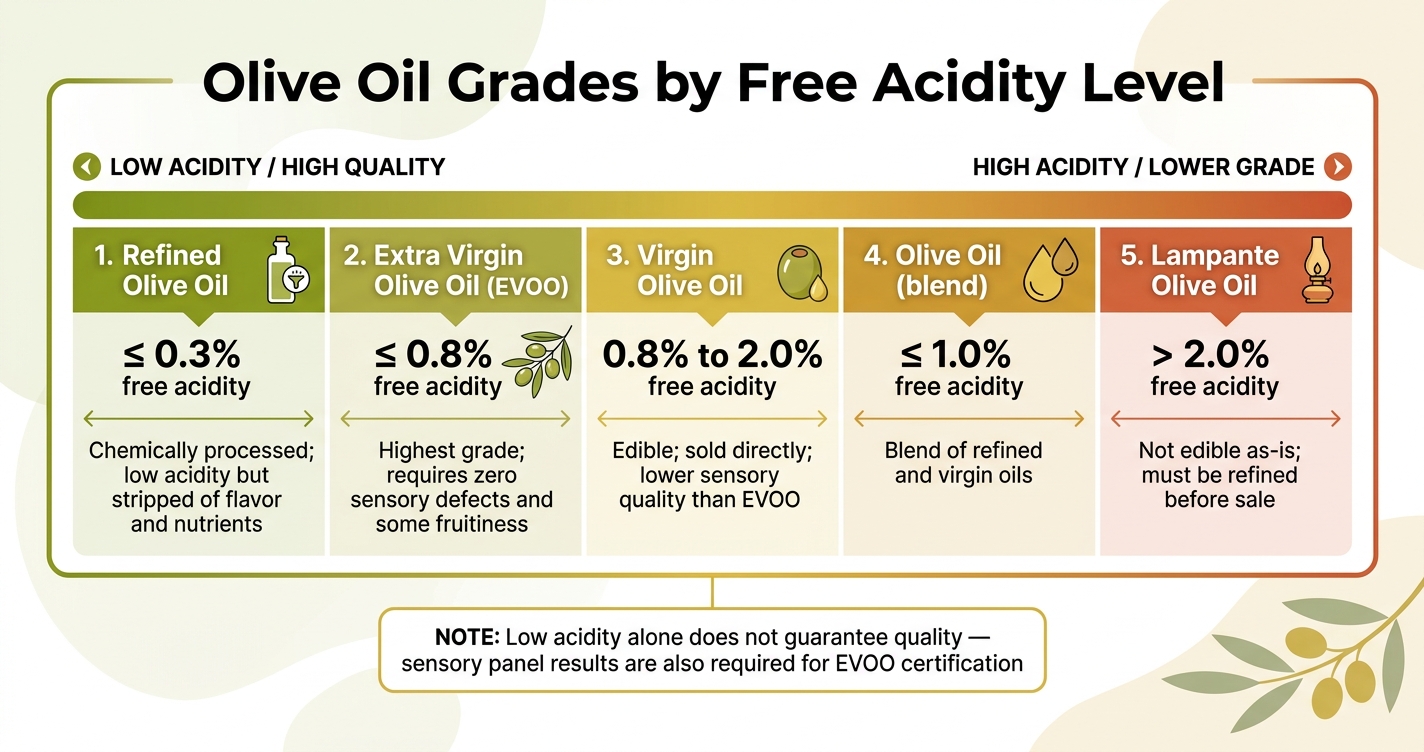
Olive Oil Grades by Free Acidity Level
High Acidity in Olive Oil Does Not Mean High Quality #carol
sbb-itb-4066b8e
Why Free Acidity Matters in Olive Oil
Free acidity is a useful way to judge olive oil quality, but it is not a flavor test.
It measures the percentage of free fatty acids in olive oil and helps classify quality. When the number is higher, it often points to poor olive handling before milling.
Lower acidity usually points to healthier olives and faster processing. It can also tell you a lot about how the olives were handled from harvest to milling. Quick separation from water helps keep acidity low too.
That said, free acidity shows only one part of quality. It does not measure antioxidants or polyphenols.
Next, see why free acidity measures free fatty acids, not sourness.
1. Free Acidity Measures Free Fatty Acids, Not Sourness
In olive oil, acidity does not mean sourness. Free acidity measures the amount of free fatty acids in the oil. These compounds are tasteless, so they don't change how the oil tastes. That's why free acidity matters before the oil is graded.
As olive oil starts to break down, some fatty acids split away from triglycerides. Labs check free acidity with titration and report the result as a percent of oleic acid.
Higher free acidity often points to bruised olives, pest damage, or too much time between harvest and milling. In plain English, it acts like a chemical clue about how the olives were handled. Lower free acidity, on the other hand, usually suggests better handling from grove to mill.
2. Lower Free Acidity Usually Reflects Better Olive Handling
This usually comes down to what happens after harvest. If olives get bruised, crushed, or sit too long before milling, free acidity goes up.
Timing plays a big role here. Ideally, olives should be milled within 4 to 12 hours of harvest. Once delays stretch past 24 hours, free acidity can rise fast. That’s why fast milling matters so much.
Low free acidity is often a sign that the fruit was handled with care from harvest through storage.
What happens at the mill matters too. Some premium oils reach free acidity as low as 0.1%. Those low numbers usually come from gentle harvesting, rapid milling, cold extraction below 27°C, and quick oil-water separation.
3. Free Acidity Helps Determine Olive Oil Grade
Free acidity is measurable, so standards groups use it to sort olive oil into grades.
It’s one of the main chemical checks for olive oil classification. Each grade has a maximum free acidity limit. If an oil goes past that limit, it moves down to a lower grade.
Here’s the breakdown:
| Olive Oil Grade | Free Acidity Limit |
|---|---|
| EVOO | ≤ 0.8% |
| Virgin | 0.8% – 2.0% |
| Lampante | > 2.0% - Requires refining |
| Refined | ≤ 0.3% |
| Olive Oil | ≤ 1.0% |
That said, free acidity does not decide the grade by itself. A trained panel also has to confirm sensory quality. So even if an oil has low acidity, it can still be downgraded if the panel finds rancid, fusty, or musty notes.
Some certification programs go further and set tighter limits. For example, COOC uses a 0.5% EVOO threshold.
Those limits come from standardized lab testing, which is why the testing method matters. Next, see how labs measure free acidity with standardized testing.
4. Free Acidity Is Measured Through Standardized Lab Testing
Free acidity is measured in a lab, not by tasting or smelling. And because olive oil isn't water-based, a pH meter can't measure it. Instead, labs use titration.
The IOC and European Commission define free acidity as acidity expressed as percent oleic acid. So the lab result is reported as percent oleic acid. That's the standardized number labs use for certification and grade checks.
But free acidity is only one quality marker, not the full picture.
5. Free Acidity Is One Part of the Quality Picture, Not the Whole Story
Refined olive oils can show lower free acidity because refining uses heat and chemicals to remove free fatty acids. But that same process also strips out flavor and health-related compounds. So a low acidity number, by itself, doesn't tell you an olive oil is high quality.
Free acidity also tells you nothing about polyphenols, antioxidants, or total nutrient content. It reflects fruit damage before and during milling - nothing more.
It also doesn't measure freshness. Poor storage can flatten flavor and reduce nutrients without changing the acidity number. That's why it helps to read free acidity next to other quality markers.
| Quality Indicator | What It Measures | EVOO Standard / Ideal Range |
|---|---|---|
| Free Acidity | Fruit damage at processing | ≤ 0.8% |
| Sensory Panel | Taste defects and fruitiness | Zero defects and some fruitiness required |
| Peroxide Value | Primary oxidation / rancidity | ≤ 20 mEq/kg (ideal is < 10) |
| Polyphenols | Antioxidant levels | > 250 mg/kg for health claims |
Use free acidity with sensory and oxidation checks to judge overall quality. Put simply, the number matters, but it only shows one slice of the picture.
Olive Oil Grade Thresholds at a Glance
Once free acidity is measured, it becomes a simple cutoff for grading.
| Grade | Free Acidity | Status |
|---|---|---|
| Extra Virgin Olive Oil | ≤ 0.8% | Edible; direct sale |
| Virgin Olive Oil | > 0.8% up to 2.0% | Edible; direct sale |
| Lampante Olive Oil | > 2.0% | Not edible; must be refined |
Some certification programs set tighter EVOO limits. But free acidity by itself doesn't decide the grade. Sensory defects can still push the oil into a lower class.
Use this chart as a quick reference for how free acidity affects classification.
Conclusion
After the lab numbers and grade thresholds, the part that matters most is how you use free acidity when picking an oil.
Free acidity is a helpful signal. But it doesn't tell you the whole story on quality. A low number simply means the olives were handled well enough to keep free fatty acids in check.
When you're buying EVOO, look for:
- A recent harvest date
- Clear sensory notes
- A recognized certification seal
And don't ignore storage. Keep oil in a dark bottle and away from light and heat, because poor storage can ruin a good starting acidity level.
Use free acidity as a filter, not a verdict.
FAQs
Can I taste free acidity in olive oil?
No. Free acidity in olive oil can't be tasted. It isn't a sour flavor, and it has no smell.
It's a chemical measurement tied to the fruit's condition and how the olives were handled during production, not something you can pick up with your senses. High-quality oils often have low free acidity, but that acidity itself doesn't change the taste.
Is low acidity enough to prove an olive oil is high quality?
No. Low free acidity is a good sign. It usually points to careful harvesting and processing. But on its own, it does not prove that an oil is high quality.
A high-quality oil also needs to be free of sensory defects, made and stored the right way, and show clear signs of freshness. That includes details like a recent harvest date, proper cold-pressing, and good storage.
What causes free acidity to rise?
Free acidity goes up when triglycerides in olive oil start to break apart and release free fatty acids. That usually happens when the olives are damaged or handled poorly, such as with:
- bruised or unhealthy olives
- delayed harvesting or processing
- high temperatures or poor storage conditions
When olives sit too long or get knocked around, enzymes have more time and contact with the oil. That speeds up the breakdown. Fast, gentle handling helps keep free acidity low.