

How Genetic Barcodes Improve Olive Oil Traceability
Olive oil fraud is a growing problem, but genetic barcodes are changing the game. By analyzing DNA from olives or olive oil, producers can verify the oil's variety, origin, and production process with scientific precision. This method, paired with blockchain and QR codes, enables full tracking from grove to bottle, ensuring the oil is exactly what it claims to be.
Here’s what you need to know:
- What are genetic barcodes? Short DNA sequences that identify specific olive varieties, such as Koroneiki or Picual.
- How do they work? DNA is extracted, analyzed, and stored securely, creating a unique genetic profile for each batch.
- Why does it matter? They detect fraud, ensure compliance with EU regulations, and give consumers confidence in their purchases.
Premium producers like Big Horn Olive Oil use this technology to back their quality claims, protect their brand, and meet strict certification standards. For consumers, it means greater transparency and trust in the olive oil they buy.
What Are Genetic Barcodes and How Do They Work?
What Genetic Barcodes Are
Genetic barcodes are short, distinct DNA sequences obtained from olives or olive oil, acting as a unique identifier for the olive variety. These barcodes help identify the specific olive cultivar - whether it's Koroneiki, Picual, Arbequina, or another type - used in producing the oil.
Unlike traditional barcodes that track packaging, genetic barcodes delve into the DNA itself to confirm the claimed olive varieties and expose undeclared mixtures, even if they make up as little as 3–5% of the product.
Take, for instance, the Greek biotech company BioCoS. They’ve developed DNAblockchain, a system that creates tamper-proof barcodes from Koroneiki olives. This technology not only identifies the olive variety but also records key details like the grove’s location, harvest date, and production volume.
Now, let’s look at how raw DNA transforms into a secure and verifiable genetic barcode.
How Genetic Barcodes Are Created
The process begins with producers collecting samples from olives, leaves, or even the oil itself at different stages of production. Since oil’s fat content can interfere with DNA recovery, specialized extraction methods are used to isolate fragmented DNA.
Once the DNA is extracted, specific regions are amplified using PCR (Polymerase Chain Reaction). This step focuses on markers such as microsatellites (SSRs) or single nucleotide polymorphisms (SNPs), creating a unique genetic fingerprint for the olive cultivar.
The final DNA profile is then stored alongside important metadata, including details like the orchard’s location, the cultivar type, harvest date, milling process, and batch ID. This combination ensures the product’s authenticity and helps detect any adulteration in the olive oil supply chain.
DNA fingerprinting to validate authenticity of PDO and PGI extra-virgin #OliveOil
How Genetic Barcodes Improve Olive Oil Traceability
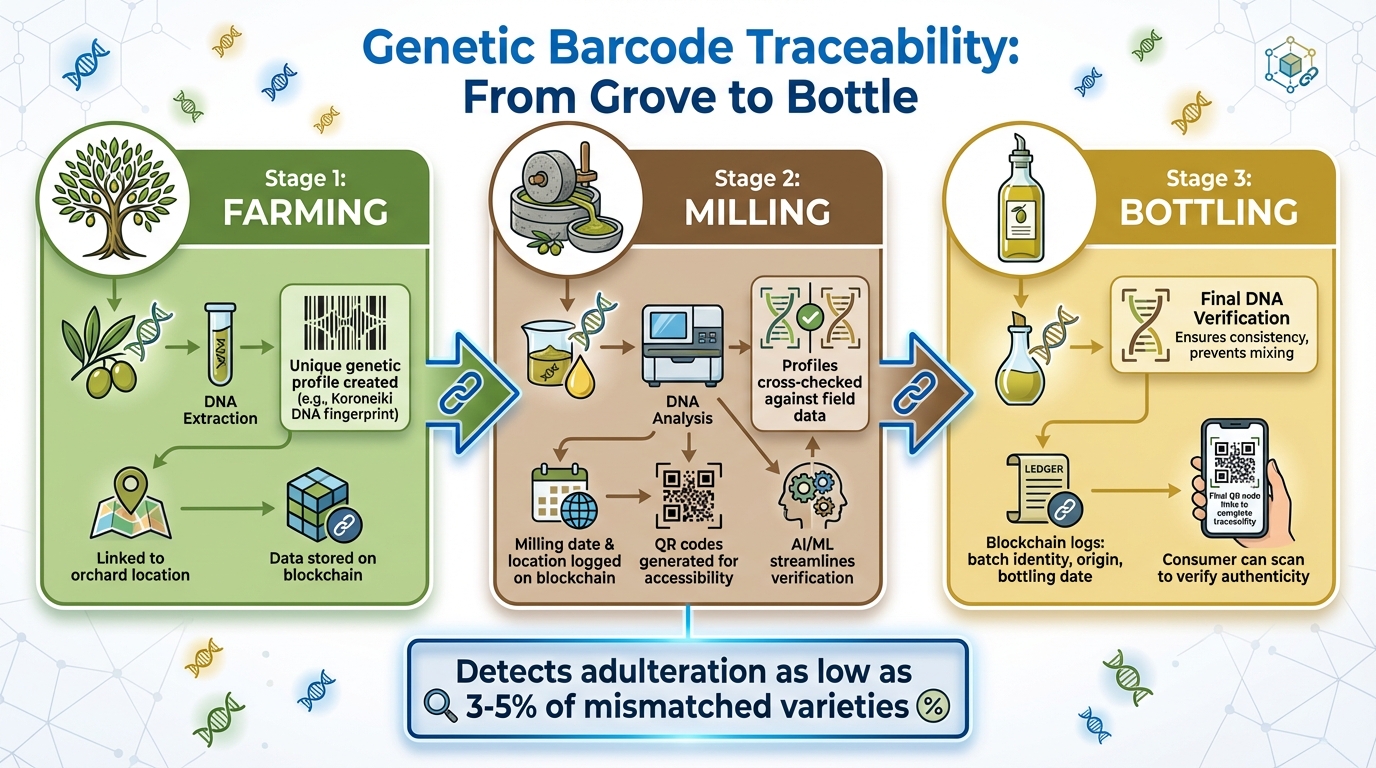
How Genetic Barcodes Track Olive Oil From Grove to Bottle
Traceability at Each Production Stage
Genetic barcodes make it possible to track olive oil from the orchard all the way to the bottle, ensuring its authenticity every step of the way. The process begins at the farming stage, where DNA is extracted from olive leaves or fruits to create a unique genetic profile for each variety. For instance, the Koroneiki olive variety is assigned a distinct DNA fingerprint tied to its specific orchard location, with this information securely stored on a blockchain system.
When olives are milled, DNA samples from the resulting paste or oil are analyzed to generate genetic profiles that are cross-checked against the original field data. Details like milling date and location are recorded on the blockchain, and QR codes make this information easily accessible. Additionally, AI and machine learning are employed to streamline the classification and verification process.
At the bottling stage, DNA verification ensures that the oil remains consistent with earlier genetic profiles, preventing unwanted mixing of products. Blockchain logs document essential details such as batch identity, origin, and bottling date. This comprehensive tracking system not only guarantees traceability but also acts as a robust safeguard against fraud.
Detecting Fraud and Adulteration
Genetic barcodes play a critical role in identifying fraud by analyzing the DNA in oil samples and comparing it to the expected genetic fingerprints of specific olive varieties. Even minor adulterations - such as adding just 3–5% of mismatched olive varieties or other vegetable oils - can significantly alter the DNA profile, making fraud detectable. For example, in 2019, Europol intercepted 150 tonnes of sunflower oil falsely marketed as olive oil. In another case, 47 millers and two bottlers were caught selling fake PGI-labeled extra virgin olive oil.
The technology also helps expose mislabeling by comparing the DNA of the oil to reference profiles. This makes it possible to distinguish Greek Koroneiki olives from Italian varieties, ensuring that false PDO or PGI claims are uncovered. Between 2016 and 2019, the Joint Research Centre documented 32 cases of fraud involving substitutions, including incidents where up to 50% of the oil was replaced with cheaper alternatives. By storing geo-genetic data on the blockchain, such deceptions become traceable, offering protection to producers and safeguarding the $5.5 billion European organic olive oil market.
How Genetic Barcodes Support EU Traceability Regulations
EU Traceability Requirements
The General Food Law (EU Regulation 178/2002) mandates that food businesses maintain a detailed tracking system for their products across every stage of production. This includes keeping records of suppliers, batch numbers, quantities, and dates for at least two years. The regulation follows a "one step back, one step forward" approach, meaning businesses must know exactly where their products came from and where they were sent. Authorities can request this information at any time.
For olive oil, Regulation (EU) No 29/2012 introduces additional requirements. Labels must specify the oil's origin, variety, and category. Premium olive oils with PDO (Protected Designation of Origin) or PGI (Protected Geographical Indication) certifications face even stricter rules under Regulation 1151/2012. These certifications require proof that the oil was produced, processed, and prepared in a specific region using approved methods and varieties. Complete documentation is required from the orchard to the bottle. These strict regulations have paved the way for advanced solutions like genetic barcodes, which go beyond traditional recordkeeping.
How Genetic Barcodes Support Compliance
Genetic barcodes provide a critical layer of verification by confirming the actual contents of olive oil bottles, something conventional records and lot codes cannot do. DNA profiling ensures that the oil matches its declared variety and geographic origin.
This technology acts like a digital passport for each batch. By extracting DNA from olive leaves or oil during the milling process, producers create a unique genetic fingerprint tied to specific grove locations, harvest dates, and varietal information. This data can then be integrated into blockchain systems, automating the recordkeeping required by Regulation 178/2002 and providing tamper-proof evidence for PDO and PGI certifications.
A practical example of this approach is the EU-funded S3FOOD project, led by Greek company BioCos. This initiative traces extra virgin olive oil (EVOO) from Cretan groves using a combination of DNA and blockchain technology. Similarly, the ALLIANCE project in Italy uses genetic fingerprinting for PDO and PGI olive oils, logging varietal identities to detect any substitutions. As Stelios Arhondakis, CEO of BioCos, explains, "While blockchain tracks bottles, genetic barcodes verify the contents", offering a powerful tool to combat fraud and adulteration in Europe’s €5 billion organic olive oil market.
sbb-itb-4066b8e
Digital Tools That Work With Genetic Barcodes
Once genetic barcodes are created and managed, digital tools play a crucial role in ensuring traceability from production all the way to the consumer.
Digital Systems in Use
Laboratory Information Management Systems (LIMS) serve as the foundation for storing and organizing DNA profiles extracted from olive oil samples. These systems integrate genetic data with essential details like batch records, harvest dates, and cultivar information, making them invaluable for identifying and preventing fraud. In several EU-funded initiatives, LIMS databases house genetic profiles of key olive varieties, allowing for quick and reliable authenticity checks.
In addition to lab software, blockchain-based traceability platforms bring an extra layer of security and transparency to the supply chain. A notable example is DNAblockchain, developed by the Greek biotech company BioCoS as part of the EU S3FOOD project. This platform combines olive oil DNA profiles with blockchain technology, creating an unchangeable record that includes varietal authenticity, grove locations, production quantities, and quality data. Consumers can later access this secure information by scanning QR codes on product packaging.
Biotagging systems add another dimension to traceability by using unique biological markers during the olive washing process. These markers link harvested olives to their genetic profiles, ensuring that only olives from specific groves are used in production. For example, Reply, a technology firm, has implemented washable biotags that integrate with digital platforms to document each step of the production process, ensuring full traceability from the farm to the final product.
Connecting Genetic Barcodes to Digital Records
Digital tools bridge the gap between laboratory data and consumer-facing transparency, making genetic records accessible and actionable.
QR codes provide a direct link between laboratory-generated genetic data and consumer transparency. By scanning a QR code, consumers can instantly access blockchain-stored details such as DNA profiles, orchard locations, and production dates. Pilot programs in Greece and Italy have successfully used this approach, allowing consumers to confirm the authenticity of products in real time via their smartphones.
RFID technology complements genetic verification by tracking the physical movement of olive oil throughout the supply chain. RFID tags, which can be attached to olives, storage tanks, or bottles, work in tandem with genetic data in systems like the Technological Traceability System (TTS). This setup documents data across multiple cultivars, supports PDO/PGI certifications, and facilitates targeted recalls when needed. By combining RFID tracking with DNA verification, every batch is given a comprehensive digital passport, aligning with the EU's "one step back, one step forward" traceability standards.
Benefits for Premium Producers Like Big Horn Olive Oil
Building Customer Trust
Genetic barcoding gives premium producers a powerful way to back up their quality claims with solid DNA evidence. Take Big Horn Olive Oil, for example. They pride themselves on offering products that are "Always pure EVOO, never mixed with other oils" and "Only the Top 5% of Olives." With DNA verification, they can provide undeniable proof to support these promises.
Customers can see this proof firsthand by scanning QR codes on the bottles. These codes link to blockchain-stored DNA data, which reveals key details like the grove location, olive variety, and pressing dates. This level of transparency is essential in an industry where fraud remains a constant threat. By offering verifiable authenticity, premium producers not only protect their brand's reputation but also prevent the kind of product devaluation that could harm their business.
This scientific approach does more than just build trust - it elevates the producers' credibility in the market.
Meeting Certification and Competition Standards
Beyond earning consumer trust, genetic barcoding helps premium producers meet strict international certification requirements. The technology provides irrefutable DNA evidence of varietal authenticity and origin, paving the way for certifications like PDO/PGI. This aligns seamlessly with EU regulations, which demand full traceability from the farm to the final product.
For producers aiming to compete in markets that value verified authenticity - such as Europe’s $5.5 billion organic EVOO market, dominated by countries like France and Germany - genetic barcoding becomes a game-changer. Industry experts often refer to this as achieving the "holy trinity" of transparency, traceability, and authenticity. This is especially critical in a market where up to 70% of organic production faces risks of substitution and mislabeling.
Conclusion
Genetic barcodes are reshaping the olive oil industry by introducing a new level of scientific verification. These DNA fingerprints, unique to each batch, allow producers to confirm varietal authenticity, geographic origin, and production methods with lab-verified precision. This breakthrough benefits everyone involved: regulators can enforce stricter traceability standards, producers can protect their brands from fraud, and consumers gain confidence in their purchases through reliable, science-backed validation.
The practical applications of genetic barcodes are already evident. By integrating with digital traceability systems, DNA-based solutions have proven their commercial viability. For example, DNAblockchain combines DNA technology, blockchain, and QR codes to detect even the slightest adulteration. In Europe, pilot projects are advancing tools like geo-genetic mapping and portable DNA extraction kits. As DNA testing becomes more affordable, adoption is expected to grow in Mediterranean regions and premium export markets like the United States.
These tools do more than just combat fraud - they enhance market trust. For premium producers, genetic barcodes provide a competitive edge by offering verifiable evidence to justify higher prices, support PDO/PGI certifications, and clearly differentiate genuine extra virgin olive oil from counterfeits. Producers such as Big Horn Olive Oil are leveraging these advancements to reinforce their commitment to quality and authenticity.
As these traceability systems evolve, they are likely to become a standard for high-quality olive oil, especially in markets where consumers demand proof of origin. U.S. shoppers and retailers can expect to see QR codes and digital labels linking to DNA-based data, offering a level of assurance comparable to trusted lab reports. By combining genetic barcodes with digital technologies, the olive oil supply chain is setting new benchmarks for quality, origin verification, and integrity.
FAQs
How do genetic barcodes help ensure the authenticity of olive oil?
Genetic barcodes are transforming how we verify the authenticity and origin of olive oil. By examining the distinct DNA of olives, these barcodes offer a reliable way to trace the oil directly to its source. This ensures that the label on the bottle truly reflects its contents.
For consumers, this translates to increased trust in the quality and purity of their olive oil. It’s also a powerful tool against fraud and mislabeling, giving buyers clarity and confidence when selecting products like Ultra Premium Extra Virgin Olive Oil.
How does blockchain improve the traceability of olive oil?
Blockchain technology is transforming how olive oil traceability works by offering a secure, tamper-resistant record for every step of the supply chain. From harvesting olives to bottling and distribution, each stage is meticulously recorded with clear and verifiable data.
This level of transparency reassures consumers about the authenticity and quality of their olive oil. At the same time, it helps producers comply with strict EU traceability regulations. By increasing accountability, blockchain also plays a crucial role in reducing fraud and mislabeling within the olive oil industry.
What role do genetic barcodes play in ensuring authentic olive oil?
Genetic barcodes are a game-changer for safeguarding the authenticity of olive oil. They provide a distinct genetic fingerprint for each olive variety, making it possible to trace the oil back to its exact origin. This level of precision helps meet the stringent requirements set by EU regulations.
For producers, genetic barcoding is a powerful tool to ensure their olive oil is pure and unaltered. It plays a vital role in preventing fraud and bolstering consumer confidence in premium products like Ultra Premium Extra Virgin Olive Oil (EVOO).