

Global Standards for Olive Oil and Vinegar
Global standards for olive oil and balsamic vinegar ensure product quality, purity, and consumer trust. These guidelines define production methods, quality benchmarks, and labeling requirements to distinguish high-grade products from imitations. Key organizations like the International Olive Council (IOC) and certifications such as PGI (Protected Geographical Indication) and DOP (Protected Designation of Origin) play a central role in regulating these products. Here's what you need to know:
- Olive Oil Standards: Extra virgin olive oil must meet strict chemical and sensory criteria, including free acidity ≤ 0.8% and no sensory defects. Certifications like the California Olive Oil Council (COOC) and Ultra Premium (UP) go beyond IOC guidelines, emphasizing freshness, harvest dates, and stricter chemical thresholds.
- Balsamic Vinegar Standards: DOP vinegar requires 12+ years of aging and 100% cooked grape must, while IGP vinegar allows shorter aging (60 days minimum) and additives like caramel. Both undergo chemical and sensory evaluations to ensure quality.
- Key Organizations: IOC sets global olive oil standards, while the EU regulates balsamic vinegar through DOP and IGP certifications. Regional bodies like COOC and UP certification provide additional quality assurance.
These standards protect consumers by ensuring clear labeling, quality consistency, and authenticity across regions.
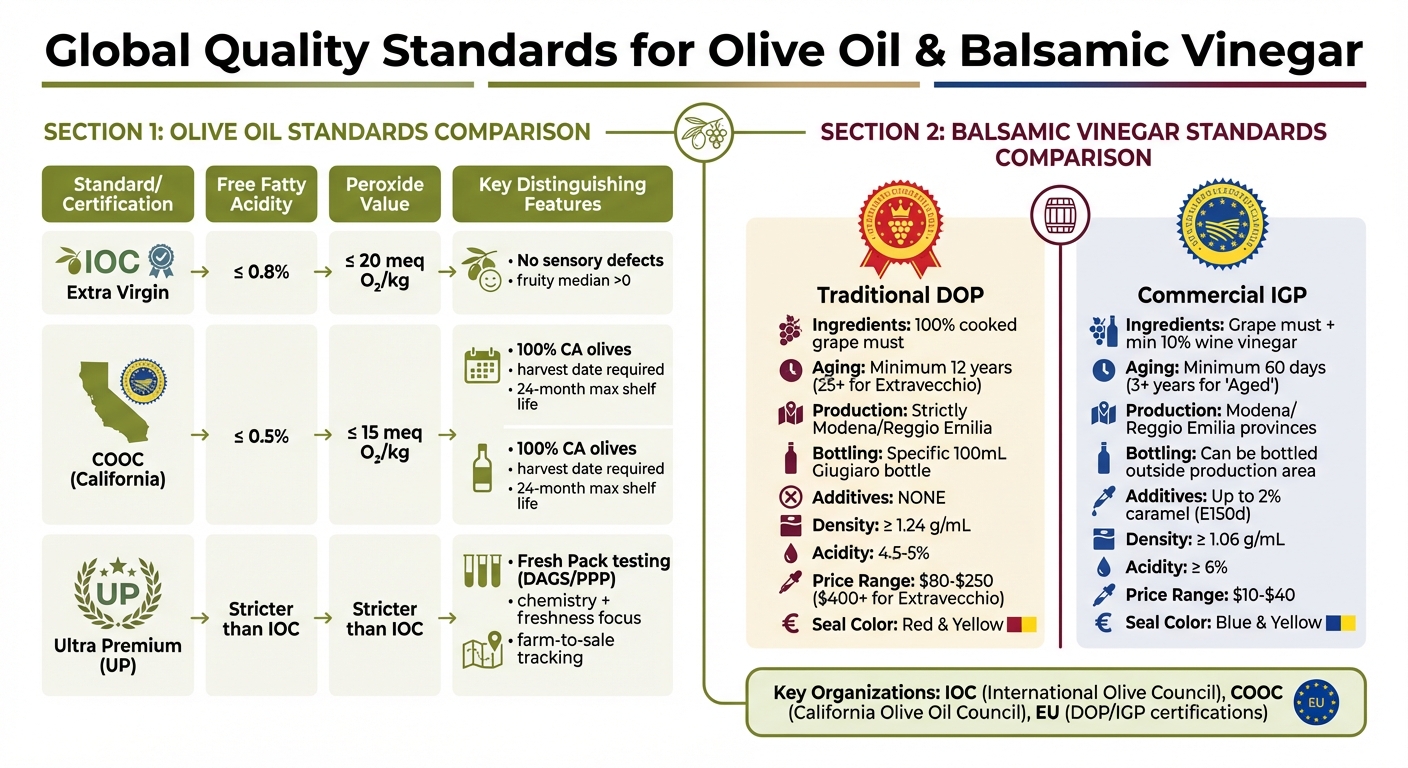
Olive Oil and Balsamic Vinegar Global Quality Standards Comparison
Interpreting Olive Oil Test Results
sbb-itb-4066b8e
Global Standards for Olive Oil
Organizations around the world have developed systems to ensure the quality and authenticity of olive oil. These standards combine lab tests with sensory evaluations by trained tasters to differentiate true extra virgin olive oils from lower-grade alternatives. A key player in this effort is the International Olive Council (IOC).
International Olive Council (IOC) Standards
The IOC categorizes olive oils into two main groups: virgin olive oils (mechanically extracted) and olive pomace oils (extracted using solvents). Oils are classified through a mix of chemical tests - like acidity, peroxide value, and UV absorbency - and sensory evaluations conducted by trained panels.
To qualify as Extra Virgin Olive Oil, the product must have a free acidity level of no more than 0.8 grams per 100 grams, show no sensory defects, and have a fruity median score above zero. Virgin Olive Oil, on the other hand, allows for up to 2.0 grams of free acidity per 100 grams and minor sensory defects up to a score of 3.5. Oils classified as Lampante Virgin Olive Oil have defects exceeding 6.0 or acidity above 3.3 grams per 100 grams, making them unsuitable for consumption without refining.
To reduce bias in sensory evaluations, the IOC uses statistical techniques, treating tasters as instruments and calculating attribute medians with 95% confidence intervals. This approach has played a key role in improving the quality of virgin olive oils globally. While these standards are comprehensive, some certifications go even further by focusing on the entire lifecycle of the oil.
Ultra Premium (UP) Certification for Olive Oil
The Ultra Premium (UP) standard takes a different approach, emphasizing freshness and chemistry rather than geographic origin. Unlike certifications tied to specific regions, UP evaluates "When, What, and How" - tracking the oil from the farm through to the point of sale.
"The UP standard has as its principal barometers Chemistry and Freshness. These two underappreciated variables can be objectively measured, quantified, and certified."
To meet UP standards, oils undergo Fresh Pack testing, which measures Diacylglycerols (DAGS) and Pyropheophytins (PPP) to quantify freshness. This certification was created to address gaps in global regulations, such as misleading "best buy" dates and inadequate enforcement against adulteration. The UP standard claims to surpass all existing international and regional guidelines, including those from Europe, North America, and California.
California Olive Oil Council (COOC) Certification
In the United States, the California Olive Oil Council (COOC) sets regional standards that raise the bar for quality. Oils must be made from 100% California-grown olives and extracted mechanically. COOC standards are stricter than the IOC’s, with free fatty acid levels capped at 0.5% (compared to the IOC’s 0.8%) and peroxide values limited to 15 meq O₂/kg oil.
Producers submit oils annually for blind sensory testing. Oils must show no defects and have a median fruitiness score above zero. Larger producers (over 5,000 gallons) face additional requirements, such as DAGS levels of at least 35% and PPP levels no higher than 17%.
The COOC also enforces strict labeling rules. Harvest dates must be displayed, and "Best If Used By" dates cannot extend beyond 24 months after harvest. Regional claims require at least 85% of olives to come from the specified area, estate labels need 95% from a specific estate, and varietal claims demand 85% of the stated variety. Additionally, the COOC seal cannot be used on flavored oils, co-milled oils, or blended products.
These diverse certification systems work collectively to uphold the quality and authenticity of olive oil, ensuring consumers can trust the products they purchase.
Global Standards for Balsamic Vinegar
Balsamic vinegar is regulated under a specific framework established by the European Commission. This framework includes two key protection systems: DOP (Protected Designation of Origin) and IGP (Protected Geographical Indication). These certifications are overseen by the Italian Ministry of Agriculture and verified by independent control bodies like CSQA. Understanding these standards is essential for distinguishing between traditional DOP and commercial IGP balsamic vinegar.
Modena IGP and DOP Certifications
Traditional Balsamic Vinegar of Modena holds the DOP certification, representing the highest standard. It must consist of 100% cooked grape must with no additives and requires a minimum aging period of 12 years, extending to 25 years for the "Extravecchio" variety. Production and bottling are strictly confined to Modena or Reggio Emilia, and the final product is packaged in a unique 100 mL bottle designed by Giugiaro.
Balsamic Vinegar of Modena with IGP certification, on the other hand, is made by blending grape must with at least 10% wine vinegar, which may include vinegar aged for 10 years or more. It requires a minimum aging period of 60 days in wooden containers, though products labeled as "Aged" (Invecchiato) must mature for at least three years. Unlike DOP balsamic, IGP-certified vinegar can be bottled outside the designated production area and may include up to 2% caramel (E150d) to stabilize color.
| Feature | Traditional Balsamic Vinegar (DOP) | Balsamic Vinegar of Modena (IGP) |
|---|---|---|
| Ingredients | 100% cooked grape must | Grape must, wine vinegar (min 10%), 10-year-old aged vinegar |
| Aging Requirements | Minimum 12 years (25+ for Extravecchio) | Minimum 60 days (3+ years for "Aged") |
| Production Area | Strictly within Modena or Reggio Emilia | Provinces of Modena and Reggio Emilia |
| Bottling Rules | Bottled in a specific 100 mL bottle in Modena | Can be bottled outside the production area |
| Additives | None allowed | Up to 2% caramel (E150d) allowed |
These standards mirror the detailed precision seen in olive oil classifications discussed earlier.
Traditional vs. Commercial Balsamic Vinegar
The production methods further highlight the differences between traditional and commercial balsamic vinegar. Traditional DOP balsamic is crafted using artisanal techniques, where the vinegar ages in progressively smaller barrels made from various woods like oak, chestnut, cherry, mulberry, ash, and juniper. This slow evaporation process results in a thick, complex product with a minimum density of 1.24 g/mL. A 100 mL bottle of traditional balsamic typically costs between $80 and $250, with "Extravecchio" varieties exceeding $400.
In contrast, commercial IGP balsamic is produced on an industrial scale. It has a lower minimum density of 1.06 g/mL and a higher acidity level, starting at 6%, compared to the 4.5%–5% range for DOP balsamic. Prices for IGP balsamic are significantly lower, ranging from under $10 to around $40 per bottle. Both types undergo rigorous analytical and sensory evaluations by accredited panels before earning their certification seals. The red and yellow DOP seal signifies a product made entirely from grape must, while the blue and yellow IGP seal indicates a blended formulation.
Recent updates under EU Regulation 2023/512 have introduced stricter quality standards for "Aged" IGP balsamic vinegar and expanded the range of approved packaging options.
Comparing Standards Across Regions
Chemical and Sensory Testing Methods
Global standards for quality rely on a mix of chemical tests - like free acidity, peroxide value, and absorbency - and sensory evaluations. These methods work together to ensure product purity and quality. While chemical analysis provides measurable benchmarks for purity, the International Olive Council (IOC) considers sensory evaluations crucial for differentiating grades of virgin olive oil. The IOC first introduced sensory testing into trade standards in 1987, with formal regulations following in 1991. Although some initially questioned the subjectivity of sensory panels, the IOC demonstrated that their error margins are comparable to those of many chemical tests. To further reduce bias, rigorous statistical methods are applied.
For balsamic vinegar, both DOP and IGP varieties undergo strict chemical and sensory evaluations by certified experts before earning their labels. These assessments examine key traits like color, density (IGP products must generally reach at least 1.06 g/mL at 68°F), aroma, and flavor. Such comprehensive testing allows for meaningful comparisons across regions, as shown in the olive oil standards table below.
Olive Oil Standards Comparison Table
Olive oil standards worldwide are closely aligned with IOC guidelines. For instance, U.S. grade standards for extra virgin olive oil require a median of defects of zero and a free fatty acid content of no more than 0.8 grams per 100 grams. Here's a quick comparison of core parameters:
| Certification | Free Fatty Acidity | Peroxide Value | Sensory Defects | Freshness Requirements |
|---|---|---|---|---|
| IOC / U.S. Grade Extra Virgin | ≤ 0.8% | ≤ 20 meq O₂/kg | Median of 0 | Not specified |
| EU Extra Virgin | ≤ 0.8% | ≤ 20 meq O₂/kg | Median of 0 | Not specified |
In addition to these benchmarks, the IOC prioritizes authenticity and purity by using advanced chemical techniques to detect possible adulteration.
Big Horn Olive Oil's Commitment to Quality
Ultra Premium Extra Virgin Olive Oils
Big Horn Olive Oil takes freshness and quality to the next level by going beyond global standards. They meet the stringent Ultra Premium (UP) certification requirements, which surpass benchmarks set by the International Olive Council (IOC) and USDA. Additionally, they follow the strict guidelines of the California Olive Oil Council (COOC). Their Estate Reserve, Picual, and Coratina extra virgin olive oils are cold-pressed within just two hours of harvest, ensuring maximum antioxidant retention and robust flavor. To maintain peak quality, these oils are delivered within three months.
This rigorous process ensures that every bottle meets demanding chemical and sensory standards. The same dedication to excellence applies to their balsamic vinegars as well.
Balsamic Vinegars from Modena
Big Horn Olive Oil sources its balsamic vinegars straight from Modena, adhering to global standards for authenticity. Their Traditional 18-Year Aged Dark Balsamic Vinegar and Molto Denissimo 25-Year Aged Dark Balsamic Vinegar are crafted using time-honored methods unique to Modena. These vinegars are aged in wooden barrels, allowing rich, complex flavors and a syrupy texture to develop over time. Certified experts verify the quality before these products earn their IGP labels.
Conclusion
Global standards play a crucial role in ensuring that olive oil and balsamic vinegar meet high-quality benchmarks and remain authentic. The International Olive Council (IOC), for instance, establishes chemical limits like keeping free fatty acids at or below 0.8% for extra virgin olive oil. Regional organizations often go a step further, tightening these limits to ensure even higher quality. These standards rely on a mix of chemical testing and sensory evaluation to detect issues that numbers alone might miss.
When it comes to balsamic vinegar, certifications like Modena IGP and DOP highlight traditional, artisanal products. These labels guarantee that the vinegar has been aged in wooden barrels and follows time-honored production methods, using high-quality ingredients from specific regions.
Brands that consistently meet and go beyond these rigorous standards stand out. Big Horn Olive Oil is one such example. Their UP certification requires olive oil to be cold-pressed within two hours of harvest and delivered within three months. For balsamic vinegar, their Modena IGP products are verified by experts to ensure adherence to traditional methods.
Recognizing these certifications helps consumers make better choices. Labels like UP, COOC, or Modena IGP signal that the product has undergone strict quality checks, including chemical analysis, sensory testing, and origin verification. Big Horn Olive Oil’s dedication to exceeding these standards ensures every bottle reflects authenticity and exceptional quality.
FAQs
What do DAGS and PPP tell you about olive oil freshness?
DAGS and PPP are chemical tests that assess the freshness of olive oil by measuring its oxidation and degradation levels. Fresher, higher-quality olive oil will have lower values for these parameters.
How can I spot fake “extra virgin” olive oil from the label?
When you're shopping for extra virgin olive oil, a few key details can help you determine if it's the real deal. Start by looking for a harvest date - this tells you when the olives were picked, which is a good indicator of freshness. Also, check if the label mentions a specific region or olive varietal. Authentic products often proudly highlight these details.
Certifications are another important clue. Look for seals from organizations like the International Olive Council, as these signify that the oil meets strict quality standards.
Another tip? Pay attention to the packaging. Genuine extra virgin olive oil is typically stored in dark bottles to protect it from light, and the seal should be tight to maintain freshness.
Finally, remember that real extra virgin olive oil is made from pure, cold-pressed olives without any chemical processing. These simple checks can go a long way in ensuring you're getting a high-quality product.
Is DOP balsamic vinegar always worth the higher price than IGP?
If you're wondering whether DOP balsamic vinegar is worth the splurge, the answer often leans toward yes. Here's why: DOP (Denominazione di Origine Protetta) guarantees that the vinegar is crafted from 100% grape must and aged for a minimum of 12 years. This meticulous process creates a flavor profile that's both rich and layered, making it a standout choice for those who appreciate depth in their ingredients.
On the other hand, IGP (Indicazione Geografica Protetta) balsamic vinegar is a more budget-friendly option. It’s a blend of grape must and wine vinegar, aged for a shorter period. While its flavor is milder and less intricate, it’s a practical choice for everyday use.
Ultimately, the higher price tag of DOP balsamic vinegar reflects its authenticity and the care taken in its production, offering a taste experience that’s hard to match.