

Why High Polyphenol Olive Oil Matters for the Heart
Not all extra virgin olive oil helps the heart in the same way. If you want more heart support, I’d look past the words “extra virgin” and focus on polyphenol content, harvest date, and storage.
Here’s the short version:
- Heart disease kills about 695,000 Americans each year
- Polyphenols in olive oil help protect LDL from oxidation
- They also help support blood vessel function and healthy blood pressure
- The EU health claim starts at about 250 mg/kg of polyphenols
- Many store-bought EVOOs sit around 50–150 mg/kg
- Oils used in studies are often 500+ mg/kg
- In one 2025 trial, a smaller amount of high-phenolic EVOO beat a larger amount of lower-phenolic oil for some blood lipid markers
So the main point is simple: the amount of polyphenols in the bottle can matter more than how much oil you pour.
If I were buying EVOO for heart support, I’d keep it simple:
- Pick extra virgin olive oil, not “light,” “pure,” or refined olive oil
- Look for a recent harvest date
- Choose oils known for higher polyphenols
- Expect some bitterness and a peppery throat hit
- Store it in a cool, dark place
- Use 1–2 tablespoons a day, with some added after cooking
A quick side-by-side makes the gap easy to see:
| Type of oil | Polyphenol level | What it may do |
|---|---|---|
| Refined or low-polyphenol olive oil | Low | Less support for LDL and blood vessels |
| Standard EVOO | Moderate | Meets the basic bar if polyphenols are high enough |
| High-polyphenol EVOO | 500+ mg/kg | More support for LDL protection, vessel function, and blood pressure |
Bottom line: if you want olive oil that does more for the heart, I’d choose a high-polyphenol EVOO and use it while the bottle is still within its best window.
Does Olive Oil Help Your Arteries? What New Research Really Shows | The Artery Report
sbb-itb-4066b8e
What Olive Oil Polyphenols Do for the Heart
Key olive oil polyphenols include hydroxytyrosol, oleuropein, tyrosol, and oleocanthal. These compounds matter most because they help protect LDL and support healthy blood vessel function.
How Polyphenols Help Protect Blood Vessels and LDL
Hydroxytyrosol helps protect LDL from oxidation, which is why it sits at the center of the EU heart-health claim.
Oleocanthal also has anti-inflammatory effects through the COX-1 and COX-2 pathways. That matters because inflammation and oxidized LDL can work together in ways that put extra stress on the cardiovascular system.
Olive polyphenols also support the endothelium, the thin inner lining of blood vessels. They help support nitric oxide too, which allows blood vessels to relax and keep blood flowing as it should.
What Research Shows About Blood Pressure and Vascular Protection
A 2025 randomized clinical trial at the General Hospital of Messinia in Greece tested this idea head-on. Researchers assigned 50 patients with high lipids to two groups. One group took 20 g/day of moderate-phenolic EVOO, while the other took 8 g/day of high-phenolic EVOO. Both groups received about the same daily polyphenol dose.
After four weeks, the high-phenolic group showed greater reductions in total cholesterol and a significant drop in lipoprotein(a), a risk factor that often does not budge much with diet changes.
The takeaway is pretty simple: concentration matters more than volume. In plain English, a smaller amount of high-phenolic EVOO may do more than a larger amount with lower phenolic content. That’s why polyphenol concentration matters more than bottle size.
High vs. Low Polyphenol Olive Oil: Why the Gap Matters
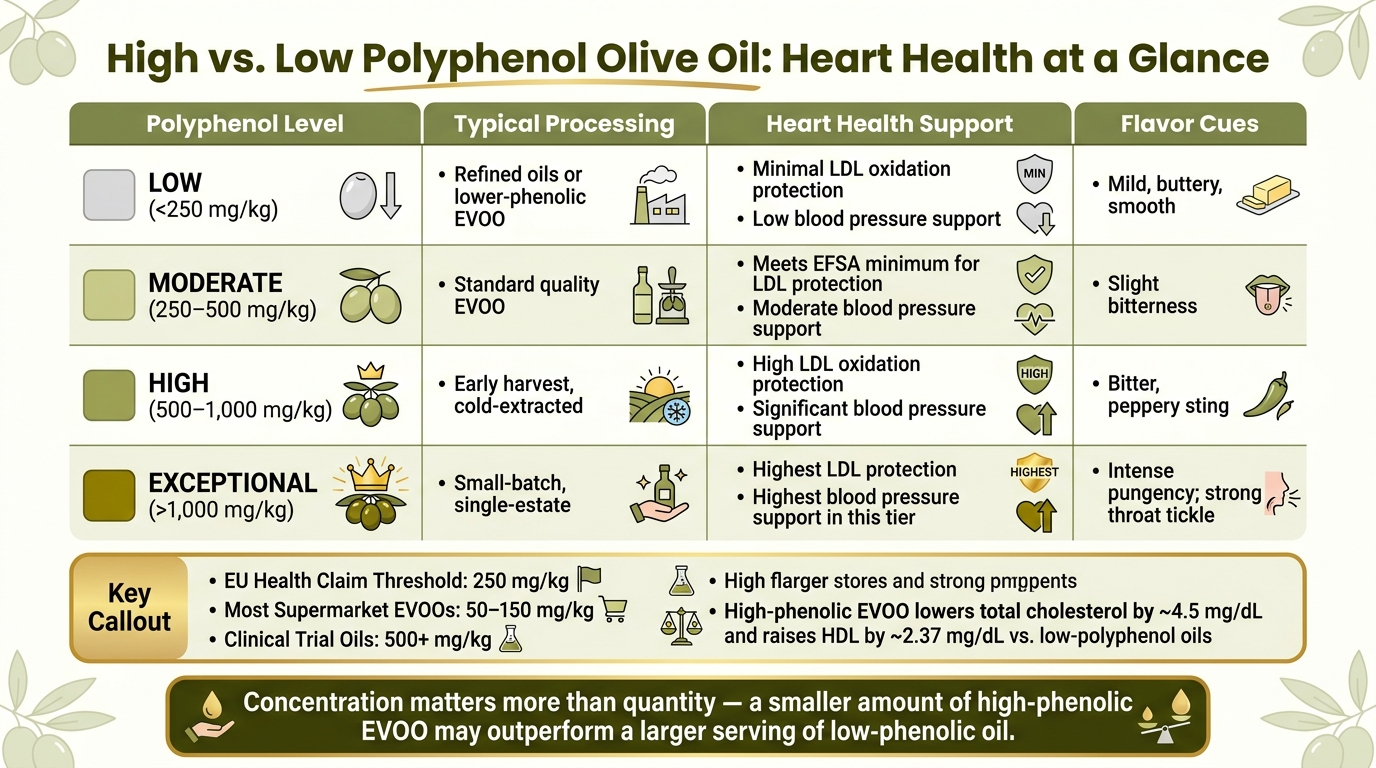
High vs. Low Polyphenol Olive Oil: Heart Health at a Glance
What Counts as High or Low Polyphenol Olive Oil
The difference gets a lot easier to see once you look at polyphenol content.
Polyphenols are measured in mg/kg, and the number can swing a lot based on harvest timing, processing, and how fresh the oil is. Even two extra virgin olive oils can land in very different ranges. EFSA sets the benchmark at 250 mg/kg, which is the level tied to the olive-oil health claim for oxidative stress.
Many standard supermarket EVOOs sit around 50 to 150 mg/kg of total polyphenols, which puts them well below that mark. By contrast, high-phenolic oils used in clinical trials often come in at more than 500 mg/kg. And once an oil is refined, most of those polyphenols are stripped out.
Heart-Relevant Differences
This isn't just a flavor or label issue. It changes what the oil can do for heart health.
High-polyphenol EVOO has been shown to lower total cholesterol by 4.5 mg/dL and increase HDL ("good") cholesterol by 2.37 mg/dL compared with low-polyphenol oils. On top of that, higher EVOO intake has been linked with lower cardiovascular risk in observational research.
Why does that matter? Because polyphenol levels help shape how much support the oil may give to LDL, blood vessels, and blood pressure. Put simply, the fat matters, but the phenolic fraction is doing a lot of the heavy lifting.
| Polyphenol Level | Typical Processing | LDL Oxidation Support | Blood Pressure Support | Flavor Cues |
|---|---|---|---|---|
| Low (<250 mg/kg) | Refined oils or lower-phenolic EVOO | Minimal to none | Low | Mild, buttery, smooth |
| Moderate (250–500 mg/kg) | Standard quality EVOO | Meets EFSA minimum | Moderate | Slight bitterness |
| High (500–1,000 mg/kg) | Early harvest, cold-extracted | High protection | Significant | Bitter, peppery sting |
| Exceptional (>1,000 mg/kg) | Small-batch, single-estate | Highest support in this tier | Highest support in this tier | Intense pungency; strong throat tickle |
How to Choose and Use High-Polyphenol EVOO at Home
Label, Flavor, and Freshness Signs That Point to Higher Polyphenols
Once you know higher-polyphenol oils matter, the next move is picking a bottle that still has those compounds when it reaches your kitchen.
Start with extra virgin olive oil. Labels like “pure,” “light,” or just “olive oil” usually mean the oil has been refined, which often leaves it with fewer polyphenols. Check for a recent harvest date too. A bottle within 12–18 months of harvest is usually a better bet.
Taste tells you a lot. High-polyphenol EVOO often has a bitter edge and a peppery throat tickle at the end. That little kick comes from compounds like oleocanthal.
Freshness and storage go hand in hand. Polyphenols drop with exposure to light, heat, oxygen, and time, so a good bottle can lose a lot if it’s handled poorly.
Storage Tips and Everyday Serving Ideas for U.S. Households
If you want to protect the same polyphenols linked to LDL and vascular support, storage matters more than many people think. Keep your EVOO in a cool, dark cabinet, not on the counter by the stove. A steady temperature around 60–72°F works best. Dark glass or opaque metal tins help block light, while clear glass sitting near a window can wear the oil down fast.
A few simple habits make a big difference:
- Keep the cap tightly sealed between uses
- Buy smaller bottles, around 8.5–17 fl oz (250–500 mL)
- Try to finish the bottle within 2–3 months after opening
For daily use, aim for 1–2 tablespoons in dressings, over vegetables, or as a finishing oil for grains and lean proteins. You can also cook with EVOO over low to medium heat, then add a fresh drizzle after cooking to hold on to more polyphenols.
Why Big Horn Olive Oil Fits This Discussion
The same steps that help protect polyphenols - early harvest, fast processing, and careful handling - are central to Big Horn Olive Oil. Their oils meet the Ultra Premium (UP) Extra Virgin standard, which uses tighter limits for acidity and freshness.
Their olives are pressed within about two hours of harvest. That short window helps limit oxidation and hold on to phenolic compounds, which can drop fast once olives are cut.
Their single-variety oils, including Picual and Coratina, come from cultivars known for higher phenolic potential when harvest and processing are done well. If you’re shopping for a heart-focused EVOO, those are exactly the kinds of traits worth looking for.
Conclusion: A Simple Upgrade That Can Better Support the Heart
The main point is simple: when it comes to heart support, the label alone doesn't tell the whole story. Polyphenol level matters. High-polyphenol EVOO - ideally above 500 mg/kg - stands out for its ability to help protect LDL from oxidation, support blood vessel function, and aid healthy blood pressure as part of a heart-healthy diet.
The research also makes one thing clear: concentration matters more than quantity. The upside came from a higher concentration of polyphenols, not from using more oil. So a smaller daily amount of a more concentrated EVOO can do more than a larger serving of a lower-phenolic one.
Choose a fresh, harvest-dated EVOO with verified polyphenol levels. Use it every day, either raw or as a finishing oil. It's a small shift, but one that can make a meaningful difference. Let the bottle - not just the label - do the work.
FAQs
How can I tell if an olive oil is truly high in polyphenols?
Look for Extra Virgin Olive Oil with a harvest date, not just a “best by” date. Oils harvested within the last 9 to 12 months usually keep the most potency.
High-polyphenol oils often smell fresh and fruity, with notes like cut grass or tomato. They also tend to have a clear peppery kick or a bit of bitterness. If you want more proof, pick oils with lab-certified polyphenol levels above 300 mg/kg and dark glass bottles.
Does cooking with EVOO reduce its heart-supporting polyphenols?
Yes. Polyphenols can break down when they're exposed to high heat.
Big Horn Olive Oil’s Ultra Premium Extra Virgin Olive Oil stays stable for cooking up to 410°F. But if you keep it at high heat for a long stretch, some of those delicate compounds can still fade.
If you want to keep more polyphenols in the oil, it helps to use it:
- Raw in dressings or smoothies
- As a finishing drizzle
- In gentle, moderate-heat cooking methods like sautéing
How much high-polyphenol EVOO should I use each day?
Research usually points to 20 to 30 grams of high-polyphenol extra virgin olive oil per day for heart health. That works out to about 1.5 to 2 tablespoons.
That said, study doses vary. Some research uses 2 to 4 tablespoons, and even 0.5 tablespoons has been linked to a lower risk of heart disease.
Because some polyphenols are sensitive to heat, Big Horn Olive Oil suggests using your daily amount raw when you can, like in a dressing or as a finishing drizzle.