

History of Continuous Fermentation in Vinegar
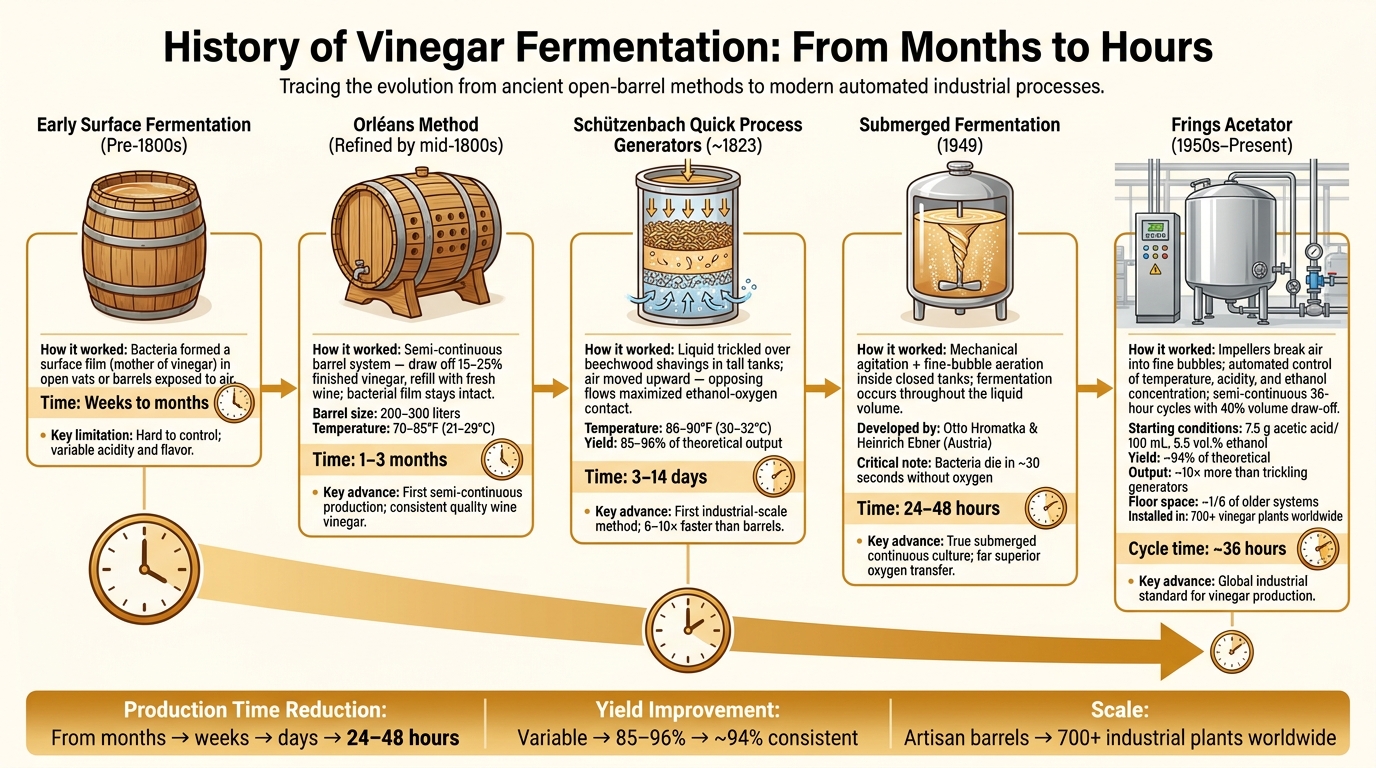
Vinegar making went from taking months to as little as 24–48 hours. The reason is simple: producers got better at moving oxygen, heat, and liquid through the process while keeping acetic acid bacteria active.
If you want the short version, here it is:
- Early surface methods were slow and hard to control.
- The Orléans method used a semi-continuous draw-off and refill system in barrels.
- Schützenbach generators cut production time from 1–3 months to 3–14 days by pushing air through packed towers.
- Submerged fermentation, developed for vinegar in 1949, moved the work into the liquid with aeration and mixing.
- The Frings Acetator turned that setup into a factory standard, with cycles around 36 hours and yields near 94%.
- Modern continuous systems improved speed, acidity control, and batch-to-batch consistency.
Here’s the core idea in plain English: acetic acid bacteria always did the same job - they turned alcohol into acetic acid. What changed over time was the equipment and process control.
| Method | How it worked | Typical time |
|---|---|---|
| Surface fermentation | Bacteria worked at the air-liquid surface | Weeks to months |
| Orléans method | Barrel draw-off and refill | 1–3 months |
| Quick process generators | Liquid trickled over packed material with airflow | 3–14 days |
| Submerged fermentation | Air and mixing inside sealed tanks | 24–48 hours |
So when I look at the history of continuous fermentation in vinegar, I see a clear shift: from slow surface growth to controlled, high-output systems that made modern vinegar production far more steady and predictable.
History of Vinegar Fermentation: From Months to Hours
From Surface Fermentation to Early Semi-Continuous Methods
Early Surface Methods and Slow Acetification
Early vinegar makers worked in a simple way: they left wine, cider, or malt solutions exposed to air in open vats or barrels. Over time, naturally occurring acetic acid bacteria (AAB) formed a thin surface film called the mother of vinegar and slowly turned ethanol into acetic acid at the air–liquid interface.
The process worked, but it was hard to control. Acidity and flavor could vary a lot because temperature, alcohol level, and shifts in the bacterial population all affected the outcome. Producers tried to steady things by reusing barrels that already had an established mother of vinegar, a technique still echoed in the traditional Solera system, filling vessels only halfway to increase surface exposure, and fermenting in cool, stable cellars. Even so, large-scale standardized production stayed out of reach. That lack of control pushed producers toward barrel systems with better-managed airflow.
The Orléans Method as a Semi-Continuous Milestone
The Orléans method, developed and refined in Orléans, France, stayed the standard for high-quality wine vinegar in Europe until the mid-19th century. It used a semi-continuous barrel setup that gave producers more control while keeping the slow, surface-based nature of older acetification methods. In plain terms, it was a clear move beyond passive open-vat production.
The system relied on wooden barrels, usually 200–300 liters, laid horizontally and only partly filled with wine plus starter vinegar containing an active mother. Small ventilation openings, often called eyes, were cut into the barrel heads and covered with cloth or mesh so air could enter while insects stayed out.
Its semi-continuous design came from a regular draw-off and refill cycle:
- Producers removed about 15–25% of the finished vinegar from the bottom of the barrel.
- They then added fresh wine from the top, leaving the surface film in place.
That meant the active bacterial culture stayed where it was and could start working on the next batch right away.
Fermentation cycles usually lasted about 1–3 months for wine at about 9% ethanol, with temperatures around 70–85 °F (21–29 °C). That moderate range helped keep bacterial activity steady while also protecting aroma. As a result, Orléans vinegars became known for complex flavor instead of sharp, harsh acidity. This emphasis on balanced acidity is a hallmark of premium white balsamic and other barrel-aged varieties.
Pasteur's Scientific Explanation of Acetification
Pasteur later showed why this surface-based system worked. In the mid-19th century, he demonstrated that the surface film was a living bacterial culture. He identified Mycoderma aceti - now classified within the genus Acetobacter - as the bacterium that converts ethanol to acetic acid, and he showed that oxygen was required for the reaction. That explained why acetification took place at the air–liquid interface and why ventilation mattered so much.
His work gave producers a scientific basis for practices they had already seen work in the cellar. It explained why they needed to protect the mother of vinegar during draw-off, adjust barrel openings and fill levels with care, and use base wines with steady alcohol content. More broadly, Pasteur recast vinegar-making as a biological process that could be managed on purpose. His findings also made oxygen control the starting point for generator-based vinegar production.
sbb-itb-4066b8e
The Quick Process and Generator-Based Industrial Production
Schützenbach Generators and the Rise of the Quick Process
Once oxygen was identified as the main factor, vinegar makers reworked production to get as much air contact as possible. Around 1823, Karl Sebastian Schützenbach introduced what became known as the quick process in the Kingdom of Baden. It became one of the first industrial-scale methods for making vinegar.
Instead of relying on a horizontal barrel with a film on the surface, Schützenbach used tall, upright cylindrical tanks filled with porous material, often beechwood shavings. That filling gave acetic acid bacteria much more area to grow on, so a bacterial film could spread across the shavings. The alcoholic liquid was pumped to the top and allowed to trickle downward, while air moved up from the bottom. That set up opposing flows of liquid and air, bringing ethanol and oxygen into close contact.
The payoff was huge. Acetification dropped from 1–3 months in barrels to just 3–14 days in generators. Beechwood became the top packing material, even though cheaper options like corncobs or charcoal were available, because it lasted longer and gave more even results.
How Multi-Generator Systems Came Close to Continuous Production
One generator still worked as a batch unit. But when plants ran several of them on staggered schedules, the system started to act almost like continuous production.
After a unit reached a steady state, operators would draw off about two-thirds of the finished vinegar and then refill it right away with fresh alcoholic mash. Since the bacterial biofilm stayed attached to the shavings, the culture did not need to be rebuilt from scratch. It could get back to work on the new feed with little delay.
By staggering those draw-off times across multiple generators, plants could remove finished vinegar at regular intervals and cut downtime enough to come close to continuous output. To keep the process on track, operators watched four main variables:
- Ethanol feed concentration
- Airflow rate
- Temperature
- Acidity level
Temperature was usually kept between 86–90 °F (30–32 °C). Vinegar was drawn once residual alcohol fell to about 0.5%, and yields often reached 85–96% of the theoretical acetic acid output.
Barrel vs. Generator Systems: A Research-Based Comparison
Barrel systems were a better fit for slow, aged vinegars. Generator systems were built for high-volume, standardized output.
The big edge was cost and speed. When fermentation time fell from months to days, plants could run more cycles each year using the same equipment. Raw materials turned over faster, and less money sat locked up in storage and inventory. By the late 19th and early 20th centuries, factories using several generators had become the main way vinegar was produced. After that, the next move was clear: shift fermentation out of the packing and into the liquid itself.
Submerged Fermentation and Modern Continuous Acetators
Mid-20th-Century Development of Submerged Fermentation
The next big shift after generator-based aeration was simple in idea but huge in practice: fermentation moved into the liquid itself.
In 1949, Austrian researchers Otto Hromatka and Heinrich Ebner adapted submerged fermentation for vinegar production. That moment marked the industry's move away from packed surfaces and toward true submerged continuous culture. Instead of relying on air passing over bacterial films, these systems used mechanical agitation and fine-bubble aeration inside closed stainless-steel tanks. The payoff was much better oxygen transfer across the entire liquid volume.
That point mattered a lot because acetic acid bacteria are unforgiving when oxygen drops. Hromatka's patents stressed that aeration had to continue without interruption. Under the acidic conditions inside a fermenter, the bacteria can die in about 30 seconds if the oxygen supply stops. Cooling also became a central part of the setup, since turning ethanol into acetic acid gives off a lot of heat.
The Frings Acetator and Industrial Standardization
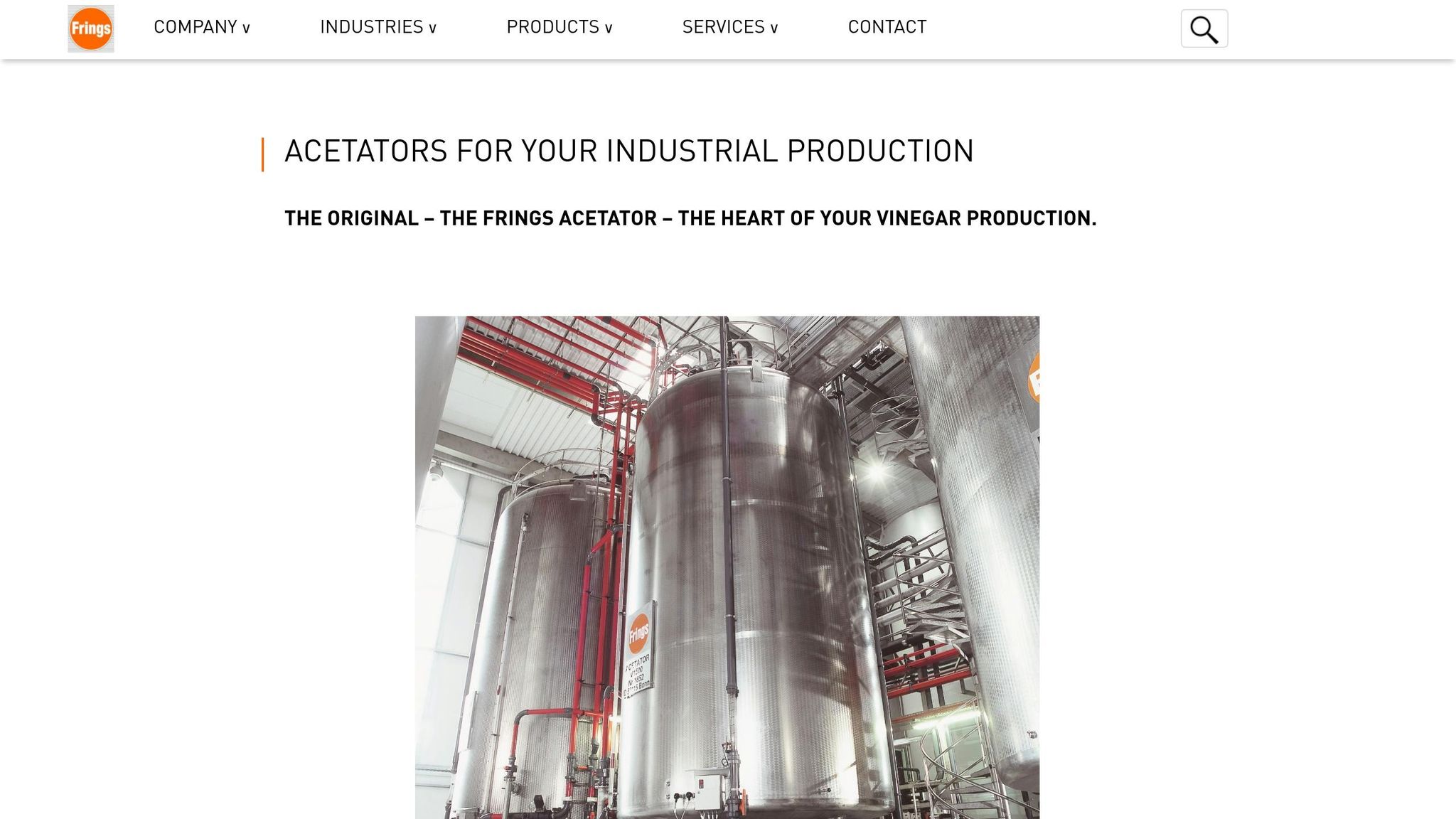
That lab advance turned into an industrial workhorse with the Frings Acetator. In the 1950s, German company Heinrich Frings GmbH brought this approach to market and made submerged fermentation a repeatable factory process.
The Acetator used impellers to keep the mash moving while breaking air into fine bubbles. It also added automatic control over temperature, acidity, and ethanol concentration. In a standard semi-continuous cycle, the process started at about 7.5 g acetic acid per 100 mL and 5.5 vol.% ethanol, ran for roughly 36 hours, and then discharged about 40% of the working volume. Fresh mash was added right away, so the bacterial population stayed in place instead of being rebuilt from zero each time.
The production jump was hard to ignore:
- About 10 times the output of older trickling generators
- Around 94% of theoretical yield in conversion efficiency
- Only about one-sixth of the floor space
Those gains helped Heinrich Frings GmbH install systems in over 700 vinegar plants worldwide.
Continuous Culture Design and Stable Acidity Control
Semi-continuous operation helped keep the process steady. By drawing off part of the finished vinegar at the end of each cycle and refilling at once with fresh mash, producers kept lag phases short and acidity within a more predictable band. Studies on submerged rice vinegar show stable acidity from cycle to cycle, with individual runs ranging from 6.6% to 7.8% (w/v) acetic acid.
That control is not just nice to have. It's what makes continuous vinegar production work. These systems run well only within a fairly narrow acidity range. Modern setups often use two reactors in series. The first keeps cell density high at a moderate acidity level, while the second lets ethanol fall to zero and final acidity build.
Single-stage continuous systems usually top out at about 8–10% acidity because beyond that point the acid level starts to hold back bacterial activity. In other words, there was a hard limit even in these more advanced systems. Still, this design completed the long move from slow surface growth to tightly controlled submerged culture, which became the base for today's premium vinegars.
Documented Impacts on Quality, Efficiency, and Modern Vinegar Products
What Research Shows About Speed, Yield, and Consistency
The effects of these process changes show up most clearly in three areas: speed, yield, and consistency.
Fermentation time dropped hard with each major shift in method, with submerged systems reaching about 24 hours. One study makes the contrast easy to see: orange vinegar took 6 weeks with surface culture and just 22 hours with submerged culture.
Yield went up as speed improved. Bubble-column continuous reactors have recorded acetic acid yields of 94.2% to 94.7% under steady-state conditions, with an overall productivity of 1.41 g/L/h. That matters because it made vinegar production faster, more repeatable, and easier to scale.
And this wasn't just about output. Sensory research on orange vinegar found that submerged-culture vinegars scored higher for fruity, floral, and general impression than surface-culture versions. So the shift didn't just save time. It also improved the final product.
How Continuous Fermentation Shaped Balsamic-Style Vinegar Production
Those same controlled fermentation methods also support many balsamic-style vinegars before aging starts.
Traditional Balsamic Vinegar of Modena works under a different set of rules. Its specifications require at least 4.5 g per 100 g acidity, a density of 1.240 at 68°F (20°C), and 12 years of aging. That's a very different path from most large-scale balsamic-style products sold today.
Many commercial balsamic-style vinegars start with an acetified wine or grape must base made through modern semi-continuous or continuous methods, then move on to aging or blending. In other words, continuous fermentation sits behind the industrial side of the category, while DOP rules still govern the artisan version. Much of the premium character in balsamic products comes later, after acetification, during aging.
Conclusion: The Main Historical Steps Behind Today's Premium Vinegars
Taken together, these changes shaped the modern model of vinegar production.
The move from slow surface oxidation to tightly controlled submerged culture followed a clear path. Early semi-continuous barrel methods gave way to generator-based quick-process systems, and later to submerged acetators. The Frings Acetator then helped make submerged fermentation a common industrial standard.
Each step brought more control, more speed, and better reproducibility. That made it possible to produce consistent, high-acidity vinegar at a scale earlier generations could not have imagined. Modern premium vinegars come out of that long progression from surface methods to controlled continuous fermentation.
Why Did We Keep Making Vinegar?
FAQs
Why is oxygen so important in vinegar fermentation?
Oxygen matters here because acetic acid bacteria use it to turn ethanol into acetic acid - the compound that gives vinegar its sharp tang.
In older methods, that process happens at the surface of the liquid, where the mother of vinegar forms. The bacteria stay there because that’s where they can reach oxygen. If the mother gets disturbed and sinks, the bacteria can lose that access, die off, and the batch may spoil.
Modern methods move faster by pumping air into the liquid, which gives the bacteria the oxygen they need throughout the process.
What makes the Orléans method semi-continuous?
The Orléans method is called semi-continuous because artisans add fresh wine to the same barrel at set intervals.
To do that, they use a special tool that sends the wine to the bottom of the barrel without disturbing the surface, where acetification takes place. That matters because it keeps the mother of vinegar in place and lets fermentation keep going in the same vessel.
Why did submerged fermentation replace generator systems?
Submerged fermentation took over from generator systems for one main reason: speed.
Older, artisanal methods can take months. Industrial submerged fermentation, by contrast, uses oxygen-pumping turbines to finish the job in just 16 to 24 hours.
At Big Horn Olive Oil, we see the tradeoff clearly. This move puts efficiency first, but it can flatten flavor, leaving less of the layered aroma and earthy character that slower fermentation tends to build.