

History of Olive Oil in Blessing Ceremonies
Olive oil has been a symbol of purity, healing, and divine connection for over 5,000 years. Used in rituals across ancient civilizations like Egypt, Greece, and Rome, it played a key role in religious practices, anointing leaders, lighting sacred spaces, and honoring deities. In Jewish and Christian traditions, olive oil became central to ceremonies such as anointing kings, priests, and the sick, as well as lighting the Menorah in the Temple.
Key points:
- Ancient uses: Consecrating altars, anointing leaders, and temple lighting.
- Jewish practices: Sacred anointing oil (shemen ha-mishchah) and "pure-beaten" oil for the Menorah.
- Christian sacraments: Baptism, healing, and church consecration.
- Modern relevance: Still used in religious ceremonies, wellness rituals, and state events like King Charles III's 2023 coronation.
Olive oil's dual role as a practical and sacred substance continues to connect ancient traditions with modern practices, symbolizing purity and spiritual presence across cultures.
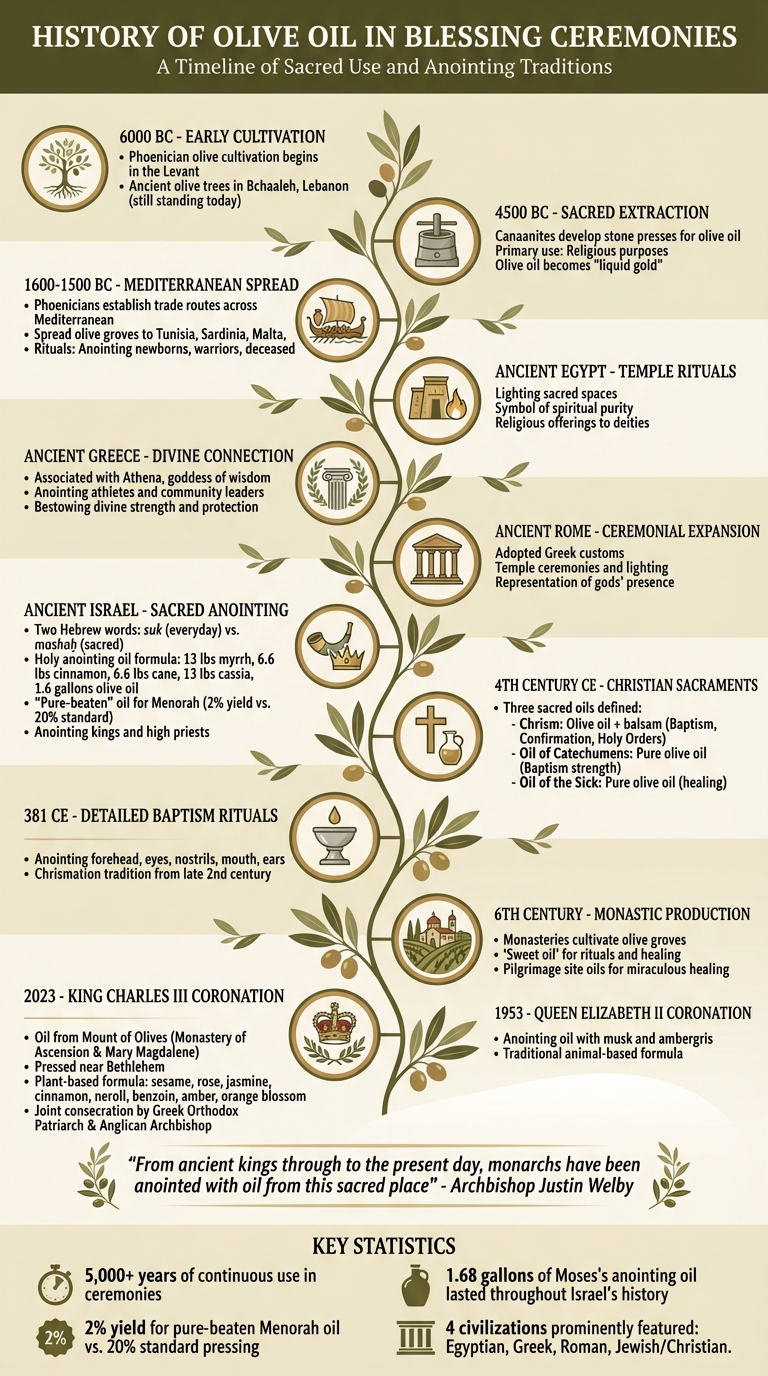
5,000-Year History of Olive Oil in Religious Ceremonies
How to use Blessed Oil
sbb-itb-4066b8e
Ancient Civilizations and Early Olive Oil Rituals
By 4500 BC, the Canaanites developed sophisticated stone presses to extract olive oil, primarily for religious purposes. This "liquid gold" was more than a practical resource - it served as a sacred connection between humans and the divine. With its purity, golden hue, and long-lasting properties, olive oil became a symbol of immortality and was used to consecrate altars and honor deities. These early rituals laid the groundwork for the ceremonial traditions of later civilizations.
Egyptian Temple Rituals and Religious Offerings
In ancient Egypt, olive oil played a significant role in temple rituals and offerings. It was used to light sacred spaces, symbolizing spiritual purity while also fulfilling practical needs. Its dual role as a functional and symbolic element made it central to Egyptian religious life.
Greek and Roman Temple Ceremonies
The Greeks embraced olive oil as a sacred substance, associating it with Athena, the goddess of wisdom. It was used in rituals such as anointing athletes and prominent community members, believed to bestow divine strength and protection. These practices heavily influenced Roman ceremonial traditions. The Romans adopted and expanded on Greek customs, incorporating olive oil into their temple ceremonies as both a light source and a representation of the gods' presence.
Phoenician Trade Routes and Ceremonial Practices
The Phoenicians elevated olive oil to a sacred commodity across the Mediterranean. Between 1500 and 300 BC, these seafarers from the Levant (modern-day Lebanon) not only transported olive oil through extensive trade networks linking the Levant to North Africa, Cyprus, Sicily, and Iberia but also established olive groves in regions like Tunisia, Sardinia, Malta, and Spain. This ensured a consistent supply of olive oil for ceremonial use and spread its spiritual significance to new cultures. Olive cultivation in their homeland began as early as 6000 BC, with ancient trees like the "Sisters" olive trees in Bchaaleh, Lebanon - estimated to be 6,000 years old - serving as living relics of this early history.
"They didn't just sell it - they embedded it into new cultures. They transported the oil in amphorae: large, ceramic jars specifically crafted to protect the oil from heat, light, and movement."
– Mazen Assaf, The Olive Oil Guy
The Phoenicians' influence extended beyond trade. They actively introduced olive trees to new regions, reshaping local religious practices. By around 1600 BC, their efforts had spread rituals involving olive oil - such as anointing newborns, warriors, and the deceased - throughout the Mediterranean. This integration of trade and spiritual tradition set the stage for olive oil's enduring role in cultural and religious ceremonies.
Jewish Religious Practices and Olive Oil
Jewish traditions have long held olive oil in special regard, intertwining it with both daily life and sacred rituals. In ancient Hebrew, there were two distinct words for oil: suk, which referred to everyday oil, and mashaḥ, used for sacred anointing. This linguistic distinction highlights how olive oil was seen not only as a practical resource but also as a medium for spiritual connection.
The Sacred Anointing Oil Formula
The Torah provides a specific recipe for the holy anointing oil, or shemen ha-mishchah. Moses crafted this sacred blend in the wilderness using a precise combination of ingredients: approximately 13 pounds of pure myrrh, 6.6 pounds of sweet cinnamon, 6.6 pounds of fragrant cane, 13 pounds of cassia, and 1.6 gallons of olive oil. These components were carefully mixed "according to the art of the apothecary" to create an oil exclusively reserved for consecrating the Tabernacle, its vessels, and individuals chosen for divine service.
The use of this oil was strictly regulated. It was forbidden for ordinary purposes or personal replication. Talmudic tradition even holds that the original 1.68 gallons prepared by Moses miraculously lasted throughout Israel's history, anointing every king and high priest up until King Josiah's time. The anointing process itself was symbolic: kings were anointed with an oil crown, while high priests received the oil in the shape of a Greek Chi (χ) or the Hebrew letter kaph. This sacred oil not only sanctified leaders but also served as a model for other ritual uses, such as temple lighting and ceremonial anointing.
The Menorah and Temple Lighting
The Menorah in the Holy Temple required a unique type of olive oil known as "pure-beaten" oil. Unlike standard oil extraction methods that used stone presses, this process involved manually crushing olives and allowing the oil to drip naturally over several days. This labor-intensive method produced only about 2% of the olive's volume, compared to the 20% yield from traditional pressing. However, the resulting oil was of exceptional purity and clarity, creating a superior flame that represented God's eternal presence.
"In the Hebrew Bible, in the Old Testament in several places it speaks of fresh harvest extra virgin olive oil for the light. Olive oil was the main oil of this region and very little other oil was ever used." – Dr. Rafael Frankel, Archaeologist
The Menorah's continuous flame served as a visible reminder of the divine presence among the Israelites. In a modern continuation of ancient practices, the Sanhedrin organization in Israel harvested olives in 2020 from trees planted specifically for Temple rituals. These trees followed biblical laws, which prohibited using fruit for the first three years and consecrated the fourth-year harvest. This connection between olive oil and divine service endures, as it not only sanctifies objects but also symbolizes God's presence.
Anointing Kings and Religious Leaders
Anointing with olive oil was central to recognizing Israel's leaders as divinely chosen. Kings from the Davidic line, such as David and Solomon, were anointed using oil from a horn, symbolizing a permanent kingship. In contrast, other rulers like Saul and Jehu were anointed with oil from a glass vial, indicating a less enduring or more specific role. This practice also ties directly to the term Mashiach (Messiah), meaning "the anointed one", linking olive oil to themes of divine authority and redemption throughout Jewish tradition.
Christian Sacraments and Healing Rituals
Early Christians took inspiration from Jewish traditions, particularly the use of olive oil in sacred rituals, and infused it with new layers of meaning to reflect their evolving spiritual beliefs.
The practice of anointing, inherited from Judaism, became a cornerstone of Christian identity. The very term "Christian" derives from the Greek word Christos, meaning "anointed one", directly tying followers to Christ and the sacred oil used in religious ceremonies. As Pope Benedict XVI explained, being "Christian" signifies belonging to the anointed one of God.
By the 4th century, olive oil was firmly established in Christian worship, with the Church defining three distinct uses for sacraments: Chrism (a blend of olive oil and dark balsamic vinegar for Baptism, Confirmation, and Holy Orders), Oil of Catechumens (pure olive oil symbolizing strength against evil during Baptism), and Oil of the Sick (pure olive oil used for healing and spiritual restoration).
Baptism and Priestly Ordination
In early Christian Baptism, olive oil played a dual role: it was used for exorcism and as an expression of gratitude. By 381 CE, detailed anointing rituals included marking the forehead, eyes, nostrils, mouth, and ears of baptismal candidates. These practices stemmed from "chrismation", a tradition dating back to the late 2nd century that symbolized spiritual renewal and divine inspiration.
Olive oil also held a central place in ordination ceremonies. During these rites, bishops received chrism on their heads, while priests historically had their hands anointed with the Oil of Catechumens. These anointings symbolized the transfer of spiritual authority and the consecration of individuals for sacred duties. This same symbolism extended naturally to healing practices, where olive oil was believed to restore both body and spirit.
The Sacrament of Anointing the Sick
The healing use of olive oil traces back to the earliest Christian communities. Writings from the time, along with correspondence from Pope Innocent I, highlight its dual role in physical and spiritual restoration. Olive oil was thought to seal in divine goodness and protect against harmful forces. Pope Benedict XVI summarized its rich symbolism:
"Olive oil has a wide range of meaning. It is nourishment, it is medicine, it gives beauty, it prepares us for battle and it gives strength" – Pope Benedict XVI
Church Consecration and Pilgrimage Sites
Olive oil's sacred significance extended beyond individual sacraments to communal worship spaces. During church dedication ceremonies, consecrated oil was used to anoint altars, chalices, and even the four corners of new church buildings. This practice symbolically transformed ordinary spaces into sanctified ground.
Pilgrims in the early Church also sought healing through oil obtained at martyrs' shrines. Historical accounts describe miraculous recoveries attributed to this oil. Specialized flasks, used by pilgrims to carry the oil home, have been uncovered by archaeologists and are now displayed in institutions like the Metropolitan Museum of Art. By the 6th century, monasteries began cultivating olive groves and producing "sweet oil" specifically for rituals and healing purposes.
From its roots in ancient traditions to its central role in Christian sacraments, olive oil has remained a powerful symbol of divine blessing. Its use in various rituals underscores its enduring importance in spiritual and communal life.
Contemporary Blessing Ceremonies with Olive Oil
Olive oil continues to hold a special place in both religious and secular ceremonies today, adapting to modern sensibilities while honoring ancient traditions.
Modern Christian and Jewish Rituals
Christian and Orthodox communities still use olive oil in sacraments like Baptism, Confirmation, Holy Orders, and healing ceremonies. In Jewish traditions, olive oil plays an important role in lighting menorahs during Hanukkah and is often featured in ceremonial meals. Beyond these religious practices, the symbolic and practical qualities of olive oil have also found their way into modern health and wellness rituals.
Secular and Wellness Ceremonies
Hippocrates once documented various medicinal uses for olive oil, and this wisdom is being reintroduced by modern health advocates. Some have adopted the daily habit of consuming a spoonful of premium extra virgin olive oil to aid digestion and boost energy. Additionally, olive oil tastings have become a popular modern ritual, where participants evaluate its aroma, flavor, and finish much like wine enthusiasts.
These contemporary practices echo the oil's historical significance. While religious ceremonies focus on sanctification through consecrated oil applied by clergy, wellness rituals emphasize its physical benefits, such as its polyphenols and anti-inflammatory properties. As Pliny the Elder aptly remarked, "There are two liquids that are especially agreeable to the human body: wine inside and oil outside [...] but oil is an absolute necessity".
King Charles III's 2023 Coronation
The coronation of King Charles III in 2023 serves as a recent example of olive oil's enduring prominence in state ceremonies. The anointing oil used in this event was sourced from two groves on the Mount of Olives: the Monastery of the Ascension and the Monastery of Mary Magdalene, where Princess Alice of Greece, the King’s grandmother, is buried. The olives were pressed near Bethlehem, and the oil was infused with a blend of sesame, rose, jasmine, cinnamon, neroli, benzoin, amber, and orange blossom.
"This demonstrates the deep historic link between the coronation, the Bible and the Holy Land. From ancient kings through to the present day, monarchs have been anointed with oil from this sacred place" – Archbishop of Canterbury Justin Welby
In contrast to Queen Elizabeth II's 1953 coronation oil, which included musk and ambergris from sperm whales, the 2023 oil was entirely plant-based. The ceremony also reflected a spirit of unity, as the oil was consecrated jointly by the Greek Orthodox Patriarch of Jerusalem and the Anglican Archbishop in Jerusalem, symbolizing modern ecumenical collaboration.
Conclusion
From the towering temples of ancient Egypt to the grandeur of King Charles III's coronation in 2023, olive oil has remained a thread weaving through humanity's sacred traditions. This timeless presence across civilizations - Egyptian, Greek, Roman, Jewish, and Christian - shows how olive oil transcends borders and carries deep symbolic meaning. For more than 5,000 years, it has stood as a symbol of purity, divine favor, and consecration.
What makes olive oil truly special is its ability to blend the practical with the spiritual. Ancient priests insisted on using the finest oil for temple rituals, just as modern religious ceremonies require specially consecrated oils. This dual role - both earthly and sacred - explains why olive oil continues to play a part in religious rites, wellness routines, and even state ceremonies today.
The story of olive oil in blessing ceremonies reminds us why some traditions endure: they meet fundamental human desires - to honor life's milestones, to seek healing, and to connect with something beyond ourselves.
This legacy continues to bridge ancient rituals with modern practices, from sacred ceremonies to everyday culinary uses. By choosing high-quality extra virgin olive oils, like Big Horn Olive Oil's Ultra Premium EVOO - cold-pressed within two hours and delivered fresh within three months - modern consumers carry forward a tradition that once anointed kings and sanctified temples.
FAQs
Why is olive oil used for blessings?
Olive oil has been used in blessings for centuries, symbolizing life, light, and purity. In ancient rituals, it was thought to draw divine favor and serve as a means of spiritual cleansing. This tradition remains a meaningful part of many ceremonies today.
What makes “pure-beaten” olive oil different?
"Pure-beaten" olive oil is created by mechanically pressing olives without the use of heat or chemicals. This careful process helps retain its natural taste, nutrients, and original qualities, making it a top-tier type of extra virgin olive oil. Its value lies in its purity and the traditional methods used to produce it.
Is any olive oil acceptable for anointing today?
High-quality olive oil, particularly extra virgin olive oil, is an excellent choice for anointing purposes today. It remains deeply tied to spiritual practices, often used in blessings and rituals, continuing its long-standing role in ceremonial traditions.