

Holy Chrism: Meaning and Preparation
Holy Chrism is a sacred oil used in Christian traditions like Catholic, Orthodox, Anglican, and Lutheran churches for sacraments such as Baptism, Confirmation, and Holy Orders. It symbolizes the Holy Spirit's presence and grace, with olive oil representing strength and balsam adding fragrance, reflecting spiritual dedication to God.
Key Points:
- Biblical Roots: Originates from Exodus 30:22–33, where God gave Moses a formula for anointing oil.
- Symbolism: Olive oil signifies grace and resilience; balsam represents Christ's "sweet odor."
- Usage: Applied in sacraments and for consecrating altars, churches, and sacred objects.
-
Preparation:
- Western traditions mix olive oil and balsam, consecrated annually during the Chrism Mass.
- Eastern Orthodox traditions involve a complex, multi-day process with up to 57 ingredients, prepared once every decade.
Holy Chrism connects believers to their faith through its sacred use and meticulous preparation, reflecting centuries of religious tradition.
The Meaning and Spiritual Significance of Holy Chrism
Biblical and Historical Origins
The origins of holy chrism can be traced back to Exodus 30:22–33, where God gives Moses a specific formula for a sacred anointing oil. This mixture - composed of myrrh, cinnamon, cane, cassia, and olive oil - was used to consecrate sacred items like the Tabernacle, the Ark of the Covenant, and the priesthood. The oil's purpose was to set these objects and individuals apart for God's service.
In the New Testament, this tradition takes on a deeper meaning. Anointing becomes a symbol of the Holy Spirit's seal, representing God's promise to believers. Even the word "Christ" comes from the Greek Christos, meaning "Anointed One", directly linking chrism to Jesus' identity and mission.
Sacramental and Symbolic Meaning
The ingredients in chrism carry rich symbolism. Olive oil represents the outpouring of sacramental grace and spiritual strength, while balsam, a fragrant resin added to the oil, evokes the "sweet odor of Christ" described in 2 Corinthians 2:15:
"For we are the good odour of Christ unto God."
When combined, these elements signify a believer's consecration to Christ, marking them as His and signifying the indwelling of the Holy Spirit. In some traditions, the application of chrism to specific parts of the body - such as the brow, ears, nostrils, hands, and feet - is an intentional act meant to awaken spiritual awareness and dedicate the entire person to God's service.
How Different Christian Traditions View Chrism
Christian traditions that use chrism share its connection to the Holy Spirit but interpret and apply it differently. Here's a quick comparison:
| Tradition | Focus | When Administered |
|---|---|---|
| Roman Catholicism | Strengthening baptismal grace; unity with the Church | Confirmation (distinct from Baptism) |
| Eastern Orthodoxy | Direct bestowal of the Holy Spirit; a "personal Pentecost" | Immediately after Baptism, even for infants |
| Anglicanism/Lutheranism | Often a rite of passage; optional in some provinces | Confirmation or ordination |
Metropolitan Kallistos (Timothy Ware) provides insight into the Orthodox perspective:
"Through Chrismation every member of the Church becomes a prophet, and receives a share in the royal priesthood of Christ; all Christians alike, because they are chrismated, are called to act as conscious witnesses to the Truth."
In Anglican tradition, one of the most public uses of chrism is the anointing of monarchs during coronation ceremonies. For example, during the coronation of King Charles III in May 2023, the Archbishop of Canterbury anointed the King’s head, hands, and heart with chrism. This oil, consecrated at the Church of the Holy Sepulchre in Jerusalem, marked a historical moment as it was the first coronation chrism in British history to be animal-cruelty free. Essential oils like rose, jasmine, and cinnamon were used instead of traditional ingredients like ambergris and civet oil.
These diverse practices highlight chrism's profound spiritual role across Christian traditions, setting the stage for a closer look at its liturgical applications.
sbb-itb-4066b8e
How Holy Chrism Is Used in Liturgy
Use in the Sacraments
Chrism plays a central role in some of the most meaningful sacraments in a Christian's life. Here's a quick look at where and how it is used:
| Sacrament | Recipient | How It's Applied |
|---|---|---|
| Baptism | Newly baptized | Anointing the crown of the head (Western) |
| Confirmation | Candidate | Sign of the cross on the forehead |
| Chrismation | Newly baptized | Anointing all parts of the body (Eastern) |
| Holy Orders (Priest) | Ordained priest | Anointing of the hands |
| Holy Orders (Bishop) | Consecrated bishop | Anointing of the head and hands |
The Episcopal Church's Book of Common Prayer describes this act beautifully: "you are sealed by the Holy Spirit in baptism and marked as Christ's own for ever". In the sacrament of Holy Orders, the anointing of a priest’s hands signifies their dedication to celebrating the Eucharist. For a bishop, both the head and hands are anointed, symbolizing the full responsibility of their role.
Chrism's significance, however, isn’t limited to personal sacraments - it also extends to the broader Church.
Use Outside the Sacraments
Chrism is also essential when dedicating sacred spaces and objects. For example, when a new church is consecrated, the bishop anoints its walls and the altar, marking them for divine worship. The altar, being the focal point of Eucharistic celebrations, receives special attention. Similarly, parts of the chalice and paten that come into contact with the consecrated bread and wine are anointed.
This sacred oil is even used to bless church bells and baptismal water. The Order of Blessing the Oil of Catechumens explains the purpose behind these rituals: to "adorn with the splendor of holiness the places and things signed by sacred oils". Whether it's a person, an altar, or a vessel, chrism serves as a visible sign of dedication to God’s service.
When and How Chrism Is Consecrated
In Western churches, chrism is consecrated annually during the Chrism Mass, typically held on Holy Thursday. This Mass highlights the bishop’s priesthood and his connection to the clergy. As stated in the Order of Blessing, "The Chrism Mass… is among the principal manifestations of the fullness of the Bishop's Priesthood and is considered to be a sign of the close bond of the Priests with him". During the consecration, the bishop breathes over the oil - a gesture symbolizing the Holy Spirit’s presence - and prays for the Holy Spirit’s gifts to be poured out on those anointed with the chrism. In the traditional Roman rite, this moment is marked by the triple genuflection of the ministers, who proclaim, "Ave sanctum chrisma" ("Hail, holy chrism").
In the Eastern Orthodox tradition, the preparation of holy myrrh (chrism) follows a different timeline. For instance, in the Patriarchate of Constantinople, the process begins on Holy Monday and ends on Holy Thursday. This intricate ritual involves a formula of 57 ingredients, including ash from burned icons. Interestingly, this preparation happens only about once every decade. A few drops from the previous batch are added to the new mixture, symbolizing the Church’s unbroken continuity through the ages.
What is the Chrism Mass? | Blessing of the Oils Explained
How Holy Chrism Is Prepared
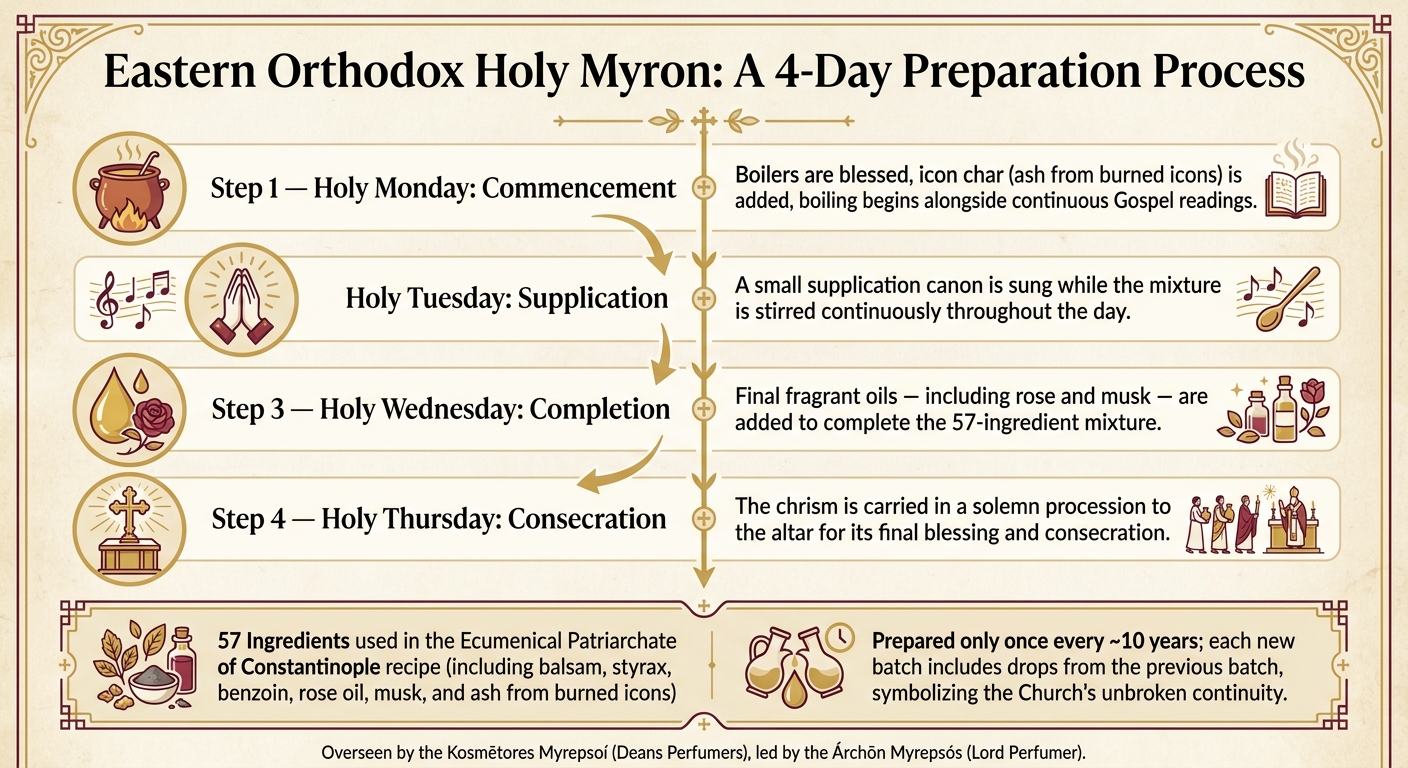
How Eastern Orthodox Holy Myron Is Prepared: A 4-Day Holy Week Process
Preparation in Western Churches
In Roman Catholic tradition, holy chrism is made by combining pure olive oil with balsam, a fragrant resin historically sourced from regions like Judea or Arabia. Patrick Morrisroe, in The Catholic Encyclopedia, explains:
"Two elements enter into the constitution of legitimate chrism, viz. olive-oil and balsam. The former is indeed the preponderating, as well as the principal, ingredient, but the latter must be added in greater or lesser quantity."
The consecration process follows a structured ritual. The oil and balsam are brought to the sanctuary in a ceremonial procession. The bishop then mixes the two, breathes over the vessel, and recites a consecration prayer. For the most solemn version of this rite, the bishop is ideally joined by 12 priests, seven deacons, and seven subdeacons.
Anglican and Lutheran traditions have similar practices but allow for more variation. They may include additional fragrant spices or essential oils to symbolize, as described in Common Worship of the Church of England, "the richness of the Holy Spirit".
Preparation in Eastern Orthodox Churches
The Eastern Orthodox method is far more intricate, spanning four days during Holy Week. The process begins on Holy Monday and concludes on Holy Thursday, producing a mixture called Holy Myron. This blend starts with olive oil and white wine and is enriched with numerous aromatic ingredients. For instance, the Ecumenical Patriarchate of Constantinople uses a detailed recipe with 57 ingredients, including balsam, styrax, benzoin, galangal, rose oil, and musk.
| Phase | Day | What Happens |
|---|---|---|
| Commencement | Holy Monday | Boilers are blessed, icon char is added, and boiling begins alongside Gospel readings. |
| Supplication | Holy Tuesday | A small supplication canon is sung while the mixture is stirred throughout the day. |
| Completion | Holy Wednesday | Final fragrant oils, such as rose and musk, are added to complete the mixture. |
| Consecration | Holy Thursday | The chrism is carried in a solemn procession to the altar for its final blessing. |
A unique feature of this process is the inclusion of a few drops of previously consecrated chrism in each new batch, symbolizing the continuity of the Church. Archpriest John A. Jillions highlights this tradition:
"Every batch of new Chrism has drops from earlier chrism... every anointing with Chrism is powerful testimony to unity in the Church."
The preparation is overseen by a specialized group called the Kosmētores Myrepsoí ("Deans Perfumers"), led by the Árchōn Myrepsós ("Lord Perfumer"). Since laity are generally not allowed to handle the chrism, these perfumers undergo a temporary ordination for their service during the four-day process. Due to the complexity and scale, the Patriarchate of Constantinople typically undertakes this ritual only once every 10 years.
This detailed preparation highlights the sacred significance of olive oil, which will be discussed in the next section.
The Role of Olive Oil in Holy Chrism
The preparation of holy chrism is a deeply meaningful process, where the quality of its ingredients plays a vital role in fulfilling its sacred purpose.
Why Olive Oil Is Used
Olive oil is an essential component of holy chrism, and its use carries deep theological significance. According to Catholic teaching, chrism must be made from pure olive oil to be valid for the Sacrament of Confirmation. Patrick Morrisroe, writing in The Catholic Encyclopedia, explains:
"That chrism may serve as valid matter for the Sacrament of Confirmation it must consist of pure oil of olives..."
Olive oil's natural richness and durability make it a powerful symbol of the overflowing grace imparted through sacraments. Morrisroe elaborates that it is "fitted to represent the copious outpouring of sacramental grace". Additionally, its symbolic strength is tied to its ability to "provide suppleness to the limbs", representing the spiritual resilience needed to resist sin. These attributes highlight the enduring significance of olive oil in liturgical traditions.
How to Source Pure, High-Quality Olive Oil
For sacred purposes, the oil must come exclusively from olives to meet canonical requirements. Beyond purity, high-quality olive oil is valued for its natural fragrance and stability - important attributes when combined with balsam. Balsam not only enhances the aroma but also acts as a preservative, symbolizing the soul's protection against corruption.
A notable example of this dedication to quality occurred in March 2018. Jim and Andrea Mayer from Frate Sole Olive Oil Company in Yolo County, California, provided 20 gallons of Tuscan-style extra virgin olive oil to the Diocese of Sacramento for its Chrism Mass. This oil, pressed from Frantoio, Leccino, Pendalino, and Coratina olives, was hand-picked and milled within 24 hours to ensure freshness. It was then distributed across 102 parishes for use in baptisms, confirmations, and holy orders. Key practices for sourcing include gentle hand-picking to avoid bruising, rapid milling to preserve the oil's quality, and rigorous testing to confirm purity.
Companies like Big Horn Olive Oil reflect these same high standards, ensuring their products meet the needs of sacred rituals.
Big Horn Olive Oil's Commitment to Quality

Big Horn Olive Oil exemplifies the level of care required for sacred olive oil. Their Ultra Premium Extra Virgin Olive Oils are cold-pressed within just 2 hours of harvest - far surpassing the usual 24-hour standard - and are delivered within 3 months to maintain peak freshness and purity. Their single-source Coratina Extra Virgin Olive Oil highlights the traceability and excellence essential for ecclesiastical use.
For parishes outside a diocesan supply chain - or anyone seeking a trustworthy, premium-grade olive oil - Big Horn Olive Oil offers a dependable option that aligns with traditional liturgical standards.
Conclusion: The Care Behind Holy Chrism
Holy chrism carries centuries of sacred tradition, carefully prepared to reflect its deep spiritual significance. Rooted in the biblical passage of Exodus 30:22–33, it plays a key role in sacraments like Baptism, Confirmation, and Holy Orders, serving as a bridge between believers and the Church’s enduring heritage.
Patrick Morrisroe eloquently described how olive oil’s natural richness symbolizes the outpouring of sacramental grace, while balsam adds a sweetness and protective quality that reflects Christian virtue. This blend of tradition, symbolism, and detailed craftsmanship highlights the sacred role of holy chrism.
The quality of olive oil is central to its preparation. For those seeking exceptional liturgical ingredients, Big Horn Olive Oil offers Ultra Premium Extra Virgin Olive Oils, cold-pressed within two hours of harvest to ensure unmatched purity and freshness - perfect for such sacred purposes.
From the bishop’s blessing to the precise blending of ingredients, every step in making holy chrism underscores its spiritual meaning. It stands as a tangible connection to divine grace, uniting the Church’s historical traditions with present-day rituals in a profound and meaningful way.
FAQs
Who is allowed to consecrate holy chrism?
The consecration of holy chrism is a special responsibility reserved for a bishop, typically carried out during the Chrism Mass. This important liturgical ceremony involves the bishop blessing and consecrating the oil, which is later used in sacraments and other sacred rites.
Can churches use oils other than olive oil for chrism?
Churches have the flexibility to use oils other than olive oil in the preparation of chrism. Traditionally, chrism is created by blending olive oil with aromatic substances like balsam. However, the essential factor is that the oil must be consecrated. Its specific composition can vary, influenced by different traditions and liturgical practices.
How should holy chrism be stored and how long does it last?
Holy chrism should be kept in a cool, dark location, away from direct light and high temperatures. With the right storage conditions, it can maintain its usability for several years. This careful handling ensures its quality and preserves its spiritual importance.