

How Producers Ensure Fair Wages for Olive Farmers
When you buy olive oil, you're impacting the lives of farmers who often struggle to earn enough to meet basic needs like food and housing. Many olive farmers face low incomes, rising production costs, and limited market access. For example:
- Income struggles: In Italy, Spain, and Greece, nearly 50% of olive farms earn less than $10,800 annually.
- Production costs: Producing high-quality olive oil can cost over $7.80 per liter, while wholesale prices often fall below this.
- Market challenges: Farmers rely on intermediaries, losing profits to bottlers and distributors.
Solutions like fair trade certifications, cooperatives, and direct sales help farmers earn stable incomes. These approaches ensure minimum prices, promote pay equity, and allow farmers to keep more of their earnings. Companies like Big Horn Olive Oil are setting an example by partnering directly with farmers to support ethical practices and fair pricing. By choosing ethically sourced olive oil, you're helping create a more equitable industry.
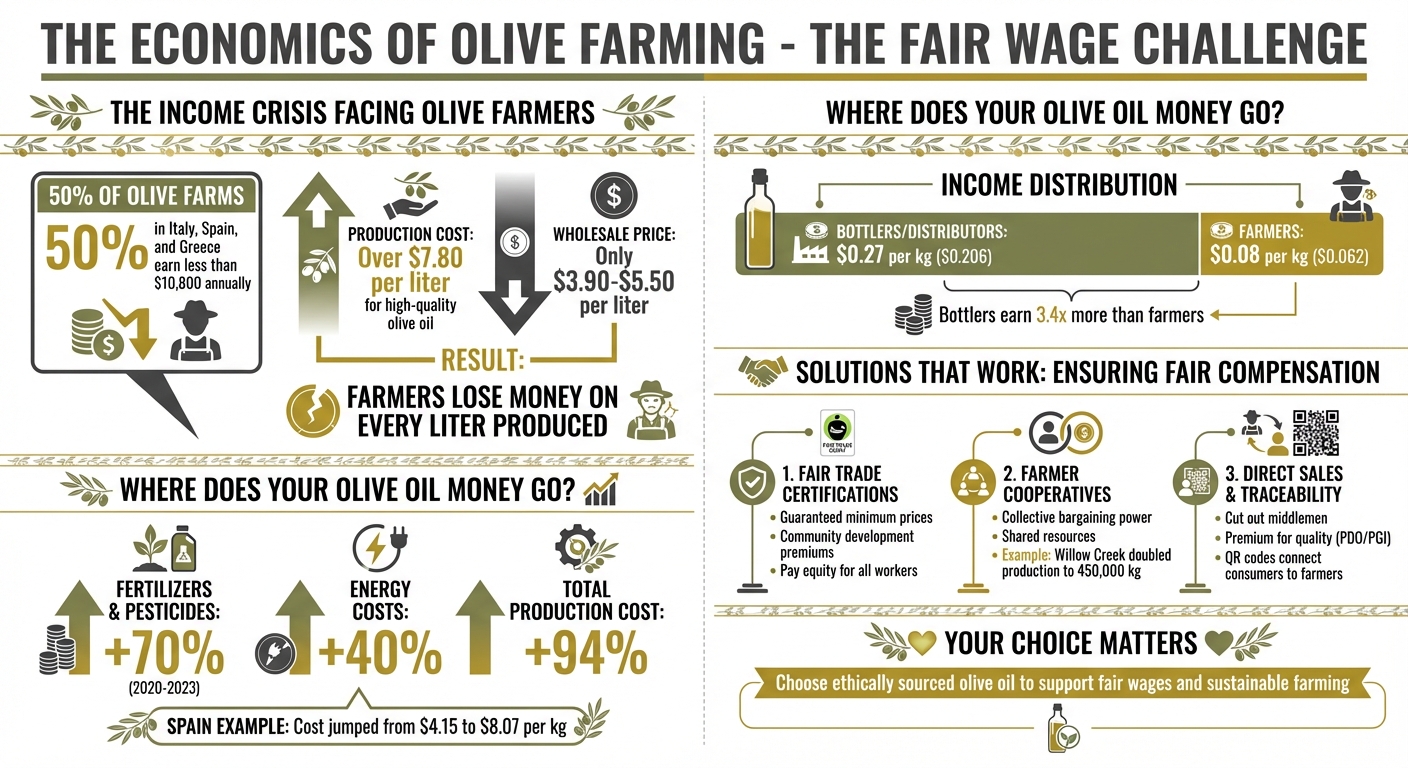
The Economics of Olive Farming: Cost vs. Price Gap and Fair Wage Solutions
Problems That Prevent Fair Wages for Olive Farmers
Market Pressures and Low Prices
The financial strain on olive farmers often starts with wholesale prices that fall below production costs. Producing high-quality extra virgin olive oil in Europe costs more than $7.80 per liter (€6), but wholesale prices have historically hovered between $3.90 and $5.50 per liter. This disparity leaves farmers with two tough choices: absorb financial losses or sacrifice quality to cut costs.
Adding to the problem, dominant bottlers in Italy and major groups in Spain wield disproportionate influence, leaving farmers with minimal bargaining power. For example, a report by the Spanish Ministry of Agriculture revealed that during the 2020/21 crop year, farmers earned just $0.08 per kilogram ($0.062 per kg), while bottlers took home approximately $0.27 per kilogram ($0.206 per kg).
Supermarkets also play a role by using olive oil as a loss leader - offering it at steep discounts to draw customers. This practice squeezes margins even further. Pierluigi Tosato, Managing Director of Deoleo, put it bluntly:
"Olive oil is a broken business model. We need to change it... Farmers have no incentive to produce a high quality olive oil, or the other way around, they are incentivized to downgrade the quality".
Limited consumer access compounds the issue, forcing farmers into pricing structures that often work against them.
Limited Direct Market Access
Most olive farmers rely on intermediaries - mills, bottlers, and distributors - to bring their products to market. This dependency means the lion’s share of profits often goes to these middlemen. In Italy, for instance, large food retailers account for 84% of total food sales, giving them immense control over pricing and market access. Farmers are left with little choice but to accept the terms dictated by these powerful players.
Procurement practices make things worse. Online auctions, which often appear as competitive tenders, typically prioritize the lowest prices over quality. Gennaro Sicolo, President of the Italian Farmers Association CIA, explained:
"These practices do not allow a focus on product quality or the participation of small and medium-sized companies, which are the backbone of national agricultural production".
While food prices climbed nearly 25% between 2021 and 2025, farmers’ margins remained razor-thin. By early 2026, the Italian Competition Authority launched an investigation into supermarket pricing strategies, examining how they affect income distribution across the olive oil supply chain.
High Production Costs and Limited Resources
Rising input costs pile further pressure on farmers. In Spain, the cost of producing one kilogram of olive oil nearly doubled between 2020 and 2023, jumping from $4.15 to $8.07 (€3.20 to €6.22). Fertilizers and pesticides saw price hikes exceeding 70%, while energy costs increased by roughly 40% during the same period.
| Cost Component | Percentage Increase (2020-2023) |
|---|---|
| Fertilizers & Pesticides | >70% |
| Energy | ~40% |
| Total Production Cost | 94% |
The type of olive grove also heavily influences production costs. Super-intensive groves can produce oil for as little as $1.87 per kilogram, while traditional groves may cost up to $5.62 per kilogram. In mountainous areas, costs can soar past $13 per kilogram.
In Turkey, the situation became particularly dire by early 2025. Saim Demirbaş, President of the Foça Agricultural Chamber, warned:
"If olive oil prices do not exceed 180 lira, producers can't cover their basic expenses".
Yet, mill purchase prices had plummeted to just 130–150 lira ($4.42–$5.13 or €3.40–€3.95) per kilogram, a sharp drop from 295 lira ($12.07 or €9) the year before. Turkish farmer Halit Uşak summed up the frustration:
"The olives collected do not even cover the cost of the worker [wages]".
These challenges highlight the urgent need for better compensation practices to ensure farmers can earn fair wages for their labor.
sbb-itb-4066b8e
How Producers Ensure Fair Compensation for Olive Farmers
Fair Trade Certifications and Guaranteed Minimum Prices
Fair trade certification plays a key role in stabilizing farmers' incomes by setting a minimum price that protects them from unpredictable market swings. This baseline ensures that farmers can cover their production costs, even when global prices drop below sustainable levels.
On top of the base price, fair trade programs include a mandatory premium - extra funds directed into a Community Development Fund. Farmers collectively decide how to use this money, often choosing projects like building schools, improving healthcare, or investing in tools for alternative income sources. As Andrés Bermeo Calderon, a cooperative member, shared:
"Before our sales were really bad and we had no control over the price. Sometimes we received only enough for the day, to buy food and nothing else, now we have a better economy and we are able to ask for loans".
Fair trade standards also promote pay equity, ensuring that women and migrant workers receive the same wages as others for the same work - addressing long-standing disparities.
In addition to fair trade, farmer cooperatives offer another effective way to secure fair compensation.
Farmer Cooperatives and Collective Bargaining
Farmer cooperatives have become a lifeline for small-scale growers, helping them overcome market pressures and access challenges. By teaming up, farmers can share resources like processing equipment, bottling facilities, and marketing services. This reduces individual costs and opens doors to higher-value markets.
A great example is Willow Creek Olive Estate in South Africa. In November 2025, the estate expanded its "Guild of Groves" cooperative to include 35 local olive farmers. CEO Eleanor Stoker explained their approach:
"Farmers focus on growing olives, while we take care of processing, bottling, and marketing. They bring their fruit, we grade it carefully, process it, store the olive oil, and distribute it throughout the year".
This cooperative model not only doubled production - from 250,000 kilograms (about 551,000 pounds) to 450,000 kilograms (around 992,000 pounds) in 2025 - but also provided farmers with stable earnings despite variations in individual harvests. It even helped secure shelf space in major retail stores.
Cooperatives often reward quality as well. In 2017, Sicily's La Goccia d'Oro cooperative, with 1,000 members, paid farmers higher rates for olives that produced oil with an acidity level below 0.2%. Thanks to technical field support, the average acidity that season dropped to 0.17%, maximizing payouts for members. As General Manager Accursio Alagna explained:
"Our operating system consists in assisting our members with technical support, information and training on the field... so that olive trees are constantly monitored".
But fair compensation doesn't stop there. Direct market access can further boost farmers' earnings.
Direct Sales and Value-Added Products
Cutting out middlemen allows farmers to keep a larger share of the final retail price. Selling directly to consumers or creating value-added products - like PDO, PGI, or organic-certified oils - can significantly increase profits per liter compared to bulk sales.
Take Agraria Riva del Garda in Italy, for instance. This cooperative uses a meticulous three-step quality control process (visual, chemical, and sensory evaluations) to determine how much farmers are paid. In 2017, they rewarded the highest-quality olives with premium payments, which were then used to create their exclusive "Uliva 1111" PDO Garda Trentino oil. As Business Development Manager Massimiliano Consolo stated:
"Our evaluation is therefore based solely and exclusively on quality".
Some cooperatives are even leveraging technology to enhance transparency. Tools like QR codes and batch tracking connect consumers directly with the farmers, building trust and justifying higher prices.
Transparency and Accountability in the Supply Chain
Traceability from Grove to Bottle
Being able to track olive oil from grove to bottle is a game-changer. It not only clarifies where the product comes from but also ensures fair compensation for farmers, cutting down on pricing confusion. Traceability systems keep a detailed record of every step - harvest, processing, and payment - giving farmers a stronger position to negotiate better prices.
Tools like QR codes and batch tracking systems let consumers verify they’re buying ethically produced olive oil. When people can trace their bottle back to a specific farm, many are willing to pay more. This willingness to spend extra often results in better earnings for the growers.
This level of traceability doesn’t just benefit individuals; it’s also tied to broader policy initiatives aimed at ensuring accountability across the entire supply chain.
Supporting Policy Changes for Fair Wages
Transparent supply chains are a start, but policy reforms are just as essential to closing the income gap for farmers. Research shows that many EU olive farms operate on earnings far below sustainable levels. Traceability data provides evidence to push for fairer subsidy systems and wage guarantees, complementing the efforts already made by producers.
Farmers are pushing for policies that go beyond subsidies based on farm size, which often favor larger operations. They’re advocating for programs like income stabilization, startup funding for young farmers, and grants for innovation. These measures are critical to addressing rural poverty and preventing the migration of workers away from farming communities. Without fair trade–style systems tailored to European growers, many farms - where family labor accounts for 83% to 99% of operations - could face financial losses, even with subsidies in place.
Big Horn Olive Oil's Commitment to Ethical Sourcing
Partnering with Trusted Growers
Big Horn Olive Oil works closely with growers who prioritize quality and uphold ethical farming practices. Their Ultra Premium EVOO is cold-pressed within just two hours of harvest, locking in freshness and nutritional benefits. This process is supported by significant investments in infrastructure and a commitment to providing fair compensation to farmers.
Recognizing the financial challenges faced by small-scale farms, Big Horn Olive Oil partners exclusively with those who meet premium standards. This partnership supports sustainable farming methods, enabling growers to invest in their operations and offer fair wages to their workers. These direct relationships form the backbone of a supply chain that prioritizes both ethical practices and exceptional product quality.
Delivering Fresh, Premium Products
Big Horn Olive Oil takes its commitment to freshness seriously, ensuring that its olive oil reaches consumers within three months of harvest. This approach preserves peak flavor and antioxidants while continuing to support fair wages for growers.
The pricing of their products reflects the true cost of ethical production. For example, the Estate Reserve Ultra Premium EVOO and single-source options like Picual and Coratina Extra Virgin Olive Oil are priced at $8.99. Considering that the production costs for authentic Italian extra virgin olive oil can exceed $6.40 per liter with conventional methods - and rise significantly for sustainable farming on difficult terrain - fair pricing becomes essential to maintaining quality and supporting ethical farms.
REAL QUALITY OLIVE OIL in a SEA Of FAKES- INTERVIEW With OWNER of CANAAN PALESTINE
Conclusion: Fair Wages Build a Better Olive Oil Industry
Fair wages for olive farmers aren't just about doing the right thing - they’re critical for keeping quality olive oil production alive. Consider this: many farms make less than €10,000 (about $10,600) annually, while production costs climb past €6 ($6.40) per liter. Meanwhile, wholesale prices hover between €3 and €4.21 ($3.20 and $4.50). This math simply doesn’t add up, and without better compensation, farmers can’t sustain the high standards required for premium olive oil.
The good news? There are solutions. Fair trade certifications and direct sales models show that transparency and commitment can drive change. Farmer cooperatives provide a stronger collective voice, while traceability systems ensure companies stick to ethical sourcing. These tools create a roadmap for companies ready to put fairness at the center of their operations.
Take Big Horn Olive Oil as an example. They’ve built a system that prioritizes ethical sourcing by working with growers who meet top-tier standards. Their olive oil reaches consumers within three months of harvest, ensuring both freshness and fair practices. Their pricing reflects the real cost of producing high-quality olive oil - because let’s face it, extra virgin olive oil can’t be made at bargain-bin prices. When consumers choose these products, they’re actively supporting a fairer, more sustainable industry.
FAQs
How can I tell if an olive oil brand pays farmers fairly?
To check if an olive oil brand compensates farmers fairly, pay attention to whether they support fair trade practices, hold sustainability certifications, and ensure producer accountability. Take Big Horn Olive Oil, for instance - they emphasize fair pay and transparent sourcing, showcasing their dedication to these principles.
Do fair wages make olive oil cost more?
Yes, paying fair wages to olive farmers can lead to higher olive oil prices. When farmers are compensated fairly, production costs naturally increase, particularly in areas where sustainable and organic farming practices are prioritized. These efforts not only support ethical treatment of workers but also help maintain quality and fairness across the entire supply chain.
What does traceability (grove to bottle) actually mean?
Traceability, often described as "grove to bottle", involves monitoring olives every step of the way - from their growth in the grove to harvesting, processing, and final packaging. This process ensures transparency and accountability throughout the supply chain, helping to maintain high standards of quality and ethical practices.