

How Salonenque Shapes Provence Olive Oil
Salonenque olives are a cornerstone of Provence's olive oil production, especially in the Vallée des Baux, where they make up over 60% of olive trees. Known for their sweet, buttery flavor with hints of green almond and artichoke, Salonenque oils are prized for their mild taste and versatility. They shine alone or as part of blends with other Provençal varieties like Aglandau and Grossane.
Key Takeaways:
- Origins: Named after Salon-de-Provence, this olive thrives in sandy, clay-rich soils and a Mediterranean climate.
- Dual Use: Harvested early for table olives (olives cassées) and later for oil.
- Flavor: Sweet, delicate, with subtle bitterness and herbaceous notes.
- Blends: Balances stronger flavors in PDO oils like AOP Vallée des Baux.
- Storage Tips: Keep in a cool, dark place; use within 1–2 months after opening for peak quality.
Salonenque olive oil is perfect for light dishes, from seafood to desserts, and brings a touch of Provence to any meal.
The Salonenque Olive: Origins, Terroir, and Traits
Salonenque in Provence: Name and Growing Regions
The Salonenque olive takes its name from Salon-de-Provence, a region where it has been cultivated for generations. This variety is a cornerstone of Provence's olive oil heritage, thriving particularly in the Vallée des Baux and the Pays d'Aix. In the Vallée des Baux, it plays a central role in local production and contributes significantly to the AOC Vallée des Baux and AOC Huile d'olive de Provence designations. While locals may refer to it by different names, "Salonenque" remains the most commonly recognized term for this versatile olive variety.
One of the defining features of Salonenque is its dual-purpose nature. Farmers harvest the olives early to prepare them as cracked table olives (known locally as olives cassées). A later harvest is then dedicated to oil production. This two-phase harvesting approach highlights the olive's adaptability and its importance in producing high-quality Provençal olive oil.
Physical Traits of Salonenque Olives
Salonenque olives stand out for their medium-to-large size and their distinct ovoid shape, often likened to a "bumpy pear" due to its slightly uneven surface. When harvested early, the fruit is a vibrant green, gradually transitioning to mauve or purple as it ripens. The stone is freestone, meaning it separates easily from the flesh, and features a wrinkled surface with a pointed base. The olive's firm, meaty texture makes it an excellent choice for table olives, which are traditionally cured with fennel after being cracked. These physical characteristics not only make the Salonenque olive visually distinctive but also enhance its ability to reflect the unique qualities of Provence's terroir.
How Terroir Shapes Salonenque Oils
The sandy, clay-rich, and well-drained soils of Provence, combined with its Mediterranean climate, play a key role in shaping the flavor of Salonenque olive oil. According to France's Ministry of Agriculture and Food Sovereignty:
"The taste, appearance and texture of this product are essentially due to the varieties of olives used and the local know-how for its preparation. In addition, in the appellation area, the soils are sandy and clayey, well drained, which brings this specific taste to the olives."
Salonenque olive trees are known for their resilience, particularly their ability to endure cold temperatures as low as 5°F (-15°C). However, they are highly sensitive to the Mistral, the strong wind that frequently sweeps through Provence. To counter this, growers often plant the trees on hillsides or use windbreaks to protect them. This interplay between the region's natural conditions and local farming practices gives Salonenque oils their distinct flavor, which will be explored further in the following section.
sbb-itb-4066b8e
Flavor Profile and Role of Salonenque in Provence Olive Oils
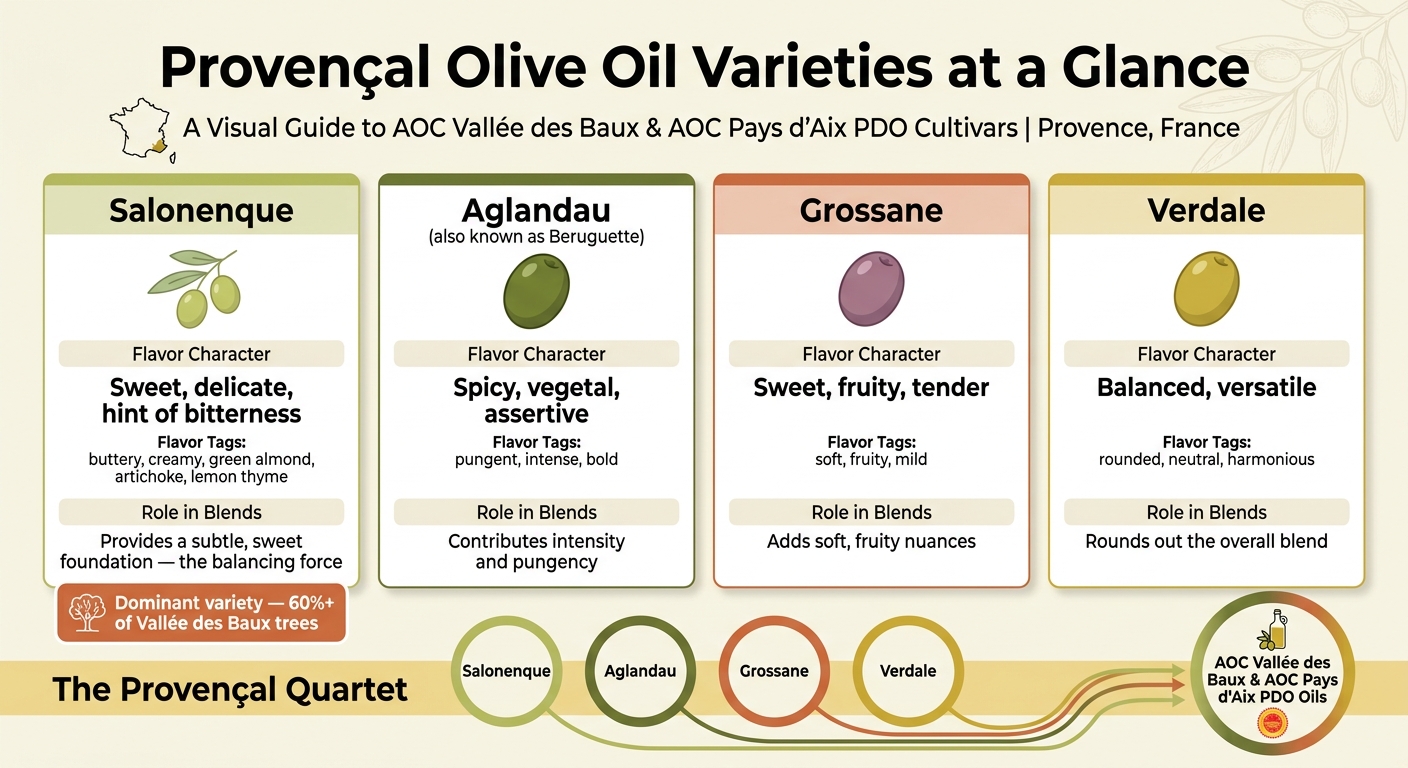
Salonenque vs. Provençal Olive Varieties: Flavor & Role Guide
Core Flavor Notes of Salonenque Oils
Salonenque olive oil offers a flavor that's both sweet and delicate, making it stand out among other Provençal oils. Michel Courboulex, author of Les oliviers, describes it as:
"The taste of the oil is sweet and delicate, and quite strong."
Its buttery, creamy texture pairs with subtle aromas, making it a versatile addition to various dishes. This combination of smoothness and mild flavor plays a key role in defining the signature taste of Provençal olive oils.
How Salonenque Fits Into PDO Blends
While Salonenque shines on its own, it also plays a critical role in Provence's most iconic olive oil blends. It's a key ingredient in the "Provençal Quartet", where it is blended with Grossane, Verdale, and Aglandau (also known as Beruguette). These combinations are the foundation of AOC Vallée des Baux and AOC Pays d'Aix oils.
In these blends, Salonenque acts as the balancing force. Its mild sweetness offsets the bolder, more intense flavors of its counterparts, creating the harmony that defines these Protected Designation of Origin (PDO) oils. This balancing act highlights Salonenque's importance in Provençal olive oil production.
Salonenque vs. Other Provençal Cultivars
When compared to other Provençal olive varieties, Salonenque's distinct qualities become even clearer. Here's how it stacks up:
| Cultivar | Flavor Character | Role in Blends |
|---|---|---|
| Salonenque | Sweet, delicate, with a hint of bitterness | Provides a subtle, sweet foundation |
| Aglandau | Spicy, vegetal, more assertive | Contributes intensity and pungency |
| Grossane | Sweet, fruity, tender | Adds soft, fruity nuances |
| Verdale | Balanced, versatile | Rounds out the overall blend |
Salonenque's gentle sweetness complements the spiciness of Aglandau and the fruity notes of Grossane. According to Moulin Saint Michel, it "is distinguished by its slight bitterness and its subtle taste", offering just enough complexity to enhance the blend without overpowering it.
How to Select and Use Salonenque-Based Olive Oils
How to Identify Salonenque Oils on Labels
When searching for Salonenque olive oils, start by carefully reading the labels. Look for regional names and PDO seals, as these are key indicators of authenticity. The variety may be listed under regional terms, so recognizing these can help confirm you're choosing the right product. Labels often reflect the unique terroir of Salonenque through subtle descriptors.
To ensure authenticity, check for PDO seals like AOP Vallée des Baux de Provence or AOP Pays d'Aix. In the Vallée des Baux region, Salonenque makes up over 60% of the olive trees, making these designations a reliable sign of a predominantly Salonenque oil. For top-quality oils, look for "Extra Virgin", a harvest date, and a low acidity level - premium Salonenque oils can have acidity as low as 0.13%. Award seals from competitions such as the NYIOOC World Olive Oil Competition or the London International Olive Oil Competition also indicate high quality. For example, Estoublon's Salonenque monovarietal won Gold awards at both competitions in 2024 and again at the NYIOOC in 2025.
Paying attention to these details ensures you select the best oil for your culinary needs.
Picking the Right Oil for Your Dish
Salonenque olive oil is known for its mild flavor. Look for labels with terms like "sweet", "buttery", or "delicate" to identify a Salonenque-forward product. Its subtle profile makes it a versatile choice for both simple and composed dishes. This oil works beautifully when you want to enhance flavors without overpowering them. It pairs particularly well with light proteins, fresh vegetables, and other delicate ingredients.
Once you've chosen your oil, it’s time to explore how to use it effectively in your cooking.
Cooking and Pairing With Salonenque Oils
Salonenque olive oil’s smooth, buttery texture and nuanced aromas - like green almond, artichoke, and lemon thyme - make it an excellent finishing oil for a variety of dishes. Drizzle it over grilled fish, shellfish, or steamed vegetables to bring out its delicate flavors. Its mild profile also makes it a great base for tapenades or garlic pastes, allowing other ingredients to shine.
For a creative twist, try it with desserts. Drizzle it over fruit salads, strawberries with basil, or even vanilla ice cream to emphasize its creamy qualities. In everyday cooking, Salonenque oil complements Mediterranean classics like ratatouille, risotto, and chicken dishes.
| Dish Category | Specific Pairings | Best Use |
|---|---|---|
| Seafood | Grilled fish, shellfish | Finishing drizzle |
| Vegetables | Steamed potatoes, ratatouille, garden greens | Seasoning or finishing |
| Meat & Poultry | Chicken, veal tartare | Light cooking or raw |
| Desserts | Strawberry salad with basil, vanilla ice cream | Finishing drizzle |
| Savory Bases | Risotto, tapenades, garlic paste | Ingredient base |
Using Salonenque olive oil thoughtfully can elevate both everyday meals and special dishes, highlighting its delicate and versatile nature.
How to Store Salonenque Oils and Keep Them Fresh
Proper Storage for Olive Oil
Salonenque olive oil is delicate, and its quality can deteriorate quickly if not stored correctly. The three biggest threats to its freshness are light, heat, and oxygen.
Light is particularly harmful. According to Olive Oil Lovers:
"In just eight hours of close exposure to strong fluorescent lights, a bottle of olive oil packed in a clear glass bottle will be totally destroyed having lost its color, flavors and aromas."
Even oils in dark bottles aren't immune to light damage over time. If your Salonenque oil comes in a clear bottle, immediately store it in a dark cupboard or a shaded area of your pantry. Avoid keeping it on a sunny countertop or near heat sources like the stove.
Heat is another enemy of olive oil. Temperatures between 68°F and 122°F can speed up chemical breakdown and deplete the oil's antioxidants. Ideally, store your oil in a cool, stable environment between 57°F and 64°F, far from heat-producing appliances or direct sunlight.
Once a bottle is opened, oxygen exposure becomes a concern. Always reseal the cap tightly after use. If you're working with a large container, consider transferring the oil into smaller, dark bottles to limit oxygen exposure.
| Storage Factor | Impact on the Oil | Recommended Practice |
|---|---|---|
| Light | Quickly destroys color, flavor, and aroma | Store in a dark cupboard or pantry |
| Heat | Speeds up oxidation and antioxidant loss | Keep in a cool, stable spot away from heat sources |
| Oxygen | Leads to rancidity after opening | Seal tightly and decant into smaller bottles if needed |
By following these practices, you can maintain the freshness and quality of your Salonenque oil for as long as possible.
Shelf Life and Best-Use Window
Proper storage not only protects the oil’s flavor but also extends its usability. Unopened bottles of high-quality Salonenque extra virgin olive oil can retain their flavor and aroma for 18 to 30 months. To ensure you're getting the freshest oil, check the harvest date on the label. Salonenque olives are typically harvested in early November, so aim to use the oil within two years of that date.
Once opened, the oil’s peak freshness period shortens significantly. For the best flavor, use it within 1–2 months, and try not to exceed 4–6 months. Oils harvested earlier in the season tend to have higher polyphenol levels, which act as natural preservatives and can slightly extend the oil’s freshness.
To check if your oil is still fresh, rely on your nose. Fresh Salonenque oil should smell clean and herbaceous, with hints of fresh-cut grass or green almond. If these aromas are missing and the oil smells flat or waxy, it’s likely past its prime.
Conclusion: Salonenque's Place in Provençal Olive Oil
Salonenque holds a special place in the world of Provençal olive oil. Named after Salon-de-Provence, this variety dominates the Vallée des Baux, where it accounts for more than 60% of the region's olive trees. Its flavor profile - described by Olive Oil Lovers as "fresh, herbaceous, buttery and round" - has been a defining feature of the area's culinary traditions for centuries.
In the U.S., Salonenque’s mild and delicate taste makes it a versatile choice for everyday cooking. Whether you're finishing off grilled fish, tossing a simple salad, or adding a touch of elegance to strawberries with basil, this oil brings a subtle yet flavorful touch to any dish.
When selecting Salonenque olive oil, look for key indicators of quality: the "Extra Virgin" label, a clearly marked harvest date, and the AOP Les Baux de Provence certification. To maintain its freshness, store the oil in a cool, dark place, keep it tightly sealed, and aim to use it within a few months of opening. With proper care, Salonenque olive oil enhances every meal, a sentiment reflected in the Ultra Premium offerings from Big Horn Olive Oil.
FAQs
Is Salonenque olive oil usually a blend or a single-variety oil?
Salonenque olive oil is crafted exclusively from Salonenque olives, focusing on a single variety. This approach brings out the distinct taste and characteristics of these olives, which are integral to the identity and flavor profile of Provence olive oil.
How can I tell if a Salonenque-forward Provence oil is fresh in the U.S.?
To determine if a Salonenque-forward Provence olive oil is fresh, start by checking the harvest date on the label. Extra virgin olive oil is at its best within 24 months of harvest. Also, make sure the bottle is opaque or dark, as this shields the oil from light, which can accelerate oxidation and diminish its quality.
Can I cook with Salonenque olive oil, or is it best only for finishing?
Salonenque olive oil is incredibly versatile in the kitchen. While it's great for cooking applications like marinades and pastries, its true charm lies in its delicate, subtle flavor. This makes it perfect for finishing dishes or adding a refined touch to sophisticated recipes. Its unique taste truly stands out when used as a final drizzle.