

How Subsidies Preserve Mediterranean Olive Farming
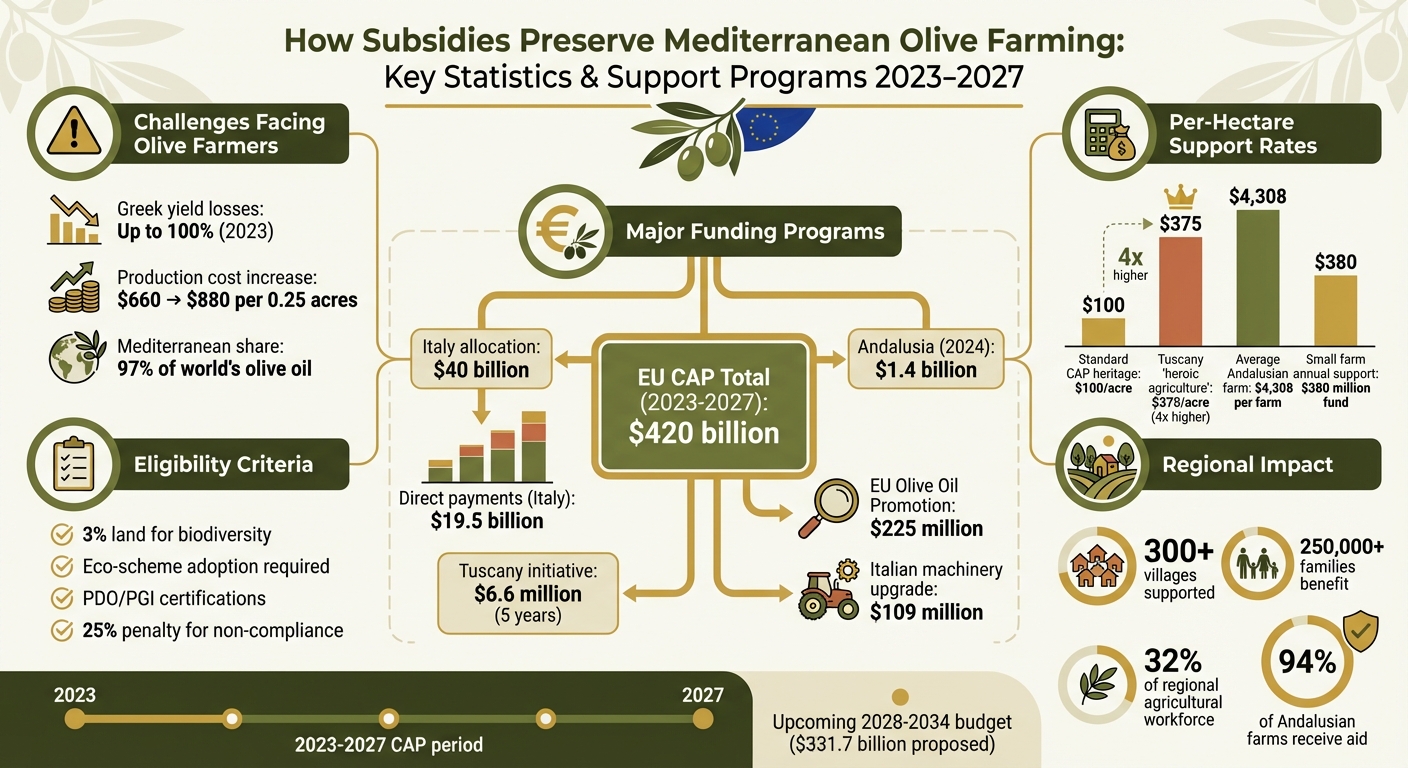
Mediterranean olive farming is under immense pressure from rising costs, extreme weather, and invasive pests. In 2023, Greek farmers faced yield losses as high as 100%, while production costs surged from $660 to $880 per 0.25 acres. Despite producing 97% of the world’s olive oil, small-scale farmers are being squeezed out by industrial competitors and cheaper imports.
Subsidies are a lifeline. The EU allocated $420 billion from 2023–2027 under the Common Agricultural Policy (CAP), with regions like Andalusia receiving $1.4 billion in 2024 alone. These funds help farmers cover costs, meet strict eco-standards, and preserve heritage groves. Programs like Tuscany’s $6.6 million initiative support farming in challenging terrains, while EU campaigns promote olive oil globally, boosting demand and competitiveness.
Farmers must meet environmental and quality benchmarks for funding, such as dedicating 3% of land to biodiversity and maintaining PDO/PGI certifications. Subsidies also stabilize rural economies, with olive farming supporting hundreds of villages and families across the Mediterranean. New reforms and tools, like the IOC’s carbon balance calculator launching in April 2026, aim to address climate challenges and modernize the sector.
Subsidies are not just financial aid - they safeguard olive farming’s role in local economies, landscapes, and global markets.
Mediterranean Olive Farming Subsidies: Key Statistics and Financial Support 2023-2027
Major Subsidy Programs for Olive Farmers
The European Union (EU) and regional governments have rolled out a variety of funding programs to support Mediterranean olive farming. These initiatives range from broad EU-wide measures under the Common Agricultural Policy (CAP) to more localized efforts aimed at addressing specific regional challenges.
EU Common Agricultural Policy (CAP)
The Common Agricultural Policy serves as the backbone of financial support for European olive farmers. Between 2023 and 2027, Italy alone is set to receive approximately US$40 billion, with around US$19.5 billion allocated to direct payment schemes. However, to qualify for these payments, farmers must adhere to strict environmental standards, such as dedicating 3% of their land to biodiversity projects.
Additionally, 17% of Italy's CAP funds are earmarked for olive growers working to protect heritage trees and preserve traditional landscapes. This translates to payments of about €220 per hectare (roughly US$100 per acre). For smaller farms - those under 14 hectares (35 acres) - an annual fund of €350 million (US$380 million) provides further financial support.
Francesco Battistoni, Italian Undersecretary of Agriculture, Food and Forestry, emphasized the importance of this funding:
"The new CAP represents a huge opportunity for our farmers because they will finally be able to plan their investments".
Beyond direct payments, the CAP also addresses market instability. For instance, in November 2019, the European Commission introduced a private storage aid scheme to stabilize olive oil prices. This initiative covered 213,500 tonnes of olive oil - 27% of the EU's total stocks - and required storage for a minimum of 180 days. More recently, in October 2022, a subsidy of approximately US$109 million was approved to help Italian olive millers upgrade machinery for improved energy efficiency, covering up to 50% of the associated costs.
While the CAP provides broad support, regional programs tackle issues unique to specific areas.
Tuscany's €6 Million Initiative
Tuscany has launched a €6 million program (about US$6.6 million) aimed at preserving olive groves in challenging terrains. Starting in January 2024, this five-year initiative focuses on "heroic agriculture", which includes groves on steep slopes and terraces - areas with higher production costs and lower yields.
Under this program, farmers can receive payments of up to €840 per hectare (approximately US$375 per acre), nearly four times the standard CAP heritage payment of €220 per hectare [10, 11]. To qualify, participants must follow strict guidelines, such as pruning trees in the first, third, and fifth years and avoiding herbicide use. The initiative specifically targets groves in PDO (Protected Designation of Origin) or PGI (Protected Geographical Indication) areas, aiming to reduce wildfire risks and maintain Tuscany's iconic landscapes. These measures also align with broader goals for biodiversity and organic farming.
This regional program complements EU-wide efforts to boost the olive oil market's competitiveness.
EU's €205 Million Olive Oil Promotion Programs
In addition to production subsidies, the EU has allocated €205 million (around US$225 million) to marketing and educational campaigns designed to increase the global demand for Mediterranean olive oil. These efforts focus heavily on promoting European extra virgin olive oil in key international markets, such as the United States, where annual consumption reaches 365,900 tonnes and the market is valued at approximately US$1.49 billion.
One notable campaign, the "EU Olive Oil" project, launched in September 2024. This three-year initiative, co-financed by the EU and led by the O.P. Associazione Olivicola Cosentina, participated in events like the Plant Based Expo in New York. The campaign featured cooking demonstrations and educational sessions aimed at restaurant professionals and buyers. Pierpaola Occhiuto, President of O.P. Associazione Olivicola Cosentina, highlighted its importance:
"Our presence at the Plant Based Expo in New York offered us the opportunity to educate American consumers about the importance of the quality of raw materials and to promote a healthy and balanced diet... it was an opportunity to tell the indissoluble link between olive growing and the land, a cultural and human heritage that for many European countries represents a value to be handed down from generation to generation".
These campaigns emphasize the health benefits, distinctive flavor, and versatility of olive oil in cooking [15, 16]. By building connections between small-scale producers and global markets, these initiatives not only help traditional growers compete internationally but also promote sustainable farming practices that reduce the use of synthetic chemicals.
sbb-itb-4066b8e
Farmer Requirements for Subsidy Eligibility
Getting subsidies for Mediterranean olive farming isn't automatic. Farmers need to meet a series of environmental, production, and quality benchmarks to qualify. These rules aim to ensure that public funds promote sustainable practices while preserving the agricultural traditions of the region.
Environmental and Farming Standards
The 2023–2027 Common Agricultural Policy (CAP) requires farmers to adopt eco-schemes to receive full funding. These eco-schemes include measures like crop rotation and organic farming. Kostas Bayinetas, Secretary-General for Agricultural Policy in Greece, explained:
In the new year, farmers will have to select an action from the list of eco-schemes, such as crop rotation, the preservation of organic farming or animal husbandry.
Farmers must also dedicate 3% of their arable land to biodiversity efforts to qualify for payments. Failing to implement these eco-schemes results in a 25% cut in subsidies. Greece, for example, has set aside over €3.6 billion (about US$3.95 billion) from its CAP funds for these initiatives.
In Italy, farmers looking for innovation funds face additional requirements. They must install digital sensors, and the €30 million modernization program prioritizes olive groves with higher-density plantings - 389 trees per hectare instead of the traditional 250. This is part of a broader push for efficiency. David Granieri, President of Unaprol, stressed the importance of this initiative:
We need to prepare a lasting strategic plan for the relaunch of Italian olive growing, and the €30 million call for the modernization of the groves is the first step.
Farmers also need to maintain "active farmer" status, which is determined by factors like the percentage of income derived from farming. Yiannis Economou, Assistant Minister of Rural Development and Food in Greece, highlighted this focus:
The new targeting of subsidies in conjunction with the definition of the active farmers provide us with the ability to support those who produce and operate in the value chain without applying illicit practices.
Meeting these environmental standards can also pave the way for additional opportunities, including quality certifications that offer further financial and operational benefits.
PDO and PGI Certifications
PDO (Protected Designation of Origin) and PGI (Protected Geographical Indication) certifications open doors to specialized financial tools. For instance, in Italy, over 9,000 producers with PDO or PGI status can use "revolving pledges." This system allows them to use stored olive oil as collateral, helping avoid the need to sell at reduced prices. David Granieri described the impact of this approach:
The fact that the oil can be given as a pledge to modulate a financial receipt is a novelty for our industry. It means giving value to the product and wealth to the territory.
These certifications, governed by EU Regulation No. 1151/2012, are a key part of the EU's agricultural quality systems. To access many quality-related funds, farmers must join official producer organizations. In Italy, membership in an Organization of Olive Producers (OEF) is essential for qualifying for innovation funds and technical support programs.
Additionally, olive oil must meet strict chemical and sensory standards to gain access to premium marketing support. For example, extra virgin olive oil must have an acidity level below 0.8% and no detectable organoleptic flaws.
Regional Effects of Olive Farming Subsidies
Subsidy programs do more than just provide financial aid - they shape entire regions, influencing both the physical environment and the economic well-being of rural communities across the Mediterranean.
Landscape and Ecosystem Protection
Subsidies play a vital role in preventing the abandonment of olive groves, especially in areas facing challenges like low rainfall and high labor costs. Take Puglia, Italy, for example - where olive groves make up a quarter of all agricultural land. Financial support here is crucial to maintaining the region's iconic landscape. Without this backing, traditional plantations, particularly those on steep slopes with gradients over 20%, would likely be abandoned. Such neglect could lead to the collapse of drystone terraces and severe soil erosion.
The shift in the Common Agricultural Policy (CAP) toward "green payments" marks a move away from production-focused aid. These modern programs reward farmers for contributing to public goods like carbon sequestration and biodiversity conservation. In Spain, environmental criteria ensure that subsidies promote these conservation efforts. Strategic consultant Juan Vilar highlights this shift:
Olive growers who do things conscientiously with the environment will receive much more money than those who are not conscientious about the environment.
Additionally, newer CAP initiatives include subsidies for upgrading machinery, further boosting sustainability efforts. Savino Muraglia, president of Coldiretti Puglia, emphasized the broader impact:
It is an opportunity for the whole production chain, which is worth €1.2 billion [for growers] and €3 billion [for millers and bottlers].
These environmental measures are deeply tied to economic initiatives that strengthen rural communities.
Financial Support for Rural Areas
While subsidies help preserve natural landscapes, they also provide a critical economic lifeline to rural areas. In Mediterranean regions, where olive trees are often one of the few viable crops in rainfed areas, subsidies stabilize local economies. For instance, in Andalusia, Spain, olive farming is the main source of income for over 300 villages and supports more than 250,000 families. The sector employs 32% of the regional agricultural workforce, reinforcing its role as a "social crop".
The financial impact of these programs is immense. In 2024, Andalusia alone received approximately €1.3 billion (about $1.43 billion) from the CAP. Nearly 94% of Andalusian olive farms benefited, with each receiving an average of €3,925 (about $4,308). Between 2023 and 2027, Spain is rolling out a national strategic plan that allocates €47.7 billion (roughly $52.4 billion) in CAP funding, with 25% dedicated to rural development. The plan aims to promote fairness by capping payments at €60,000 (around $65,880) per farm, ensuring small and medium-sized growers receive more equitable support.
This dual focus on financial aid and environmental stewardship not only stabilizes rural economies but also safeguards the cultural heritage of Mediterranean olive farming.
What's Next for Olive Farming Subsidies
The future of olive farming subsidies is taking shape, focusing on addressing new challenges while building on existing support systems. For years, subsidies have been the backbone of Mediterranean olive groves, sustaining both the industry and the communities around it. But as the agricultural landscape evolves, so do the policies. A major development came in November 2025, when the European Parliament and Council reached a provisional agreement on "Omnibus III" - a reform package aimed at simplifying the Common Agricultural Policy (CAP) and boosting farmers' competitiveness. These changes are expected to save EU farmers up to $1.76 billion annually in administrative costs. Additionally, the "Vision for Agriculture and Food", published in February 2025, outlines strategies to tackle modern issues like climate change and water scarcity.
International Olive Council (IOC) Initiatives
The International Olive Council (IOC) is stepping up its efforts to shape the future of olive farming with innovative tools and partnerships. In March 2026, the IOC partnered with the Polytechnic University of Madrid through a Memorandum of Understanding to enhance technical training and research in the olive sector. Another milestone is set for April 2026, when the IOC will release its first-ever carbon balance calculation tool for olive groves. This tool will help farmers measure their environmental contributions, potentially unlocking access to green subsidies.
Beyond technical advancements, the IOC is working to preserve and expand olive biodiversity. In February 2026, olive seeds were deposited in the Svalbard Global Seed Vault in Norway, ensuring these varieties are safeguarded for future generations. Additionally, the World Catalogue of Olive Varieties will be updated in March 2026 to include nearly 400 more varieties, offering farmers options for resilient crops in a changing climate. These efforts by the IOC are increasingly influencing subsidy criteria, as their standards guide regional bodies like the EU in determining eligibility for financial support.
Addressing Climate and Water Challenges
Subsidy programs are adapting to help farmers confront immediate climate threats and water scarcity issues. The EU has introduced "crisis payments" to provide quick financial support during extreme weather events, natural disasters, droughts, floods, or outbreaks of animal diseases. Member states now have more flexibility to adjust their CAP Strategic Plans to address such emergencies without requiring lengthy approval processes.
Small-scale farmers, in particular, are seeing some relief. Those with fewer than 10 hectares (about 24.7 acres) are now exempt from certain environmental conditionality requirements and penalties. Furthermore, the annual lump-sum payment for small farms has been increased from $1,373 to $2,746 per farm. Danish Minister for European Affairs Marie Bjerre highlighted the importance of these changes:
Today, we took a big step to keep our promise to make EU agricultural rules simpler. It has been a priority for the Danish presidency to reduce extra work and get rid of unnecessary rules for farmers and member states.
Looking ahead, the CAP's proposed $331.7 billion budget for 2028–2034 reflects a shift toward local fund management and eco-focused payments through "National and Regional Partnership Plans". However, this budget represents a reduction of over 20% from the current level when adjusted for inflation. At least 25% of the direct payments budget is now earmarked for "eco-schemes" that promote environmental practices, such as improving soil health and conserving biodiversity.
Conclusion
Subsidies play a crucial role in supporting Mediterranean olive farming, helping the industry navigate market fluctuations and rising production costs. Without direct payments from the Common Agricultural Policy, many small-scale farmers would face financial ruin. These funds not only keep farms running but also protect historic landscapes and sustain rural communities, ensuring that premium olive oils continue to reach global consumers.
In Italy, the olive production chain significantly contributes to the economy, with billions flowing through growers, millers, and bottlers. Programs aimed at young farmers - who receive 3% of direct payments - are essential for rejuvenating the sector, especially given the stark reality that for every farmer under 40, there are 11 over the age of 65. Subsidies have also enabled producers to embrace advanced processing technologies, further strengthening the sector's economic role.
Environmental considerations are now central to subsidy eligibility. Farmers must dedicate at least 3% of their land to conservation efforts and adopt eco-friendly practices to receive full funding. In Madrid, traditional groves with a density of 60 to 150 trees per hectare (roughly 24 to 61 trees per acre) qualify for subsidies of €100 per hectare for plots up to 40 hectares. This measure helps preserve biodiversity and prevent land abandonment. By prioritizing sustainability, these policies ensure that farming practices remain resilient and that the quality of premium olive oil is upheld.
Subsidies also help PDO and PGI-certified producers maintain the stringent quality standards that set premium oils apart in competitive markets. For consumers seeking ultra-premium extra virgin olive oils - such as those from Big Horn Olive Oil, sourced from top-tier Mediterranean producers - these programs safeguard the traditional craftsmanship and exceptional quality that define this industry. This comprehensive support not only preserves a centuries-old tradition but also ensures that consumers continue to enjoy the unparalleled quality of ultra-premium olive oils.
FAQs
Who qualifies for olive-farming subsidies?
Subsidies for olive farming are typically aimed at small-scale or traditional farmers who align with the criteria outlined by various policy programs. For instance, recent initiatives in the EU prioritize providing assistance to small farmers while also safeguarding traditional olive-growing methods.
Do subsidies make olive oil cheaper for U.S. shoppers?
Subsidies play a role in making olive oil more affordable for U.S. shoppers by cutting production costs and offering financial support to farmers. However, recent tariffs and trade disagreements have pushed prices higher, canceling out much of the intended savings. While subsidies are designed to ease costs for consumers, factors like trade policies can heavily influence the final price tag.
What happens if subsidies are reduced after 2027?
If subsidies decrease after 2027, olive farming in Mediterranean regions could face serious challenges. With less financial support, farmers might struggle to maintain their production levels and preserve long-standing traditions tied to olive cultivation. Current debates around EU budget reductions and policy shifts underscore the uncertainty surrounding the industry's future.