

How to Make Dijon Balsamic Sauce
Dijon balsamic sauce combines balsamic vinegar, Dijon mustard, and olive oil to create a flavorful, creamy dressing or marinade. The secret is balancing the ingredients: equal parts balsamic and olive oil, with Dijon mustard as an emulsifier. Adding honey or maple syrup enhances sweetness, while salt and pepper tie it all together. This versatile sauce works for salads, roasted vegetables, or proteins.
Key Points:
- Ingredients: Balsamic vinegar, Dijon mustard, olive oil, sweetener (honey/maple syrup), salt, and pepper.
- Steps: Blend mustard and vinegar first, then slowly whisk in olive oil for a stable emulsion.
- Storage: Refrigerate in a sealed jar for up to 7 days. Shake before use if separated.
- Variations: Add garlic, herbs, or use pomegranate syrup for unique flavors.
Using high-quality olive oil and balsamic vinegar vs red wine vinegar elevates the taste. For a quick method, mix everything in a jar and shake vigorously. Adjust sweetness and tanginess to suit your preferences.
1 Minute Dijon Balsamic Vinaigrette Salad Dressing
sbb-itb-4066b8e
Key Ingredients and Their Role
This sauce works because every ingredient brings something essential to the table. Changing or removing any of them throws off the balance. Here's a breakdown of what each component does and why it matters.
Core Ingredients and Ratios
The recipe is built around five main ingredients: extra virgin olive oil, balsamic vinegar, Dijon mustard, a sweetener (like honey or maple syrup), and salt and pepper.
| Ingredient | Role in the Sauce | Recommended Amount |
|---|---|---|
| Extra Virgin Olive Oil | Adds richness, smooth texture, and fruity notes | ¼ cup |
| Balsamic Vinegar | Brings tangy sweetness and a layer of acidity | ¼ cup |
| Dijon Mustard | Provides sharp tang and works as a natural emulsifier | 2 teaspoons |
| Honey or Maple Syrup | Balances acidity and rounds out the flavor | 1 tablespoon |
| Kosher Salt & Pepper | Enhances and ties together all the flavors | To taste |
The balance between olive oil and balsamic vinegar is key. Using equal parts ensures harmony, as good-quality balsamic naturally adds sweetness without overwhelming sharpness. You can tweak the Dijon mustard and balsamic vinegar ratio depending on your taste. For a more savory kick, try equal parts mustard and balsamic (1:1). If you prefer a tangier, lighter flavor, go for a 4:1 ratio of balsamic to mustard.
Dijon mustard isn’t just about flavor - it keeps the oil and vinegar from separating, giving the sauce its smooth consistency.
This balance in proportions ensures the flavors work together seamlessly, but ingredient quality takes it to the next level.
Why Ingredient Quality Matters
With just five ingredients, there's no hiding behind fillers or extras - every component directly affects the final taste. This is especially true for balsamic vinegar and olive oil.
Sonja Overhiser highlights this in her advice:
"The quality of your balsamic does make a difference! ... the cheapest condiment-grade versions lack depth."
Budget balsamic, often priced under $5, typically relies on wine vinegar and caramel coloring, which results in a sharp and one-dimensional flavor. A mid-range option, like Balsamic Vinegar of Modena IGP (priced between $8 and $15), offers natural sweetness and complexity, elevating the sauce significantly.
For standout results, consider products like Big Horn Olive Oil’s Estate Reserve Ultra Premium EVOO ($8.99) and Traditional 18-Year Aged Dark Balsamic Vinegar ($8.99). Both are sourced from Modena, Italy. The balsamic is naturally aged without added thickeners or sugars, delivering a sweetness that pairs beautifully with the mustard and oil. Meanwhile, their cold-pressed EVOO, processed within two hours of harvesting, provides a fresh, fruity profile ideal for this simple yet flavorful recipe.
This recipe is naturally gluten-free, dairy-free, and vegetarian. To make it vegan, simply swap out honey for maple syrup.
How to Make Dijon Balsamic Sauce
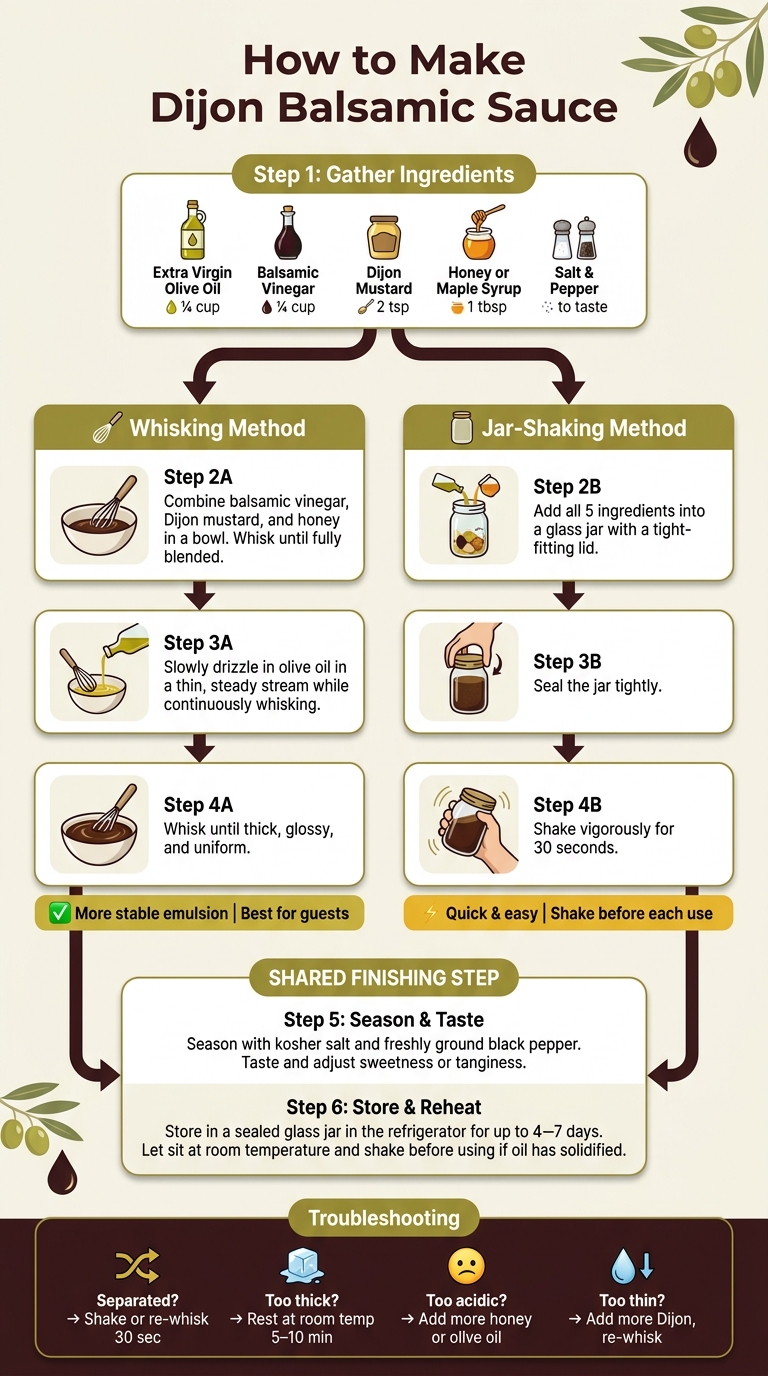
How to Make Dijon Balsamic Sauce: Step-by-Step Guide
Get your ingredients ready and follow these steps. Using high-quality components, as mentioned earlier, makes all the difference in achieving a smooth and flavorful sauce.
Measuring and Mixing the Sauce
Start by measuring out balsamic vinegar, Dijon mustard, and honey, then mix them in a bowl. It's crucial to fully blend the mustard with the vinegar before moving on to the next step.
Next, slowly drizzle in the olive oil while continuously whisking. Pouring the oil gradually - ideally in a thin, steady stream - ensures proper emulsification. If needed, add the oil a tablespoon at a time. Whisk the mixture until it becomes thick, glossy, and uniform. Finally, season with kosher salt and freshly ground black pepper, adjusting the flavors to your liking.
For a quicker option, you can try the jar-shaking method.
The Jar-Shaking Method
Combine all five ingredients in a glass jar with a tight lid. Shake the jar vigorously for about 30 seconds. This method not only mixes the sauce efficiently but also lets you store it in the same container for refrigeration.
Here’s a quick comparison of the two methods:
| Feature | Whisking Method | Jar-Shaking Method |
|---|---|---|
| Speed | Slower; oil added gradually | Quick; all ingredients added at once |
| Cleanup | Requires a bowl and whisk | Only uses the jar |
| Emulsion Control | More precise; gradual oil addition improves stability | Less precise; relies on shaking |
| Emulsion Stability | Longer-lasting and more stable | May separate faster; shake again before use |
If you're short on time, go for the jar method. But if you're serving guests or want a creamier, more stable sauce, the whisking method is your best bet.
Fixing Common Problems
Here are some common issues and how to resolve them:
| Issue | Cause | Solution |
|---|---|---|
| Separation | Natural settling during storage | Shake or re-whisk for 30 seconds |
| Chunky or Thick Texture | Olive oil solidified in the fridge | Let it sit at room temperature for 5–10 minutes before shaking |
| Too Sharp or Acidic | Too much vinegar or poor-quality vinegar | Add more olive oil or an extra tablespoon of honey |
| Thin Consistency | Oil added too quickly or not enough mustard | Add more Dijon mustard and whisk again to re-emulsify |
As Sonja Overhiser, author of A Couple Cooks, explains:
"The Dijon mustard keeps it creamy and prevents separation."
Flavor Variations and Pairing Ideas
Flavor Variations to Try
You can easily tweak the base sauce to explore different flavor profiles.
For a Garlic Herb twist, mix in 1 clove of freshly minced garlic and 1 teaspoon of chopped fresh herbs like thyme, rosemary, or basil. The garlic adds a savory edge that balances the balsamic's sweetness, making it ideal for roasted vegetables or as a dip for crusty bread.
Want something Sweet & Fruity? Substitute honey with pomegranate syrup and increase the sweetener to 2 tablespoons. This variation pairs beautifully with salads featuring strawberries, pears, or apples, as the vinegar's tanginess balances the natural sweetness of the fruit.
If you're after a creamy texture, whisk in 2 tablespoons of mayonnaise. This creates a thicker sauce that clings well to hearty greens like kale or works as a dressing for grain bowls.
Now, let’s explore how to pair these variations with Big Horn Olive Oil's premium products to take your creations to the next level.
Pairing Big Horn Olive Oil Products with Each Variation
Big Horn Olive Oil offers a range of products that complement these variations perfectly. For bold flavors like Garlic Herb and Savory Marinade, robust, high-polyphenol oils such as Picual or Coratina EVOO (priced at $8.99) add depth and a peppery finish, ideal for roasted vegetables, grilled chicken, or baked tofu. For sweeter, fruit-forward variations, opt for a milder oil to keep the balsamic and sweetener in the spotlight.
Big Horn's Traditional 18-Year Aged Dark Balsamic Vinegar ($8.99) is an excellent everyday choice, while their Molto Denissimo 25-Year Aged Dark Balsamic Vinegar ($12.99) delivers a richer, more nuanced flavor that complements the Sweet & Fruity variation beautifully. Drizzle it over aged cheeses or fresh fruit for an indulgent touch.
For the Savory Marinade variation, increasing the ratio of Coratina EVOO in the base recipe makes it perfect for marinating proteins like grilled chicken or baked tofu before cooking.
| Variation | Recommended Big Horn Product | Best Pairings |
|---|---|---|
| Garlic Herb | Picual or Coratina EVOO | Roasted vegetables, crusty bread |
| Sweet & Fruity | Traditional 18-Year Aged Dark Balsamic Vinegar | Strawberry, pear, or apple walnut salads |
| Creamy Dijon | Estate Reserve Ultra Premium EVOO | Grain bowls, hearty kale salads |
| Savory Marinade | Coratina EVOO | Grilled chicken, baked tofu |
| Sweet & Rich | Molto Denissimo 25-Year Aged Dark Balsamic Vinegar | Aged cheeses, fruit segments, dark chocolate bark |
As Lisa Bryan, bestselling cookbook author and creator of Downshiftology, says:
"A homemade balsamic vinaigrette is super easy to make! My version has just the right amount of zingy sweetness and will elevate a wide range of meals from salads to roasted veggies."
Storage, Food Safety, and Make-Ahead Tips
How to Store the Sauce and How Long It Lasts
Once your sauce is prepared, it’s important to refrigerate it within 2 hours. A sealed glass jar, like a mason jar with a screw-top lid, works perfectly. It doubles as both a storage container and a handy shaker to re-emulsify the sauce later on.
When stored properly, the sauce stays fresh for about 4–7 days. If your recipe includes fresh garlic or lemon juice, aim to use it within the shorter end of that range since these ingredients tend to break down more quickly than the oil and vinegar base. For the best flavor, consider making the sauce a day ahead to give the ingredients time to meld.
You might notice olive oil solidify in the fridge - don’t worry, that’s completely normal. Just let the sauce sit at room temperature for a bit and give it a good shake before using. As Lisa Bryan of Downshiftology explains:
"Vinaigrettes will naturally separate, so just give them a shake before using, and they'll be as good as new!"
Avoid freezing the sauce. Freezing disrupts the emulsion, leaving you with a separated, oily mess that won’t come back together no matter how much you shake it.
By following these storage tips, you can easily adjust the recipe size without worrying about waste.
Scaling the Recipe Up or Down
Once you’ve nailed the base recipe, tweaking the quantities to fit your needs is a breeze. The ratio of ingredients scales perfectly - just multiply or divide each component proportionally. For example, a standard starting point might be 3 tablespoons of balsamic vinegar, 1½ teaspoons of Dijon mustard, and ½ cup of olive oil. You can double or triple this for meal prep or cut it in half for smaller portions.
When making larger batches, keep an eye on the intensity of premium ingredients. A high-quality extra virgin olive oil, like Big Horn's Coratina, or an aged balsamic with a robust flavor can pack more punch per tablespoon than standard options. As you scale up, taste the mixture as you go. You might find that slightly reducing the quantity of these concentrated ingredients helps maintain the perfect balance of tangy, sweet, and savory flavors.
Conclusion
Making a Dijon balsamic sauce comes down to a few key elements: quality ingredients, balanced proportions, and a straightforward method. The harmony between oil and vinegar is crucial, while Dijon mustard does double duty by adding flavor and acting as the emulsifier that gives the sauce its creamy texture.
Using premium products like Big Horn Olive Oil's extra-virgin olive oil and their 18-Year Aged Dark Balsamic Vinegar from Modena, Italy, elevates the sauce to another level. These ingredients bring a richness and depth of flavor that make every batch stand out.
This sauce works for just about anything - whether you’re tossing it with salad greens, marinating chicken, or drizzling it over roasted vegetables. Over time, you can fine-tune the recipe to match your preferences. Adjust the sweetness, swap in white balsamic, or mix in fresh herbs to complement your dish. Play around with the ingredients and ratios to craft a sauce that enhances every meal.
FAQs
Can I make it without honey?
Yes, you can make Dijon balsamic sauce without honey. While honey contributes sweetness and aids in emulsifying the sauce, it’s not a must-have ingredient. You can swap it with maple syrup or another sweetener if you prefer, or leave out sweeteners altogether for a sharper, tangier taste. Dijon mustard itself works as a natural emulsifier, so combining high-quality balsamic vinegar, olive oil, and Dijon mustard will still give you a smooth, well-blended sauce.
Why won’t it emulsify?
Your Dijon balsamic sauce might not be coming together because it doesn't have enough emulsifiers to hold the oil and vinegar together. Ingredients like Dijon mustard, egg yolks, or mayonnaise act as stabilizers in such mixtures. To fix it, you can whisk the sauce more vigorously or mix in a small amount of mayonnaise or extra Dijon mustard to achieve that smooth, creamy consistency.
What can I use it on besides salads?
Dijon balsamic sauce works beautifully as a dip for veggies, meats, or bread, bringing a bold, tangy kick to your bites. It also shines in marinades or as a finishing touch - drizzle it over roasted vegetables, grilled chicken, or seafood to elevate their flavor.