

How IFOAM Certification Ensures Organic Integrity
IFOAM certification guarantees that organic products meet strict global standards, ensuring they are produced, processed, and transported without contamination. This certification system builds trust in organic labels by monitoring every step of the supply chain and verifying compliance through independent inspections. Here's what you need to know:
- What is IFOAM? Founded in 1972, IFOAM – Organics International sets global benchmarks for organic farming, ensuring products meet high standards across over 100 countries.
- How It Works: The Organic Guarantee System (OGS) includes IFOAM Norms, accreditation programs, and the Family of Standards, which align organic practices worldwide.
- Certification Process: Producers submit an Organic System Plan, undergo inspections, and maintain detailed records to ensure compliance.
- Supply Chain Oversight: From farm to packaging, products are tracked to prevent contamination and maintain organic integrity.
- Global Benefits: IFOAM certification simplifies international trade by aligning with recognized standards, opening doors to global markets.
IFOAM certification is more than a label - it’s a rigorous system that ensures organic products remain pure, credible, and globally recognized.
The HOW of Organic: Steps to Certification & OSP Tips | FARRMS Webinar
sbb-itb-4066b8e
What is IFOAM and Its Purpose
Founded in 1972, IFOAM – Organics International represents organic agriculture across more than 100 countries. The organization describes its mission as follows: "We empower, mobilize, and lead the global organic movement and its allies to drive transformative food and farming systems changes and policies for the benefit of people and the planet". Rooted in the principles of health, ecology, fairness, and care, IFOAM’s current 10-year strategy (2024–2034) focuses on advancing organic agriculture by refining organic practices. For companies like Big Horn Olive Oil, meeting IFOAM’s benchmarks guarantees that each product - whether extra virgin olive oil or balsamic vinegar - upholds the highest organic standards.
IFOAM's Organic Guarantee System
IFOAM furthers its mission through the Organic Guarantee System (OGS), a global framework designed to maintain organic integrity. At the core of the OGS are the IFOAM Norms, which include three key components:
- Common Objectives and Requirements of Organic Standards (COROS)
- The IFOAM Standard
- IFOAM Accreditation Requirements
In July 2011, COROS received overwhelming approval from IFOAM members, with 93.8% voting in favor.
The IFOAM Accreditation Program, launched in 1992, ensures that certification bodies operate in line with international norms. This process is independently verified by the International Organic Accreditation Service (IOAS). For instance, ACT Organic Company Ltd. in Thailand, an IFOAM-accredited body, certifies organic operations across 12 countries, including Bhutan, Cambodia, and Vietnam, covering areas like crop production, livestock, and aquaculture. Similarly, IBD Certifications Ltd. in Brazil holds accreditation for work in countries such as Canada, China, Ethiopia, and the United States.
The Family of Standards
To complement the Organic Guarantee System, IFOAM developed the Family of Standards, a tool that unifies organic protocols worldwide. This is the only international mechanism that facilitates multilateral equivalence between different organic standards and regulations. It includes all standards officially recognized as organic by the global organic community.
IFOAM highlights its importance: "Approval in the IFOAM Family of Standards is the only international recognition mechanism for standards to demonstrate their true 'organicness'". This system supports international trade by recognizing equivalent standards. For example, a government regulation in Japan could be deemed equivalent to a private standard in Germany, provided both align with COROS requirements. Additionally, standard owners can request IFOAM’s help to align their standards with COROS, and certification bodies seeking global recognition can apply for IFOAM Accreditation.
The IFOAM Certification Process
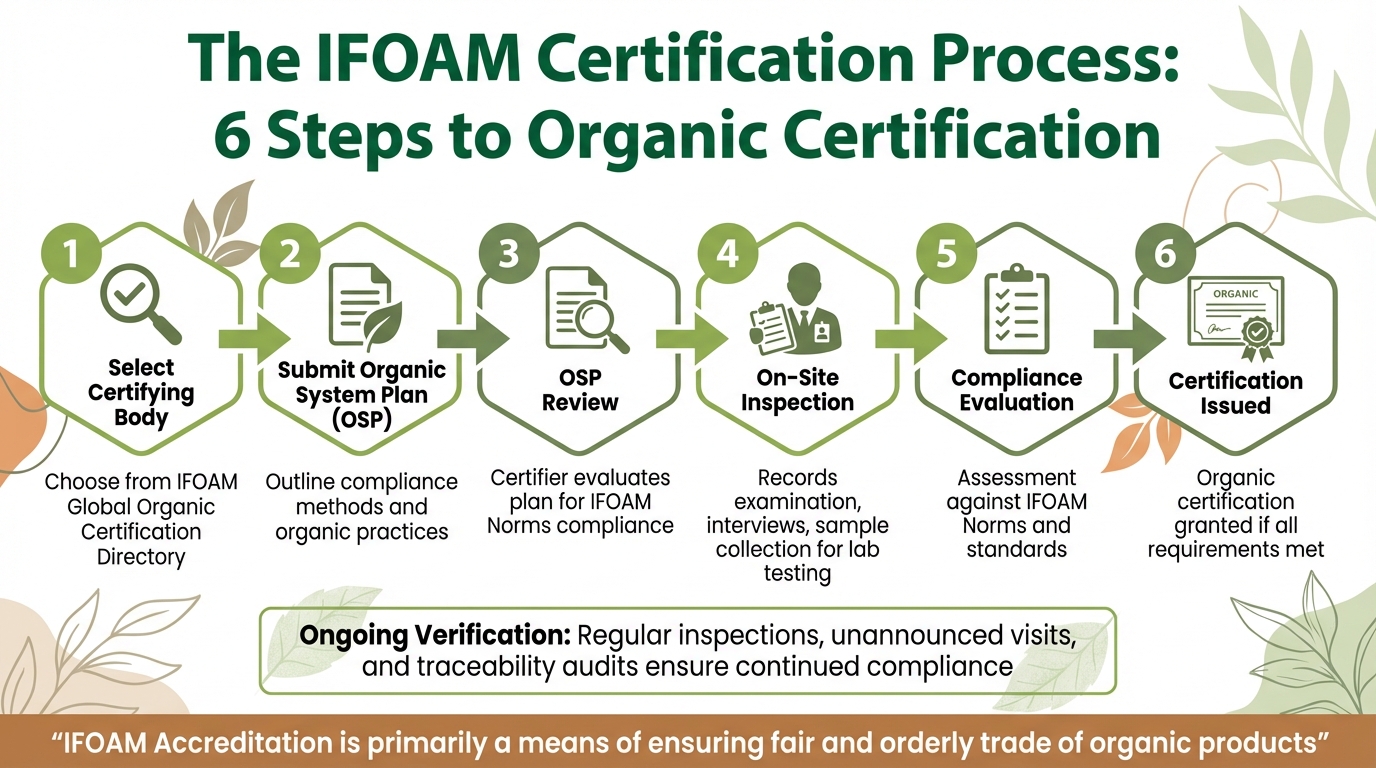
IFOAM Organic Certification Process: 6 Steps from Application to Approval
IFOAM certification ensures that organic products maintain their integrity from cultivation to bottling. Producers like Big Horn Olive Oil follow a strict process to meet these high standards. Here's a breakdown of the steps involved in this certification journey.
6 Steps in the Certification Process
The process starts with operators selecting a certifying body listed in the IFOAM Global Organic Certification Directory. They then submit an Organic System Plan (OSP), which outlines how they will comply with organic standards. The certifier reviews the OSP, conducts an on-site inspection, evaluates compliance with IFOAM Norms, and, if all requirements are met, issues the certification. During inspections, inspectors examine records, conduct interviews, and may even collect samples for lab testing.
IFOAM emphasizes the importance of this process:
"IFOAM Accreditation is primarily a means of ensuring fair and orderly trade of organic products. It is in this sense a service for the trade and producers as well as for certifiers".
Inspection and Verification Methods
Certification is just the beginning. Regular inspections ensure producers continue to meet organic standards. These include unannounced visits and traceability audits to confirm that production, storage, and transportation practices remain compliant.
Traceability audits play a key role in this verification. Inspectors meticulously review each step of the supply chain. For example, in olive oil production, they might check harvest dates, pressing schedules, storage conditions, and bottling records. This ensures that no prohibited substances or practices were used at any stage of production.
This meticulous system guarantees the integrity of organic products and supports consumer trust.
Protecting Organic Integrity Throughout the Supply Chain
IFOAM certification doesn’t stop at the farm gate - it follows organic products through every step of their journey, from production to final packaging. By extending oversight beyond the farm, the system ensures that organic goods remain free from contamination with non-organic substances at every stage of the supply chain. This careful monitoring guarantees that organic standards are upheld throughout the entire process.
Documentation and Approved Inputs
Operators are required to maintain detailed records, including soil tests, seed source verification, fertilizer application logs, harvest dates, and storage records. These documents play a crucial role in ensuring traceability across the supply chain, proving that synthetic fertilizers, pesticides, and genetically modified organisms (GMOs) were not used at any stage.
Modern technology has made this process even more efficient. For example, in October 2025, Organic India partnered with TraceX to digitize its agricultural operations. By adopting a digital traceability platform, the company onboarded farmers, geo-mapped farm boundaries, and standardized the data collection process for organic inputs and regenerative practices. This upgrade enabled Organic India to offer batch-level traceability from farm to consumer, streamlining audits for organic and fair trade certifications.
As IFOAM Organics Europe highlights:
"Organic supply chain integrity is based on the availability and accessibility of the certification, production system, and production data for relevant actors to monitor and maintain authenticity along the entire supply chain".
This meticulous record-keeping feeds directly into robust chain of custody measures.
Chain of Custody Certification
Chain of custody certification builds on the foundation of detailed documentation by tracking when, how, and by whom products are handled. For producers of items like olive oil and vinegar, such as Big Horn Olive Oil, this involves separating organic products during storage and transport. If facilities are shared with non-organic goods, strict cleaning protocols must be documented and verified during inspections.
The bioC platform takes this a step further by serving as a centralized directory where only Certification Bodies can input data. This prevents fraudulent operators from using fake certificates and allows real-time verification of organic status. Both traders and consumers can confirm that products meet international standards. As the IOAS emphasizes:
"Control over the chain of custody is universal in its importance to products with an organic or sustainability label in order to demonstrate proof of origin and integrity of handling".
Global Recognition and Business Benefits
IFOAM certification isn't just about maintaining supply chain integrity - it also opens doors to new markets and strengthens consumer confidence. With its globally recognized standards, it simplifies export processes and ensures credibility.
Access to International Markets
IFOAM's standardized approach makes it easier for producers and certifiers to navigate the complexities of international trade. Its Family of Standards is a key tool, enabling equivalence between different organic standards and technical regulations worldwide. For example, olive oil and vinegar producers aiming to export must meet varying requirements:
- Selling to the United States requires certification by a USDA-accredited certifier or adherence to an equivalency agreement.
- The European Union relies on equivalent standards and certification procedures.
- Japan mandates the JAS logo from a Registered Certification Organization.
To further streamline this process, the GOMA Project - a collaboration between the FAO, IFOAM, and UNCTAD - introduced the Common Objectives and Requirements of Organic Standards (COROS) in 2011. Approved by IFOAM members with a 93.8% vote, COROS provides a unified benchmark for meeting the technical regulations of importing countries. Exporters can turn to the Organic Certifiers' Directory to find certification bodies with specific market approvals, cutting down on inspection costs and simplifying the export journey.
Building Consumer Trust
IFOAM certification goes beyond facilitating trade - it also builds trust with consumers. The Organic Guarantee System (OGS) ensures that organic labels meet strict international standards, creating a clear distinction between authentic organic products and misleading claims. As the FAO explains:
"Organic is a claim on the production process rather than a claim on the product itself".
For businesses like Big Horn Olive Oil, IFOAM certification reassures customers that their Ultra Premium Extra Virgin Olive Oils and Balsamic Vinegars meet verified organic standards at every stage of production. The IFOAM Accreditation Seal serves as a visible marker of compliance with rigorous international rules. Additionally, platforms like bioC allow consumers and retailers to verify organic certifications in real time, protecting against fraud and ensuring the integrity of organic claims.
Conclusion
IFOAM certification represents a strong assurance of organic quality, thanks to its detailed certification process and strict supply chain controls. Through the Organic Guarantee System, it ensures that genuine organic products are easily distinguished from misleading claims, aligning them with global organic standards. This is especially critical for high-value, minimally processed products that retain their nutritional benefits.
For businesses, IFOAM accreditation offers more than just compliance - it provides a pathway to streamline operations across borders. The Family of Standards, approved by an overwhelming 93.8% vote, facilitates equivalence between regional regulations, making it easier to maintain organic status internationally. As IFOAM highlights:
"Approval in the IFOAM Family of Standards is the only international recognition mechanisms for standards to demonstrate their true 'organicness'".
The certification process also combats fraud through third-party audits and advanced digital tools like the bioC platform. This platform allows traders and consumers to verify organic certificates in real time, ensuring authenticity. Such transparency is especially important for premium products, where consumer trust and market value are directly tied to authenticity.
Beyond ensuring compliance with global trade standards, IFOAM certification builds consumer confidence in premium goods like Ultra Premium Extra Virgin Olive Oils and Balsamic Vinegars. For businesses such as Big Horn Olive Oil, which sources Ultra Premium products from Italy, this certification underscores a commitment to delivering organic quality that meets the highest international benchmarks.
IFOAM certification is more than just a label - it’s a mark of trust, quality, and international recognition for businesses dedicated to organic excellence.
FAQs
Is IFOAM a certifier or a standard-setter?
IFOAM plays a key role in shaping the organic industry by developing and maintaining essential standards and norms. These include the IFOAM Basic Standards and the IFOAM Family of Standards, which act as frameworks for certification bodies. These guidelines help ensure the integrity and authenticity of organic products worldwide.
How can I verify an IFOAM organic certificate is real?
To verify the authenticity of an IFOAM organic certificate, make sure it was issued by a certification body accredited by IFOAM. You can find these organizations listed in the IFOAM Global Organic Certification Directory, which ensures they meet IFOAM standards and follow proper accreditation processes. Always cross-reference the certificate details with this directory to ensure its legitimacy.
Does IFOAM certification cover processing and transport too?
IFOAM certification plays a key role in maintaining the quality and trustworthiness of organic products. It ensures that every step - processing, handling, and transport - meets strict organic standards. This means the integrity of organic goods is preserved from the moment they're produced to when they reach the consumer.