

International Certification Standards for Olive Oil Labels
When buying olive oil, certifications on the label matter. They ensure the oil meets strict quality standards, preventing fraud and guaranteeing purity, flavor, and proper production methods. Key players like the International Olive Council (IOC), the California Olive Oil Council (COOC), and the European Union set and enforce these standards.
Here’s what you need to know:
- IOC Standards: Global benchmarks for chemical and sensory testing.
- COOC Standards: Stricter U.S.-based requirements, especially for acidity levels.
- EU Certifications: PDO (Protected Designation of Origin) and PGI (Protected Geographical Indication) focus on regional authenticity.
Testing includes lab analyses (free fatty acids, peroxide values) and sensory evaluations by trained panels. Labels must display harvest dates, best-by dates, and storage instructions. Proper packaging, like dark glass bottles, helps maintain oil quality.
Certifications build trust, ensure quality, and make it easier to choose oils that meet your preferences. Look for seals from reputable organizations to get the best product.
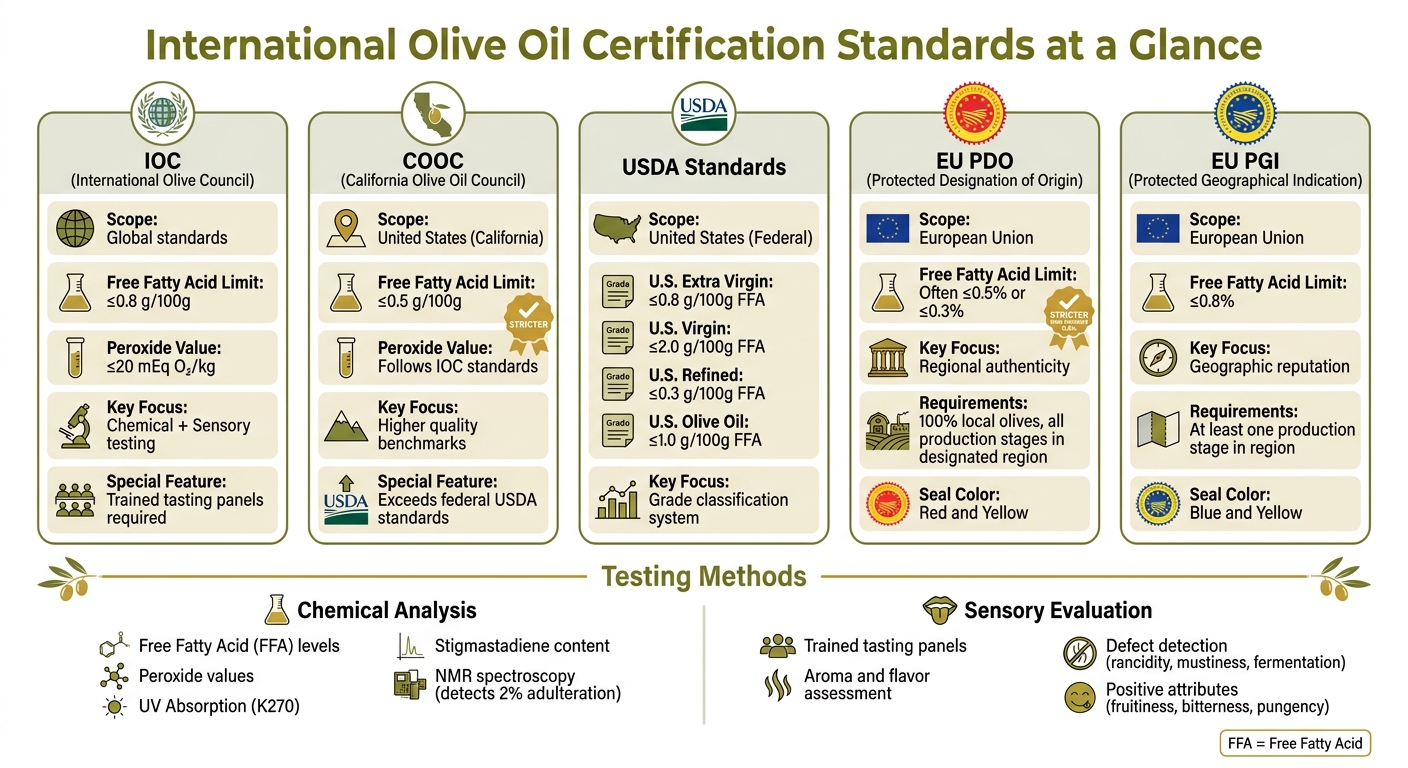
Olive Oil Certification Standards Comparison: IOC, COOC, USDA, PDO and PGI
International Olive Council (IOC) Standards
What the IOC Does
The International Olive Council (IOC) plays a key role in maintaining consistent olive oil quality across global markets. Its main goal? To ensure that certified extra virgin olive oil adheres to the same standards worldwide. This protects consumers while also fostering fair trade practices among producers.
To achieve this, the IOC relies on specialized committees. For example, the Chemistry and Standardization Committee focuses on creating testing protocols to distinguish extra virgin olive oil from lower-grade alternatives. At the same time, the Standardization and Research Unit oversees laboratory recognition programs, ensuring that testing facilities everywhere adhere to uniform scientific practices. This prevents producers from exploiting less stringent labs to gain certification.
But the IOC doesn’t stop at setting standards. Its Economy and Promotion Committee tracks global market trends, while the Technology and Environment Committee promotes sustainable production methods. By tackling both quality control and industry improvement, the IOC works to elevate olive oil production on a global scale. These efforts form the foundation for the rigorous testing and certification processes outlined below.
Testing and Certification Requirements
When it comes to certification, the IOC sets precise chemical and sensory standards that olive oil must meet to qualify for specific grades. These standards are verified through strict laboratory testing and sensory evaluations.
For extra virgin olive oil, two key chemical markers are free fatty acid levels and peroxide values. Free fatty acids reveal how much the oil has broken down, while peroxide values indicate the level of oxidation. The IOC enforces strict maximum limits for these and other parameters - any oil exceeding them is automatically disqualified from the extra virgin category.
However, lab tests alone don’t tell the full story. The IOC also mandates sensory evaluations by trained tasting panels. These experts assess the oil’s aroma and flavor, searching for defects like rancidity, mustiness, or signs of fermentation. Even if an oil meets all chemical criteria, it can still fail certification if tasters identify flaws. By combining scientific analysis with human sensory judgment, the IOC has created a thorough quality control system that’s tough to circumvent or compromise.
sbb-itb-4066b8e
United States Certification Standards
California Olive Oil Council (COOC) Standards
The California Olive Oil Council (COOC) holds olive oil producers to stricter standards than those set by the federal government. For example, while the USDA allows a free fatty acid content of up to 0.8 grams per 100 grams for extra virgin olive oil, California’s standards cap it at 0.5 grams per 100 grams. This tighter limit means that oils certified by the COOC are subject to more rigorous testing.
To earn COOC certification, producers must submit their oils for both chemical analysis and sensory evaluation. These tests include laboratory and organoleptic assessments to ensure the oil meets California’s higher standards. This comprehensive process mirrors international practices but applies even tougher benchmarks, making the COOC seal a trusted indicator of high-quality, domestically produced olive oils.
USDA Olive Oil Grades
USDA standards, while less stringent than California’s, define clear grades for olive oil based on chemical and sensory criteria.
- U.S. Extra Virgin Olive Oil: Must have no detectable defects, a positive fruity flavor, and free fatty acids capped at 0.8 grams per 100 grams.
- U.S. Virgin Olive Oil: Allows for minor defects (scored between 0 and 2.5), retains a positive fruity profile, and permits free fatty acids up to 2.0 grams per 100 grams. Compared to international standards like the IOC and EU, which tolerate defects up to 3.5, the U.S. imposes stricter sensory requirements.
- U.S. Refined Olive Oil: This oil is stripped of flavor and aroma, with free fatty acids limited to 0.3 grams per 100 grams.
- U.S. Olive Oil: A mix of refined and virgin oils, it has free fatty acids capped at 1.0 gram per 100 grams.
The USDA also uses "limiting rules" to ensure accuracy in grading. If an oil fails to meet the criteria for a higher grade based on even one factor - such as acidity or flavor - it is automatically assigned to a lower grade. This approach prevents oils from being marketed as premium when they don’t fully meet the necessary standards.
Olive Oil Standards
European Union Geographic Labeling Standards

The European Union safeguards region-specific olive oils with two key certifications: Protected Designation of Origin (PDO) and Protected Geographical Indication (PGI). These certifications ensure that product names remain authentic and tie the oil's distinctive qualities to its region and traditional production methods. Together, they complement international standards by focusing on origin and heritage.
Protected Designation of Origin (PDO) Certification
PDO certification establishes a complete connection between the olive oil and its region. Every stage of production - from cultivating the olives to bottling the oil - must happen within the designated area. This means that 100% of the olives must be locally sourced.
"The red and yellow seal guarantees that every step of the production - from growing the olives to pressing and bottling - took place in a specific, designated region."
– O-Liv
PDO regulations are often stricter than general EU guidelines. For instance, while standard Extra Virgin Olive Oil can have up to 0.8% acidity, many PDO regions impose stricter limits, often below 0.5% or even 0.3%. Producers aiming for PDO certification must form a cooperative and draft detailed specifications that link their oil to its region.
While PDO demands that all production remains within the region, PGI offers a more flexible approach without compromising regional authenticity.
Protected Geographical Indication (PGI) Certification
PGI certification allows more flexibility while still protecting the regional identity of the olive oil. Unlike PDO, PGI requires only one production stage to take place in the designated region, though the raw materials can come from other areas. This certification highlights the connection between the product's quality or reputation and its geographic origin.
"PGI emphasises the relationship between the specific geographic region and the name of the product, where a particular quality, reputation or other characteristic is essentially attributable to its geographical origin."
– European Union
PGI-certified products display a blue and yellow seal, distinguishing them from PDO's red and yellow label. A significant update came with Regulation (EU) 2024/1143, effective May 13, 2024, which streamlined the registration process into a unified framework. This regulation also allows producers to incorporate mandatory sustainability practices into their product specifications. Applications are typically reviewed by the European Commission within six months, followed by a three-month opposition period for challenges.
| Feature | PDO | PGI |
|---|---|---|
| Link with region | Complete (strong, direct link) | Association based on reputation |
| Raw materials | 100% sourced from the designated region | At least one stage must occur in the region |
| Production stages | All stages must occur within the region | At least one stage must occur in the region |
| Seal color | Red and Yellow | Blue and Yellow |
| Acidity standards | Often require limits below 0.5% or 0.3% (stricter than 0.8%) | Conform to the general standard of up to 0.8% acidity |
How Different Certification Bodies Test Olive Oil
Certification bodies rely on thorough testing methods to ensure olive oil meets established standards. These tests fall into two categories: chemical analysis and sensory evaluation. Chemical tests measure specific compounds to confirm freshness and purity, while sensory panels evaluate flavor and identify defects. Together, these methods help uncover issues like dilution with lower-quality oils.
Main Testing Parameters
Key chemical indicators include Free Fatty Acid (FFA) levels and peroxide values, which reflect oil quality. According to the IOC and EU, extra virgin olive oil (EVOO) must have FFA levels below 0.8% and peroxide values under 20 milliequivalents of O₂ per kilogram. Some regional bodies enforce even stricter limits. Additional chemical tests, like UV Absorption (K270) and Stigmastadiene content, detect refined oils or blends with non-virgin oils. Advanced techniques, such as Nuclear Magnetic Resonance (NMR) spectroscopy, can identify adulteration at concentrations as low as 2%.
Sensory evaluation involves trained tasting panels that confirm the oil has no defects and highlight positive traits like fruitiness, bitterness, and pungency. This organoleptic analysis determines the oil's quality and classification.
"Certifications exist to bridge that gap [the trust gap]. They provide third-party verification that an oil meets specific standards whether for quality, origin, or production methods." – Erica Booth
Different certification bodies apply these parameters in unique ways, as explained below.
Certification Body Testing Comparison
The IOC sets international standards, but some organizations, like the California Olive Oil Council (COOC), enforce stricter guidelines. For example, COOC requires lower acidity levels than the IOC's 0.8% benchmark. Additionally, terms like "First Cold Pressed" and "Cold Extraction" mandate that oils are processed at temperatures below 81°F (27°C). The IOC continues to refine its protocols, most recently updating its trade standards in 2025 with Standard COI/T.15/NC No 3/Rev.21/2025.
Certifications vary in focus. Quality certifications ensure chemical and sensory purity, while geographic certifications like PDO (Protected Designation of Origin) and PGI (Protected Geographical Indication) confirm the oil's production location. While competition awards highlight excellence in specific batches, official certifications guarantee consistent compliance across all batches. Knowing these distinctions empowers consumers to choose oils that align with their preferences and expectations.
Labeling and Packaging Requirements
Certification comes with strict rules for labeling and packaging to protect olive oil from its biggest enemies: light, heat, and oxygen. These elements speed up oxidation, which can make the oil go rancid. Below, we’ll break down the required labeling details and packaging standards that help maintain freshness.
Required Information on Labels
Labels need to include key details like the harvest date, best-by date (usually 18–24 months after bottling), and storage instructions, which recommend keeping the oil in a cool, dark place. The harvest date tells you when the olives were picked, making it the best indicator of freshness. The best-by date, on the other hand, is the producer’s estimate of how long the oil will maintain its quality.
Packaging Standards for Freshness
Proper packaging plays a crucial role in keeping olive oil fresh. In the European Union, retail containers can hold no more than five liters (around 1.32 gallons), which helps ensure the oil is used before it starts to lose quality. Containers must also have tamper-proof seals that cannot be reversed, safeguarding authenticity and preventing tampering.
For the best protection against light, dark glass bottles and tin containers are preferred over clear materials. Once opened, olive oil remains fresh for about six months at room temperature. If stored in the refrigerator, it can last up to a year. The International Olive Council (IOC) also provides guidelines (COI/BPS/Doc. No 1/2018) to ensure quality is maintained from bottling onward.
Conclusion: How Certification Ensures Quality
How Certification Builds Consumer Confidence
Certification plays a critical role in maintaining the quality of olive oil. Fraudulent practices like dilution, mislabeling, or misrepresentation can erode consumer trust. Certification provides third-party verification, helping to close this trust gap. For shoppers, seals and stamps of certification make it easier to identify trustworthy products. At the same time, these certifications allow producers who prioritize quality to stand out from competitors cutting corners.
Making Informed Purchasing Decisions
Certifications also guide consumers toward products that meet specific standards. Different types of certifications highlight various attributes. For instance:
- Quality-focused certifications (like COOC, NAOOA, IOC) confirm high production standards.
- Geographic certifications (such as PDO and PGI) ensure the product’s origin and authenticity.
- Production method certifications (like USDA Organic) emphasize sustainable and natural practices.
It’s important to note that certifications differ from competition awards. While awards recognize the excellence of a particular batch, certifications guarantee consistent adherence to strict quality standards.
When shopping for olive oil, look for certifications that validate purity and grade. For example, Big Horn Olive Oil offers Ultra Premium Extra Virgin Olive Oils that meet internationally recognized benchmarks, ensuring freshness, quality, and health benefits. By choosing certified products, you’re not only ensuring a superior product but also supporting authentic and ethical olive oil production.
FAQs
Which olive oil certifications matter most in the U.S.?
In the United States, olive oil certifications play a crucial role in ensuring quality and authenticity. Among the most recognized are the U.S. Olive Oil grades, which evaluate factors like free acidity and sensory characteristics. These include classifications such as U.S. Virgin Olive Oil and U.S. Refined Olive Oil.
Beyond domestic standards, international guidelines from the International Olive Council (IOC) also set benchmarks for purity and quality. Additionally, regional certifications like those from the California Olive Oil Council (COOC) provide further assurance by focusing on authenticity and maintaining strict quality standards. These certifications collectively help consumers trust the olive oil they purchase.
What’s the difference between PDO and PGI on an olive oil label?
PDO (Protected Designation of Origin) guarantees that every step of production - harvesting, processing, and packaging - happens in a specific region. This certification ensures the use of traditional methods and local ingredients, preserving the heritage and character of the product.
On the other hand, PGI (Protected Geographical Indication) is less restrictive. For PGI products, only one stage of production needs to occur in the designated region. This means ingredients can come from outside the area while still maintaining a connection to the region’s identity.
Both certifications focus on maintaining quality and authenticity, but they differ in how strictly they tie the product to its region of origin.
How can I tell if “extra virgin” is real from the label?
To ensure that "extra virgin" olive oil is genuine, look for certification seals from organizations like the International Olive Council (IOC) or the California Olive Oil Council (COOC). Pay attention to important details, such as a free acidity level of 0.8% or lower, a clearly labeled harvest date, and results from sensory evaluations that confirm the oil has no detectable flaws. These indicators help verify its quality and authenticity.