

International Olive Council Standards for EVOO
The International Olive Council (IOC) sets global standards to ensure the quality and authenticity of extra virgin olive oil (EVOO). These guidelines focus on chemical and sensory criteria, such as free acidity (≤ 0.8%), peroxide value (≤ 20 mEq O₂/kg), and UV absorption limits, to guarantee purity and freshness. EVOO must be mechanically extracted without heat or chemicals, preserving its natural properties.
Polyphenols, key compounds in EVOO, contribute to its flavor, health benefits, and stability. Oils with higher polyphenol levels (250 mg/kg or more) meet EU health claims for protecting blood lipids from oxidative stress. Producers following IOC standards, like Big Horn Olive Oil, prioritize quick processing and proper storage to maintain these qualities. When choosing EVOO, look for verified polyphenol levels, harvest dates, and compliance with IOC standards to ensure quality.
Does all olive oil have polyphenols?
sbb-itb-4066b8e
IOC Classification and Quality Standards for EVOO
The International Olive Council (IOC) has established a detailed classification system for olive oils, with Extra Virgin Olive Oil (EVOO) sitting at the top. This premium category is defined by strict chemical and sensory standards, ensuring only the highest-quality oils earn the designation. These classifications provide a framework for understanding how EVOO is extracted, tested, and evaluated.
Key Criteria for Extra Virgin Olive Oil
According to the IOC's trade standard (COI/T.15/NC No 3/Rev.21/2025), EVOO must be produced solely through mechanical methods, without the use of heat or chemical solvents. This ensures the oil retains its natural characteristics and purity.
Another critical measure is free acidity, expressed as oleic acid, which must not exceed 0.8%. Low free acidity indicates minimal degradation and higher quality. Beyond this, EVOO must meet additional chemical and sensory standards to maintain its premium status.
Sensory and Chemical Standards
EVOO must have a peroxide value of ≤ 20 mEq O₂/kg, which reflects the oil's freshness and resistance to oxidation. UV spectrophotometric tests are also used to evaluate quality, with specific absorption limits set at K₂₃₂ ≤ 2.5, K₂₇₀ ≤ 0.22, and ΔK ≤ 0.01.
These stringent standards ensure both the chemical integrity and sensory appeal of EVOO, reinforcing its reputation for quality and reliability:
| Parameter | EVOO Requirement |
|---|---|
| Free Acidity | ≤ 0.8% |
| Peroxide Value | ≤ 20 mEq O₂/kg |
| K₂₃₂ (UV Absorption) | ≤ 2.5 |
| K₂₇₀ (UV Absorption) | ≤ 0.22 |
| ΔK | ≤ 0.01 |
| Sensory Defects | Median = 0 |
| Fruity Attribute | Median > 0 |
| Extraction Method | Mechanical only |
To further guarantee authenticity, the IOC employs advanced chemical markers like stigmastadienes and sterol profiles. These tests help detect potential adulteration, such as the presence of refined vegetable oils or olive-pomace oil. Producers like Big Horn Olive Oil, who adhere to these rigorous standards, provide consumers with confidence in the authenticity and quality of their products.
Polyphenols and Antioxidants in EVOO Quality
What Are Polyphenols and Antioxidants?
Polyphenols are the compounds that give extra virgin olive oil (EVOO) its distinct flavor and many of its health benefits. Among these, secoiridoids - such as oleuropein aglycone, oleocanthal, and oleacein - stand out. These compounds are responsible for the bitterness and pungency characteristic of fresh EVOO. As they break down, they produce simple phenols like hydroxytyrosol and tyrosol, which also contribute to the oil's antioxidant properties. Additionally, tocopherols (Vitamin E) enhance the oil's ability to resist oxidation, further protecting its quality.
"Secoiridoids in olive oil represent the main source of hydroxytyrosol and tyrosol derivatives... These compounds are also responsible for crucial properties associated with virgin olive oil such as the bitterness and pungency attributes, the oxidative stability, and the health claim associated with their preventive role against oxidative stress." - Ana Castillo-Luna and Feliciano Priego-Capote, University of Córdoba
Under European Regulation (UE) 432/2012, olive oil must contain at least 250 mg/kg of phenolic compounds to qualify for a recognized health claim. A daily intake of 20 g (roughly 0.7 oz) of such oil, providing at least 5 mg of these compounds, is considered beneficial. To ensure these benefits, careful handling is essential, and the International Olive Council (IOC) has developed standards to help maintain EVOO's quality.
How IOC Standards Help Preserve Polyphenol Levels
The IOC has established specific limits on free acidity and peroxide values to ensure freshness and protect polyphenols from oxidation. Additionally, ultraviolet absorption standards (K₂₃₂ and K₂₇₀) play a key role. For instance, high K₂₇₀ values indicate secondary oxidation, which signals the degradation of secoiridoids into aging markers like oleaceinic acid and oleocanthalic acid.
To further support quality, the IOC provides storage and handling guidelines (COI/BPS/Doc. No 1) and protocols for mill operations (T.33/Doc. No 2–4). These measures help minimize polyphenol loss caused by heat, light, and oxygen exposure. Together, these standards safeguard the chemical and sensory qualities of EVOO.
Polyphenol Content Ranges in High-Quality EVOOs
Polyphenol levels in EVOO vary depending on factors like olive variety, harvest timing, and production methods. Oils made from early-harvest, green olives typically have higher polyphenol concentrations, while those from fully ripe olives are milder and lower in these compounds. The IOC uses these differences to classify EVOOs based on their polyphenol content.
| Polyphenol Level | Approximate Range | Notes |
|---|---|---|
| Standard EVOO | 100–250 mg/kg | Meets IOC quality standards; below the EU health claim threshold |
| Health Claim Threshold | ≥ 250 mg/kg | Minimum required under EU Regulation 432/2012 |
| Premium / High-Phenolic EVOO | 500–1,000+ mg/kg | Often from early-harvest olives; significantly exceeds the minimum |
The enzymatic activity during oil extraction is another critical factor. Enzymes like β-glucosidase and esterase influence how secoiridoids are converted and retained in the oil. Producers such as Big Horn Olive Oil focus on freshness and precise processing techniques to preserve these beneficial polyphenols effectively.
Testing Protocols for EVOO Quality and Polyphenols
Thorough analytical testing forms the backbone of IOC standards, linking chemical profiles with sensory criteria to verify EVOO authenticity.
Sampling and Lab Testing Best Practices
When preparing samples, use liquid–liquid extraction with an 80:20 methanol/water ratio. For oils with high polyphenol levels, a dual extraction method is recommended at a 1:8 mass ratio (e.g., 0.5 g oil to 4 mL extractant) to prevent saturation. Temperature control is essential during handling to protect heat-sensitive secoiridoids. All testing should comply with ISO 17025 and IOC document COI/T.28/Doc. No 1.
Polyphenol and Antioxidant Analysis Methods
The IOC's official method for measuring phenolic compounds is outlined in COI/T.20/Doc. No 29 (Revision 2, 2022). This approach uses HPLC with UV detection at 280 nm to profile individual phenolic compounds, with syringic acid serving as the internal standard.
While the Folin–Ciocalteu assay is widely used, it lacks specificity and tends to underestimate bio-phenol content compared to chromatographic methods. For labs seeking the highest level of accuracy, LC-MS/MS with an electrospray ionization (ESI) source in negative ion mode is the preferred technique for absolute quantitation of compounds like oleocanthal and oleacein.
| Method | Technology | Purpose | IOC Status |
|---|---|---|---|
| Folin–Ciocalteu | Photometric (765 nm) | Total phenolic content (unspecific) | Common/Obsolete |
| COI/T.20/Doc. No 29 | HPLC-UV (280 nm) | Individual phenolic profiling | Official Standard |
| LC-ESI-MS/MS | Tandem Mass Spectrometry | Absolute quantitation; health claim verification | Advanced/Research |
These detailed analytical results complement sensory evaluations, offering a well-rounded IOC quality profile.
How Polyphenol Testing Fits Into IOC Quality Evaluation
Polyphenol testing plays a critical role in confirming EVOO quality. The IOC's COI/T.20/Doc. No 19 (Spectrophotometric Investigation in the Ultraviolet, Revision 5, 2019) measures UV absorption values (K₂₃₂ and K₂₇₀) to identify oxidation and detect chemical changes from processing or aging. When paired with polyphenol data, these metrics present a more complete view of the oil's integrity.
Sensory evaluation is another crucial component. The mandatory organoleptic assessment outlined in COI/T.20/Doc. No 15 (Revision 11, 2024) ties directly to phenolic content, as bitterness and pungency - assessed by trained tasting panels - are influenced by secoiridoids measured in the lab. All of these protocols are unified under the Trade Standard COI/T.15/NC No 3, updated to Revision 21 in 2025, which defines and verifies olive oil quality and purity on a global scale.
Using IOC Standards to Choose a Premium EVOO
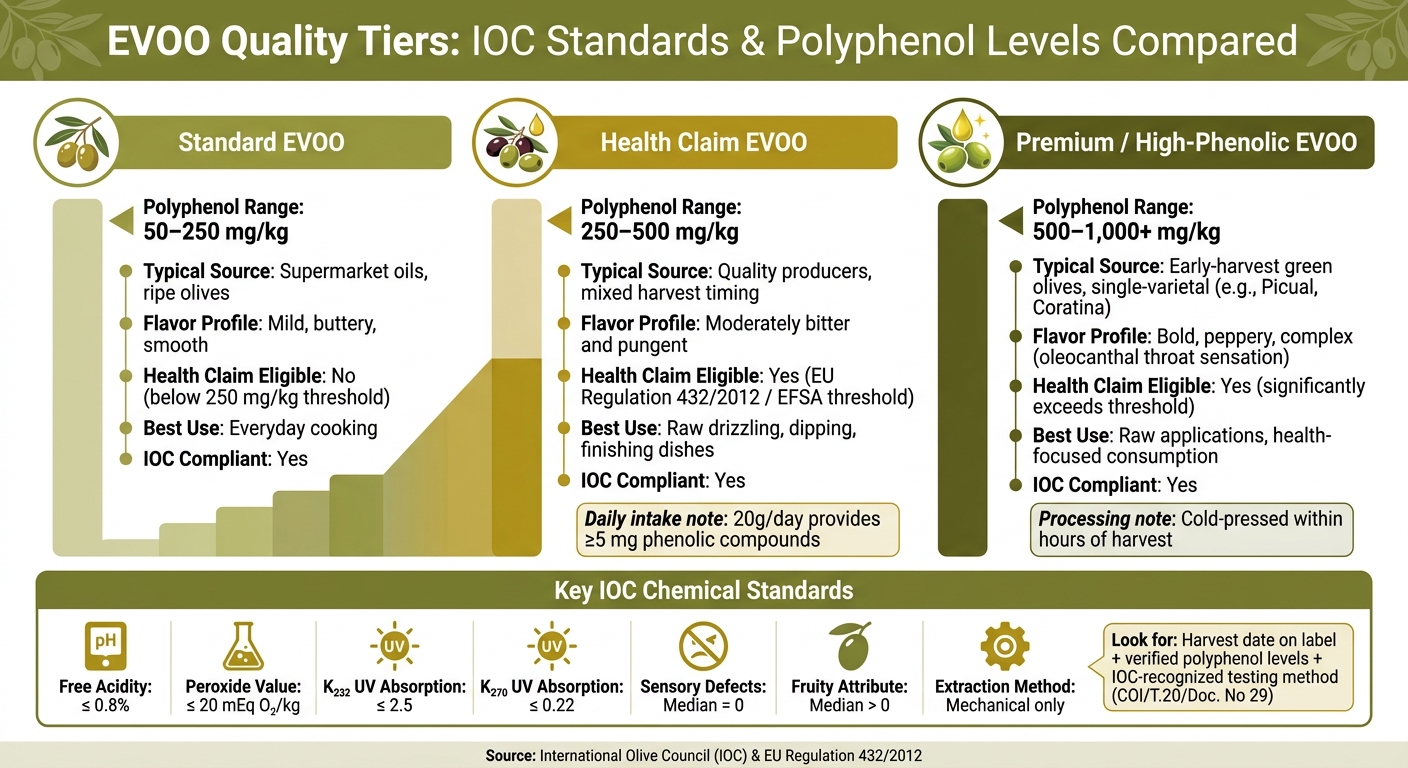
EVOO Quality Tiers: IOC Standards & Polyphenol Levels Compared
Reading Labels and Certifications
When selecting extra virgin olive oil (EVOO), understanding the label is crucial. According to International Olive Council (IOC) standards, authentic EVOO must have a free acidity level of 0.8% or lower. It must also pass a sensory evaluation, showing no defects and featuring a distinct "fruity" characteristic. These details confirm that the oil is made from top-tier olives.
Another important detail is the UV absorption value, often found on the technical sheet. Lower UV readings indicate fresher oil, as per IOC guidelines. Additionally, always check for a harvest date - this is critical because polyphenols, which contribute to both flavor and health benefits, degrade over time. EVOO is best consumed within 6–9 months of production. If the harvest date is missing, consider it a red flag.
While these label metrics are essential, the production methods behind the oil can make all the difference.
How Premium Producers Go Beyond IOC Requirements
High-end producers take extra steps to ensure superior oil quality. While many supermarket EVOOs contain only 50–150 mg/kg of polyphenols, premium oils often exceed 500 mg/kg, with some ultra-high-phenolic oils surpassing 1,000 mg/kg. Achieving these levels requires meticulous practices, including early harvesting - when polyphenol content is at its peak - and cold-pressing the olives within hours of picking to preserve their beneficial compounds.
For example, Big Horn Olive Oil exemplifies these practices. Their oils are cold-pressed within two hours of harvest and reach customers within three months. This rapid timeline helps retain key antioxidants and secoiridoids, which are measured by IOC standards. Their single-varietal oils, such as Picual and Coratina, naturally boast high polyphenol levels, offering buyers transparency down to the specific olive variety.
"A smooth, mellow, buttery-tasting olive oil is low-polyphenol. Not bad oil - just a different category." - Ahmad Qazi, Founder, Curated Sense
Matching EVOO Metrics to Your Needs
The best EVOO for you depends on how you plan to use it. For raw applications - like drizzling on salads, dipping bread, or finishing a dish - a high-phenolic EVOO (500+ mg/kg) is ideal. These oils deliver robust health benefits and bold, complex flavors, including the peppery throat sensation caused by oleocanthal. On the other hand, for everyday cooking where a milder flavor suffices, an EVOO that meets standard IOC certifications is perfectly fine.
If your focus is health, look for oils that meet the European Food Safety Authority (EFSA) threshold of 250 mg/kg of hydroxytyrosol and related compounds. This level allows the oil to carry the regulated claim that it helps protect blood lipids from oxidative stress. To achieve this benefit, you’d need about 20g of oil daily, which provides 5 mg of these phenolic compounds. Oils with verified polyphenol levels - tested using IOC-recognized methods like COI/T.20/Doc. No 29 - are the ones you can trust.
Conclusion: Key Points on IOC Standards and EVOO Quality
The IOC standards go beyond simply defining a baseline for quality - they establish a clear, science-based system that protects buyers from fraud while helping producers showcase authentic excellence. Through mandatory sensory evaluations and chemical tests like free fatty acid analysis and ultraviolet spectrophotometric testing, these requirements ensure that the claims on the label align with the actual quality of the oil.
At the core of this system are polyphenols. Compounds such as oleocanthal, oleacein, and hydroxytyrosol not only shape the flavor of Arbequina extra virgin olive oil but also contribute to its health benefits. The IOC's standardized testing method, COI/T.20/Doc. No 29, guarantees that these polyphenol levels are measured with precision and consistency. This testing reflects the IOC's broader efforts to continually refine best practices across the olive oil industry.
The organization's ongoing updates to its standards help maintain consumer trust. For buyers, this means greater confidence in the quality of the EVOO they choose.
To make the most informed purchase, consumers should pay attention to the harvest date and look for oils with verified polyphenol levels measured using IOC-recognized methods. Producers who prioritize quick processing and proper storage are key to preserving these valuable antioxidants. For instance, Big Horn Olive Oil cold-presses olives within two hours of harvest and delivers the oil to customers within three months - an approach that aligns perfectly with the quality benchmarks set by IOC standards.
FAQs
How can I tell if an EVOO really meets IOC standards?
To ensure an extra virgin olive oil (EVOO) meets International Olive Council (IOC) standards, check for certification seals from trusted organizations. These seals confirm the oil has undergone rigorous chemical tests - like measuring free fatty acidity, peroxide value, and UV absorbency - along with sensory evaluations conducted by certified tasting panels. Always verify the documentation to confirm the oil complies with these standards.
What is the best lab test to verify an EVOO’s polyphenol level?
The most precise way to measure the polyphenol content in extra virgin olive oil (EVOO) is through High-Performance Liquid Chromatography (HPLC). This technique accurately identifies and measures specific polyphenols, delivering dependable and detailed results.
What’s the best way to store EVOO to protect polyphenols?
To keep the phenolic compounds in extra virgin olive oil (EVOO) intact, proper storage is key. Aim to store it at cooler temperatures, around 39°F. Use dark containers to block out light and ensure minimal exposure to air. These steps help reduce degradation, preserving the oil's phenolic content.