

International Standards for Olive Oil Purity
Extra Virgin Olive Oil (EVOO) standards ensure quality, health benefits, and authenticity. These guidelines, developed by organizations like the International Olive Council (IOC) and California regulators, define clear chemical and sensory benchmarks to protect consumers from adulterated or mislabeled products. Key parameters include free acidity (≤ 0.8%), peroxide value (≤ 20 mEQ O₂/kg), and sensory evaluations by expert panels.
Key Points:
- EVOO Standards: Strict limits on chemical properties like free acidity and oxidation levels.
- Testing Methods: Includes chemical analysis (e.g., UV absorption, gas chromatography) and sensory evaluations.
- Global Oversight: The IOC sets international benchmarks, while California enforces additional U.S. regulations.
- Certification: Producers undergo lab testing and sensory reviews to maintain compliance and earn consumer trust.
These measures ensure consumers receive high-quality olive oil with optimal flavor and health properties while supporting transparency in the market.
IOC Trade Standards for Extra Virgin Olive Oil
The IOC and Its Function
The International Olive Council (IOC) stands as the only intergovernmental organization dedicated to olive oil and table olives. Headquartered in Madrid, the IOC brings member nations together to create a consistent regulatory framework for international trade and quality standards. Its role goes beyond regulations - it also tracks market trends and documents olive varieties globally.
"Welcome to the International Olive Council (IOC), the world's only intergovernmental organisation..."
- International Olive Council
In March 2026, the IOC partnered with the Polytechnic University of Madrid through a Memorandum of Understanding aimed at advancing research and technical training. As part of this initiative, the University of Jaén is set to host the 23rd International Expert Course in Virgin Olive Oil Tasting, with applications closing on April 6, 2026.
The IOC’s commitment to quality is evident in its detailed chemical and sensory guidelines for certifying extra virgin olive oil (EVOO).
Core Parameters in IOC Standards
To qualify as extra virgin, olive oil must meet strict chemical and sensory benchmarks set by the IOC. These include:
- Free Acidity: Must remain under 0.8 g/100g, reflecting minimal processing or damage.
- Peroxide Value: Limits are in place to measure oxidation levels.
- UV Absorption: Used to identify refining processes or possible adulteration.
The IOC also promotes excellence through the Mario Solinas Quality Award, a prestigious competition for producers. For the 2026 edition, samples had to be submitted by February 25, 2026, to IOC headquarters in Madrid for evaluation.
Additionally, the IOC collaborates with the University of Navarre on the Olive Health Information System (OHIS). This platform regularly publishes research that connects the chemical properties of olive oil to its health advantages, further emphasizing the value of adhering to these standards.
sbb-itb-4066b8e
California Grade and Labeling Standards
California's EVOO Standards
California has established a detailed legal framework to maintain the integrity of olive oil in the U.S. market, going beyond the basic guidelines set by the International Olive Council (IOC). Under the state's Health and Safety Code, olive oil is strictly defined as edible oil derived solely from the fruit of the olive tree, without the use of solvents or reesterification methods. To meet the criteria for extra virgin olive oil (EVOO) in California, the oil must have a free acidity level of no more than 0.8 grams per 100 grams and a peroxide value that does not exceed 20 milliequivalents per kilogram.
"Extra virgin olive oil means virgin olive oil which has a free acidity, expressed as oleic acid, of not more than 0.8 grams per 100 grams oil, has a peroxide value of not more than 20 milliequivalent peroxide oxygen per kilogram oil and would meet the sensory standards of extra virgin olive oil as determined by a taste panel certified by the International Olive Council..." - California Health and Safety Code Section 112877
The regulations also extend to flavored and imitation products. Flavored olive oil must consist of at least 90% olive oil, regardless of whether it is extra virgin, virgin, or standard grade. On the other hand, imitation olive oil refers to any blend of edible oils that are artificially colored or flavored to mimic the appearance and taste of authentic olive oil.
These precise standards aim to uphold quality and authenticity, creating ripple effects across the U.S. olive oil market.
Impact on U.S. Producers and Consumers
California's regulations promote transparency by requiring that blends containing refined olive-pomace oil be explicitly labeled as "olive-pomace oil" rather than simply "olive oil". The standards also define clear acidity thresholds for various grades: virgin olive oil can have up to 2.0% free acidity, while ordinary virgin olive oil is permitted up to 3.3%. This tiered categorization helps differentiate quality levels and encourages producers to rely on mechanical extraction processes that retain the oil's natural qualities.
How to spot FAKE Olive Oil | 7 science-backed tips
Purity Parameters and Testing Methods
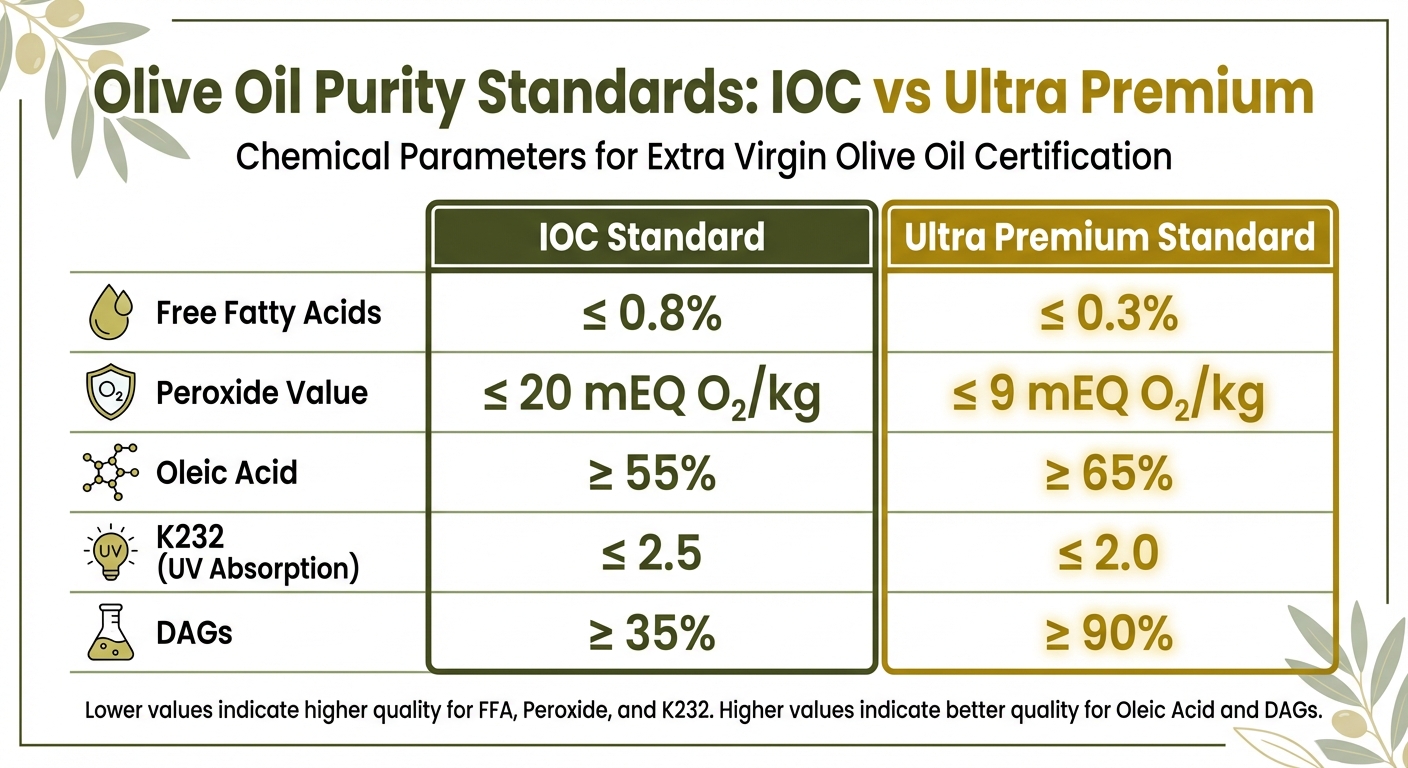
IOC vs Ultra Premium Olive Oil Quality Standards Comparison
Chemical Analysis for Purity
Chemical testing plays a key role in confirming the authenticity of olive oil. One critical metric is Free Fatty Acids (FFA), which reflects how the olives were handled during harvest and extraction. High FFA levels suggest poor fruit quality or processing methods. According to the International Olive Council (IOC), the acceptable FFA limit for extra virgin olive oil is ≤ 0.8%, while Ultra Premium (UP) standards are stricter, requiring ≤ 0.3%.
Peroxide Value is another important measurement, as it indicates oxidation and rancidity levels. The IOC allows a maximum of 20 mEQ O₂/kg, but UP standards limit it to just 9 mEQ O₂/kg.
UV absorption testing (measuring K232, K270, and Delta K) provides additional insights into rancidity and helps uncover adulteration with refined oils. IOC's thresholds are K232 ≤ 2.5, K270 ≤ 0.22, and Delta K ≤ 0.01. Advanced methods like gas chromatography-mass spectrometry (GC-MS) can verify geographic origins with 94.5% accuracy, while fluorescence spectroscopy detects adulterants with an impressive 95–100% accuracy.
Here’s a summary of the key chemical parameters and their limits:
| Parameter | IOC Standard | Ultra Premium Standard |
|---|---|---|
| Free Fatty Acids | ≤ 0.8% | ≤ 0.3% |
| Peroxide Value | ≤ 20 mEQ O₂/kg | ≤ 9 mEQ O₂/kg |
| Oleic Acid | ≥ 55% | ≥ 65% |
| K232 (UV Absorption) | ≤ 2.5 | ≤ 2.0 |
| DAGs | ≥ 35% | ≥ 90% |
Sensory Evaluation and Organoleptic Testing
After chemical testing, sensory evaluation ensures that the oil meets all quality standards. For olive oil to be labeled as Extra Virgin, it must pass both chemical and sensory tests. Sensory analysis is conducted by a trained panel of 8 to 12 assessors in a controlled environment that is free from odors and maintains a consistent temperature. To avoid bias, tasters use blue-tinted glasses to obscure the oil’s color.
During this process, assessors score the oil on positive attributes like fruitiness, bitterness, and pungency, while also identifying any flaws. Common defects include "Fusty" (swampy or fermented smell), "Musty" (moldy), "Rancid" (oxidized), and "Winey/Vinegary" (resembling nail polish remover). The evaluation adheres to a strict "zero defect" rule: even the slightest negative flavor causes the oil to be downgraded from Extra Virgin to "Virgin" or "Lampante".
This human assessment is crucial for detecting subtle issues, such as "soft deodorizing" (a refining technique used to mask flaws) or defects caused by fermented olives - problems that machines might overlook.
Certification Processes and Compliance Verification
The Certification Process
Certifying olive oil involves rigorous testing to ensure it meets strict chemical and sensory standards. This process includes over 20 laboratory tests along with evaluations by certified tasters. Producers send their samples to accredited labs, where tests measure critical factors like free fatty acids, peroxide values, and UV absorption. To earn certification, the oil must pass all these chemical benchmarks.
Once the lab work is complete, a sensory panel recognized by the International Olive Council (IOC) steps in. Typically, at least 5 out of 8 certified tasters must agree on the oil’s quality for it to qualify as Extra Virgin. This thorough evaluation process lays the groundwork for maintaining high standards.
Maintaining Compliance Over Time
Certification isn’t a one-and-done process - it requires ongoing effort. Certified producers participate in annual testing, which includes both chemical analysis and sensory evaluations. These regular checks are vital for ensuring consistent quality. For instance, a 2021 audit found that 15% of lots failed due to elevated FAEE levels, highlighting the importance of these yearly reviews. On the flip side, COOC-certified California producers achieved a 100% compliance rate, compared to only 30% for non-certified producers.
In addition to scheduled testing, third-party organizations conduct surprise audits and batch tests throughout production cycles. This extra layer of oversight ensures that producers stay accountable.
How Certification Builds Consumer Trust
Ongoing verification doesn’t just maintain quality - it also strengthens consumer confidence. A certified seal is more than just a label; it’s proof of documented quality. Certified brands share test results showing that their oil has passed over 20 lab tests and won approval from sensory panels. This transparency removes any uncertainty about the product’s integrity.
Take Big Horn Olive Oil, for example. Its Ultra Premium certification reflects a commitment to rigorous, multi-stage testing. For consumers, this seal guarantees that the oil is free from adulteration and meets both analytical and sensory standards. It’s a promise built on science, precision, and trust.
Conclusion
Key Takeaways on Olive Oil Purity Standards
Global standards play a crucial role in ensuring the quality and authenticity of extra virgin olive oil (EVOO). Organizations like the International Olive Council (IOC), along with California regulations and USDA guidelines, provide a structured framework to protect consumers from issues like adulteration and false labeling. Through chemical testing - checking factors such as free fatty acid levels and peroxide values - and certified sensory panels evaluating taste and aroma, these standards uphold the integrity of EVOO. Together, these measures ensure that EVOO delivers the health benefits and flavors that define its premium status.
Testing and certification enhance transparency across the supply chain. Producers committed to regular testing and third-party audits showcase their dedication to quality, making their claims credible and measurable. These rigorous standards provide a foundation for companies like Big Horn Olive Oil to showcase their superior quality.
Big Horn Olive Oil's Commitment to Quality and Purity
Big Horn Olive Oil stands out with its Ultra Premium certification, which goes beyond basic EVOO standards. Their oils undergo strict, multi-step testing, including both laboratory analyses and sensory evaluations. By partnering with top-tier producers and ensuring olives are cold-pressed within two hours of harvesting, they maintain the freshness and chemical balance required by international purity benchmarks.
The company’s dedication to delivering fresh olive oil within three months of harvest ensures optimal polyphenol levels and flavor retention. This meticulous focus on timing, combined with adherence to stringent purity standards, guarantees that every bottle lives up to consumer expectations. In a crowded marketplace, these certifications and practices provide buyers with confidence and clarity in their choices.
FAQs
What do IOC standards actually guarantee?
The International Olive Council (IOC) sets standards to guarantee that olive oil adheres to strict chemical and sensory benchmarks. These include limits on free acidity (no more than 0.8%), peroxide levels, and specific sensory characteristics. These criteria help confirm the oil’s purity, genuineness, and overall quality.
Why do olive oils need both lab tests and taste panels?
Lab tests and taste panels play a key role in ensuring olive oil meets the strict standards required for extra virgin classification. Lab tests focus on verifying the oil's chemical purity and identifying any possible adulteration. Meanwhile, taste panels assess the flavor and aroma to ensure the oil delivers the quality expected. Together, these processes safeguard both the authenticity and the appealing characteristics of the product.
How can I tell if an EVOO certification seal is trustworthy?
Look for certification seals from reputable organizations like the International Olive Council (IOC), USDA Organic, or the California Olive Oil Council (COOC). These certifications ensure the oil meets strict standards, including accurate labeling, clear harvest dates, low acidity levels, and minimal oxidation. Paying attention to these details helps verify the quality and integrity of extra virgin olive oil.