

International Standards for Olive Oil Traceability
Traceability in olive oil ensures you know exactly where your oil comes from and how it’s made. By following its journey from grove to bottle, international standards guarantee quality, purity, and transparency. Here’s what you need to know:
- Why It Matters: Fraud and mislabeling are common in the olive oil market. Standards help detect adulteration and ensure labels reflect the oil’s true quality.
- Key Organizations: The International Olive Council (IOC) sets global standards, while the European Union enforces strict traceability rules to track every step of the supply chain.
- Certification Systems: Protected Designation of Origin (PDO) ties olive oil to specific regions, preserving its unique traits and production methods.
- Benefits for Producers and Consumers: Producers gain access to global markets and build trust, while consumers get verified quality, origin, and safety.
With advances like DNA fingerprinting and blockchain, the future of olive oil traceability is evolving to ensure even greater accuracy and reliability.
Olive Oil Standards
Key International Traceability Standards
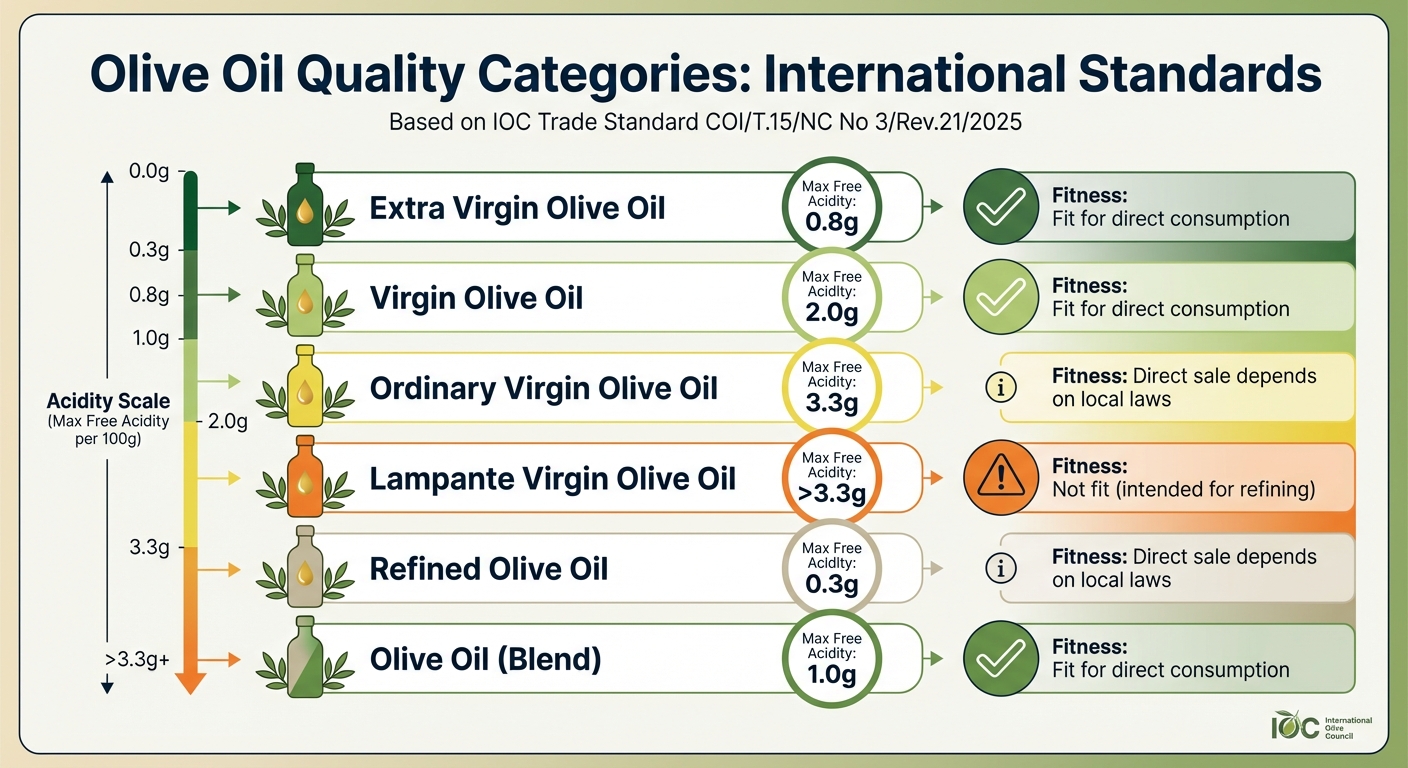
International Olive Oil Quality Standards and Acidity Levels by Category
International Olive Council (IOC) Standards
The International Olive Council (IOC) stands as the only intergovernmental organization dedicated to olive oil and table olives. It sets the Trade Standard Applying to Olive Oils and Olive-Pomace Oils (COI/T.15/NC No 3/Rev.21/2025), which serves as the global reference for defining legal categories and quality parameters in international markets.
The IOC also provides Quality Management Guides that cover key production stages, including olive oil mills (T.33/Doc. No 2-4), packing plants (T.33-2/Doc. No 4), and refineries (T.33-1/Doc. No 2-2). These guides ensure that traceability is maintained consistently from the olive grove to the final product. To combat fraud, the IOC employs rigorous chemical testing methods capable of detecting adulterants like seed oils, desterolized seed oils, or halogenated solvents. On the sensory side, standardized organoleptic assessments evaluate taste and aroma to certify whether an oil qualifies as "Extra Virgin". These measures form a solid foundation for regional regulations to build upon.
| Olive Oil Category | Max Free Acidity (per 100g) | Fitness for Consumption |
|---|---|---|
| Extra Virgin Olive Oil | 0.8g | Fit for direct consumption |
| Virgin Olive Oil | 2.0g | Fit for direct consumption |
| Ordinary Virgin Olive Oil | 3.3g | Direct sale depends on local laws |
| Lampante Virgin Olive Oil | > 3.3g | Not fit (intended for refining) |
| Refined Olive Oil | 0.3g | Direct sale depends on local laws |
| Olive Oil (Blend) | 1.0g | Fit for direct consumption |
The IOC's standards establish global benchmarks that protect consumers while supporting fair practices for honest producers.
European Union Traceability Requirements
Building on the IOC framework, the European Union (EU) enforces strict traceability rules to safeguard the olive oil supply chain. These regulations rely on the "one step back, one step forward" principle, requiring every business in the supply chain to document where their product originated and where it is headed. This creates a seamless documentation trail, ensuring accountability at every stage.
EU regulations demand complete traceability from the oil's source to its final destination. This system allows for the quick identification of quality issues and affected batches, minimizing risks to consumers. By mandating quality management systems within production facilities, these rules work in tandem with IOC standards to make fraudulent oils nearly impossible to slip through undetected.
The EU's approach ensures comprehensive documentation and accountability throughout the supply chain.
Protected Designation of Origin (PDO) Standards
Alongside international and regional standards, PDO certification adds another layer by guaranteeing geographical authenticity. PDO certification ties olive oil to a specific region, requiring that the oil be produced, processed, and prepared entirely within that area. This ensures the oil retains the unique characteristics associated with its origin while preserving traditional production methods.
PDO certification also includes organoleptic assessments to confirm that the oil reflects the distinct qualities of its region's terroir. The IOC supports this process through its World Catalogue of Olive Varieties, which tracks and verifies the botanical origins of oils - an essential step for confirming geographical authenticity.
PDO standards reinforce regional authenticity, safeguarding traditional methods and bolstering consumer confidence.
How Standards Affect Producers
Compliance and Certification Requirements
To meet international traceability standards, producers must follow strict protocols for documentation and testing at every stage of production. For instance, the International Olive Council (IOC) Trade Standard (COI/T.15/NC No 3/Rev.21/2025) requires producers to conduct chemical tests to detect adulterants and sensory evaluations by trained panels to confirm the oil's grade. Facilities are also expected to implement quality management systems based on IOC guidelines, using ISO 17025-certified laboratories. On top of that, proper storage practices are crucial to maintaining product quality over time. While these measures help ensure consistency and authenticity, they can be particularly demanding for smaller producers.
Challenges for Small Producers
For small-scale producers, meeting these extensive requirements can feel like an uphill battle. The costs of advanced technology, documentation systems, and regular audits often strain their limited resources. While many small producers support the idea of centralized traceability systems, they often struggle to build and maintain complex independent operations.
To address these challenges, some recent regulatory updates and collaborative initiatives offer practical solutions. For example, small producers can adopt simplified measures tailored to their capabilities or join non-profit networks to share data, reducing costs and boosting transparency. In Spain, regulatory changes introduced in August 2025 aim to streamline reporting processes, making compliance more achievable for smaller operations.
Business Benefits of Compliance
Although compliance can be challenging, the rewards are clear. Meeting these standards allows producers to access new markets that prioritize verified quality and authenticity. Standardized testing not only helps prevent fraud - such as the misuse of seed oils or olive-pomace oil - but also ensures that premium products retain their competitive edge. Additionally, confirming that products align with their labeled commercial category strengthens brand reputation and builds consumer trust.
Producers can also take advantage of tools like the Olive Health Information System (OHIS) to support health-related claims in marketing. Certifications like PDO further boost consumer confidence, enhancing market credibility and opening doors to greater opportunities.
sbb-itb-4066b8e
How Traceability Benefits Consumers
Traceability standards do more than just protect producers - they give consumers the confidence to trust the quality, origins, and safety of the products they buy.
Verifying Quality and Authenticity
Traceability systems play a key role in helping consumers confirm the quality of products. Take olive oil, for instance - one of the most frequently adulterated food products. Standardized testing methods can uncover fraudulent practices like mixing in seed oils, desterolized seed oils, or even halogenated solvents, which can pose health risks.
When you see olive oil labeled as "Extra Virgin", it means the product has undergone stringent chemical tests and sensory evaluations by trained experts. Advanced methods can even verify the oil's origin and the specific type of olive used. Since 1988, international chemistry experts have been meeting twice a year to refine fraud detection techniques as science evolves. These efforts ensure every bottle meets strict safety and quality standards.
Transparency in Origin and Production Methods
Traceability systems also provide detailed insights into where and how your olive oil was made. For example, 67% of consumers recognize the importance of the Protected Designation of Origin (PDO) label, which ties specific quality traits to particular regions. Labels like PDO or Protected Geographical Indication (PGI) let you confirm that the oil originates from a certified region.
These systems also reveal critical production details, such as the type of olives used, the extraction process, and even the pressing date. Some certification programs include the pressing date on the label, helping consumers gauge freshness. Advanced technologies, like analyzing multi-elemental signatures and strontium isotope ratios (87Sr/86Sr), can create a unique "fingerprint" for the oil, linking it directly to the soil where the olives were grown. This level of detail ensures the oil’s regional authenticity and verifies its production methods.
Food Safety Protection
Traceability doesn’t just confirm origins - it also protects your health. These systems enable quick action in cases of contamination or quality issues. Standardized testing ensures oils comply with strict safety regulations. Additionally, quality management guidelines for olive oil mills and packaging facilities help prevent contamination and maintain the oil's integrity during storage and transport.
When shopping for olive oil, look for products that adhere to International Olive Council Trade Standards or European Union regulations. Certifications like USDA Extra Virgin or PDO/PGI seals indicate that the oil has passed rigorous purity and safety tests.
At Big Horn Olive Oil, we take traceability seriously. Every bottle of extra virgin olive oil we offer is not only safe but also meets the highest standards of quality and authenticity, so you can enjoy it with confidence.
The Future of Olive Oil Traceability
The olive oil industry is blending cutting-edge technology with its long-standing commitment to quality. Starting in January 2025, the International Olive Council updated its trade standards (Standard COI/T.15/NC No 3/Rev.21/2025) to incorporate advancements in oil analysis. These updates mark a shift from merely tracking bottles to verifying the oil's actual composition - a game-changer for authenticity.
One of the most promising developments is DNA fingerprinting, which now verifies extra virgin olive oil (EVOO) by analyzing the genetic material of both the orchard and the oil itself. This method makes unauthorized blending nearly impossible. As InTTrust explains:
The ability to obtain the genetic profile of an EVOO via DNA tests makes it almost impossible to admix.
Unlike older systems, such as IBM Food Trust, which focus on tracking lot numbers and packaging, DNA Blockchain tools log the oil’s unique biological signature, ensuring traceability from the grove to the bottle.
A notable example of this innovation comes from Italy. In May 2020, researchers from the Consiglio per la Ricerca in Agricoltura e l'Analisi dell'Economia Agraria (CREA) created a fully electronic traceability prototype at the Ponzani Antonio farm in Montorio Romano. They tracked extra virgin olive oil from 33 specific trees using UHF RFID tags (860 MHz) and the "Infoliva" Android app. This data was then securely stored on an Ethereum blockchain, ensuring traceability for 100 bottles. While these pilot projects highlight the potential of technology, the lack of consistent regulatory enforcement remains a challenge.
A January 2026 audit by the EU Court of Auditors exposed gaps in enforcement, noting that 4 out of 24 samples tested lacked confirmed origins. According to the EU Court of Auditors:
The principal weakness lies not in the absence of rules, but in how they are enforced, monitored and reported.
Achieving seamless international tracking will require harmonizing national traceability registers to work together effectively.
FAQs
How does DNA fingerprinting help ensure the authenticity of olive oil?
DNA fingerprinting is a powerful tool for verifying the authenticity of olive oil. It works by identifying the specific olive varieties used and confirming their geographic origin. This process ensures the product lives up to its label claims, helping to combat fraud and safeguard both consumers and producers.
By improving traceability, DNA fingerprinting strengthens trust within the olive oil supply chain. It ensures customers get genuine, high-quality products while promoting transparency and fairness across the industry.
What obstacles do small olive oil producers face in meeting international traceability standards?
Small olive oil producers often struggle to meet international traceability standards, mainly because they operate with limited resources and infrastructure. These standards demand detailed tracking of every stage in the production process - harvesting, processing, and packaging - which can be both costly and complicated for smaller operations to manage.
Adding to the challenge, many producers don’t have access to the advanced technology or software needed to keep accurate records. This lack of tools increases the risk of mistakes. On top of that, upgrading equipment or adopting new systems often comes with a hefty price tag, making compliance even more difficult.
Still, meeting traceability standards is crucial. It’s not just about following the rules - it’s about safeguarding product quality, maintaining authenticity, and building consumer trust. These factors are key to thriving in today’s competitive global markets.
What is a PDO certification, and how does it guarantee authentic olive oil?
The Protected Designation of Origin (PDO) certification is a mark of authenticity for olive oil, ensuring it adheres to stringent standards regarding its origin, quality, and production methods. For an olive oil to carry this certification, every step - production, processing, and preparation - must take place within a specific region, following time-honored techniques.
This certification preserves the oil's distinct traits, including its flavor and chemical makeup, which are deeply connected to the region it comes from. For consumers, a PDO label is a reliable assurance of the olive oil's genuine origin and high quality.