

Italy's Tougher Penalties for Olive Oil Fraud
Italy has introduced stricter penalties to combat olive oil fraud, a growing issue fueled by rising prices and reduced production due to climate challenges. Fraudsters often blend high-quality olive oil with cheaper alternatives, mislabel products, and use fake documentation, creating health risks and financial deception. Italy's revised laws impose harsher fines, longer prison sentences, and stronger traceability measures to address these problems.
Key points:
- Olive oil fraud involves blending, mislabeling, and fake documentation.
- Italy now treats fraud as a criminal offense, with penalties up to 4 years in prison and €50,000 fines.
- New laws target all stages of the supply chain, from import to distribution.
- Advanced enforcement includes wiretapping, undercover operations, and lab tests.
- Despite efforts, fraud persists due to sophisticated techniques and weak oversight in smaller markets.
Italy's approach, focusing on pre-sale traceability and severe penalties, sets it apart from other EU countries. However, challenges remain as fraudsters adapt to enforcement efforts.
The Italian Mafia's New Weapon: Olive Oil | Food Fraud Mafia Investigation
sbb-itb-4066b8e
1. Italy
Italy has taken a firm and proactive approach to tackling olive oil fraud, addressing gaps in EU traceability systems head-on.
Penalty Types
Italy has revised its Penal Code to classify olive oil fraud as a serious criminal offense rather than a minor administrative issue. The updated Chapter II bis outlines two key crimes: "food fraud", which carries penalties of 2 months to 1 year in prison and fines ranging from €1,000 to €4,000 (about $1,070–$4,280), and "trading foodstuffs with misleading signs", punishable by 3 to 18 months in prison and fines up to €20,000 (approximately $21,400).
Counterfeiting protected geographical indications now results in harsher penalties, with prison sentences of 1 to 4 years - double the previous maximum - and fines between €10,000 and €50,000 (roughly $10,700 to $53,500). When fraud involves organized criminal networks, classified as "agropiracy", penalties increase by 33–50%. Additional consequences include asset forfeiture, public disclosure of convictions, and bans on conducting business. Companies can also face penalties under Decree 231 if employees commit aggravated food fraud for corporate benefit.
Traceability Enforcement Mechanisms
Italy has adopted a "preemptive protection strategy" to combat fraud at every stage before products reach consumers. This means anyone involved in importing, exporting, transporting, or distributing mislabeled olive oil can face prosecution, even if the product hasn’t been sold. Giovanni Negri highlights the scope of this approach:
"The new measure... introduces protection in advance of the moment of selling or marketing of the products: it punishes whoever... imports, exports, transports, offers for sale, distributes or puts into circulation... food water or beverages that in origin, provenance, quality or quantity are substantially different from those indicated".
To enforce these measures, authorities utilize tools like wiretapping, undercover operations, and lab tests to detect fraudulent practices such as chemical deodorization or artificial coloring used to disguise low-quality oils as premium extra virgin olive oil. The law also excludes cases of "limited offensiveness", enabling a focus on larger or organized fraud cases. This comprehensive enforcement strategy sets Italy apart from other EU countries with less stringent measures.
Impact on Fraud Trends
Despite these stricter laws, challenges persist. In a major operation in late 2023 and early 2024, the Italian Carabinieri, working with Europol and Spain's Guardia Civil, seized 45,000 liters (about 11,900 gallons) of adulterated oil. The operation resulted in the arrest of company owners accused of mixing sunflower and pomace oil into products falsely labeled as premium olive oil. Fraudsters continue to exploit weaknesses in traceability by using fake batch codes and counterfeit documentation to move products across borders. Smaller businesses, restaurants, and online buyers remain particularly vulnerable due to weaker oversight.
2. Spain
While Italy has leaned into high-tech traceability solutions, Spain has taken a more traditional route, focusing heavily on enforcement to combat olive oil fraud. Spanish authorities rely on coordinated law enforcement operations and asset seizures to crack down on fraudulent activities. Instead of emphasizing cutting-edge technology, Spain prioritizes dismantling fraud networks through raids and physical inspections.
Penalty Types
Spanish law enforcement employs strict measures like criminal arrests and asset confiscation to enforce compliance. For example, in late 2023, a joint operation involving the Spanish Guardia Civil, Italian Carabinieri, and Europol led to 11 arrests. The operation resulted in the seizure of 260,000 liters (approximately 68,700 gallons) of adulterated olive oil, €91,000 (roughly $97,400) in cash, and vehicles used for transportation. These efforts often target key production hubs such as Jaén and Córdoba, focusing on bottling plants and warehouses where fraud tends to originate.
Traceability Enforcement Mechanisms
In addition to punitive actions, Spain enforces rigorous traceability checks. These include physical inspections and document audits, which aim to uncover fraudulent practices. Authorities randomly inspect oil tankers for transport irregularities and scrutinize billing records, emails, and fiscal documents to identify falsified category labels. Laboratory testing plays a key role, analyzing fat and erythrodiol levels to verify whether the oil meets the standards for extra virgin olive oil or if it is lower-grade lampante oil. Registration checks are also critical, as unregistered oils can disrupt traceability efforts.
Europol has emphasized the urgency of these measures, stating:
"Unfortunately, the faking of extra-virgin olive oil is a common practice, which is why the fight against it is a law enforcement priority - especially in production countries".
Despite these stringent inspections, fraud remains a persistent issue.
Impact on Fraud Trends
Even with these enforcement efforts, Spain continues to face challenges in combating olive oil fraud. In 2022, the country accounted for 15% of all suspicious food product reports submitted to the European Commission's food fraud system. By early 2023, 41 out of 182 olive oil fraud cases in the EU were linked to Spanish producers.
This rise in fraud is tied to economic pressures, including inflation, reduced olive oil production, and growing demand. Europol noted:
"Various factors, such as the general inflation of prices, reduced olive oil production, and increasing demand, have created the perfect breeding ground for fraudulent producers".
Adding to the problem, counterfeit oils are increasingly bypassing major distribution channels and finding their way into smaller businesses, restaurants, and online platforms, where oversight tends to be weaker. These economic and logistical challenges highlight the importance of Spain's enforcement-driven approach, even as fraud persists.
3. Greece
Greece has taken inspiration from Italy and Spain but leans heavily on cutting-edge technology to enforce the 2022 EU regulations. By employing tools like DNA fingerprinting and blockchain technology, the country is determined to ensure the integrity of its olive oil supply chain.
Traceability Enforcement Mechanisms
Greek authorities are using DNA fingerprinting to create unique genetic profiles for different olive cultivars. This process involves rapid DNA extraction to generate specific profiles for each olive oil batch. An AI-powered system then classifies these profiles, ensuring that the oil matches the label's claims. To further secure the process, all traceability data - such as orchard locations, pressing dates, and bottling details - is stored on a tamper-proof blockchain platform.
What makes this system even more consumer-friendly is the inclusion of a digital passport. Shoppers can scan QR codes on product labels to verify the oil's authenticity and trace its journey. This initiative is part of the WATSON project, funded by Horizon Europe, which runs from 2023 to 2026.
Impact on Fraud Trends
Even with these advanced measures, Greece continues to grapple with economic factors that drive fraud. Adulteration - where extra virgin olive oil is mixed with lower-quality oils and mislabeled - remains a growing issue. Since 2018, olive oil prices have more than doubled due to environmental challenges, fueling fraudulent activity. EU-wide fraud notifications reflect this trend, climbing from 15 cases in the first quarter of 2018 to 50 cases in the same period of 2024. This highlights the ongoing struggle to combat olive oil fraud across the EU.
4. France
France has aligned its olive oil regulations with the 2022 EU standards, emphasizing conformity and rigorous product testing to ensure quality and authenticity.
Traceability Enforcement Mechanisms
French authorities target three main issues: adulteration, mislabeling, and the improper use of Protected Designation of Origin (PDO) labels.** To combat fraud, they ensure that origin labels genuinely represent the geographic source of the oil. However, the complexity of cross-border supply chains and vague origin labeling can create loopholes for fraudulent activity. These measures are part of a broader strategy to tighten oversight and reduce opportunities for deception.
Impact on Fraud Trends
Fraudulent practices often emerge in smaller businesses, restaurants, and online sales platforms. With production dropping and prices climbing due to climate challenges, the financial incentive for fraud increases significantly.
Strengths and Weaknesses
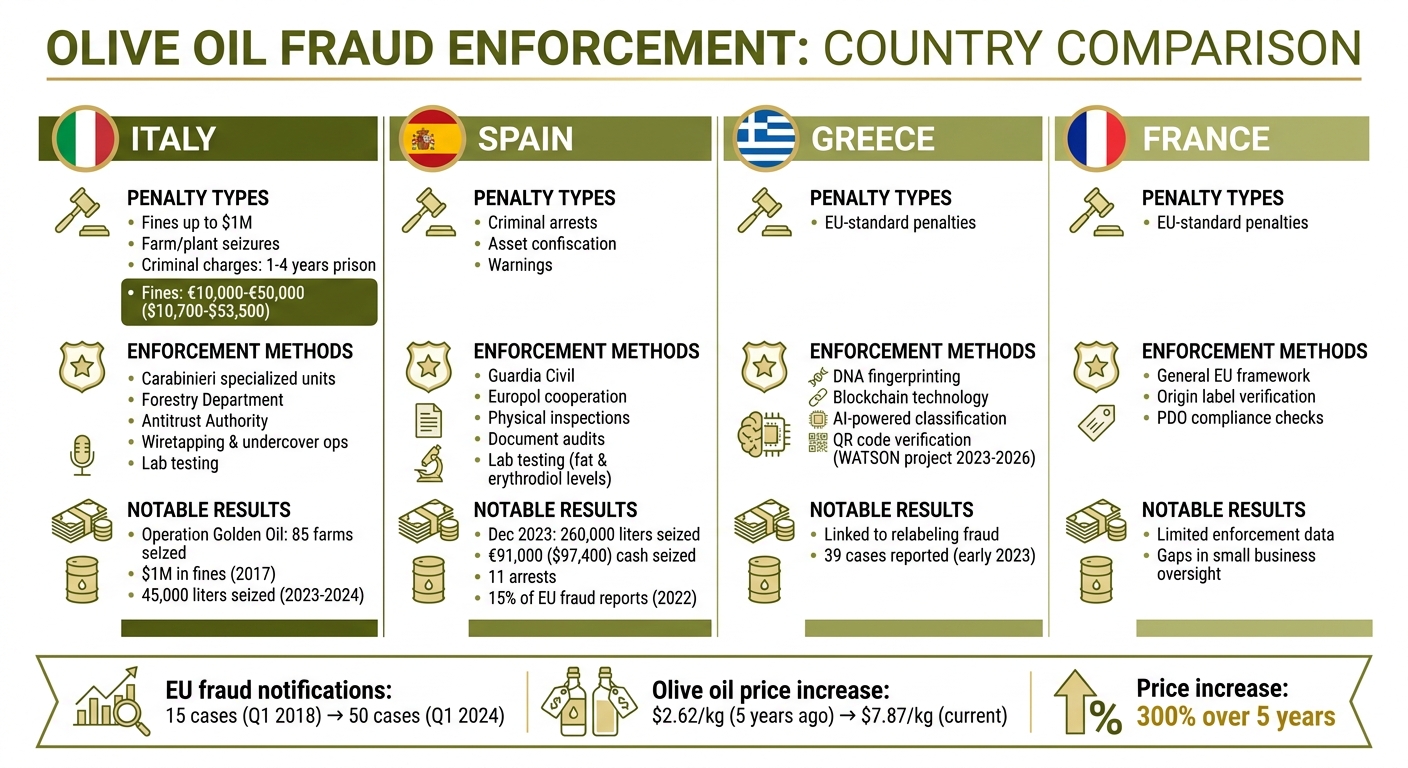
Olive Oil Fraud Penalties and Enforcement Methods Across EU Countries
This section dives into how different countries tackle olive oil fraud, comparing their strengths and weaknesses.
Countries use a variety of approaches to combat fraud, and their success rates differ. Italy takes a strong stance with specialized units like the Carabinieri and Forestry Department. These groups focus on large-scale criminal investigations, going beyond fines to seize farms and production facilities. A prime example is March 2008's Operation Golden Oil, where 400 Italian officers arrested 23 people and seized 85 farms involved in fraudulent relabeling schemes. Italy's Antitrust Authority has also been proactive, fining brands nearly $1 million in June 2017 for falsely labeling "virgin" oil as "extra virgin".
Spain, on the other hand, excels in international collaboration, working closely with Italy and Europol on cross-border operations. This cooperation has led to notable successes, such as joint raids that seized significant amounts of fraudulent olive oil. However, Spain faces challenges like a 27% drop in production in key areas such as Jaén, driven by climate-related issues, which has increased the temptation for fraud.
Greece and France rely more on general EU regulations rather than specialized enforcement units. Greece has been frequently linked to fraud cases, particularly involving the mislabeling of oil as "Italian". France focuses on issues like adulteration and mislabeling but struggles with enforcement gaps, especially among smaller businesses, restaurants, and online platforms.
Here’s a quick comparison of the approaches:
| Country | Penalty Types | Enforcement Methods | Notable Results |
|---|---|---|---|
| Italy | Fines up to $1M, farm/plant seizures, criminal charges | Carabinieri, Forestry Dept, Antitrust Authority | Operation Golden Oil: 85 farms seized; $1M in fines (2017) |
| Spain | Arrests, warnings, joint raids | Guardia Civil, Europol cooperation | Dec 2023: 68,000 gallons seized (with Italy); 45,000 liters of fake EVOO confiscated |
| Greece | EU-standard penalties | General EU framework | Linked to relabeling fraud; 39 cases reported in early 2023 |
| France | EU-standard penalties | General EU framework | Limited data; enforcement gaps in small business oversight |
One common challenge for all countries is detecting increasingly advanced fraud techniques. For example, the International Olive Council's standard tests often fail to identify "deodorized" oils - low-quality oils that are treated to remove odors and then mixed with a small amount of genuine extra virgin oil for flavor. To ensure quality, consumers should look for fresh harvest extra virgin olive oil from trusted sources. With extra virgin olive oil prices now averaging $7.87 per kilogram (up from $2.62 five years ago), the potential profits from fraud have skyrocketed, making enforcement even harder. Italy's robust enforcement stands out in this landscape, but the shared challenges highlight the need for stronger, more unified efforts across the EU.
Conclusion
Italy's approach to combating olive oil fraud, with its criminal charges and specialized task forces, stands out within the EU. Authorities like the Carabinieri and the forestry department have taken decisive action - seizing entire farms, arresting numerous individuals, and levying nearly $1 million in fines against major brands such as Bertolli and Carapelli.
Meanwhile, Spain has leaned on collaboration with Europol to conduct joint cross-border operations, showcasing a different yet effective strategy.
These national efforts directly impact the trustworthiness of premium olive oil sourcing. Italy's stringent penalties and focus on single-estate producers, who ensure full traceability from harvest to bottle, bolster the integrity of sourcing for companies like Big Horn Olive Oil. However, fraudulent oils often evade detection in major retail chains, slipping into smaller businesses and online markets where oversight is often weaker. This underscores the importance of building direct relationships with transparent producers, especially in a market where olive oil prices have skyrocketed by 300% over the past five years.
Still, Italy's robust enforcement can't eliminate fraud entirely. Advanced methods like soft column deodorization continue to fool even the International Olive Council's standard tests, allowing subpar oils to pass as extra virgin.
Italy’s strategy, which includes mandatory traceability, dedicated enforcement units, and cross-border collaboration, could serve as a model for the EU. Requiring producers to specify the exact farm and press of origin - despite opposition from the EU - helps close loopholes that allow blended oils from multiple countries to be marketed under a single "Italian" label. For importers aiming for Ultra Premium standards, Italy's stricter penalties make identifying authentic producers more feasible, though constant vigilance remains essential in an industry still vulnerable to sophisticated fraud.
FAQs
How can I spot fake “extra virgin” olive oil when shopping?
To spot fake "extra virgin" olive oil, start by checking the label for certification or quality seals, which can confirm its authenticity. Pay attention to details like the specific origin and a harvest or bottling date - these indicate freshness. Real olive oil typically has a fruity, grassy aroma and a greenish-golden hue. Be cautious of oils that smell rancid or musty, as these are red flags. When in doubt, buy from trusted sellers who offer clear product details and traceability.
What do Italy’s new olive oil fraud penalties mean for U.S. consumers and importers?
Italy has introduced tougher penalties for olive oil fraud, targeting counterfeit or mislabeled products. These measures include stricter fines, product seizures, and even criminal charges. For U.S. consumers and importers, this could boost trust in the authenticity of olive oil. However, it might also present challenges in meeting these more rigorous standards when sourcing products.
Why is olive oil fraud rising even with stricter EU traceability rules?
Olive oil fraud is on the rise, even with stricter traceability rules in the EU. Why? Climate-related harvest failures and rising prices are making it harder for producers to keep up with demand while staying profitable. This creates a tempting environment for adulteration and mislabeling. Adding to the challenge, enforcement and penalties differ from one EU country to another, which can weaken the overall impact of these regulations.