

Legal Protections for Balsamic Vinegar of Modena
When you buy a bottle labeled "Aceto Balsamico di Modena", you're purchasing a product protected by strict European Union regulations. Since 2009, the Protected Geographical Indication (PGI) certification has ensured that only vinegar made in Modena, Italy, following specific production standards, can use this name. This safeguards quality and prevents misleading products from entering the market.
Here’s what you need to know:
- PGI Certification: Protects the full name "Aceto Balsamico di Modena" and enforces rules on grape varieties, aging, and production processes.
- Legal Enforcement: EU regulations and courts ensure compliance, penalizing misuse of the name.
- Consortium Oversight: A group of Modena producers monitors production, educates consumers, and fights counterfeits.
- U.S. Impact: Certified products are imported under strict rules, ensuring American consumers get genuine vinegar with clear origins.
For buyers, look for the PGI seal and the full product name to ensure you're getting a certified product. Avoid generic terms like "balsamic" or "vinegar", which may indicate lower-quality, uncertified alternatives.
What makes Balsamic Vinegar of Modena PGI so unique?
Legal Frameworks That Protect Balsamic Vinegar of Modena
Three key legal structures work together to ensure the authenticity and quality of Balsamic Vinegar of Modena. These measures safeguard the product’s heritage, prevent counterfeiting, and assure consumers they’re getting genuine vinegar from Italy’s Modena region.
Protected Geographical Indication (PGI) Certification
At the heart of the protection is the PGI certification, a European Union quality standard that specifically safeguards the name "Aceto Balsamico di Modena." This protection ensures that only vinegar produced in the Modena region using approved traditional methods can carry this label.
The certification doesn’t just protect the geographic name - it enforces strict production standards. Producers must use specific grape varieties, follow traditional cooking techniques, and adhere to aging processes that have been practiced in Modena for generations.
European Union Rules and Enforcement
The European Union builds on the PGI framework with comprehensive regulations. Regulation (EU) No 1151/2012 establishes quality schemes for agricultural products and foodstuffs, including Balsamic Vinegar of Modena. This regulation sets binding rules that all EU member states must follow to protect geographical indications.
To enforce these rules, the EU employs several tools, including fines, injunctions, and the removal of products that misuse protected names. Authorities regularly monitor markets, online platforms, and imports to identify violations. When disputes arise over product names or labels, a structured legal process - sometimes escalating to the European Court of Justice - resolves conflicts. This system has consistently upheld the boundaries of PGI protection, clarifying what qualifies as legitimate use and what doesn’t.
The Consortium for the Protection of Balsamic Vinegar of Modena
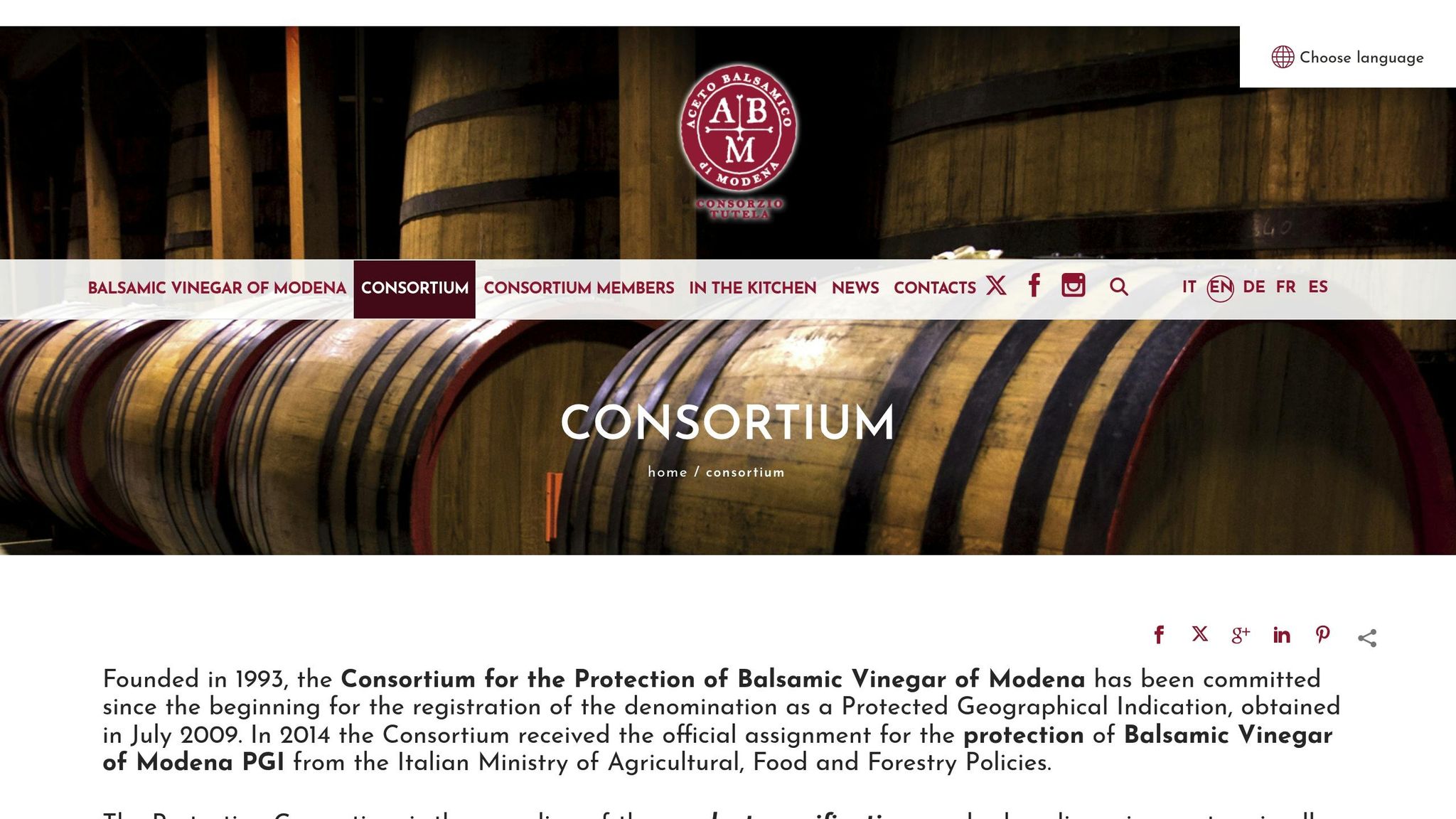
The Consortium for the Protection of Balsamic Vinegar of Modena plays a critical role in maintaining PGI standards and defending against misuse of the name. Comprising certified producers from the Modena region, the Consortium acts as both a quality control body and an enforcement authority.
Its responsibilities include inspecting member facilities, verifying production processes, and testing products to confirm compliance with PGI requirements. The Consortium also works closely with Italian and EU authorities to identify and address potential violations. They provide clear guidance to consumers on recognizing authentic products, including what to look for on labels.
A notable example of their efforts occurred in 2023 when the Milan Court of Appeal ruled on a case involving "Acetaia del balsamico." The Consortium successfully argued that while the terms "aceto" and "balsamico" are not individually protected, the overall presentation of a product must not mislead consumers or evoke the protected geographical area. The court upheld this position, reinforcing the integrity of PGI standards.
Together, these legal protections form a robust system that preserves the heritage and quality of Balsamic Vinegar of Modena while ensuring consumers can trust the authenticity of their purchase.
International Legal Cases and Enforcement
European courts have played a key role in defining the legal protections for Balsamic Vinegar of Modena. Their rulings have set clear boundaries for the use of balsamic-related terms, shaping how specialty foods are safeguarded on a global scale.
Important Court Decisions on Labeling and Product Claims
One of the most notable cases, CJEU Case C-432/18 (2019), clarified the scope of Protected Geographical Indication (PGI) protection. This case arose when the German Federal Court of Justice referred a dispute involving the Consorzio Produzione Certificata Aceto Balsamico Modenese and a German vinegar producer marketing products under names like "Deutscher Balsamico" and "1. Deutsches Essig-Brauhaus, Premium, 1868 Balsamico, Rezeptur No. 3."
The European Court of Justice ruled that PGI protection applies only to the full name "Aceto Balsamico di Modena" and does not extend to individual terms like "balsamico" or "vinegar." This decision allowed the German producer to continue using "Deutscher Balsamico", as long as the product's presentation didn't mislead consumers about its origin.
In 2023, the Milan Court of Appeal ruled on a dispute between the Consortium for the Protection of Balsamic Vinegar of Modena and Acetaia del balsamico trentino di Bombardelli. The court found that the name "Acetaia del Balsamico" did not unlawfully evoke the protected PGI because it referred to Trentino, a region distinct from Modena.
The Italian Supreme Court reinforced these principles in 2024, upholding earlier decisions in a case involving the Consortium Tutela Aceto Balsamico di Modena against Acetaia del balsamico trentino di Bombardelli and Bennet S.p.A. The court confirmed that terms like "vinegar" and "balsamic vinegar" are generic and can be used by producers outside Modena, provided they don't mislead consumers.
| Court/Case | Year | Key Ruling |
|---|---|---|
| CJEU Case C-432/18 | 2019 | PGI protection applies only to the full name "Aceto Balsamico di Modena" |
| Milan Court of Appeal | 2023 | Generic terms like "aceto" and "balsamico" cannot evoke PGI |
| Italian Supreme Court | 2024 | GI protection applies to full composite names only |
These courts use a "direct link" test to assess whether a disputed name creates a misleading association with the protected PGI in the mind of the average European consumer. This ensures fair competition while safeguarding the authenticity of Modena products.
Effects on Global Trade and Specialty Food Protection
These legal decisions have had a meaningful impact on international trade and the protection of specialty foods. By establishing clear labeling guidelines, they strike a balance between protecting authentic products and encouraging fair competition. The rulings prevent the misuse of protected names while allowing legitimate producers to use generic terms like "balsamic vinegar", provided their branding doesn't falsely suggest a connection to Modena or imply compliance with PGI standards.
For producers, importers, and retailers, these decisions offer clarity and consistency. They ensure that companies can market their products without fear of overstepping legal boundaries, as long as they adhere to proper labeling practices. This clarity also supports the PGI system, which benefits not just Modena products but other well-known specialties like Parmigiano Reggiano, Champagne, and Roquefort cheese.
The ripple effect of these rulings is evident in U.S. markets, where they help protect the integrity of products labeled as "Balsamic Vinegar of Modena." By adhering to strict quality standards, these protections guard against counterfeits and bolster the reputation of genuine Italian products in the U.S.
Globally, these enforcement efforts have pushed for greater transparency in labeling practices. Producers are now more accountable for accurately representing their products' origins and production methods. This not only helps consumers make informed choices but also fosters fair competition in the specialty food industry.
sbb-itb-4066b8e
Certification Requirements for Balsamic Vinegar of Modena
The PGI certification for Balsamic Vinegar of Modena is built on a solid legal foundation, ensuring strict production, geographic, and labeling standards are met. These rules aren’t just guidelines - they’re enforced to maintain the product’s quality and authenticity. The certification process involves detailed oversight of how the vinegar is made, where it originates, and how it’s labeled.
Production Rules and Geographic Limits
Authentic Balsamic Vinegar of Modena can only come from Modena and Reggio Emilia, where producers follow time-honored methods. The process starts with specific grape varieties, primarily Trebbiano and Lambrusco. These grapes are transformed into concentrated must, which is then aged in wooden barrels to develop the vinegar's signature flavor.
Aging plays a crucial role in the certification. The PGI standard mandates a minimum aging period of 60 days, but many producers go well beyond this to create a richer, more complex taste.
The Consortium for the Protection of Balsamic Vinegar of Modena oversees the entire process. From monitoring production facilities to testing product quality and verifying labeling, the Consortium ensures that every certified vinegar meets the established standards. Producers must register with the Consortium and undergo regular inspections to retain their certification.
How to Spot Certified Products
When buying Balsamic Vinegar of Modena, start by checking the label and packaging. Look for the full name “Aceto Balsamico di Modena” and the official PGI seal. These are non-negotiable elements for certified products, as confirmed by recent legal rulings.
Authentic labels also include details like the geographic origin, approved grape varieties, and producer registration information. Many certified products proudly display the Consortium’s official seal as an additional mark of authenticity.
Trusted retailers are another key to finding genuine balsamic vinegar. Specialty stores that focus on high-quality Italian goods often carry certified products and can share information about their origins. For example, companies like Big Horn Olive Oil source directly from Modena, ensuring customers receive certified vinegar.
Be wary of prices that seem too good to be true - authentic balsamic vinegar involves high production costs, so counterfeit products often sell at suspiciously low prices. Packaging can also be a clue: certified producers often use traditional bottle designs and provide detailed information about production and aging, while counterfeit products tend to have simpler, less informative packaging.
| Certification Level | Geographic Origin | Minimum Aging | Key Identifiers |
|---|---|---|---|
| Balsamic Vinegar of Modena (PGI) | Modena/Reggio Emilia | 60 days | PGI seal, full name required |
| Traditional Balsamic Vinegar of Modena (PDO) | Modena only | 12 years | PDO seal, strict aging verification |
| Generic "Balsamic Vinegar" | Any | No requirement | No protected designation |
Reading the ingredient list is another way to confirm authenticity. Certified products contain only grape must and wine vinegar from approved varieties. If you see artificial flavors, colors, or additives, it’s not the real deal.
These certification standards don’t just protect the integrity of Balsamic Vinegar of Modena - they also help consumers make informed choices. By understanding these requirements, buyers can support genuine producers and enjoy the rich tradition behind this Italian specialty.
Impact on U.S. Consumers and Importers
The EU's Protected Geographical Indication (PGI) standards extend their influence across the Atlantic, shaping U.S. import regulations and consumer decisions. By safeguarding traditional practices, these standards not only preserve heritage but also enhance consumer trust globally. The framework ties European certification processes directly to U.S. market expectations, creating a cohesive system for authentic products.
How EU Certifications Work in the U.S.
EU PGI certifications carry legal weight in the U.S., but they work within certain limitations. For instance, while generic terms like "balsamic" or "vinegar" can still be used by non-certified products, only those meeting strict PGI criteria can claim the full name, such as "Balsamic Vinegar of Modena."
This dual-layered regulatory environment requires U.S. importers to navigate both American labeling laws and EU certification rules. Importers aiming to sell authentic Balsamic Vinegar of Modena must source exclusively from certified producers in Modena and Reggio Emilia. Products from other regions, even if similar, cannot legally use the protected name.
Enforcement involves trade agreements and intellectual property protections. U.S. customs officials and trade regulators recognize these geographical indications, ensuring that mislabeled products face legal consequences, including removal from the market. Retailers are therefore obligated to stock only certified imports, maintaining a transparent supply chain from Italy to American store shelves.
Why Certified Balsamic Vinegar Benefits U.S. Consumers
For American consumers, PGI-certified Balsamic Vinegar of Modena offers more than just a label - it’s a promise of quality, tradition, and authenticity. Certification ensures adherence to strict production methods, aging processes, and ingredient standards that generic versions often bypass.
In 2022, the U.S. imported over $100 million worth of Italian balsamic vinegar, with a large chunk being PGI-certified. This trend reflects growing consumer awareness of the quality gap between certified and non-certified options, as well as a willingness to pay for authenticity.
Certified balsamic vinegar typically costs $10–$40 for a 250 ml bottle, significantly higher than the $3–$15 range for generic versions. This price difference reflects the craftsmanship, aging, and origin guaranteed by certification.
Specialty retailers play a pivotal role in bridging the gap between Italian producers and U.S. consumers. For instance, Big Horn Olive Oil sources directly from Modena, ensuring customers receive authentic products along with detailed information about their origin and certification. This direct approach helps maintain the integrity of the product.
Consumers often note that generic balsamic vinegars lack complexity, lean on excessive sweetness, and come with unclear origins. PGI certification addresses these concerns by enforcing consistent quality standards and transparent production practices.
For U.S. buyers, the advantages are clear: certification guarantees traceability, approved ingredients, and a rich, consistent flavor while supporting traditional Italian craftsmanship.
| Benefit Category | PGI-Certified Products | Generic Products |
|---|---|---|
| Quality Assurance | Guaranteed production standards | Variable quality |
| Ingredient Transparency | Only approved grape varieties | May contain additives |
| Traceability | Complete production history | Limited source information |
| Flavor Profile | Consistent, complex flavor | Often lacking in depth |
Conclusion: Protecting Quality and Heritage
The legal protections for Balsamic Vinegar of Modena go beyond simple regulations - they uphold centuries of tradition and ensure consistent quality. Thanks to its Protected Geographical Indication (PGI) status, only vinegars made in Modena, Italy, under strict guidelines can bear the name, preserving its genuine heritage for future generations.
Legal decisions have further solidified these protections. For instance, the Court of Justice of the European Union (CJEU) has ruled that only the full name "Aceto Balsamico di Modena" is covered by PGI status, excluding generic terms like "balsamico" or "aceto". This precedent not only strengthens enforcement but also provides clear direction for producers, importers, and buyers.
These protections offer tangible benefits for consumers and businesses alike. For American buyers, they ensure access to products that meet high standards of quality, transparency in production, and authentic taste. Companies like Big Horn Olive Oil, which source directly from Modena, exemplify how such legal safeguards allow retailers to maintain the integrity of their products across borders.
The persistent issues of counterfeiting and misleading marketing underscore the importance of these legal measures. As more people seek authentic specialty foods, the protections for Balsamic Vinegar of Modena set a strong example of how culinary traditions can be preserved while meeting modern global demand.
FAQs
What are the specific grape varieties and production standards required for Balsamic Vinegar of Modena to earn PGI certification?
To meet the standards of Balsamic Vinegar of Modena (Aceto Balsamico di Modena) under the PGI (Protected Geographical Indication) certification, the product must follow specific, time-honored guidelines. It starts with grape must sourced from particular varieties like Trebbiano and Lambrusco, which are traditionally cultivated in the Modena and Reggio Emilia regions of Italy.
The process involves combining grape must with wine vinegar and then aging the mixture in wooden barrels for at least 60 days. The PGI certification guarantees that the vinegar is produced exclusively in Modena or Reggio Emilia, using traditional methods that maintain its distinct character and flavor.
This certification not only safeguards the authenticity of this renowned product but also helps consumers confidently choose genuine Balsamic Vinegar of Modena, allowing them to experience its rich history and exceptional quality.
What ensures the authenticity of Balsamic Vinegar of Modena in the U.S. market?
The Protected Geographical Indication (PGI) certification safeguards the true identity of Balsamic Vinegar of Modena. This certification ensures that only vinegar produced in Modena, Italy, and meeting strict quality criteria can bear this esteemed label. It's a guarantee of both origin and craftsmanship.
At Big Horn Olive Oil, you'll find a selection of premium balsamic vinegars sourced straight from Modena. These offerings bring the rich tradition and genuine quality of this iconic product right to customers in the U.S.
How can I make sure I'm buying authentic Balsamic Vinegar of Modena, and what are the signs of fake products?
To make sure you're getting authentic Balsamic Vinegar of Modena, check for the Protected Geographical Indication (PGI) label on the bottle. This label ensures the vinegar is produced in Modena or Reggio Emilia, Italy, and meets strict production standards.
Be cautious of fake products. Counterfeits often have vague labels, suspiciously low prices, or no clear details about their origin. Authentic balsamic vinegar usually comes in well-made packaging and lists its ingredients transparently - typically just cooked grape must and wine vinegar, with no added sugars or artificial flavors. For peace of mind, stick to trusted retailers or brands that emphasize quality and authenticity.