

Mediterranean Olive Farms Adopting No-Till Practices
Mediterranean olive farms are moving away from plowing to manage soil and weeds, a practice that has caused erosion, reduced fertility, and biodiversity loss. Instead, many are trying no-till farming, which avoids disturbing the soil. This method often uses cover crops or herbicides to manage weeds, with cover crops offering better results for soil health and water conservation.
Key findings include:
- Soil erosion drops significantly with no-till and cover crops (0.8 tons/acre/year vs. 2.9 tons with plowing).
- Water runoff is lower with cover crops (1.2% vs. 11.9% for bare soil in no-till systems).
- Carbon storage increases with cover crops, adding up to 570 pounds/acre/year.
- Farm income improves with regenerative no-till systems, earning $1,460/acre compared to $509/acre with plowing.
However, there are challenges:
- Cover crops can compete with olive trees for water during dry summers.
- Farmers still prefer weed-free fields, which aligns with older farming practices but worsens erosion.
No-till farming with cover crops offers better soil health, water retention, and yields, but requires careful management and a shift in mindset.
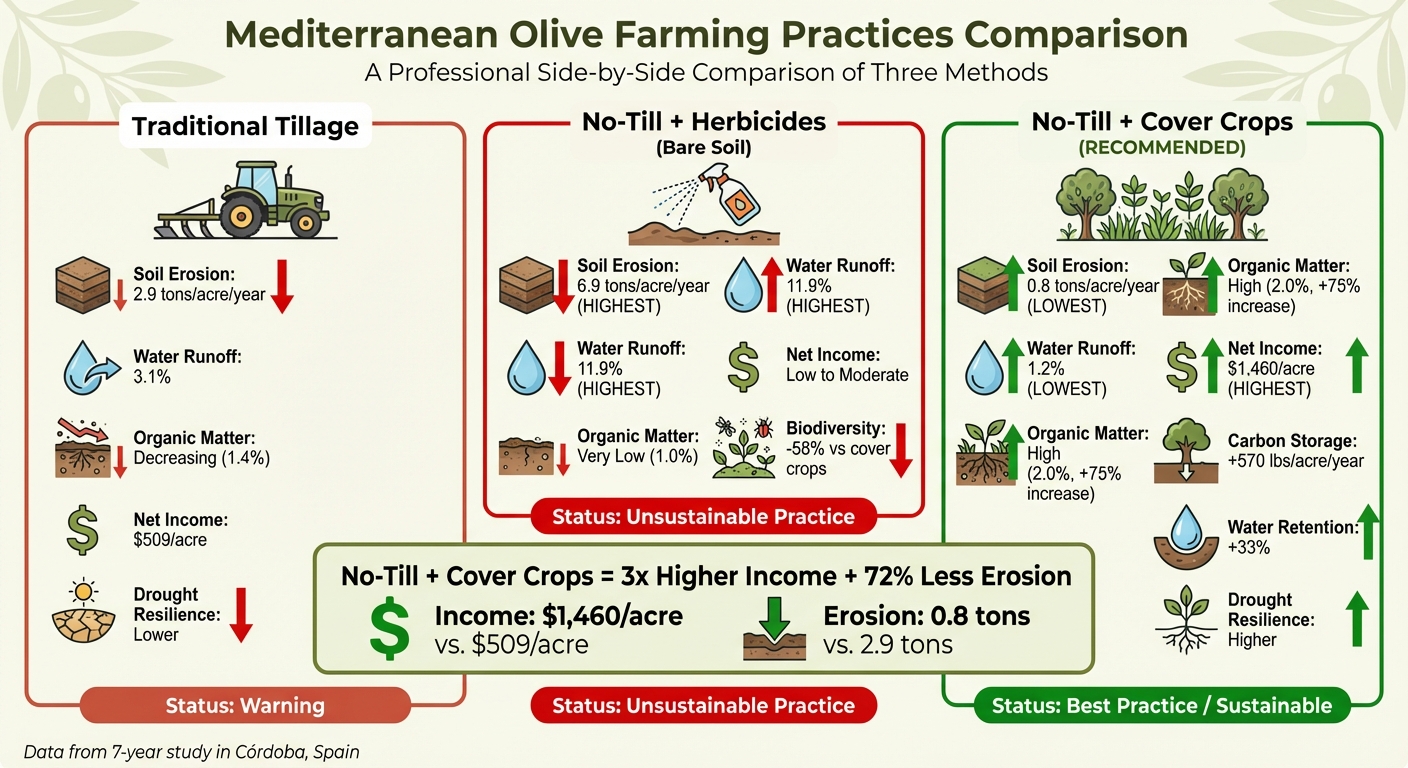
Comparison of Tillage Methods in Mediterranean Olive Farming: Soil Health and Economic Impact
Reviving Abandoned Olive Groves: a Regenerative Approach in Spain
sbb-itb-4066b8e
1. No-Till Practices in Mediterranean Olive Farming
Recent research highlights how moving from traditional tillage to no-till methods with cover crops is transforming olive farming in the Mediterranean region.
Soil Health and Erosion Control
The effectiveness of no-till farming often hinges on how the soil is managed. Leaving soil bare with herbicides can actually worsen erosion. A seven-year study conducted near Córdoba, Spain, led by José Alfonso Gómez of the Institute for Sustainable Agriculture (IAS-CSIC), revealed that bare no-till systems lost 6.9 tons of soil per acre annually - more than double the 2.9 tons lost with conventional plowing. Without vegetation or roots, the soil develops a crust that limits water absorption.
Cover crops, however, make a huge difference. The same study showed that using cover crops reduced soil loss to just 0.8 tons per acre per year. In some cases, this approach reduced erosion by up to 140 times compared to tilled fields. These plants protect the soil from rain impact and excessive heat. When mowed, they decompose into humus, naturally enriching the soil.
Between 2020 and 2026, Milagros Torrús Castillo led a project in Córdoba's Conde Valley comparing regenerative practices to conventional tillage. Regenerative plots that included permanent turf, shredded pruning residues, and controlled grazing saw a 75% rise in organic matter and a 33% improvement in water retention capacity. As Torrús Castillo explained:
"The study shows that we can restore soil health to levels close to those of a natural ecosystem. This translates into greater resilience for family farms, often threatened by high costs and climate change."
These soil improvements pave the way for better water retention, as observed in follow-up studies.
Water Retention and Runoff
Effective water management in no-till systems depends heavily on ground cover. In a study at the La Conchuela orchard, bare no-till fields had a runoff coefficient of 11.9%, while fields with cover crops reduced runoff to just 1.2%. Vegetative roots enhance soil structure, creating channels that allow water to infiltrate more easily and delay runoff. In contrast, bare soil tends to compact, sealing the surface. Another study found that weed cover extended the time before runoff began from 273 seconds on tilled soil to 788 seconds - nearly three times longer for water to soak in. This delay is particularly valuable in the Mediterranean's dry climate, where every drop counts.
Crop Productivity and Ecosystem Benefits
Healthier soil leads to better crop yields and financial benefits. Regenerative no-till systems offer both environmental and economic advantages. For example, in the Conde Valley project, regenerative olive groves generated a net income of $1,460 per acre (about €1,340 per hectare), compared to $509 per acre (around €467 per hectare) for conventional groves. Stronger soil structure supports healthier olive trees while cutting down on input costs.
Another benefit is carbon sequestration. Andalusian groves with cover crops capture up to 570 pounds of carbon per acre annually. Additionally, shredding pruning branches on-site instead of burning them creates a natural mulch, promoting beneficial fungi and improving long-term soil quality.
Adoption Challenges
Despite the advantages, implementing no-till practices comes with hurdles. Cover crops can compete with olive trees for water and nutrients, especially in rainfed systems with limited rainfall. Mowing in early spring, before the dry season begins, can help minimize this competition. Sowing cover crops in early autumn, right after the rains, also improves their establishment.
Cultural preferences for weed-free fields persist, even though they increase erosion risks. Other challenges include selecting the right seeds and managing higher herbicide costs for bare no-till systems. The lack of a clear European certification for regenerative farming adds regulatory uncertainty. Additionally, dry periods can heighten fire and pest risks, requiring careful monitoring. Addressing these obstacles is essential to fully realizing the benefits of regenerative practices.
| Management Practice | Soil Loss (tons/acre/year) | Runoff Coefficient (%) | Organic Matter (%) |
|---|---|---|---|
| No-Till + Cover Crops | 0.8 | 1.2 | 2.0 |
| Conventional Tillage | 2.9 | 3.1 | 1.4 |
| No-Till + Herbicides (Bare) | 6.9 | 11.9 | 1.0 |
Data from a seven-year study near Córdoba, Spain.
2. Traditional Tillage in Mediterranean Olive Farming
Despite the growing interest in no-till methods, traditional tillage remains widespread in Mediterranean olive farming. This is largely due to deeply ingrained practices and cultural perceptions, even though the environmental downsides are becoming harder to ignore. Historically, farmers have used discing to a depth of about 8 inches (20 cm) to manage weeds and reduce water competition. A bare, weed-free field is often seen as a hallmark of good farming. However, this approach has left over half of Spain's olive-growing areas exposed, with herbicides playing a significant role in maintaining these conditions.
Soil Health and Erosion Control
Traditional tillage continues to dominate, but its impact on soil health is severe. Repeated tilling disrupts soil structure and accelerates the breakdown of organic matter by exposing it to oxygen and microorganisms. Over time, this leads to the formation of a compacted "plough layer", which limits water infiltration, restricts root growth, and damages the shallow root systems of olive trees.
The erosion caused by this method is staggering. A long-term study in Torredelcampo, Spain (2004–2019), found that conventional tillage led to soil carbon losses of about 1.8 metric tons per hectare (0.8 short tons per acre) annually. Over the same period, soil organic carbon and nitrogen stocks dropped by more than 30% across all soil layers. On average, Mediterranean olive groves lose roughly 7.51 metric tons of soil per hectare (3.4 short tons per acre) each year due to tillage. In some areas, particularly on slopes, losses can skyrocket to 72.3 metric tons per hectare (32 short tons per acre) when combining water and tillage erosion. Historical data shows erosion rates have ranged between 29 and 47 metric tons per hectare per year (13–21 short tons per acre) over the past 250 years.
Water Retention and Runoff
Repeated tilling also worsens water runoff, especially during heavy Mediterranean rainstorms. While tillage initially loosens the soil surface, the absence of vegetation leaves the ground exposed and vulnerable. This bare soil quickly forms a crust, reducing its ability to absorb water. As a result, runoff begins much sooner on tilled fields compared to those with vegetation cover.
For example, at La Conchuela farm near Córdoba (1999–2006), conventional tillage led to a runoff coefficient of 3.1%, meaning 3.1% of rainfall flowed off the surface instead of soaking in. The sediment concentration in this runoff reached 18.6 grams per liter, compared to just 1.43 grams per liter in vegetated plots. In some cases, runoff from tilled fields can account for as much as 27.6% of total rainfall.
Crop Productivity and Ecosystem Benefits
Traditional tillage also takes a toll on soil biodiversity and overall ecosystem health. Research shows that tilled olive groves have 47.7% fewer nematodes and 12.4% lower species diversity compared to natural oak woodlands. These disruptions simplify the soil food web and deplete essential bacterial and fungal decomposition pathways.
When it comes to crop yields, the results under traditional tillage can vary depending on rainfall. A 15-year trial in Santaella, Córdoba, revealed that during normal rainfall years, yields were similar between conventional and no-till systems. However, in drought years, no-till systems performed much better due to their improved water retention. While conventional tillage initially reduced surface bulk density (0.40 MPa compared to 6.04 MPa in no-till), it also created deeper compaction zones that hindered root growth and reduced water storage.
As researcher Andrés Peñuela explains:
"A 'clean' tilled, weed-free field is perceived as signs of diligent farming, while the presence of groundcover is seen as neglect."
This perception continues to influence farming practices, even as evidence mounts that these methods are unsustainable for soil health and long-term productivity. It highlights the growing need for a shift toward no-till practices to address these challenges.
Advantages and Disadvantages
When it comes to soil health, comparing no-till and traditional tillage methods highlights a variety of trade-offs. The choice between these approaches often depends on local conditions, available resources, and long-term farming goals.
Traditional tillage offers some immediate perks, like reducing soil compaction and improving short-term water infiltration. It also mechanically removes weeds, making it a viable option for organic farming without the need for herbicides. However, these benefits come with significant downsides. Soil erosion under this method can reach alarming levels - about 3.25 metric tons per hectare annually (roughly 1.45 short tons per acre). Water runoff averages around 17.6 mm per year (0.69 inches), and frequent soil disruption speeds up organic matter loss while harming shallow root systems, which are crucial for crops like olive trees.
No-till with cover crops, on the other hand, presents a more sustainable path. This method significantly curbs soil erosion, reducing it to about 0.70 metric tons per hectare annually (approximately 0.31 short tons per acre), and water runoff drops to 5.8 mm per year (0.23 inches). Cover crops also introduce multiple benefits: organic matter levels can increase by 75%, soil stability against water erosion improves by 33%, and moisture retention rises by the same percentage. Financially, this system is more rewarding, with profits of approximately $1,474 per hectare (around $597 per acre), compared to $514 per hectare (about $210 per acre) from conventional methods.
No-till with herbicides (bare soil) is another option, offering lower machinery costs and reduced erosion compared to traditional tillage. However, it comes with its own set of challenges. Carbon losses can be even higher than those from conventional tillage, averaging 1.8 metric tons per hectare annually over 15 years. Soil biodiversity also suffers, dropping by nearly 58% compared to systems using cover crops. In addition, surface sealing limits water infiltration. Researcher Manuel González-Rosado summed it up well:
"No-tillage with bare soil by using herbicides was demonstrated as an unsustainable agricultural practice".
To make these comparisons easier to digest, here’s a quick breakdown:
| Feature | Traditional Tillage | No-Till with Herbicides (Bare) | No-Till with Cover Crops |
|---|---|---|---|
| Soil Erosion | High (3.25 t/ha/yr; ~1.45 short tons/acre) | Moderate | Very Low (0.70 t/ha/yr; ~0.31 short tons/acre) |
| Water Runoff | High (17.6 mm/yr; ~0.69 in/yr) | Moderate | Low (5.8 mm/yr; ~0.23 in/yr) |
| Soil Compaction | Low (0.40 MPa; ~58 psi) | High (6.04 MPa; ~876 psi) | Moderate |
| Organic Matter | Decreasing | Very Low (high loss) | High (+75%) |
| Biodiversity | Low (disturbed) | Very Low (-57.9%) | High (structured) |
| Net Income | ~$514/ha (approx. ~$210/acre) | Low to Moderate | ~$1,474/ha (approx. ~$597/acre) |
| Drought Resilience | Lower | Moderate | Higher (+33% moisture) |
This comparison underscores why regenerative no-till systems, especially those using cover crops, are gaining traction in Mediterranean olive farming. The benefits for both the environment and profitability make them a compelling alternative.
Conclusion
No-till farming combined with cover crops offers a promising approach for Mediterranean olive groves. These regenerative methods improve soil conditions by reducing erosion to just 0.8 metric tons per hectare annually, boosting organic matter by 75%, and increasing moisture retention by 33%. On the financial side, the difference is striking - regenerative farms yield about $1,340 per hectare, compared to $467 per hectare for conventional systems.
That said, there are hurdles to address. No-till systems often face higher soil compaction (6.04 MPa compared to 0.40 MPa in traditional tillage). Additionally, cultural perceptions remain a challenge; some farmers still associate bare, tilled soil with good land management, while groundcover is sometimes seen as neglect. Another obstacle is the lack of clear European certification for regenerative practices, which makes it harder for farmers to command premium prices.
Farmers can take practical steps to enhance these systems. Maintaining permanent cover by planting forage crops and mowing early in spring helps reduce water competition. Shredding pruning residues for mulch and incorporating controlled winter grazing further support sustainability. For farms dealing with severe compaction, reduced tillage methods like chiseling can strike a balance between conservation and soil workability.
Research consistently shows that improving soil health strengthens the resilience of family farms.
With Mediterranean droughts becoming more frequent and operational costs on the rise, these regenerative no-till strategies provide both environmental and economic benefits. Studies from regions like Andalusia and Córdoba demonstrate that these methods are scalable and effective.
The challenge for the future lies in balancing soil health improvements, water conservation, and economic gains with the technical and cultural barriers farmers face. For olive oil enthusiasts, these efforts - exemplified by producers like Big Horn Olive Oil - highlight a dedication to environmental care that enhances the quality of premium extra virgin olive oil.
The path forward for Mediterranean olive farming lies in adopting practices that protect the land, conserve resources, and ensure the long-term success of both farms and the communities that depend on them.
FAQs
How do farmers choose the right cover crops for olive groves?
Farmers choose cover crops based on a mix of soil type, climate conditions, and how well the crops fit into their current farming practices. The main goals? To cut down on erosion, keep soil moisture intact, and add organic carbon and nutrients back into the soil. Many farmers lean toward species that naturally thrive in their area or temporary cover crops that promote biodiversity. These choices help strike a balance between ecological benefits and practical management, ultimately strengthening soil health and boosting productivity.
How can cover crops be managed without stealing water from olive trees?
Cover crops can be thoughtfully managed to ensure they don't compete with olive trees for water. By using either spontaneous or specifically chosen cover crops, farmers can actually improve soil moisture retention. Research from long-term studies in Andalusia highlights how this approach boosts soil health and biodiversity without cutting into olive yields. This shows that with the right management, water use can be balanced effectively while promoting sustainable farming practices.
Do no-till and cover crops change olive oil quality?
No-till farming and the use of cover crops play a crucial role in improving soil health. By minimizing erosion, increasing organic carbon levels, and fostering biodiversity, these methods create a healthier environment for olive trees. Healthier trees often produce more nutrient-dense olives, which can, in turn, enhance the quality of olive oil. Beyond these direct benefits, adopting such practices supports sustainable agriculture and may even elevate the flavor and nutritional profile of the oil.