

How Modena Sets the Standard for Balsamic Vinegar
Modena, Italy, is the heart of balsamic vinegar production, with a history spanning nearly 1,000 years. Its strict production standards and legal protections, including PGI and DOP certifications, ensure quality and authenticity. The region's unique climate, specific grape varieties, and time-honored aging methods contribute to its global reputation.
Key points:
- Two classifications: DOP (aged 12-25+ years, no additives) and IGP (aged 60 days or more, caramel allowed).
- Aging process: Uses wooden barrels made from oak, cherry, chestnut, and more, enhancing flavor over time.
- Pricing: Ranges from $2 for basic IGP to over $200 for premium DOP.
- Grape varieties: Includes Trebbiano, Lambrusco, and others grown in Emilia-Romagna.
- Legal protections: Italy defends the "Balsamic Vinegar of Modena" designation globally.
Modena's dedication ensures a high-quality product, perfect for salads, meats, desserts, and more, while preserving its centuries-old legacy.
Creating Italian food’s “black gold”: how Traditional Balsamic Vinegar of Modena is made
sbb-itb-4066b8e
Balsamic Vinegar Grading and Quality Standards
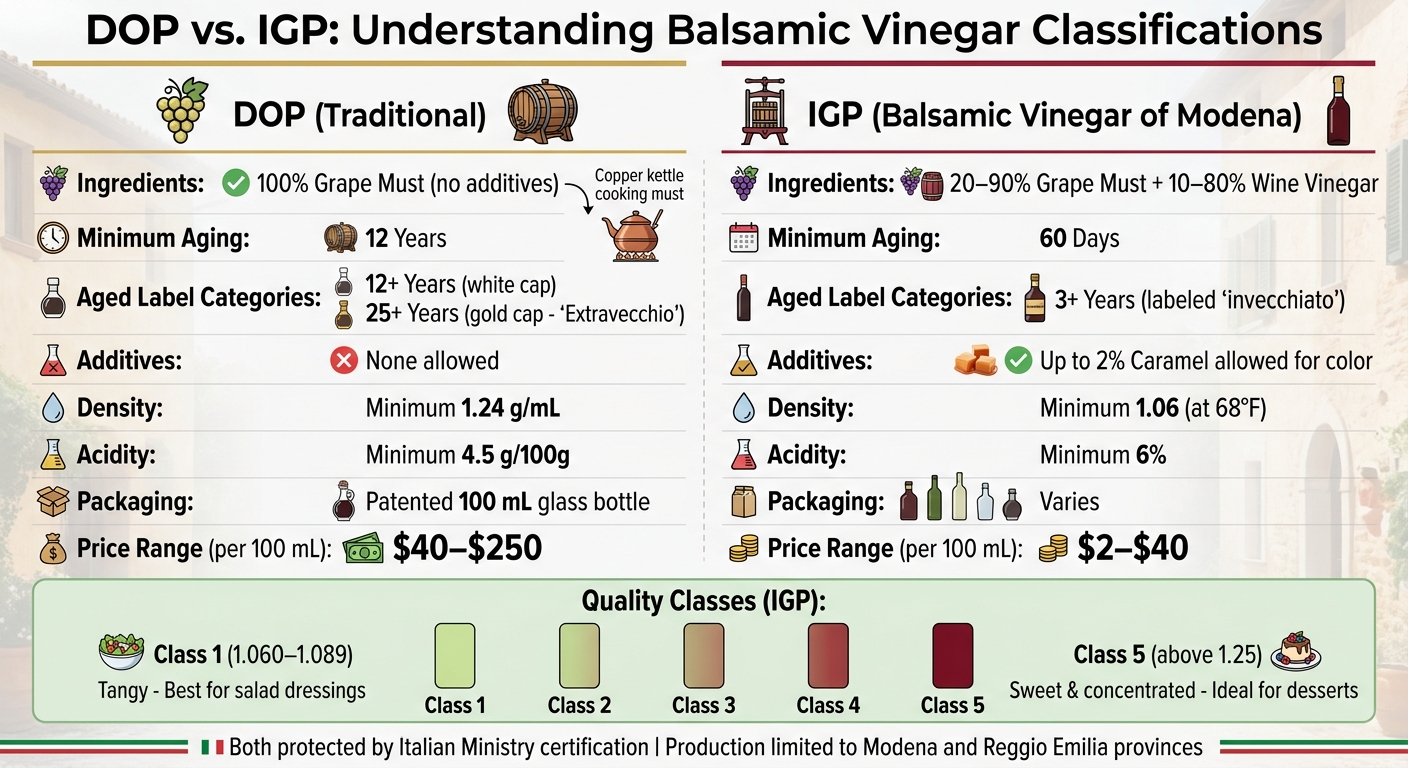
DOP vs IGP Balsamic Vinegar: Key Differences and Quality Standards
Modena's centuries-old tradition of balsamic vinegar production has evolved into a precise grading system that defines its global reputation. This system separates authentic balsamic vinegar into two main categories, each with its own production rules and benchmarks. These distinctions explain why prices range from about $2 to over $200.
DOP vs. IGP: Understanding the Classifications
DOP (Protected Designation of Origin) is the pinnacle of balsamic vinegar quality. It must be made entirely from cooked grape must, without additives, and aged for at least 12 years in a series of wooden barrels. For the "Extravecchio" label, aging extends to a minimum of 25 years. Production is strictly limited to the provinces of Modena or Reggio Emilia.
IGP (Protected Geographical Indication) refers to the more widely available Balsamic Vinegar of Modena. This type allows a blend of 20–90% grape must and 10–80% wine vinegar, with up to 2% caramel permitted for color consistency. The minimum aging requirement is just 60 days, though products aged for three years or more can carry the "invecchiato" (aged) label.
| Feature | DOP (Traditional) | IGP (Balsamic Vinegar of Modena) |
|---|---|---|
| Ingredients | 100% Grape Must | 20–90% Must; 10–80% Wine Vinegar |
| Aging Minimum | 12 Years | 60 Days |
| "Aged" Label | 12+ Years (white cap); 25+ Years (gold cap) | 3+ Years (labeled "invecchiato") |
| Additives | None allowed | Up to 2% Caramel allowed |
| Price Range (per 100 mL) | $40–$250 | $2–$40 |
These classifications establish the foundation for the rigorous quality standards that follow.
Quality Criteria for Authentic Balsamic Vinegar
Before hitting store shelves, every bottle undergoes certification by bodies authorized by the Italian Ministry. For IGP balsamic vinegar, the product must achieve a minimum density of 1.06 (measured at 68°F) and a total acidity of at least 6%. Only seven grape varieties - Lambrusco, Sangiovese, Trebbiano, Albana, Ancellotta, Fortana, and Montuni - are allowed. The aging process must take place in wooden barrels (oak, chestnut, mulberry, or juniper), and all steps of production are confined to Modena or Reggio Emilia.
Traditional DOP balsamic vinegar faces even stricter requirements. It must have a minimum density of 1.24 g/mL and an acidity level of at least 4.5 g/100 g. Authenticity is further ensured by its packaging in a patented 100 mL glass bottle. A white cap indicates the standard 12-year aging, while a gold cap signifies the "Extravecchio" designation for 25-year-aged products.
These rigorous standards highlight how the aging process enhances flavor and quality.
How Aging Affects Flavor and Quality
The Consorzio Tutela Aceto Balsamico di Modena uses a five-class system to grade IGP balsamic vinegar based on density and sensory characteristics. For instance, Class 1 vinegars (density 1.060–1.089) are tangier, making them perfect for salad dressings, while Class 5 vinegars (density above 1.25) are sweeter and more concentrated - ideal for desserts like strawberries.
Aging involves transferring the vinegar through barrels made of different woods, such as chestnut, cherry, mulberry, juniper, and oak. Each wood type contributes unique flavors: chestnut adds tannins and deepens color, cherry lends sweetness, mulberry aids oxygenation, juniper introduces resinous notes, and oak imparts vanilla undertones. This process typically takes place in attics where summer heat promotes fermentation and evaporation, while winter cold helps sediments settle. These time-tested methods continue to shape the premium EVOO and balsamic vinegar sets we enjoy today.
This natural aging and concentration process explains the wide price range. A 60-day IGP balsamic might cost around $20, a 7-year-aged condiment about $45, a traditional 12-year DOP bottle roughly $130, and a 25-year "Extravecchio" version as much as $220.
Production Methods in Modena
Grape Varieties and Ingredients Used in Modena
The creation of authentic Modena balsamic vinegar begins with specific grape varieties grown in Emilia-Romagna. Two key players - Trebbiano (especially Trebbiano di Castelvetro) and Lambrusco - are favored for their naturally high sugar content. This sweetness is essential for the cooking process, which concentrates the sugars and creates the characteristic flavor balance of sweetness and acidity.
In addition to these primary grapes, the regulations for Balsamic Vinegar of Modena (IGP) allow for seven specific cultivars: Lambrusco, Sangiovese, Trebbiano, Albana, Ancellotta, Fortana, and Montuni. Each contributes something unique. For example, Ancellotta enhances the color and body of the must, while Sangiovese adds aromatic depth, particularly noticeable after extended aging. These varieties ensure the vinegar retains its distinct connection to the Modena region.
The production process differs slightly between DOP and IGP balsamic vinegar. Traditional DOP balsamic uses 100% cooked grape must, while IGP allows blending - 20–90% grape must with 10–80% wine vinegar, and up to 2% caramel for color consistency. High-quality IGP vinegars often prioritize grape must as the main ingredient, signaling a richer concentration of this premium component.
These carefully chosen grapes and ingredients provide the perfect foundation for the meticulous cooking and aging processes that follow.
Cooking and Barrel Aging Techniques
Once the grapes are selected, the transformation begins with cooking and aging. Whole grapes - stems, seeds, and juice included - are pressed, and the must is cooked over an open flame. This process reduces the liquid by half, concentrating the sugars and creating a thick, syrupy base. For IGP balsamic vinegar, the must must reach a density of at least 1.240 at 68°F and contain at least 55 g/L of dry extract, ensuring the rich texture and flavor balsamic vinegar is known for.
After cooking, the must undergoes natural fermentation for up to three weeks. Then, the aging process begins using a batteria - a series of 5 to 10 wooden barrels that decrease in size, ranging from about 16 gallons to just 2.6 gallons. Each year, producers transfer the vinegar to smaller barrels in a process called rincalzo. This method blends older and newer vinegar while allowing evaporation, which thickens the vinegar and intensifies its flavors. Over time, the vinegar loses about 10% of its volume annually due to evaporation, so 100 liters of grape must will yield just 15 liters after 12 years.
The type of wood used for the barrels plays a huge role in the final flavor. Oak gives the vinegar woody undertones, juniper adds sharp, spicy notes, cherry contributes sweetness and fruity hints, chestnut deepens the color and adds tannins, and mulberry accelerates evaporation while imparting a delicate flavor. Aging takes place in attics, known as acetaia, where Modena's dramatic temperature shifts - hot summers and cold winters - drive the fermentation and maturation process. The summer heat promotes fermentation and acetification, while the winter cold allows the vinegar to rest and develop its complex flavors.
The Global Impact of Modena's Quality Standards
Modena’s dedication to precise standards and time-honored methods has left its mark not only on global markets but also on everyday kitchens worldwide.
Using Modena Balsamic Vinegar in Home Cooking
Thanks to Modena's grading system, home cooks can confidently choose the right balsamic vinegar to suit their recipes. Lighter varieties are ideal for daily use in salads and marinades, while the richer, aged "invecchiato" versions - matured for at least three years - bring a deep, woodsy complexity to dishes. These aged vinegars can transform roasted vegetables, grilled meats, aged cheeses, fresh strawberries, and even vanilla ice cream into something extraordinary. To ensure quality, authentic PGI balsamic vinegar must include 20% to 90% grape must and maintain a total acidity of no less than 6%, guaranteeing a consistent and flavorful experience.
Health Benefits of Quality Balsamic Vinegar
Modena’s balsamic vinegar is celebrated not only for its versatility in cooking but also for its natural, nutrient-rich formulation. The aging process in wooden barrels - crafted from oak, chestnut, mulberry, or juniper - enhances the vinegar’s depth without relying on artificial additives. This meticulous process uses only grape must, wine vinegar, and up to 2% caramel for color, ensuring a product free from unnecessary fillers or preservatives. With every drop, you’re enjoying a naturally refined product with uncompromised quality.
Where to Purchase Authentic Modena Balsamic Vinegar
To ensure you’re buying genuine Modena balsamic vinegar, check for the PGI (Protected Geographical Indication) seal and the full designation "Balsamic Vinegar of Modena" on the label. For trusted options, Big Horn Olive Oil (https://bhooc.com) offers a curated selection of authentic vinegars sourced directly from Modena. Their lineup includes the Traditional 18-Year Aged Dark Balsamic Vinegar ($8.99) and the premium Molto Denissimo 25-Year Aged Dark Balsamic Vinegar ($12.99). Each batch undergoes verification by an independent certification body appointed by the Italian Ministry of Agricultural, Food and Forestry Policies, ensuring it meets strict production and sensory standards before reaching your table.
Conclusion: Modena's Lasting Impact on Balsamic Vinegar Standards
Modena’s legacy has set the gold standard for balsamic vinegar, blending centuries of tradition with meticulous quality control. For over eight hundred years, the region has upheld precise production techniques, protected designations, and independent quality checks. This dedication has created a clear distinction between authentic artisan balsamic vinegar and mass-produced alternatives, proving that consumers around the world appreciate the genuine craftsmanship Modena offers.
The Protected Designation of Origin (PDO) and Protected Geographical Indication (PGI) seals serve as guarantees of quality. These labels ensure that each bottle is made using specific grape varieties grown exclusively in Modena and Reggio Emilia, aged in traditional wooden barrels, and contains no additives beyond the permitted 2% caramel for color.
Every bottle tells a story of heritage and artistry. Whether it’s a PGI vinegar aged for 60 days, perfect for everyday dishes, or a PDO traditional balsamic aged for 12 years, reserved for special meals, you’re experiencing the result of Modena’s dedication to excellence.
This commitment has influenced kitchens worldwide. The 2019 European Court of Justice ruling, which protects the name "Aceto Balsamico di Modena", underscores the region’s role as the global authority on authentic balsamic vinegar. When you choose products with official seals, you’re not just buying vinegar - you’re embracing a legacy that elevates both flavor and culinary traditions.
FAQs
How can I tell if a balsamic vinegar is truly from Modena?
To ensure a balsamic vinegar is genuinely from Modena, check for the official PGI (Protected Geographical Indication) or PDO (Protected Designation of Origin) seals. These certifications guarantee that the product meets strict production standards, which include traditional techniques like aging in wooden barrels and, for PDO products, the use of specific ingredients such as cooked grape must. These seals are your assurance of both origin and quality.
When should I choose DOP vs. IGP for cooking?
When crafting gourmet dishes where tradition and quality take center stage, choose DOP. Its pure, long-aged character makes it perfect for those finishing touches that elevate a meal. For everyday cooking, go with IGP. It's lighter, more adaptable, and easier on the budget - ideal for a wide range of culinary needs.
Does barrel wood really change the taste?
The type of wood used in barrels is crucial in defining the flavor of balsamic vinegar. Woods like oak or cherry contribute distinct characteristics, such as fruity, spicy, or woody aromas. As the vinegar ages, these flavors develop further, adding layers of richness and depth. This process is a hallmark of traditional balsamic vinegar production, especially in Modena.