

Modena vs. Reggio Emilia: Vinegar Comparison
Looking for the perfect balsamic vinegar? Modena and Reggio Emilia produce some of the finest varieties, each with subtle differences in production, flavor, and labeling. Both regions follow strict PDO standards, ensuring quality and authenticity. Here's what you need to know:
- Aging: Both require a minimum of 12 years, with "Extra Vecchio" for 25+ years.
- Flavor: Modena leans sweeter with a thicker texture, while Reggio Emilia has a sharper tang.
- Bottle Design: Modena uses a rounded globe shape; Reggio Emilia opts for a straighter, flared bottle.
- Labeling: Modena uses "Affinato" (12 years) and "Extra Vecchio" (25+ years). Reggio Emilia uses color-coded labels: Red (12+ years), Silver (18+ years), Gold (25+ years).
Quick Comparison:
| Feature | Modena | Reggio Emilia |
|---|---|---|
| Minimum Density | 1.240 g/mL | 1.200 g/mL |
| Minimum Acidity | 4.5% | 5.0% |
| Bottle Design | Rounded, globe-shaped | Straighter, flared base |
| Labeling | Affinato (12+), Extra Vecchio | Red (12+), Silver (18+), Gold (25+) |
Whether you're finishing meats, enhancing risottos, or pairing with desserts, understanding these details will help you choose the right vinegar for your needs.
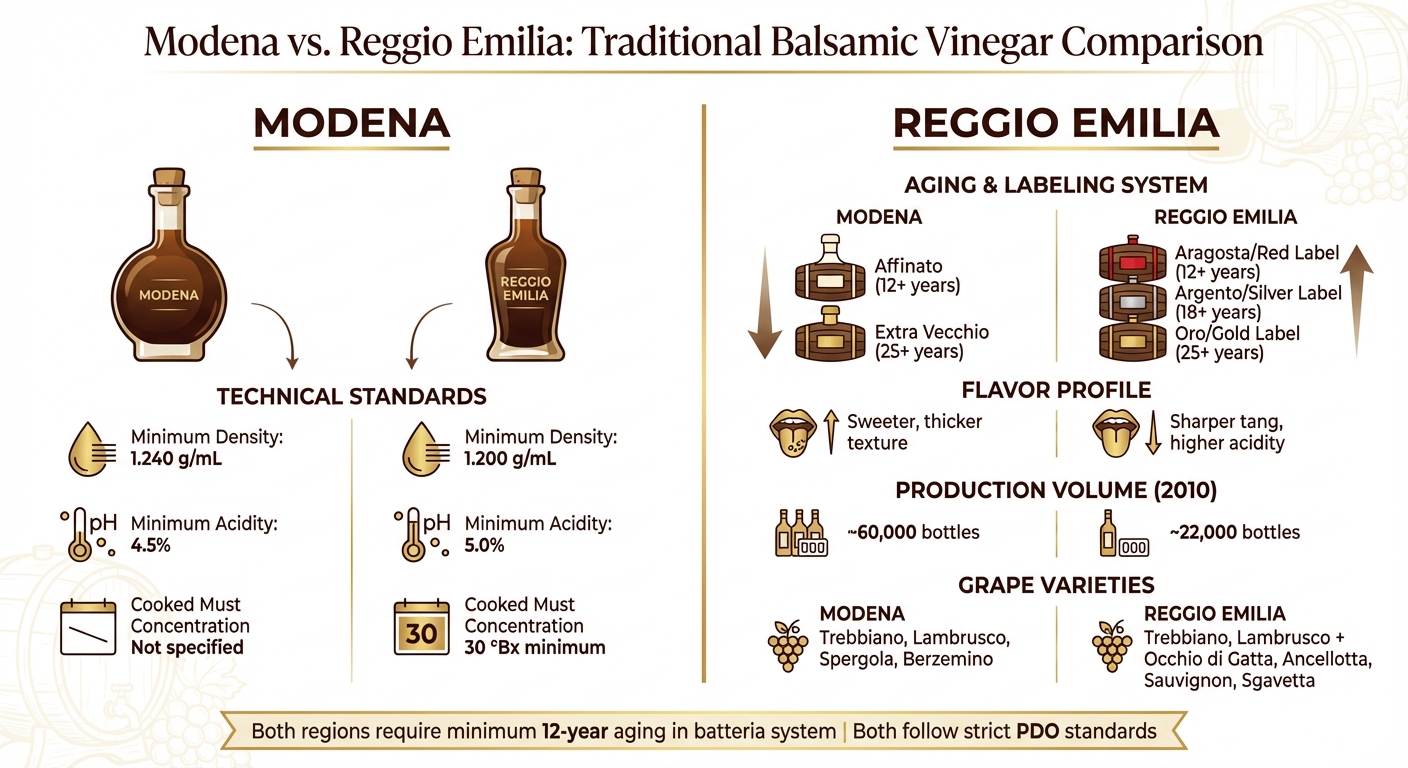
Modena vs Reggio Emilia Balsamic Vinegar Comparison Chart
How Certified Balsamic Vinegar Of Modena Is Made
sbb-itb-4066b8e
Production Process Differences
Although Modena and Reggio Emilia share similar foundational methods, their production processes reveal some clear distinctions. Both regions begin by cooking grape must in open vessels over direct fire for 12 to 24 hours, reducing the volume by 50%–70%. However, Reggio Emilia's standards require the cooked must to reach a minimum concentration of 30 °Bx (degrees Brix, used to measure sugar content), while Modena does not enforce a specific sugar concentration. The grape varieties also differ slightly: Modena primarily uses Trebbiano, Lambrusco, Spergola, and Berzemino, whereas Reggio Emilia incorporates additional varieties like Occhio di Gatta, Ancellotta, Sauvignon, and Sgavetta. This broader selection allows for more variation in flavor profiles between the two regions.
Cooking and Fermentation of Grape Must
Once the must is cooked, fermentation marks the next critical step, and here, the regions diverge slightly. Both follow a two-step process: alcoholic fermentation by yeasts, followed by acetic oxidation by acetic acid bacteria. In Modena, fermentation often occurs in a specialized vessel called the badessa. In contrast, Reggio Emilia producers typically transfer the cooked must to a "mother" barrel before it moves into the aging battery. These early fermentation choices influence the vinegar's character long before the aging process begins.
Aging Requirements
Both regions require a minimum aging period of 12 years in a "batteria" - a set of at least five wooden casks that decrease in size. Vinegars aged 25 years or more earn the prestigious "Extra Vecchio" (Extra Old) label in both Modena and Reggio Emilia. Aging is a continuous process, with annual transfers of vinegar from larger to smaller casks to account for evaporation and withdrawals. The types of wood used for the barrels - oak, chestnut, mulberry, cherry, ash, and juniper - impart unique aromatic qualities to the final product. In 2010, Modena produced around 60,000 bottles of Traditional Balsamic Vinegar, while Reggio Emilia produced approximately 22,000 bottles.
Density and Acidity Standards
The two regions also differ in their technical standards for density and acidity. Modena requires a minimum density of 1.240 g/mL at 68°F (20°C) and a total acidity of at least 4.5%. Reggio Emilia, on the other hand, sets a lower density threshold of 1.200 g/mL but demands a higher minimum acidity of 5%. Modena places greater emphasis on a thicker texture, while Reggio Emilia prioritizes a sharper tang.
| Standard | Traditional Modena (PDO) | Traditional Reggio Emilia (PDO) |
|---|---|---|
| Minimum Density | 1.240 g/mL | 1.200 g/mL |
| Minimum Total Acidity | 4.5% | 5.0% |
| Cooked Must Concentration | Not specified | 30 °Bx minimum |
| Grading System | Affinato, Extra Vecchio | Aragosta, Argento, Oro |
Flavor and Sensory Profile Comparison
Flavor Characteristics
The flavor profiles of traditional balsamic vinegars from Modena and Reggio Emilia showcase both shared qualities and distinct differences. Both types feature the classic agrodolce balance - a harmonious blend of sweet and sour. However, the technical standards governing their production create unique characteristics for each. Modena's vinegar, crafted with stricter density guidelines, is thicker and leans toward a sweeter taste. On the other hand, Reggio Emilia's vinegar, with its higher acidity, delivers a sharper, tangier flavor.
Reggio Emilia's traditional balsamic vinegar is categorized into three levels based on aging and sensory qualities. The Orange Label, aged for at least 12 years, is known for its pronounced acidity and a more sour profile with less sweetness. The Silver Label offers a smoother, richer character, balancing a thicker acidity with a sweeter fragrance. Finally, the Gold Label (Extravecchio), aged for a minimum of 25 years, is predominantly sweet with a robust and enduring flavor structure.
These flavor distinctions naturally influence the aromatic and textural qualities of the vinegars.
Aroma and Texture
Both Modena and Reggio Emilia vinegars owe their intricate aromas to the batteria aging system, where the vinegar matures in a series of wooden barrels over time. This method enhances their aromatic depth, creating a complex bouquet. In terms of texture, both vinegars are syrupy, with an average viscosity of approximately 0.56 Pa·s. This rich, thick consistency makes them ideal for finishing dishes rather than being used as a simple salad dressing.
Shared Sensory Traits
Despite their differences, these vinegars share fundamental sensory characteristics. As Italiaregina.it notes, "Between the traditional balsamic vinegar of Modena and that of Reggio Emilia there are minimal differences... rather than differences we should speak of similarities". Both varieties naturally develop a deep brown to black hue through the cooking of grape must and prolonged barrel aging. They are made exclusively from 100% cooked grape must and exhibit a balanced complexity that enhances meats, cheeses, fruits, and desserts. Additionally, the shared climate, soil, and grape varieties of the Emilia region contribute to the unique quality that has earned these vinegars their reputation as "liquid gold."
Packaging and Labeling Differences
Packaging and labeling go beyond mere aesthetics - they reflect the regional identity and authenticity of each vinegar.
Bottle Shapes and Cap Colors
The bottle designs for traditional balsamic vinegars from Modena and Reggio Emilia are instantly recognizable and unique to their origins. Traditional Balsamic Vinegar of Modena comes in a 100 ml (about 3.4 fl oz) clear glass bottle with a bulbous, globe-shaped body, a rectangular base, and an elongated neck. This iconic design was created by automotive designer Giorgetto Giugiaro in 1987. Meanwhile, Traditional Balsamic Vinegar of Reggio Emilia is housed in a straighter bottle with a slightly flared base, often described as resembling an "inverted tulip".
"In Modena, traditional balsamic vinegar is bottled in a rounded, globe-shaped bottle with a rectangular base and elongated neck. In Reggio Emilia, the bottle is straighter with a subtly flared base, allowing the two origins to be visually distinguished." – Emilia Delizia
These designs are not just for show - they are mandated for all producers in their respective regions, ensuring authenticity and making it easier for consumers to identify genuine products. Both regions limit their DOP (PDO) vinegars to the 100 ml size, while the more affordable PGI (IGP) versions from Modena are often sold in larger bottles starting at 250 ml (around 8.5 fl oz).
Labeling and Age Designations
The labeling systems for these vinegars highlight their meticulous aging processes. Italian law forbids printing specific ages, such as "12 years" or "25 years", on labels for traditional balsamic vinegars. Instead, age is indicated through terms and color-coded caps or labels. In Modena, vinegars are labeled as "Affinato" (at least 12 years old, marked by a white or cream cap) or "Extra Vecchio" (at least 25 years old, marked by a gold cap like our 25-year aged dark balsamic).
Reggio Emilia uses a slightly different system with three levels of labels: "Aragosta" (red label) for vinegars aged 12 years or more, "Argento" or "Vecchio" (silver label) for those aged 18 years or more, and "Oro" or "Extra Vecchio" (gold label) for vinegars aged 25 years or more.
Rick Petrocelly, Owner of The Olive Tap, warns: "Anyone labeling a product as Traditional Balsamic Vinegar of Modena and claiming that it is specifically 12, 18, 25, etc. years old is likely attempting to deceive the buying public".
Authentic bottles also feature a wax seal and the EU PDO (DOP) logo, further guaranteeing their origin and quality. With roughly 160 producers across both regions creating about 75,000 bottles annually, these visual cues are essential for distinguishing genuine products. In a market where authentic traditional vinegars often cost $100 or more per 100 ml bottle, these details ensure that consumers can confidently select legitimate options that reflect the craftsmanship and heritage of these iconic vinegars.
Big Horn Olive Oil's Modena-Sourced Balsamic Vinegars
Big Horn Olive Oil brings the rich heritage of Modena straight to American kitchens, offering premium balsamic vinegars at prices that won't break the bank. While authentic Traditional Balsamic Vinegar of Modena often costs over $100 per 100 ml, Big Horn's aged selections provide similar depth and quality at a fraction of the cost. Their 18-year aged variety starts at just $8.99, while the 25-year aged option is available for $12.99. Let’s dive into what makes each of these offerings stand out.
Traditional 18-Year Aged Dark Balsamic Vinegar
Crafted with care, this vinegar spends 18 years aging in a mix of chestnut, oak, mulberry, and ash barrels, following time-honored methods. This process results in a dense vinegar with a syrupy texture, boasting a density over 1.28 g/mL and a balanced 4% acidity. It's versatile and perfect for elevating everyday dishes. Priced at $8.99 for smaller bottles or $23.99 for a 375 ml size, it’s an affordable entry into the world of premium aged balsamic, offering a taste of Modena’s traditional craftsmanship without the hefty price tag.
Molto Denissimo 25-Year Aged Dark Balsamic Vinegar
The Molto Denissimo represents the peak of Big Horn’s balsamic collection. Aged for up to 25 years using the traditional Solera method in Modena’s iconic "Batteria" barrel system, this vinegar achieves the "Extra Vecchio" classification, comparable to the finest Traditional Balsamic Vinegar of Modena PDO. Its extended aging results in a luxurious, velvety texture and a flavor profile bursting with notes of cherry wood, dried fruits, raisins, figs, dark chocolate, and malt. This exceptional vinegar, priced at $12.99 for smaller bottles or $32.99 for a 375 ml size, brings the complexity of Modena’s best to your kitchen, perfect for both special occasions and everyday cooking. Plus, like all high-quality balsamics, it can last three to five years after opening.
Both vinegars may naturally develop a "mother of vinegar" over time - a harmless byproduct of fermentation that highlights their natural production process. Far from being a flaw, this is a hallmark of authentic, traditionally crafted vinegars and a testament to their quality.
Conclusion: Choosing Between Modena and Reggio Emilia
When it comes to Traditional Balsamic Vinegar, the differences between Modena and Reggio Emilia are subtle. Both regions share similar climates, soil conditions, and grape varieties - like Trebbiano and Lambrusco - resulting in nearly identical flavor profiles. The real variation lies in their classification systems and packaging, rather than the taste itself.
These small differences can influence how each vinegar complements specific dishes. For cooking red meats or shellfish, younger vinegars aged around 12 years - like Modena's Affinato or Reggio Emilia's Aragosta - work well due to their higher acidity. Intermediate-aged vinegars, such as Reggio Emilia's Argento (18+ years), bring a balanced sweet-and-sour profile, perfect for finishing dishes like risottos or beef fillets. The oldest vinegars - Extra Vecchio or Oro (25+ years) - are best reserved for desserts, pairing beautifully with black currant-infused desserts or strawberries or dark chocolate thanks to their rich sweetness and velvety texture.
For those seeking exceptional quality at accessible prices, Big Horn Olive Oil offers Modena-sourced vinegars crafted with traditional methods. Their 18-year aged option starts at $8.99, while the 25-year Molto Denissimo is priced at $12.99, making premium balsamic vinegar a practical choice for both everyday meals and special occasions.
FAQs
How can I tell a real PDO balsamic from Modena or Reggio Emilia?
To spot genuine PDO (Protected Designation of Origin) balsamic vinegar from Modena or Reggio Emilia, start by looking for the PDO label - it’s your first clue. Authentic balsamic is crafted using cooked grape must, aged for a minimum of 12 years, and traditionally packaged in a 100ml "Giugiaro" bottle. Its signature traits include a rich brown hue, a syrup-like consistency, and a perfectly balanced sweet-and-sour taste, all achieved through aging in wooden barrels.
Which is better for savory dishes vs. desserts?
Traditional balsamic vinegars from Modena and Reggio Emilia, particularly the aged DOP varieties, are a fantastic match for savory dishes. Their deep, layered flavors complement meats, cheeses, and salads beautifully. On the other hand, for desserts, lighter or less aged balsamic vinegars - often labeled for everyday use - are a better choice. These have a gentler, sweeter taste that pairs wonderfully with strawberries or ice cream. While the thicker, aged options shine in savory recipes, the milder varieties are perfect for enhancing sweet treats.
What’s the difference between PDO (DOP) and PGI (IGP) balsamic?
The main distinction lies in how they're made and aged. PDO balsamic is crafted using strict traditional methods and aged in wooden barrels for at least 12 years. This process develops a deep, refined flavor. On the other hand, PGI balsamic undergoes a shorter aging period - at least 60 days - and combines cooked grape must with wine vinegar. The result is a more flexible and approachable option that still carries the essence of the Modena region.