

Olive By-Products as Renewable Energy
Did you know the olive oil industry generates 40 million tons of waste annually? This waste - like pits, pomace, and wastewater - has long been a problem. But now, it’s being turned into energy. By converting these by-products into electricity, heat, and biofuels, producers are reducing costs, cutting fossil fuel use, and even generating new income streams.
Here’s what you need to know:
- Olive pits: High energy density (16–20 MJ/kg) makes them perfect for heating and electricity.
- Pomace: Rich in organic compounds, it’s ideal for biogas production.
- Wastewater: Can be processed into biogas through anaerobic digestion.
- Leaves: While underutilized, they hold potential for biofuel after extracting valuable compounds.
Facilities in Spain and Italy are already using these techniques to power operations, sell electricity, and reduce emissions. For example, a plant in Grottaglie, Italy, processes 3,000 tons of olive by-products annually, producing biogas and selling surplus energy to the grid.
Leading olive oil producer Spain turns to olive stones for fuel | REUTERS

Main Olive By-Products Used for Energy
The production of olive oil generates three key by-products - pits, pomace, and leaves - each with unique properties that make them suitable for energy production. Here's a closer look at their characteristics and potential as renewable fuels.
Olive Pits: A Dense Energy Source
Olive pits, the woody stones inside olives, account for about 8–15% of the total weight of processed olives. These pits are prized for their high energy density, with a Lower Heating Value (LHV) ranging from 16 to 20 MJ/kg. Their low moisture content, typically 10–12%, makes them an excellent choice for direct combustion in both domestic boilers and industrial cogeneration systems.
"The use of olive pit as a biofuel offers an alternative in the agricultural industry to the use of fossil fuels and could contribute to a reduction in CO2 emissions." - C. Pattara, Researcher
A practical example of their potential can be seen at the Úbeda Pilot Plant in Andalusia, Spain. This facility uses olive pits and tree prunings in a downdraft gasifier connected to a spark ignition engine to generate electricity. Over 200 hours of continuous operation, the plant achieved a net electric efficiency of 15% and a combined heat and power (CHP) efficiency of nearly 50%. The producer gas produced during the process had a calorific value of 4.8 to 5.4 MJ/kg.
Pomace: A Flexible Energy Material
Olive pomace, the leftover material from oil extraction, is a versatile fuel option. Packed with organic compounds like cellulose, hemicellulose, and lignin, it boasts a volatile matter content of 70–80%, making it particularly suitable for gasification.
The moisture content of pomace varies depending on the extraction method. Two-phase systems generate wetter pomace with 60–70% moisture, while three-phase systems yield a drier product with 40–45% moisture.
A notable example of pomace utilization is the Frantoio Oleario Domenico Cassese in Grottaglie, Italy. This facility operates a 100 kWe two-stage anaerobic digestion plant that processes olive pulp and pitted pomace. As of August 2021, the plant maintained a 40-day retention time, producing 51–52 m³/h of biogas with a methane content of 60%. Processing over 3,000 tons of olive by-products annually, the plant not only meets its own energy needs but also sells surplus electricity to the grid.
Olive Leaves: A Resource with Untapped Potential
Olive leaves and branches from pruning and cleaning operations have long been overlooked as a fuel source. While they contain valuable bioactive compounds, their high ash content and the difficulty of collection have limited their use . However, modern biorefineries are changing this narrative. By first extracting high-value compounds like antioxidants and mannitol, these facilities can convert the remaining material into renewable fuel.
These distinct characteristics shape the best approaches for converting each by-product into energy, which will be explored in the following section.
Methods for Converting Olive By-Products into Energy
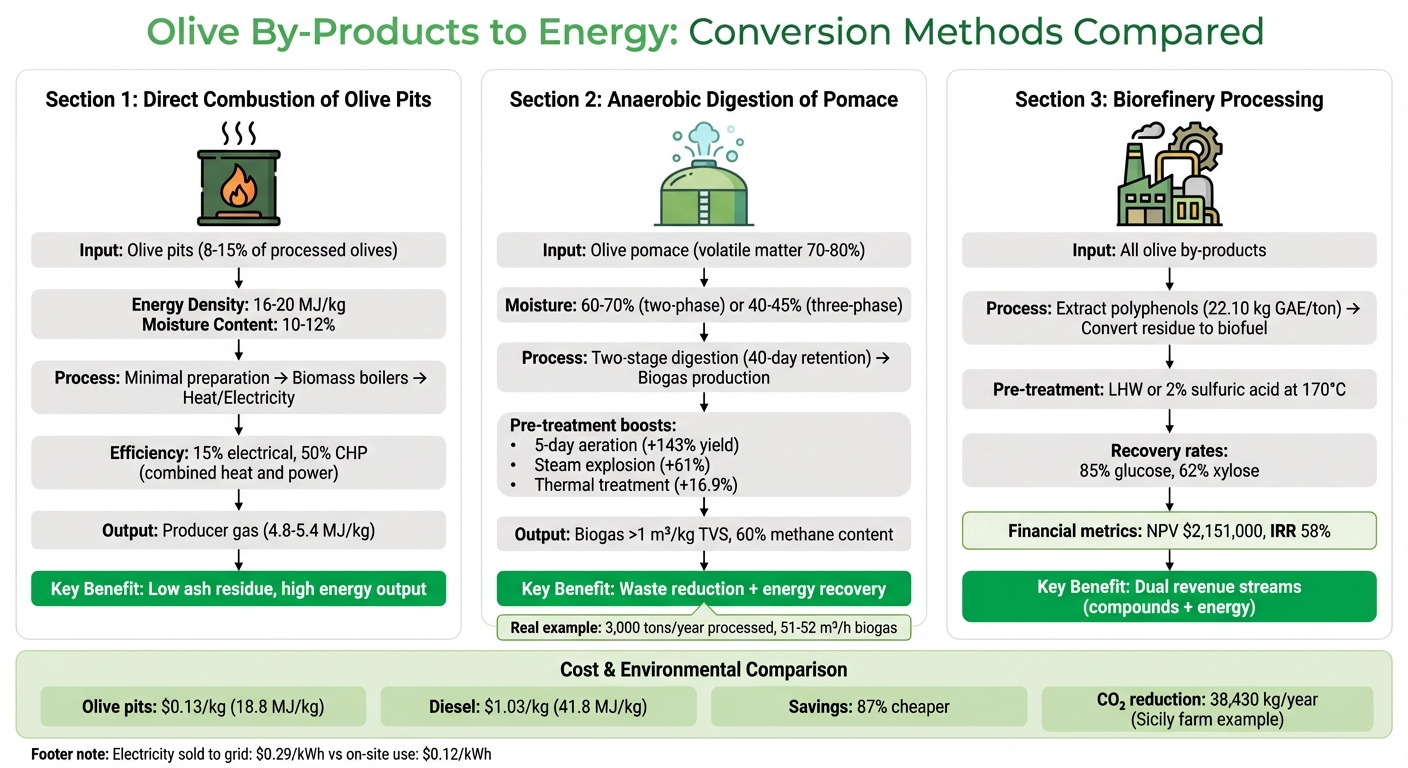
Olive By-Products Energy Conversion Methods and Efficiency Comparison
Once olive by-products are separated and prepared, they can be turned into energy using a variety of methods. Each approach comes with its own benefits, depending on the facility's size, existing infrastructure, and energy objectives.
Direct Combustion of Olive Pits
One straightforward way to generate energy is by burning olive pits directly in biomass boilers. This method is particularly effective for onsite heating or cogeneration and requires minimal preparation, such as separation and drying. It produces a high energy output with very low ash residue. For larger-scale operations, pelletizing dried pits and pomace can help prevent ash clinkers and ensure stable performance in fixed-bed reactors.
Another option for energy recovery involves anaerobic digestion, particularly for olive pomace.
Anaerobic Digestion of Pomace
Anaerobic digestion transforms olive pomace into biogas, offering both energy recovery and waste reduction. Industrial facilities typically use a two-stage digestion process to handle the toxic effects of polyphenols when concentrations exceed 600 mg/L. This process includes a hydrolytic phase followed by a methanogenic phase, with each stage lasting about 20 days, for a total retention time of 40 days. To maintain optimal bacterial activity, facilities often add 0.75% urea and essential micronutrients like iron, cobalt, selenium, and manganese every 100 days.
Pre-treatment steps can significantly improve methane yields. For instance, a 5-day aeration boosts yields by 143%, steam explosion increases them by 61%, and thermal pre-treatment at 338°F (170°C) for 60 minutes results in a 16.9% improvement.
"The high organic load (45–220 g/L of COD) represents a significant energy potential and would make the olive wastewater one of the most suitable agro-industrial wastes for anaerobic digestion."
- Antonia Tamborrino et al.
For facilities aiming to maximize both energy and economic returns, biorefineries offer a more integrated solution.
Biorefinery Processing of Olive By-Products
Biorefineries take a two-step approach to processing olive by-products: first, they extract valuable compounds, and then they convert the remaining material into fuel. This method optimizes both the financial and energy output.
Pretreatments like Liquid Hot Water (LHW) or dilute acid at temperatures between 338°F and 410°F (170–210°C) break down the lignocellulosic structure effectively. For example, a 2% sulfuric acid pretreatment at 338°F (170°C) can recover 85% of glucose and 62% of xylose, which are key components for bioethanol production.
Before energy conversion, facilities can extract polyphenols using water at room temperature. This step recovers about 22.10 kg of Gallic Acid Equivalent per ton of olive pomace. Removing polyphenols not only creates a valuable product but also eliminates their inhibitory effects on anaerobic digestion, allowing for higher organic loading rates.
"The recovery of polyphenols therefore allows the subsequent anaerobic digestion to be performed at higher organic loading rates."
- Orive et al.
A 2021 analysis of a biorefinery processing 1,500 tons of extracted olive pomace annually reported a Net Present Value of approximately $2,151,000 and an Internal Rate of Return of 58%. While extracting phenols may reduce methane yields by about 25%, the high market value of phenolic extracts - around $560 per liter for a 10% hydroxytyrosol concentration - makes up for the energy trade-off.
sbb-itb-4066b8e
Energy Efficiency and Life Cycle Comparisons
Using olive by-products as a renewable energy source offers a cost-effective and eco-friendly alternative to traditional fuels. For instance, while diesel provides 41.8 MJ/kg of energy, olive pits deliver around 18.8 MJ/kg. However, the price difference is striking: olive pits cost about $0.13/kg compared to diesel at $1.03/kg - making olive pits nearly 87% cheaper.
The environmental benefits are also noteworthy. Burning olive by-products is considered carbon neutral because the CO₂ released is balanced by the carbon absorbed during the growth of olive trees. On the other hand, diesel combustion emits 3.15 kg of CO₂ per kilogram of fuel burned. Additionally, emissions from olive biomass are significantly lower: carbon monoxide levels drop from 1,100 mg/Nm³ (diesel) to 550 mg/Nm³, and sulfur dioxide emissions decrease from 150 mg/Nm³ to just 18 mg/Nm³. These advantages highlight the potential of olive by-products to create cleaner, more cost-efficient energy systems.
Performance Data for Olive By-Product Energy Systems
Real-world applications further illustrate the benefits of olive by-product energy systems. In Sicily, a farm producing Valdemone DOP olive oil replaced diesel with olive pits in a 70 kW heat generator for greenhouse heating. This switch reduced annual fuel costs from €11,592 to €1,440, saving €10,152 each year, while cutting approximately 38,430 kg of CO₂ emissions annually.
Another example comes from the Frantoio Oleario Domenico Cassese company in Grottaglie, Italy, which operates a 100 kWe anaerobic digestion plant fueled by olive pulp and pitted pomace. In August 2021, this facility achieved biogas production exceeding 1 m³ per kg of total volatile solids, with a methane concentration of 60%. The biogas powered the mill’s operations, with surplus electricity sold to the national grid, while the thermal energy generated was used to heat local homes.
| System Type | Electrical Efficiency | Thermal/CHP Efficiency | Key Output |
|---|---|---|---|
| Downdraft Gasifier | 15% | 50% (CHP) | Producer Gas (4.8–5.4 MJ/kg) |
| Gasification + ORC | 12–15% | ~68% (Thermal) | 240 kW Electricity / 1,360 kW Heat |
| Anaerobic Digestion | N/A | N/A | Biogas (>1 m³/kg TVS) |
Electricity sold to the grid fetches about $0.29 per kWh, compared to $0.12 per kWh for on-site use. In Italy, recovering olive pits for energy could save between 100,000 and 180,000 tonnes of heating oil annually. These systems not only make olive oil production more efficient but also align with environmental and economic goals.
Benefits for Olive Oil Production
Reducing Waste and Carbon Emissions
Traditional methods of disposing of olive waste - like dumping it in open lagoons or discharging it into streams - bring a host of environmental problems. These practices pollute groundwater, harm soil quality, and produce unpleasant odors.
"The uncontrolled discharge of OMW leads to serious environmental problems such as discoloration of natural waters, threats to aquatic ecosystems, contamination of surface and groundwater resources, soil degradation, phytotoxicity, and foul odor generation." – Nature Scientific Reports
Transforming olive by-products into energy offers a much cleaner alternative. It eliminates waste-related issues and prevents methane emissions caused by the anaerobic breakdown of organic matter in storage ponds. Advanced technologies, such as gasification paired with thermal evaporation, can even achieve "Zero Liquid Discharge." This process recovers water from wastewater for agricultural use while utilizing solid residues to generate power. Plus, the carbon released when burning olive biomass is mostly offset by the carbon absorbed during the growth of olive trees. This makes it a greener option compared to fossil fuels.
Economic Benefits for Producers
The environmental perks are just one side of the coin - there are also financial advantages for olive oil producers. By converting waste into energy, producers can cut down on disposal costs, generate their own thermal and electrical energy, and even create new revenue streams by selling surplus electricity. For instance, processing one ton of olives produces about 150 kg of olive pits, which can significantly reduce energy expenses.
Consider this: an integrated biorefinery handling 1,500 tons of extracted olive pomace annually can achieve a net present value of roughly $2,150,000 with an impressive internal rate of return of 58%. Small-scale gasification plants typically recoup their costs within 5 to 6 years. For even greater returns, producers can sell excess electricity to the grid at about $0.29 per kWh - more than double the $0.12 per kWh saved by using it on-site. Additionally, drying wet pomace on-site reduces its volume, cutting transportation costs for material sent to secondary extraction facilities.
Conclusion: The Future of Renewable Energy in Olive Oil Production
The olive oil industry is at a pivotal moment, where waste materials like pits, pomace, leaves, and wastewater are no longer just byproducts - they’re becoming valuable sources of renewable energy. With the sheer volume of waste produced, the opportunity for transformation is immense.
Adopting integrated energy systems offers a range of benefits. Emissions can be reduced by up to 60%, water can be reclaimed for irrigation in drought-stricken areas, and production facilities can generate their own power on-site. From a financial perspective, circular management approaches can deliver a net gain of about $28 per acre, thanks to revenues from bioenergy and compost.
"Nearly 100% of the waste can be converted into valuable outputs." – Nature.com
These systems aren’t just environmentally responsible - they also make sound business sense. Companies like Big Horn Olive Oil, which prioritize both quality and sustainability, are uniquely positioned to lead this transformation. By embracing renewable energy solutions, producers can show that exceptional quality and environmental stewardship are not mutually exclusive. Technologies such as gasification systems, anaerobic digesters, and biorefinery processes are already proving their effectiveness in olive oil facilities across Italy and Spain.
As the industry progresses toward zero-waste operations and energy independence, those who adopt these innovations will not only cut costs and protect the environment but also strengthen their businesses for the future. The tools to make this shift are available now, and the benefits are too significant to ignore.
FAQs
How do olive by-products compare to fossil fuels in energy efficiency and cost?
Olive by-products like pits, pomace, and pruning waste can be turned into bioenergy through methods such as combustion or gasification. While their energy content - around 4,000 kcal/kg (16.7 MJ/kg) - is lower than that of fossil fuels like coal (24 MJ/kg), modern biomass systems can still make efficient use of them. These systems typically achieve 30–35% efficiency in electricity generation, which aligns with the lower range of coal-fired power plants but with the added benefit of much cleaner emissions.
On the financial side, olive by-products are often low-cost or even free, as they are generally considered waste. When you factor in savings from avoided disposal costs and potential incentives for renewable energy or carbon reduction, they become an economical alternative to conventional fuels. Plus, they have a much smaller carbon footprint, emitting approximately 0.06 kg of CO₂ per kWh of energy compared to coal’s 0.8–1.0 kg CO₂ per kWh. This makes olive by-products an environmentally friendly and cost-effective renewable energy option for U.S. producers.
How does using olive by-products for energy benefit the environment?
Transforming olive by-products, such as pits and pomace, into bioenergy offers a range of environmental perks. For starters, this renewable energy option helps cut down our dependence on fossil fuels, which in turn reduces greenhouse gas emissions and curbs air pollution. On top of that, it tackles waste by turning materials that might otherwise be thrown away into a practical energy source for powering production facilities.
By putting these by-products to good use, industries can embrace a greener, more sustainable approach. This not only aids in cleaner energy efforts but also supports the principles of a circular economy.
How can olive oil producers use by-products to create renewable energy?
Olive oil producers have found innovative ways to turn by-products like olive pits and pomace into renewable energy, helping to cut down on waste and operational costs. Two popular techniques for this are anaerobic digestion and gasification.
With anaerobic digestion, pomace is broken down in a controlled environment, producing biogas that can be used to generate electricity and heat. Gasification takes a different approach by converting dried pomace into a clean gas, which can then power turbines or generators. Both methods create energy that can be used directly on-site, whether for drying pomace, refining olive oil, or other operational needs.
By embracing these energy solutions, producers can reduce their energy bills, lower waste disposal expenses, and even take advantage of U.S. renewable energy incentives, such as the Renewable Energy Production Tax Credit (PTC).