

How Olive Oil Shaped Ancient Mediterranean Cooking
Olive oil was more than just a cooking ingredient in the ancient Mediterranean - it was a vital part of daily life. Used for food, lighting, skincare, and even medicine, its significance spanned thousands of years. Originating around 5000–6000 BCE, olive oil became a key dietary fat, replacing animal fats and providing essential calories. Its production methods evolved from simple stone tools to advanced Roman presses, making large-scale trade possible. Olive oil symbolized wealth, powered economies, and became a marker of social status. It also played a role in religious rituals and preserved food, while enriching dishes like roasted vegetables, stews, and salads. Today, its influence endures in culinary traditions and modern olive oil craftsmanship.
The History of Olive Oil Production in the Mediterranean
First Methods of Growing and Extracting Olive Oil
The origins of olive oil production trace back to around 5000 BCE along the Carmel coast in ancient Israel. Early farmers discovered that they could propagate olive trees by planting cuttings and ovules - small growths from the tree trunk. This method allowed them to expand cultivation into areas where wild olive trees already thrived.
Extraction methods in those early days were surprisingly straightforward. Farmers used simple stone tools to crush olives into a paste. The paste was then placed in woven bags or baskets and pressed, sometimes with the help of hot water to extract any remaining oil. The liquid was left to settle in stone tanks, where the oil naturally separated and floated to the top, ready to be skimmed off by hand or with a ladle.
By the 6th century BCE, the Greeks introduced a game-changing invention: mechanical beam presses. First seen in Klazomenai, in what is now Turkey, these presses used a beam anchored to a wall and weighted with stones to apply greater pressure during extraction. This innovation significantly reduced the labor involved while increasing the yield, setting the stage for more efficient production across the region.
The Minoans of Crete were pioneers in large-scale olive oil production as early as 2000 BCE. They industrialized the process, using massive pressing workshops and storage facilities. On the island of Delos, archaeologists uncovered six large terracotta storage vessels, known as pithoi, capable of holding up to 4,000 liters (1,057 gallons) of oil. The Minoans meticulously documented their oil trade on clay tablets written in Linear A and B scripts, treating olive oil as a cornerstone of their economy and wealth. Their advancements laid the foundation for olive oil to become a major commodity across the Mediterranean.
How Trade Routes Spread Olive Oil Across the Mediterranean
As production improved, olive oil began to move far beyond its regions of origin. The Phoenicians and Greeks played pivotal roles in spreading olive oil cultivation and trade throughout the Mediterranean. The Phoenicians carried their knowledge westward, introducing olive oil to North Africa and the Iberian Peninsula, where they established the city of Cadiz in the 8th century BCE. Meanwhile, Greek colonists planted olive groves in their territories, sharing the advanced cultivation methods they had perfected at home.
Maritime trade was key to olive oil's expansion. Transporting goods by sea was far more economical than overland routes - 50 times cheaper than land transport and 5 times cheaper than river routes. Merchants shipped olive oil in terracotta amphorae, which were often stamped with seals indicating the producer, origin, and quality. These marks acted as an early system of branding and quality assurance. In 594 BCE, the Athenian legislator Solon underscored olive oil's importance by passing laws that made it the only agricultural product Athens could export, cementing its role as a vital trade commodity.
The Romans elevated olive oil production to an industrial scale. They expanded cultivation into less fertile regions like central Tunisia and western Libya by employing irrigation systems. During the reign of Emperor Septimius Severus (193–211 CE), olive oil became a formal tax in provinces such as Tripolitania (Libya) and Baetica (Spain). The proceeds were used to provide free oil to Roman citizens, showcasing its economic and social significance. The scale of this trade was immense. Monte Testaccio, an artificial hill in Rome, is composed almost entirely of fragments from approximately 25 million discarded olive oil amphorae, evidence of the vast quantities transported from Spain’s Guadalquivir Valley over three centuries.
How Ancient Cooks Used Olive Oil in Their Recipes
Common Dishes That Relied on Olive Oil
In ancient Mediterranean kitchens, olive oil was the heart of many meals, particularly in Greek cuisine. Take "ladera", for instance - vegetable and bean dishes simmered in olive oil to create hearty, satisfying main courses. These meals transformed simple ingredients into flavorful dishes.
One popular example is briam, a roasted medley of zucchini, eggplant, peppers, and tomatoes, all infused with olive oil and herbs. Similarly, fasolakia combined green beans, zucchini, and potatoes, stewed in a rich mix of olive oil and tomato juices. Even wild greens, or horta, were boiled with potatoes and dressed with fresh lemon juice and a generous drizzle of olive oil. And let's not forget the humble act of bread dipping - using crusty bread to soak up olive oil and vegetable juices ensured that every last bit of flavor was enjoyed.
Olive oil wasn’t just for vegetables. It browned lamb for stews, fried sausages like kofta, and added depth to lentil or bean stews cooked with aromatic vegetables. The versatile ladolemono, a simple blend of olive oil and lemon juice, was a go-to dressing for grilled fish, meats, and salads.
Beyond its role as a flavor booster, olive oil also played a key part in preserving food.
Using Olive Oil to Preserve Food and Improve Taste
In ancient kitchens, olive oil did double duty: it preserved ingredients while enhancing their flavors. In the Levant, adding salt or nitre to stored olive oil helped maintain its quality over time.
Taste mattered greatly, especially to the ancient Greeks. They prized oil made from green, unripe olives, which produced a "sharp, bitey, and peppery" flavor considered a luxury. This premium oil elevated the taste of vegetables and grains, while olives themselves were preserved through salting or pickling - a practice dating back to 5000 BCE.
Interestingly, isotopic analysis from Herculaneum reveals that even working-class individuals consumed about 20 liters (5.3 gallons) of olive oil per person annually, contributing roughly 450 calories to their daily diet. Olive oil wasn’t just a cooking ingredient; it was a dietary cornerstone, as essential as wheat and grapes.
Its practical uses blended seamlessly with its symbolic significance, especially in religious and ceremonial contexts.
Olive Oil in Religious Ceremonies and Ritual Meals
Olive oil held a sacred role in ancient rituals. It was used to anoint sacrificial animals, garments for festivals, and as libations poured over sacred statues or tombs.
At Greek symposiums - formal banquets where guests sometimes wore perfumed olive oil as a status symbol - it helped elevate these gatherings into sacred events. In Hebrew and other Near Eastern traditions, olive oil infused with myrrh and cinnamon was used to anoint priests and kings during initiation ceremonies, often accompanied by ritual meals.
The Panathenaic Games in Athens showcased the immense value of olive oil. Winners of the men’s sprint were awarded 1,000 gallons of sacred oil from the city’s holy groves, while boys’ sprint winners received 500 gallons. This prize oil could be sold for about 12 drachmas per 10-gallon vessel. To put that in perspective, a carpenter earned roughly 1 drachma per day, meaning a single victory could equal three years’ wages. Beyond its sacred uses, this oil fueled temple lamps, supported economies, and became a symbol of community and celebration.
The History of Olive Oil Part 1: From the Ancients to Today
sbb-itb-4066b8e
Advances in Olive Oil Extraction Methods
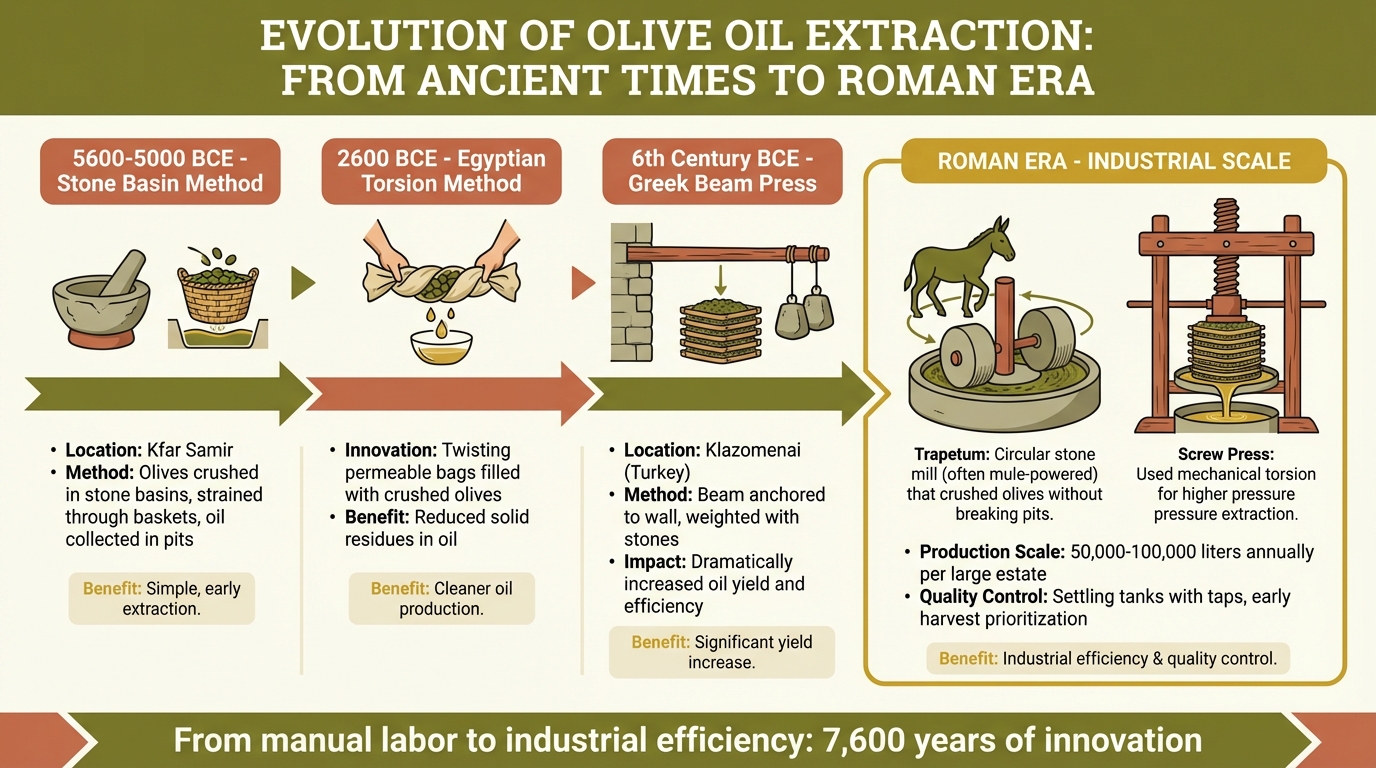
Evolution of Olive Oil Production Methods from 5000 BCE to Roman Era
The Development of Olive Presses
In the early days, extracting olive oil was a grueling, manual process. Archaeological evidence from Kfar Samir, dating back to 5600–5000 BCE, reveals that olives were crushed in stone basins, strained through baskets, and the oil was collected in pits. By around 2600 BCE, the Ancient Egyptians refined this process with a torsion method - twisting permeable bags filled with crushed olives. This gentle technique reduced solid residues in the oil.
For centuries, simpler manual methods like crushing olives underfoot or using mortars were the norm, with unripe green olives - valued for their bold, peppery flavor - posing a particular challenge to these rudimentary tools. A significant leap came in the 6th century BCE when the Greeks introduced beam presses. These presses used stone weights and winches, dramatically increasing oil yield and efficiency. This innovation set the stage for even greater advancements during the Roman era.
How Romans Improved Olive Oil Production
The Romans took olive oil extraction to the next level, turning it into an industrial-scale operation. They built upon earlier methods, introducing new tools and techniques that revolutionized production. One of their key inventions was the trapetum, a circular stone mill designed to crush olives without breaking the pits, which helped prevent bitterness in the oil. Often powered by mules, the trapetum allowed for continuous, large-scale processing.
Another game-changer was the screw press. Unlike the beam press, which relied on heavy weights, the screw press used mechanical torsion to apply higher pressure, extracting significantly more oil. Thanks to this innovation, large Roman estates could produce between 50,000 and 100,000 liters of olive oil annually. This surge in productivity was especially evident in regions like Tripolitania (modern Libya) and Byzacena (modern Tunisia).
The Romans also focused on improving oil quality. They prioritized early harvests, picking olives before they fully ripened, and introduced settling tanks with taps to separate oil from water and sediment with precision. Pliny the Elder famously noted, "For what flows from light pressure is very sweet and very thin". This emphasis on first-press oil, extracted with minimal crushing, highlighted its superior quality.
These advancements did more than just improve efficiency - they fueled a thriving export economy. Over 260 years, Rome imported an estimated 6.5 billion liters of olive oil, transported in standardized amphorae holding about 18 gallons each. By making olive oil more accessible and affordable, these innovations not only supported its role as a dietary staple but also helped shape the culinary traditions of the Mediterranean region.
The Economic and Social Impact of Olive Oil
Advancements in extraction techniques not only increased olive oil production but also elevated it to a key player in trade and a cornerstone of social practices.
Olive Oil as a Major Trade Good
In ancient times, olive oil became one of the most important commodities for trade. From the days of the Phoenicians and Greeks to the height of the Roman Empire, it fueled economic growth across the Mediterranean. Its cultivation spread widely, from Asia Minor to Iberia and North Africa, to meet the demands of thriving trade networks.
The economic significance of olive oil was evident in early Athenian laws under Solon (c. 640–560 BCE), which restricted agricultural exports to olive oil alone. Such was its value that victorious athletes were sometimes rewarded with large quantities of olive oil - amounts equivalent to several years' wages.
The Romans took olive oil production to an industrial scale. Between the 3rd and 5th centuries CE, farms in regions like Syria and Cilicia experienced economic booms to meet the growing demand in Constantinople. Roman Emperor Septimius Severus even accepted olive oil as tax payment, redistributing it to Rome's populace. Amphorae used to store olive oil were stamped with marks indicating the producer, place of origin, and production date - an early example of branding and quality assurance. This practice laid the groundwork for the quality standards seen today in products like those offered by Big Horn Olive Oil. By the 1st century AD, Italy had established itself as a reliable producer of high-quality olive oil at accessible prices.
Yet olive oil's influence extended beyond economics - it also played a transformative role in personal care and medicine.
Olive Oil in Medicine and Beauty Practices
Olive oil was a cornerstone of ancient healthcare and beauty routines. Esteemed physicians like Hippocrates and Galen relied on it as a primary healing agent. It served as the base for herbal remedies, treated nettle stings, and helped alleviate exhaustion and fever. The Greek medical writer Celsus recommended:
"If an exhausted person is bordering on a fever, they should immerse themselves … in warm water to which a little oil has been added and then gently rub the whole body … with oil".
In both Greek and Roman cultures, olive oil was a staple of personal hygiene. Before exercising or bathing, people would apply it to their skin and then scrape it off with a tool called a strigil, removing dirt and sweat in the process. It was also the base for ancient perfumes, infused with scents like myrrh, cinnamon, roses, and iris. Additionally, it was used in hair dyes and as a skin softener. Modern research has confirmed olive oil's antimicrobial properties, validating its long-standing reputation as a healthful and versatile product.
This dual legacy of economic importance and personal care continues to shape the high standards associated with olive oil today, blending ancient practices with modern expectations of quality.
Conclusion: The Enduring Influence of Olive Oil
An Ingredient That Stands the Test of Time
For nearly 8,000 years, olive oil has been a staple in kitchens and cultures across the globe. From the Neolithic settlements of Kfar Samir to today’s culinary world, its appeal remains rooted in ancient traditions. The practice of using oil from green, unripened olives and prioritizing first pressings has been carried forward to modern standards for Extra Virgin Olive Oil. Remarkably, archaeological findings show that Minoan olive oil from the Bronze Age matched the quality of today’s cold-pressed virgin olive oils, proving that the pursuit of excellence has stood the test of time.
With over 2,000 olive varieties now cultivated in the Mediterranean region, the core principles of olive oil production remain unchanged. Its influence goes beyond the kitchen. For example, olive oil was part of the anointing oil used during King Charles III’s coronation in May 2023, continuing a tradition that dates back thousands of years to ancient Mediterranean cultures. Olive oil's versatility also extends to skincare and wellness practices, echoing Hippocrates’ description of it as "the great healer". This timeless connection between history and the present is vividly reflected in the way premium olive oils are crafted today.
Big Horn Olive Oil: Connecting Ancient Methods to Modern Quality
The legacy of olive oil’s excellence thrives in the hands of modern artisans like Big Horn Olive Oil. By adhering to age-old principles, they bring ancient craftsmanship into the 21st century. Their cold-pressed Extra Virgin Olive Oils are processed within two hours of harvest, mirroring the ancient practice of immediate pressing to maintain freshness and prevent fermentation.
Big Horn Olive Oil’s commitment to delivering fresh olive oil within three months of harvest, while preserving high antioxidant levels, reflects a deep appreciation for early-harvest quality. By keeping extraction temperatures below 80°F (27°C) and sourcing from top-tier cultivars, they produce oils that align with the high standards of ancient Athens and Rome - where fine olive oil was once as valuable as gold. Their Ultra Premium products, available at https://bhooc.com, show that the benchmarks set thousands of years ago continue to define quality today.
FAQs
Why was olive oil so important in ancient Mediterranean trade and cooking?
Olive oil was a cornerstone of life in the ancient Mediterranean, valued for its incredible versatility. Beyond being a staple in cooking, it served multiple purposes - preserving food, fueling lamps, and playing a central role in religious rituals. Its importance grew as Greek and Phoenician colonies expanded, spreading olive cultivation far and wide.
As demand surged, olive oil evolved into a prized export, linking cultures through bustling trade routes. Its durability and diverse applications cemented its place as an essential commodity, influencing daily life and shaping culinary traditions across the Mediterranean region.
How has olive oil extraction evolved throughout history?
Olive oil extraction has evolved significantly from its humble beginnings. In ancient times, the process was straightforward - stones were used to crush olives, and basic wooden presses with ropes helped extract the oil. The Greeks improved this with screw presses, making the task more efficient. The Romans took it a step further, introducing tools like the millstone crusher and the trapetum, which streamlined production.
Fast forward to modern times, and the industry has seen remarkable advancements. Hydraulic presses and centrifugation systems revolutionized the process, offering faster and more efficient methods. By the 20th century, innovations like percolation and decanter centrifuges enabled continuous processing, boosting both yield and quality. These developments highlight humanity's long-standing dedication to refining olive oil production, resulting in the premium extra virgin olive oils we enjoy today.
What role did olive oil play in ancient religious and ceremonial traditions?
Olive oil played a crucial role in ancient Mediterranean religious and ceremonial traditions, often regarded as a sacred substance with deep spiritual meaning. It was widely used in rituals for healing, purification, and anointing, symbolizing purity, divine favor, and a connection to the spiritual realm.
Cultures such as the Greeks, Romans, and early Christians wove olive oil into their sacred practices. It was offered as a precious gift to the gods during religious festivals and sacrifices, underscoring its value and spiritual significance. The substance also carried associations with peace and victory, famously represented by the olive crowns awarded to victors in the ancient Olympic Games. While olive oil is well-known for its culinary uses, its role in ancient traditions went far beyond the kitchen, embodying sanctity and a profound link to the divine.