

Olive Oil for Inflammation and Digestive Health
If I want one everyday fat for lower inflammation and better gut support, I’d pick extra-virgin olive oil first. It has the best human research of the four fats here, plus plant compounds that butter, coconut oil, and refined seed oils mostly lack.
Here’s the short version:
- EVOO leads the group for inflammation support and gut lining support.
- Butter can help with fat absorption, but it is high in saturated fat and has no meaningful polyphenols.
- Coconut oil is easy for some people to tolerate in small amounts, but it is still very high in saturated fat.
- Refined seed oils lose much of what matters during processing and can be a weaker pick for gut health.
- In studies, about 1 to 3 tablespoons per day of EVOO is a common range.
- One large trial with 7,447 people linked EVOO use with lower inflammation markers and a 30% drop in major cardiovascular events.
If I were keeping this simple, I’d use EVOO as my main daily fat, keep butter for taste, use coconut oil in small amounts, and cut back on refined seed oils.
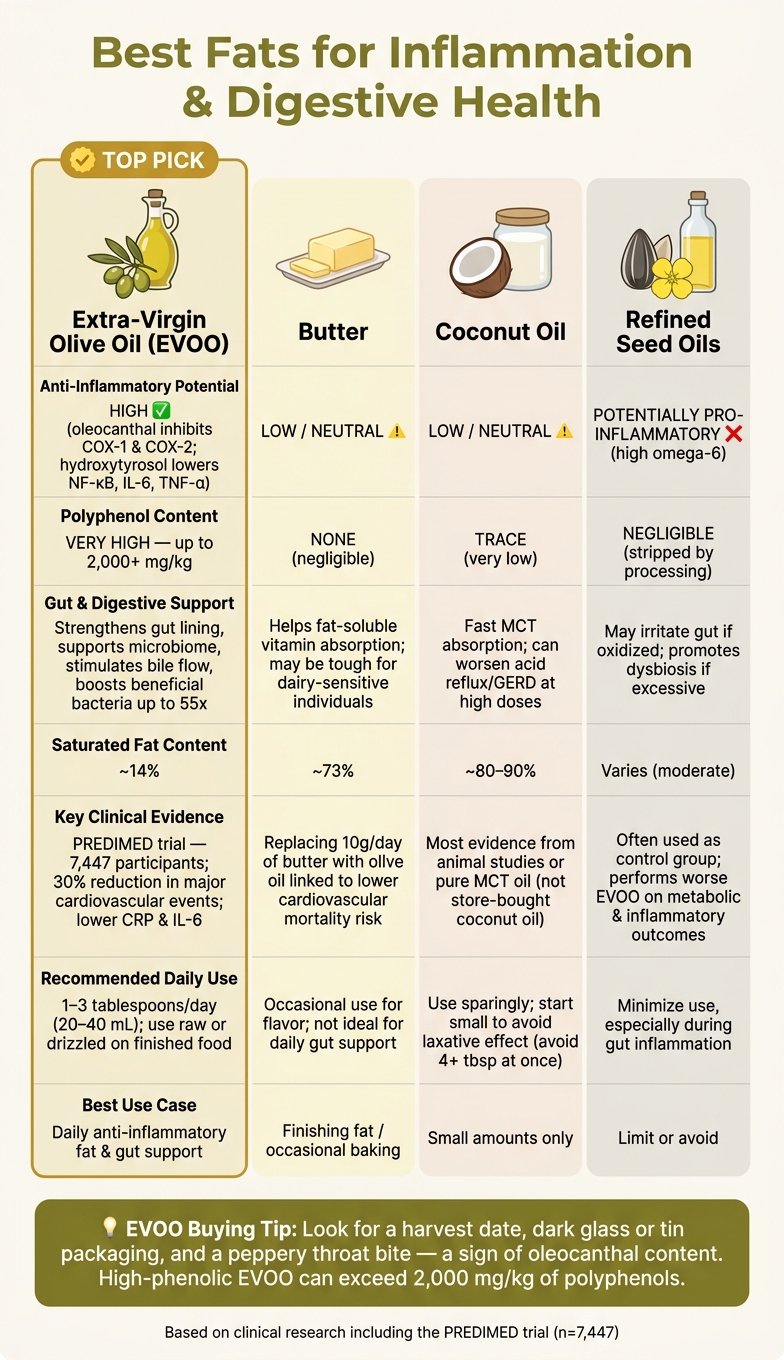
EVOO vs Butter vs Coconut Oil vs Refined Seed Oils: Inflammation & Gut Health Compared
This is What 10 Tbsp of Olive Oil Daily for 30 Days Does to Your Body
sbb-itb-4066b8e
Quick Comparison
| Fat | Inflammation | Digestion | Polyphenols | Best Use |
|---|---|---|---|---|
| Extra-virgin olive oil | Strongest support in this group | Helps bile flow, gut lining, and microbiome | High | Daily use |
| Butter | Low to neutral | Helps fat digestion, but may bother some people | None worth counting | Occasional use |
| Coconut oil | Low to neutral | May help some people in small amounts | Very low | Small amounts |
| Refined seed oils | Less favorable overall | Less gut support after processing | Very low | Limit use |
The rest of the article explains why EVOO stands out, where the other fats fall short, and how to use each one in day-to-day meals.
1. Extra-virgin olive oil (EVOO)
Anti-Inflammatory Activity
EVOO contains compounds that act on key inflammation pathways. Oleocanthal inhibits COX-1 and COX-2, while hydroxytyrosol dampens NF-κB signaling and lowers IL-6 and TNF-α.
Digestive Effects
EVOO stimulates bile flow from the gallbladder, which helps with fat-soluble vitamin absorption. That matters because better bile flow can also help shape the gut environment. It may support beneficial gut bacteria and short-chain fatty acid production as well.
One clinical trial found that EVOO intake increased beneficial gut bacteria by up to 55 times in overweight adults and lowered inflammation markers. In day-to-day use, 1.5 to 3 tablespoons per day fits the ranges used in trials, and you can split that across meals.
Polyphenol Content
Not all olive oil is the same. High-phenolic EVOO can exceed 2,000 mg/kg of polyphenols, while refined olive oils can drop to just 0 to 50 mg/kg after processing. That gap is huge.
A peppery throat bite is a simple clue that the oil contains oleocanthal. If it gives you that slight kick, that's often a good sign. Those polyphenol differences help explain the trial results below.
Evidence Strength
The PREDIMED trial, a randomized study of 7,447 participants, found lower CRP and IL-6, along with a 30% reduction in major cardiovascular events with EVOO supplementation. EUROLIVE also found that high-polyphenol oil lowered LDL oxidation more than low-polyphenol oil.
Use EVOO as the baseline for the comparisons that follow.
2. Butter
Anti-Inflammatory Activity
Compared with EVOO, butter brings much less to the table for inflammation support. Its fat profile is also less favorable. In plain terms: butter has far fewer compounds that help calm inflammation.
Most of butter’s gut-related upside comes from butyrate and, in grass-fed butter, CLA. But that comes with a trade-off. Butter is about 73% saturated fat, and that can raise LDL cholesterol, especially in people who already have high levels. So while butter may help with digestion in a practical sense, it doesn’t offer the same anti-inflammatory support as EVOO.
Digestive Effects
Butter can help trigger bile release, which supports fat digestion and the absorption of fat-soluble vitamins. That said, its saturated fat tends to digest more slowly than EVOO.
There’s also a dairy angle to think about. Regular butter still contains small traces of lactose from the milk solids. For people with dairy sensitivities, that may be enough to cause issues. Ghee is often the better pick because the milk solids are removed.
Polyphenol Content
Butter contains no meaningful polyphenols. That matters because polyphenols are part of what gives EVOO its edge for inflammation control. Without those plant compounds, butter simply doesn’t offer the same chemical makeup, which helps explain why the human data is weaker.
Evidence Strength
The evidence on butter is mostly neutral to unfavorable, largely because of its effect on LDL cholesterol. One finding stands out: replacing 10 grams of butter per day with olive oil was linked with a lower risk of cardiovascular mortality.
If you use butter, it makes more sense as a finishing fat or for occasional baking than as an everyday main fat.
3. Coconut oil
Anti-Inflammatory Activity
Coconut oil contains lauric acid, which may offer some antimicrobial effects. But EVOO has broader support for inflammation control because it contains oleocanthal and polyphenols.
There’s also a big fat-profile difference. Coconut oil is about 80% to 90% saturated fat, while olive oil is roughly 14%. That matters because saturated fat can raise LDL cholesterol in some people, which can work against the goal of lowering inflammation.
So while some people use coconut oil for digestion, it’s best used sparingly, not as an everyday cooking fat. Its main upside is narrower than what EVOO offers.
Digestive Effects
Coconut oil may help with constipation. It can also stimulate bile and pancreatic enzymes, and its MCTs are absorbed faster than long-chain fats.
That said, dose matters. Taking a large amount too fast - say, 4 tablespoons at once - can lead to a laxative effect or stomach discomfort. If you don’t usually eat higher-fat foods, starting small makes more sense.
Polyphenol Content
Coconut oil has only trace amounts of polyphenols, and refined versions lose even more of their already low antioxidant content. Virgin or unrefined coconut oil keeps more of these natural compounds than refined oil.
That low polyphenol level helps explain why the human evidence isn’t very strong.
Evidence Strength
The human research here is still limited. A lot of the positive talk around coconut oil comes from animal studies or from research on pure MCT oil, which is not the same thing as store-bought coconut oil.
Refined seed oils come with a different tradeoff: they tend to have fewer protective compounds and a higher risk of oxidation.
4. Refined seed oils
The last comparison looks at the most processed category: refined seed oils.
Anti-Inflammatory Activity
Refined seed oils like soybean, corn, sunflower, and canola are high in omega-6 fats. When intake gets too high, they can push the diet toward more inflammatory signaling. EVOO is different. It contains oleocanthal, a compound linked to anti-inflammatory activity.
Digestive Effects
For digestion, the main issue is what the refining process takes out. It removes antioxidants and other compounds that help support the gut barrier. EVOO keeps those compounds and tends to do more for the microbiome.
Polyphenol Content
Refining strips out most polyphenols and antioxidants. EVOO keeps much more of them. That difference helps explain why EVOO is often seen as more protective when it comes to inflammation and digestion.
Evidence Strength
In clinical studies, refined seed oils often show up as the control group. And in many cases, they do worse than EVOO on metabolic and inflammatory outcomes. The tradeoff comes down to processing, oxidation, and the loss of antioxidants.
The core tradeoff is pretty simple: processing helps with shelf stability, but it removes the compounds that matter most for gut health.
Mechanisms and Practical Tradeoffs
These fats mainly differ in how they affect inflammation, the gut barrier, and the microbiome. And that gap becomes much easier to see when EVOO is stacked against butter, coconut oil, and refined seed oils.
EVOO works through a few overlapping pathways. Its polyphenols help lower oxidative stress in the intestinal lining, while oleocanthal inhibits COX enzymes, which lowers inflammatory signaling. It also helps strengthen tight junctions and increase the protective mucin layer, which may reduce intestinal permeability. On top of that, it supports helpful gut bacteria and SCFA production.
EVOO also slows gastric emptying and helps with fat-soluble vitamin absorption. It stimulates bile release too, which helps with fat digestion. If you have gallstones, it makes sense to increase intake slowly. Butter tends to have a weaker gut profile and may be tougher to digest for some people. Coconut oil is digested fast because of its MCTs, but it can make reflux worse in people who are prone to it. Refined seed oils lose most of their protective compounds during refining, so their inflammation profile tends to be less favorable.
In day-to-day use, those mechanisms lead to some pretty clear tradeoffs:
| Feature | EVOO | Butter | Coconut Oil | Refined Seed Oils |
|---|---|---|---|---|
| Anti-Inflammatory Potential | High | Low/Neutral | Low/Neutral | Potentially pro-inflammatory |
| Gut Barrier Support | Strengthens tight junctions + mucin | Minimal | Neutral | May irritate if oxidized |
| Microbiota Impact | Prebiotic; supports beneficial bacteria and SCFA production | Increases harmful bacteria | Reduces some harmful bacteria | Can promote dysbiosis if excessive |
| Polyphenol Content | Very high | Negligible | Low | Negligible |
For most people, the simplest move is to use EVOO daily instead of more processed fats. Clinical trials usually use 1.5 to 3 tablespoons (20 to 40 mL) per day, which fits pretty easily into most meals.
Pros and Cons of Each Fat for Inflammation and Digestion
These mechanisms lead to four practical tradeoffs you can use in day-to-day eating.
| Fat | Key Benefits | Tradeoffs | When to Use |
|---|---|---|---|
| Extra-Virgin Olive Oil | High in polyphenols, including oleocanthal and hydroxytyrosol; prebiotic effect; supports the intestinal lining; helps lubricate stool | Calorie-dense; quality varies with freshness and storage | Daily anti-inflammatory support and constipation relief |
| Butter | Contains butyrate, which may support the gut lining; helps with fat-soluble vitamin absorption | High in saturated fat; lacks antioxidants; can raise LDL cholesterol; may shift the microbiome less favorably | Occasional use for flavor; not ideal for daily gut support |
| Coconut Oil | Contains MCTs that absorb quickly | Very high in saturated fat; can trigger acid reflux or GERD; lacks polyphenols | Use sparingly; digestive benefits are limited |
| Refined Seed Oils | - | Often high in omega-6 fatty acids; processing strips antioxidants; can oxidize when reheated | Minimize use, especially during gut inflammation |
Extra-Virgin Olive Oil stands out. Its polyphenols, especially oleocanthal, help anti-inflammatory pathways and support gut lining integrity. That gives it an edge if your goal is steady gut support, not just cooking with fat.
Butter has some upside. Butyrate can help the gut lining, and butter can aid absorption of fat-soluble vitamins. Still, it doesn't bring the antioxidant profile that makes EVOO so useful. So while butter has a place for flavor, it doesn't make as much sense as a daily pick for digestion.
Coconut oil is a bit of a mixed bag. It contains MCTs, so it can digest fast. But its saturated fat load is high, and for some people it can set off acid reflux or GERD. That makes it a weaker everyday choice for most people, even if it seems easy on the stomach at first.
Refined seed oils have the weakest case here. Processing strips out most of what might help, and reheating can lead to oxidation. On top of that, a high omega-6 intake without enough omega-3 to balance it can push inflammation the wrong way over time.
With EVOO, freshness matters more than many people think. If the oil isn't fresh, part of its edge is gone. Choose EVOO in dark glass or tins, and look for a peppery throat bite, which often points to more oleocanthal.
Conclusion
Across the four fats compared here, extra-virgin olive oil has the strongest evidence for lowering inflammation and supporting digestive health. That edge comes from its mix of oleic acid, more than 200 polyphenols, and oleocanthal. The anti-inflammatory case for EVOO is strong. The digestion-focused research, including microbiome support and gut barrier function, looks promising, but it’s still taking shape.
That evidence points to a simple day-to-day pick: choose EVOO. Look for a fresh bottle with a harvest date, and keep it in a dark bottle or tin away from heat. Use 1–3 tablespoons per day, ideally raw in dressings or drizzled over finished food, so heat-sensitive phenolics stay in better shape. For inflammation and digestive health, EVOO stands out as the best everyday fat.
FAQs
How do I choose a high-quality EVOO?
Look for quality and a recent harvest date. Try to use the oil within 18 months. Choose EVOO in dark glass or tin to help slow oxidation, and if you can, go with single-origin oils.
If you want more health perks, look for high-phenolic or early-harvest oils with 250–500 mg/kg polyphenols. A good EVOO should smell fresh and fruity, with a peppery finish.
Can I cook with EVOO or use it only raw?
Yes - you can absolutely cook with Big Horn Ultra Premium Extra Virgin Olive Oil and use it raw.
Using it raw lets you enjoy its full, layered flavor. Think drizzling it over salads, vegetables, bread, or finished dishes where the oil can stand out.
Cooking with fresh, high-quality EVOO works well too. When you heat it, it can help your body take in nutrients from the foods you’re eating. That makes it a smart pick for sautéing, roasting, and finishing dishes with a final drizzle.
Who should increase EVOO intake slowly?
People with olive allergies or gastrointestinal issues should add extra virgin olive oil (EVOO) slowly. If they take in too much at once, it may lead to unwanted side effects.
Big Horn Olive Oil says these people should be careful when adding larger amounts to their diet, so they can make sure their body handles the change well.