

5 Ways Organic Certification Improves Olive Oil Quality
Organic certification can help olive oil quality, but it does not guarantee a top bottle. If I want a better bottle, I look for USDA Organic, extra virgin, a harvest date, dark packaging, and clear lot and producer details.
Here’s the short version:
- Soil and grove care: Organic rules push growers toward compost, cover crops, and non-synthetic pest control.
- Lower residue risk: Synthetic pesticides and herbicides are banned under USDA organic rules.
- More polyphenols in some cases: One study found 456.89 mg/kg in organic oil vs. 338.19 mg/kg in conventional oil, a 26% gap.
- Longer shelf life in some cases: One study showed oxidation stability at 26.3 hours for organic oil vs. 22.9 hours for conventional.
- Better recordkeeping: Annual inspections, batch records, and USDA enforcement checks help match the bottle to the source.
My takeaway: organic is a production standard. Extra virgin is a quality grade. You want both.
Quick Comparison
| What to check | Organic certified olive oil | Conventional olive oil |
|---|---|---|
| Farm inputs | No synthetic pesticides, herbicides, or chemical fertilizers | Synthetic inputs allowed |
| Extraction | Mechanical extraction only; no chemical solvents | Mechanical extraction is common, but organic rules do not apply |
| Residue risk | Lower | Higher |
| Polyphenols | Can be higher | Can be lower |
| Handling records | Annual inspection and batch tracking | Standard business records |
| What it does not promise | Best taste, early harvest, low acidity, high phenols | Same |
If I’m shopping in the U.S., I treat the organic seal as one strong clue, not the whole answer.
How to Choose REAL Extra Virgin Olive Oil: A Practical Guide
sbb-itb-4066b8e
How Organic Certification Shapes Olive Oil Quality
Olive oil quality is built across the whole production chain. It starts in the grove, moves through processing, and depends on how the oil is stored after milling. If one step goes wrong, it can undo a lot of good work that happened earlier.
That’s where organic certification comes in. It supports quality across the same five stages this article covers: farming, purity, antioxidants, handling, and verification. Certified producers must follow rules for extraction, storage, and traceability, and those rules are checked through third-party audits.
Certification sets a baseline. It is not a promise of top-tier flavor. It requires production without synthetic chemicals and chemical solvents, which helps cut some of the risks that can hurt purity and consistency. But it does not guarantee early harvest timing, low acidity, or high polyphenol levels.
In plain terms, certification helps reduce the weak points that can drag quality down. It doesn’t make a great olive oil on its own. What it does is make high quality easier to achieve. That’s why the next five points focus on the specific ways certification supports quality. The first and most visible effect starts in the grove.
1. Organic Farming Practices Improve Olive and Soil Health
Healthy soil is where good olive oil starts. In certified organic groves, farmers work on building the soil instead of leaning on synthetic inputs.
Rather than using synthetic nitrogen fertilizer, certified organic growers use compost, manure, and cover crops like vetch to feed the ground. These inputs help the soil hold more water, which matters a lot in semi-arid regions. In one study, organic olives had higher oil content and lower water content than conventionally grown olives.
And that shift in soil care doesn’t stop underground. It changes the whole grove.
In many conventional systems, vegetation between rows gets cleared out to make harvesting easier. The trade-off is more soil erosion. Organic systems take a different path. Growers use mowing, grazing, and steady ground cover to protect organic matter and support about 30% higher biodiversity than conventional farms.
That healthier grove setting also affects the olives themselves. With more plant and insect life in the system, olives tend to produce more phenolic compounds, including oleocanthal and secoiridoids. Those compounds help give olive oil a sharper taste and stronger antioxidant activity.
Pest control follows the same pattern. Organic growers use mass trapping, kaolin clay, and biological agents like Bacillus thuringiensis instead of synthetic insecticides. The result is a lower chemical load in the grove, which leads into the next advantage: cleaner, purer oil.
2. Reduced Chemical Residues Increase Purity and Safety
What happens in the grove doesn’t stay in the grove. It can make its way into the final oil, which is why this point matters for both safety and taste.
In conventional olive oil production, synthetic chemicals can leave residues that carry into the final oil. Organic certification bars synthetic chemicals, and annual inspections verify compliance.
That cleaner starting point matters at the mill too. Cleaner fruit can support a purer profile and reduce the need for corrective steps during milling.
3. Higher Natural Antioxidant Levels Support Better Quality
Organic certification can improve more than the grove. It can affect the oil itself.
Organic groves often produce more polyphenols, the compounds that give extra virgin olive oil its bitterness, peppery finish, and longer shelf life. When olive trees grow without synthetic inputs, they often make more defensive compounds.
Soil care plays a part too. Organic soil practices can support higher phenolic production by limiting readily available nitrogen. That can push trees to produce more phenolic compounds instead.
You can see that gap in lab data. In one study of the Hojiblanca olive variety, organic EVOO had a mean total phenol content of 456.89 mg/kg, compared with 338.19 mg/kg in conventional oil from the same variety. That's a 26% difference. Oleocanthal, a specific antioxidant tied to anti-inflammatory benefits, was 30% higher in the organic samples.
Higher antioxidant levels also slow oxidation. In plain English, the oil holds up better and stays fresh longer. A study of the Verdial de Badajoz cultivar found that organic oils had an oxidative stability induction time of 26.3 hours, versus 22.9 hours for conventional oils.
Those compounds matter most when handling preserves them.
4. Certified Organic Handling Protects Flavor and Freshness
Once antioxidants stay in the oil, the next step is simple: handling decides whether that quality makes it into the bottle.
Organic certification covers more than what happens in the grove. It also sets rules for milling and storage. Olives should be pressed within 6 to 24 hours of harvest to help protect aroma and phenolics. Certified organic oil must be mechanically extracted, with no chemical solvents, and kept below 80.6°F (27°C) to help protect aroma, polyphenols, and vitamin E.
Storage matters just as much. Finished oil should be kept in cool, dark, low-oxygen stainless steel tanks to slow oxidation and help prevent rancidity. For packaging, dark glass or tin helps block UV light and slow breakdown.
That handling trail leads naturally to the final quality check: traceability and testing.
5. Traceability and Testing Strengthen Authenticity
Careful handling helps protect flavor. Traceability shows the oil still lines up with its certified source.
Every certified producer has to keep an Organic System Plan, along with handling logs that back it up. During annual inspections, certifiers compare those records with what they see at the grove and the mill.
That paper trail now gets tougher checks under the USDA's Strengthening Organic Enforcement rule. The SOE rule adds production-versus-sales reviews and calls for unannounced inspections at at least 5% of certified operations each year.
Testing adds one more check. Inspectors collect samples to look for residues and make sure the oil matches its paperwork. Certified bottles should also include a lot or batch code that ties the oil to a specific harvest, producer, and production date.
Organic vs. Conventional Olive Oil Production: A Side-by-Side Look
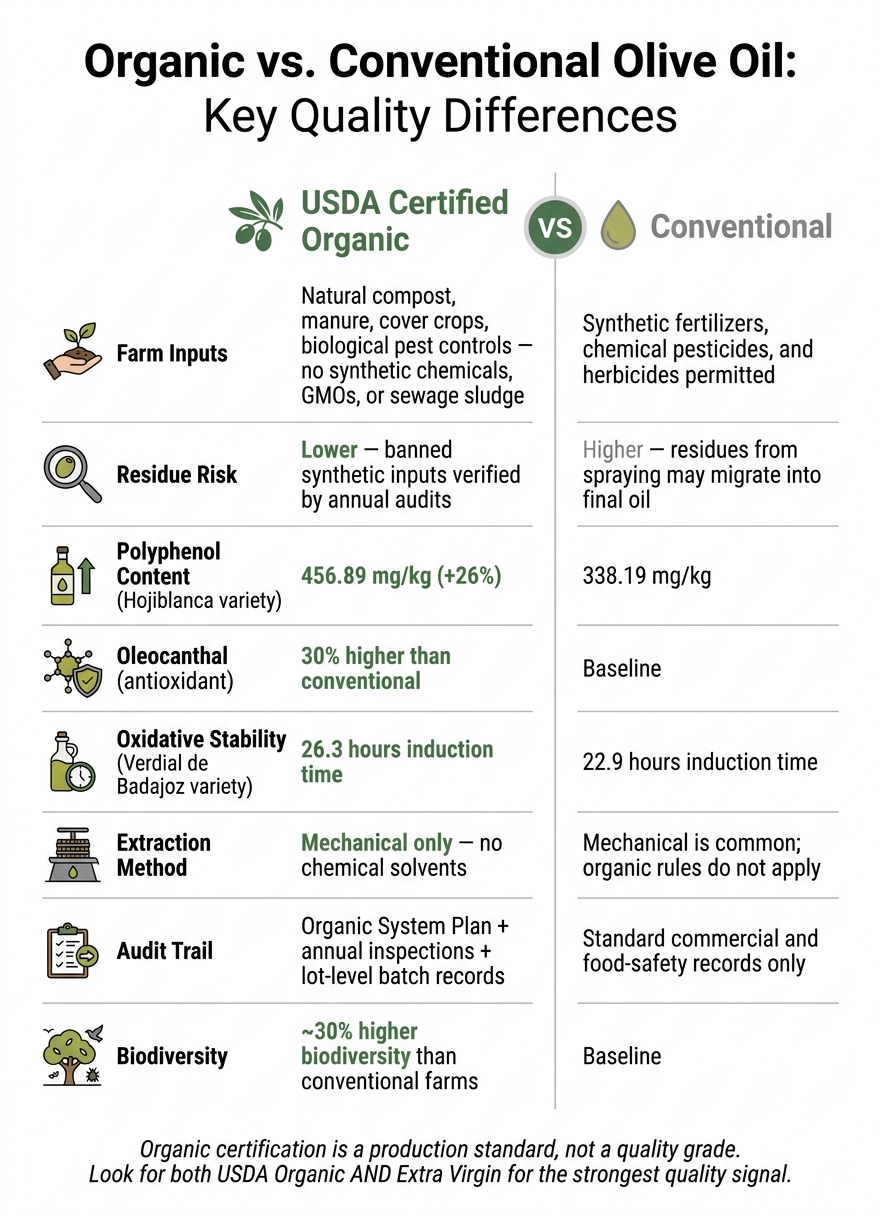
Organic vs. Conventional Olive Oil: Key Quality Differences
The table below gives you a plain-English view of how USDA Certified organic rules can show up in product quality.
| Feature | Organic (USDA Certified) | Conventional |
|---|---|---|
| Allowed Inputs | Natural compost, manure, biological pest controls, and nonsynthetic minerals; synthetic chemicals, GMOs, sewage sludge, and ionizing radiation are prohibited | Synthetic fertilizers, chemical pesticides, and herbicides permitted; no organic restrictions beyond standard food-safety rules |
| Residue Risk | Lower residue risk from banned synthetic inputs and audits | Higher; residues from intensive spraying may migrate into the final oil |
| Post-Harvest Controls | Mechanical extraction and segregated handling protect freshness | Mechanical extraction is standard; segregation and cleaning rules are less strict |
| Audit Trail | Organic System Plan, inspections, and lot-level records | Standard commercial and food safety records only |
Put simply, the label is often the fastest place to check these differences.
What U.S. Shoppers Should Look for on the Label
If an organic claim is legit, it should be right there on the bottle. Once you know what organic certification changes in production, the label becomes your best reality check. Use it to confirm production claims, not just the sales pitch.
USDA Organic Seal
The green-and-white USDA Organic seal means the oil was made without synthetic pesticides, herbicides, or chemical fertilizers. In the U.S., a product needs at least 95% organic ingredients to carry that seal.
There’s one more thing to check: a proper organic label should also list the certifying agent’s name apart from the seal itself. If a bottle says “organic” but doesn’t name a certifier, that’s incomplete.
Extra Virgin Olive Oil Label
“Organic” tells you how the olives were grown. “Extra virgin” tells you the quality grade based on extraction and testing. Those are two different things.
If you want the strongest signal on the shelf, look for both.
Harvest Date and Freshness Window
A harvest date tells you more than a best-by date. It gives you a better sense of how fresh the oil is. Aim for bottles harvested within the last 12 to 18 months for the best flavor and nutrient content.
Dark Glass or Tin Packaging
Packaging matters more than many shoppers think. Dark glass or tin helps block light and slow rancidity.
A clear or lightly tinted bottle sitting under bright store lights? That’s a red flag, no matter how nice the label looks.
Producer Details and Handling Claims
Strong labels give you enough detail to trace the oil back to a specific harvest and mill. Check the country of origin - meaning where the olives were grown, not just where the oil was bottled - along with the mill location.
It also helps to see a lot number, origin, and mill details that tie the bottle to one certified batch.
Conclusion
Organic certification can support olive oil quality in a few key ways. It can help soil health, lower residue risk, support antioxidant retention, protect freshness, and improve traceability.
But there’s a catch: certification is a starting point, not proof that the oil is top-tier.
That’s why the label matters so much. When you’re scanning a bottle on the shelf, the strongest signals to look for are:
- USDA Organic
- Extra virgin
- A harvest date
- Protective packaging
- Clear producer details
Treat organic certification as one quality signal, not the whole story.
FAQs
Does organic mean better-tasting olive oil?
Not always.
Organic certification can support better flavor. Why? Because it often goes hand in hand with practices like soil biodiversity and careful harvest timing. Those things may improve aromatics, herbaceous notes, and the finish.
That said, the evidence is mixed. Taste also depends on a lot more than the label, including harvest methods, how fast the product is processed, and how well temperature is controlled.
Why should I look for both organic and extra virgin?
Organic means the oil was grown and processed without synthetic additives, GMOs, or harsh chemicals. It also involves inspections and traceability, so there’s a clear record of where the oil came from and how it was handled.
Extra virgin is a separate quality grade. It has strict rules for taste, aroma, and acidity. One label doesn’t guarantee the other, so it’s smart to check for both if you want more confidence in the oil’s standards, purity, and flavor.
How can I verify an organic olive oil label?
Look for an official seal, such as USDA Organic or the EU organic leaf logo. The label should also list the accredited certifying agency by name.
If you see a seal but no certifier named, that's a red flag. It's also smart to check that the country of origin is clearly shown on the packaging.