

5 Ways Olive Oil Reflects Regional Heritage
Olive oil shows where it comes from in five clear ways: land, how it’s made, protected origin labels, food and faith, and export branding.
When I read the article, the main takeaway was simple: a bottle can tell me more than taste. It can point to a region, a set of long-used farm and mill practices, and even how buyers in the U.S. judge quality. The piece also backs that up with facts, like 132 PDO and PGI extra virgin olive oils in the EU, only about 4% to 5% of eligible output sold under those seals in some countries, and about $1.33 billion (€1.228 billion) in EU olive oil exports to the U.S. per crop year.
If I want the short version, here it is:
- Land matters: soil, climate, slopes, and altitude shape flavor
- How it’s made matters: harvest timing and milling style affect taste and quality
- PDO/PGI seals matter: they tie a bottle to a named place with set rules
- Food and faith matter: olive oil stays tied to daily meals and sacred use
- Branding matters: names like Toscano, Kalamata, and Jaén shape buyer views
A quick point that stands out: if I’m shopping, the most useful label clues are region, olive variety, harvest date, and PDO/PGI seal. That gives me a fast way to judge both origin and timing without relying on vague package claims.
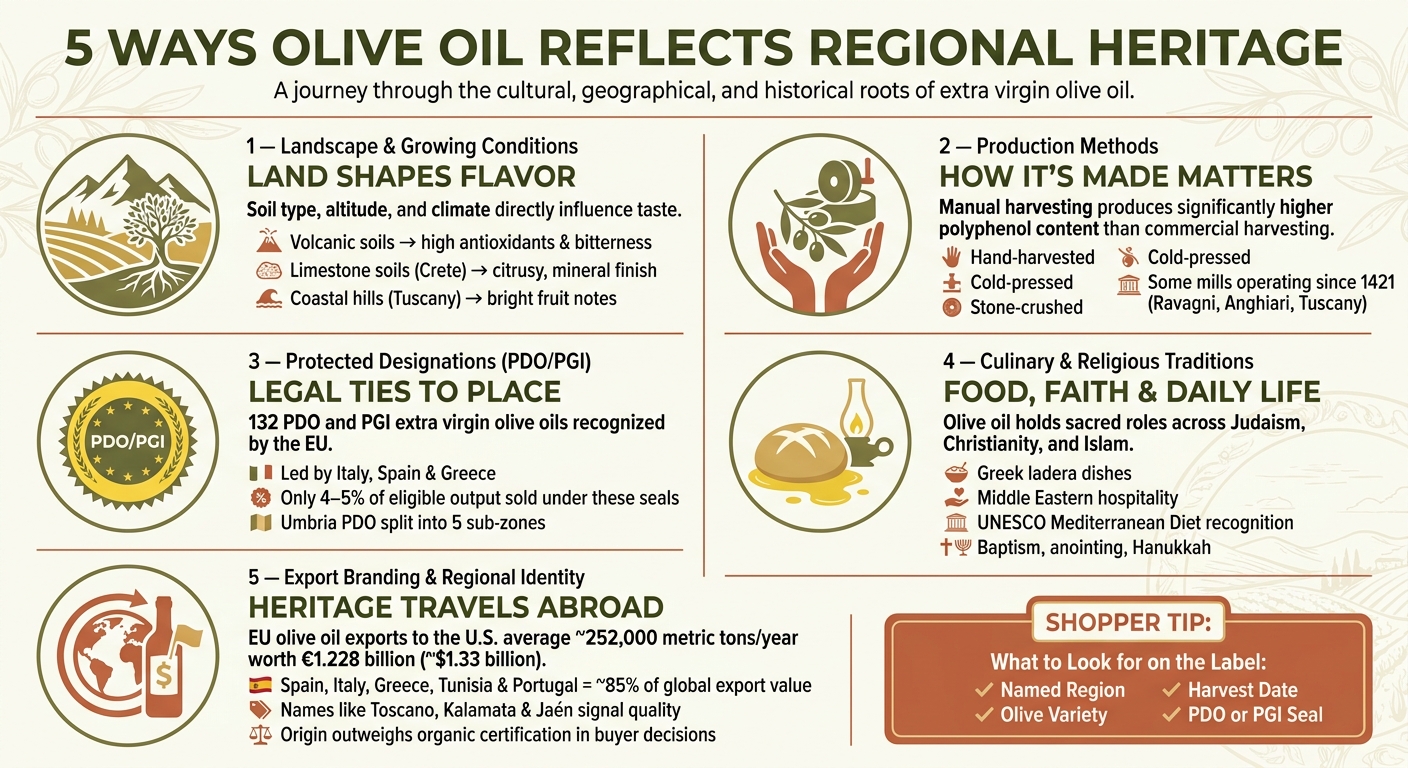
5 Ways Olive Oil Reflects Regional Heritage: A Visual Guide
Is Your Olive Oil Real? A Look At the Traditional Craft
sbb-itb-4066b8e
Quick Comparison
| Way heritage shows up | What it tells me | What to look for on the label or in the story |
|---|---|---|
| Landscape | How place shapes flavor | Region, soil notes, altitude, grove location |
| Production methods | How harvest and milling shape the oil | Hand-harvested, cold-pressed, milling details |
| Protected designations | Whether the name is legally tied to a place | PDO or PGI logo |
| Food and faith | How olive oil stays part of daily life | Regional food links, ritual use, local identity |
| Export branding | How origin is sold abroad | Country/region callouts, family history, place imagery |
So if I boil the article down to one line, it’s this: olive oil reflects regional heritage because place, process, law, everyday use, and market identity all leave a mark on the bottle.
1. Landscape and Growing Conditions
Soil, climate, and altitude all shape olive oil. Change the land, and the oil changes too.
Take sunny coastal hillsides in Tuscany. Those slopes drain well, and sea breezes help soften temperature swings. Olives grown there often make oils with bright fruit notes and balanced bitterness. In higher-altitude groves in parts of Greece and Spain, cooler nights slow ripening. That slower pace can increase the natural compounds behind bitterness and that peppery kick. Research on Chilean virgin olive oils also ties climate to the aroma compounds that shape flavor, and found that soil and climate can matter more than the cultivar itself when it comes to sensory-quality compounds. After generations, those conditions become part of a region’s identity.
Over centuries, growers turned local conditions into local methods. In dry parts of southern Spain, rainfed groves were often spaced wide apart so roots could reach more moisture in the soil. In frost-prone parts of central Italy, growers planted on slopes to help cold air drain away. In mountain areas like Liguria, stone terraces created sheltered microclimates that helped protect trees from wind and excess moisture. Even now, producers still lean on these patterns, even when they add drip irrigation or mechanized harvesting.
That’s part of why old groves and terraced hillsides carry so much meaning. People don’t just buy the oil. They walk the land, hear how the microclimate works, and taste the oil where it was made. Suddenly, the bottle has a place and a story. Specialty retailers like Big Horn Olive Oil push that link to origin with clear region labels and tasting notes.
Some soil types are tied to pretty specific flavor traits. Volcanic or basaltic soils, found in parts of the Mediterranean, are linked to oils with very high antioxidant content, pronounced bitterness, and layered herbal notes. Limestone-rich soils in places like Crete tend to produce balanced oils with a bright, citrusy edge and a clean mineral finish. These aren’t just romantic ideas about place. They’re measurable regional traits that give buyers a more reliable sense of what’s in the bottle.
Those same local conditions also shaped how growers harvested and milled the fruit.
2. Production Methods Passed Down Over Time
Those same limits of the land shaped more than taste. They also shaped how people picked, crushed, and pressed olives.
In many olive-growing areas, the way oil is made still reflects the local terrain and the habits families passed down over generations.
Place-Based Identity
In Liguria, steep hills made mechanical harvesters hard to use, so hand-harvesting became part of the region's identity. Frantoio San Martino in Liguria still uses water-mill-driven granite stones and hydraulic presses, keeping that old milling method in use.
For U.S. shoppers, labels like hand-harvested, stone-crushed, or first cold-pressed can be helpful clues. They suggest the oil's production method is tied to a certain place and the conditions there, not just a marketing pitch.
Historical Continuity
Some mills have been at it for a very long time. The Ravagni oil mill in Anghiari, Tuscany, has documented continuous operation since 1421, with the same family keeping cold-processing methods in place for more than 600 years.
That doesn't mean every mill stayed frozen in the past. Many replaced animal power with electric motors or brought in stainless steel storage tanks. But the core pattern often stayed the same: harvest at the right time, sort with care, and mill the fruit fast.
That timing matters for more than tradition. Research shows that manual harvesting can produce oils with much higher polyphenol content than fruit gathered through commercial harvesting. So careful handling isn't just about heritage. It can have a measurable effect on quality. When these methods last, they become part of a region's identity too.
Cultural Visibility
Production methods become visible in public life when they move outside the mill and into the community. In many Mediterranean regions, harvest season means family gatherings, shared milling days, and the ritual tasting of olio nuovo - the season's first oil - poured over bread.
Mills like Aristeon Olive Press in Zakynthos make that link easy to see. They pair live production with museum exhibits that trace the shift from animal-powered presses to modern systems. Places like this tie flavor to a living tradition.
Regional Reputation
A region's reputation often rests on how the oil is made, not only where it comes from. Andalusia's Jaén province, for example, is known for high-quality Picual oils partly because of practices like night harvesting, which shields fruit from daytime heat before milling.
When regions keep careful older methods while also using modern hygiene and temperature controls, their reputation for quality tends to grow stronger.
In some places, that reputation becomes official through protected origin rules.
3. Protected Regional Designations
Building on that reputation, PDO and PGI labels give regional names legal weight. These EU labels link an oil's name, production, and standing to a defined place.
Place-Based Identity
A PDO label limits a regional name to producers inside the stated area who use approved local varieties and production methods. The EU recognizes 132 PDO and PGI extra virgin olive oils, with Italy, Spain, and Greece leading the group. Some regions get even more specific. Umbria PDO in Italy is split into five sub-zones, and each one has its own flavor profile and production rules.
So when you see "Kalamata" or "Umbria" on a bottle with that seal, the name points to something specific and checkable.
Those rules protect more than the name. They protect the method behind it.
Historical Continuity
PDO and PGI rules keep long-standing practices in place by spelling out cultivars, harvest timing, and milling speed. In plain terms, they help keep old groves in use and support local olive varieties that might otherwise fade out.
Cultural Visibility
Protected names show up on labels, restaurant menus, and tourism campaigns. For U.S. consumers, a bottle with a recognized PDO or PGI seal signals a specific place, its farming traditions, and its food culture.
That kind of legal protection also helps the region's name travel better in export markets.
Regional Reputation
Protected designations help stop misuse of a region's name. Producer consortia set chemical and sensory standards, enforce traceability, and can go after imitators. Over time, that steady standard can build trust and often support a higher price in global markets.
Still, use of these labels stays fairly limited. In some countries, only about 4% to 5% of eligible olive oil production is sold under PDO or PGI labels.
For U.S. shoppers, the easiest signal is the PDO or PGI logo on the label. If a bottle names a region but doesn't carry the seal, treat that name as marketing language, not a protected origin claim.
4. Culinary and Religious Traditions
Olive oil’s story doesn’t stop at seals, labels, or store shelves. It lives in everyday habits: how people cook, how they greet guests, and how they mark sacred moments. Across the Mediterranean and the Middle East, olive oil carries memory as much as flavor.
Place-Based Identity
In Greek cooking, olive oil sits at the center of ladera - vegetable dishes simmered with onions, garlic, tomatoes, and herbs. In many Middle Eastern homes, bread and olive oil are also a plain, familiar sign of hospitality.
Historical Continuity
Olive oil has held a sacred place for a very long time. Judaism used it in the Temple and for anointing. Christianity kept it in baptism and healing rites. Islam describes it as blessed in scripture and tradition.
Those links to the past aren’t stuck in history books. They still appear in public rituals today.
Cultural Visibility
Ritual practice makes that meaning easy to see. Orthodox churches use olive oil in baptism and lamps, Hanukkah centers on oil, and Islamic texts preserve its spiritual weight. Put simply, these references make olive oil a clear religious symbol.
Regional Reputation
UNESCO’s recognition of the Mediterranean Diet as living heritage strengthens olive oil’s place in everyday food culture. It also helps explain why Greece, Spain, and Italy are so closely tied to olive oil tradition. In that sense, olive oil is more than a pantry staple - it signals regional identity.
5. Export Branding and Regional Identity
Once a regional name is protected, exporters use it as a signal in overseas markets. When olive oil moves across borders, heritage from a specific place becomes part of the pitch.
Place-Based Identity
Names like Toscano, Kalamata, and Jaén matter because they tell shoppers where the oil comes from before they read the rest of the label. In the U.S., country and region of origin shape how people judge quality, so those names carry real weight. EU olive oil exports to the United States average about 252,000 metric tons per crop year, worth roughly €1.228 billion.
Historical Continuity
That naming works even better when exporters tie it to family history. Many export brands present their oil as the product of generations of work. They point to family ownership that spans decades, sometimes centuries, and connect family names to specific estates. That story helps support higher prices. Olio Toscano PGI shows this clearly: about 60% to 65% of its output is exported, and the United States is its main non-EU market.
Cultural Visibility
Some brands go a step further and link geography with culture. Labels and campaigns may draw on regional art, architecture, and food traditions so the oil reads as more than an item on a shelf. It becomes a cue for a whole way of life. Andalusian exporters, for example, use trademarks and imagery tied to monuments and regional identity to make the origin signal stronger in foreign markets.
Regional Reputation
Visual cues may get attention, but reputation is what brings buyers back. Collective branding helps guard that reputation, and in export markets, that name carries clear economic force. Spain, Italy, Greece, Tunisia, and Portugal together make up roughly 85% of global olive oil export value, and their regional branding shapes how buyers read quality. Research also shows that origin is one of the strongest factors people use when judging extra virgin olive oil quality, often carrying more weight than organic certification.
Those heritage cues tend to work best when they stand apart from modern branding signals. The next issue is where heritage stops and modern branding starts.
Heritage Cues vs. Modern Branding Signals
Heritage and branding work side by side. On a store shelf, they act like fast visual shortcuts that help shoppers size up an olive oil in seconds.
| Heritage Element | Origin Signal | Branding Effect |
|---|---|---|
| Landscape & growing conditions | Tuscan hills, Andalusian orchards, altitude notes | Terroir-driven flavor |
| Production methods | Hand-harvested, cold-pressed, family mill | Artisanal quality |
| Protected designations | PDO/PGI seal with named origin | Certified, premium |
| Culinary & religious traditions | Regional dish and festival links | Cultural legitimacy |
| Export branding | Product of Italy/Spain/Greece call-outs | Country-of-origin recognition |
Some heritage cues sound nice but don’t say much on their own. A label that says Bottled in Italy, for example, leaves a lot unsaid. Add the harvest month, varietal, and certification, and the message becomes much more concrete.
If the heritage story feels thin, freshness details often carry the load. Harvest month and year are the clearest freshness signal because they tell shoppers when the oil was produced. Pair that with a named region, and the label starts doing two jobs at once: heritage tells you where; the harvest date tells you when.
Big Horn Olive Oil shows how this pairing works in practice with fresh harvest, cold-pressed within 2 hours, and single-source oils such as Picual and Coratina. Those details turn origin from a broad idea into a quality claim shoppers can check for themselves.
Together, these cues help shoppers read both the source of the oil and the kind of quality story the brand can credibly tell.
Conclusion
Every bottle of extra virgin olive oil is more than flavor. It carries land, time, and tradition - from family-run mills passed down through generations to PDO seals that put local know-how into writing.
These five elements work together: landscape, production methods, protected designations, culinary and religious traditions, and export branding. Put together, they make olive oil a record of origin. You can see that in global demand.
Global demand reflects growing interest in origin, freshness, and the story behind the bottle.
When you buy olive oil, look past the label design. Check for a specific region, a named olive variety, a harvest year, and a protected origin seal. Those details connect your kitchen to groves, families, and traditions that may stretch back hundreds of years. Specialty shops can make those signals easier to read.
In practical terms, choosing origin-specific oil supports the producers and landscapes that keep these traditions alive.
FAQs
How can I verify an olive oil’s true origin?
Look for the PDO (Protected Designation of Origin) seal. It appears as a red and yellow sunburst and shows that the olives were grown, harvested, processed, and bottled in one tightly defined region.
Then check the label for the harvest date, the exact region of origin, and the olive variety. Watch out for vague wording like “style” or “produced as in,” which can give the wrong impression.
What’s the difference between PDO and PGI?
PDO means every step happens in the named region: growing, harvesting, processing, and bottling. That keeps the olive oil closely tied to that specific place.
PGI is looser. Only one stage of production has to happen in the region.
You can also spot them by their seals: PDO uses a red and yellow logo, while PGI uses a blue and yellow seal.
Which label details matter most when buying olive oil?
Look for labels that spell things out clearly: origin, harvest date, olive variety, and production methods. You should also check for official EU certification seals like PDO or PGI, along with a numbered back label from the relevant regulatory council.
Go for a recent harvest date, ideally from the last 12 to 18 months. And skip vague terms like “pure” or “Mediterranean blend.” They may sound nice, but they don’t tell you much about top-tier quality.