

Top Olive Oil Regions in Catalonia
Catalonia has five PDO olive oil regions, and each one tastes different. If you want a quick answer: Les Garrigues is greener and peppery, Siurana is softer and fruity, Terra Alta is mellow and nutty, Baix Ebre–Montsià is more herbal and structured, and Empordà is green and aromatic.
Here’s the simple breakdown:
- 5 PDOs: Les Garrigues, Siurana, Terra Alta, Baix Ebre–Montsià, and Empordà
- Main olives: Arbequina, Empeltre, Argudell, Morruda/Morrut, Sevillenca, and Farga
-
Main style split:
- Arbequina-led oils: softer, fruitier, smoother
- Morruda, Farga, Sevillenca, and Argudell-led oils: greener, more herbal, more bite
- Early harvest: greener, more bitter, more peppery
- Later harvest: softer, rounder, sweeter
- PDO rules: olives must come from the named area, and the oil must be made there under fixed production rules
- Key quality point: standard EVOO allows up to 0.8% acidity, while Les Garrigues caps it at 0.5%
If I were picking by use, I’d keep it simple:
- For finishing: Empordà or early-harvest Les Garrigues
- For daily cooking: Siurana
- For softer, nutty dishes: Terra Alta
- For grilled or bold food: Baix Ebre–Montsià
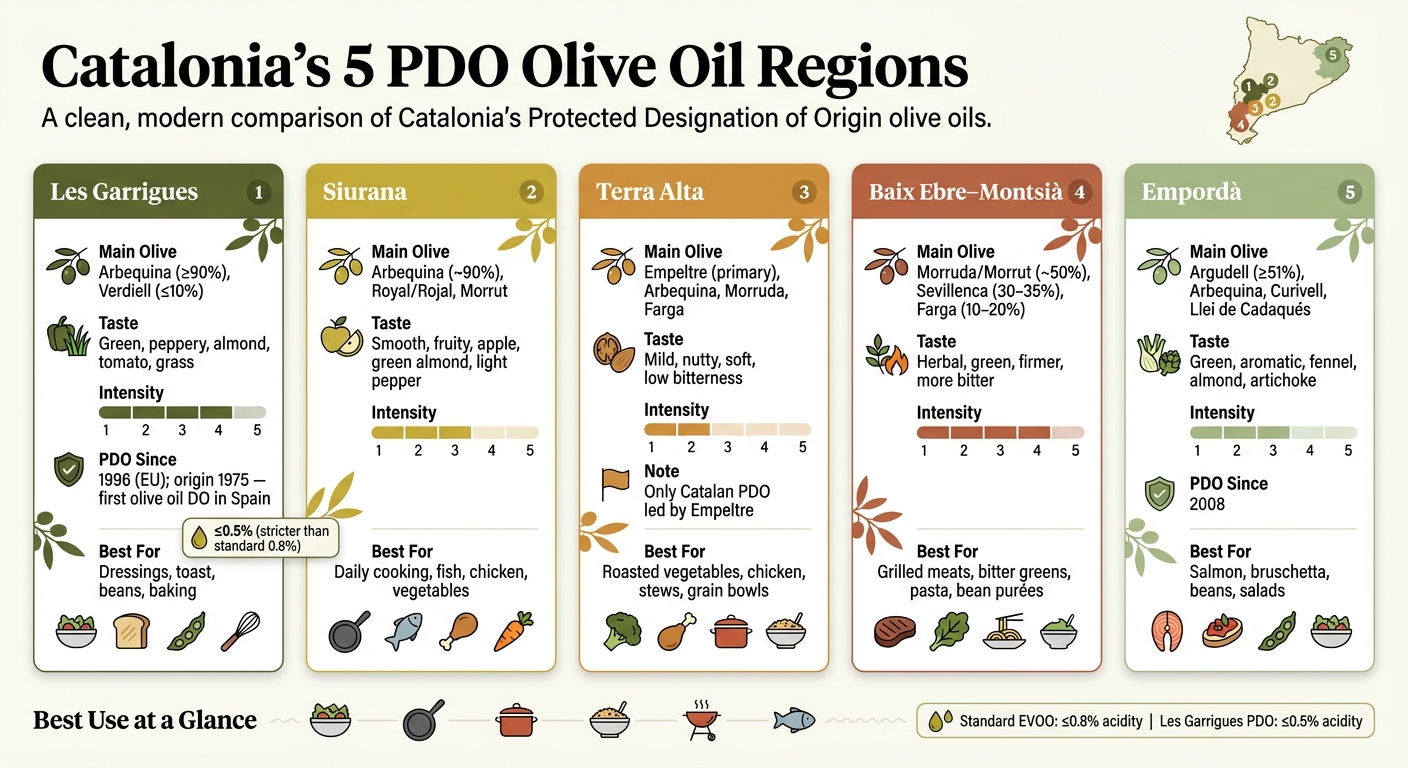
Catalonia's 5 PDO Olive Oil Regions Compared
Quick Comparison
| Region | Main olive focus | Taste | Best use |
|---|---|---|---|
| Les Garrigues | Arbequina | Green, peppery, almond, tomato, grass | Dressings, toast, beans, baking |
| Siurana | Arbequina | Smooth, fruity, apple, green almond, light pepper | Daily cooking, fish, chicken, vegetables |
| Terra Alta | Empeltre | Mild, nutty, soft, low bitterness | Roasted vegetables, chicken, stews |
| Baix Ebre–Montsià | Morruda, Sevillenca, Farga | Herbal, green, firmer, more bitter | Grilled meats, greens, pasta, bean purées |
| Empordà | Argudell | Green, aromatic, fennel, almond, artichoke | Salmon, bruschetta, beans, salads |
Bottom line: if you know the region, the olive type, and whether the oil was picked early or late, you can get much closer to the style you want. You can also shop fresh harvest oils to find your perfect match.
sbb-itb-4066b8e
What Sets Catalan Olive Oil Apart
Catalonia’s Mediterranean climate does a lot of the heavy lifting when it comes to flavor. Mild, wet winters and hot, dry summers give olives time to ripen at a steady pace. That slower ripening helps build the polyphenols that give olive oil its bitterness and peppery kick. Cooler nights help hold onto those bright, green aromas too, like fresh herbs, green apple, and tomato leaf. The result is oil that feels light and clean on the tongue, but still has enough personality to stand out without taking over a dish. You can taste those patterns across Catalonia’s five PDOs, though each one shows them in its own way.
Soil and terrain push those climate effects in different directions. In rocky inland areas with less moisture, olives often yield oils that feel more concentrated. These oils tend to be more fruity, bitter, and peppery, with notes like artichoke, green almond, or fresh-cut grass. In lower, more fertile coastal zones, the profile usually shifts. The oils are often smoother, softer, and slightly sweeter, with ripe fruit or nutty notes and a gentler finish.
Harvest timing is one of the biggest style levers producers have. When olives are picked early, while they’re still green, the oil comes out fuller-bodied, greener, more bitter, and noticeably peppery, with a rich herbal aroma. Let the fruit ripen longer, and the style changes. The oil becomes softer, fruitier, and milder, with softer fruit notes and less bite. Early harvest brings more intensity. Later harvest keeps things calmer and rounder.
The approved olive varieties pull all of this together. Arbequina stays smooth and fruity. Empeltre is mellow and nutty. Argudell comes across as green and layered. Morrut, Farga, and Sevillenca bring structure and spice. Each variety acts as the main driver behind its PDO’s style. Those differences come into focus in the five PDOs below.
1. Les Garrigues
Protected Designation of Origin Status
Les Garrigues has a special place in Spanish olive oil history. It was the first olive oil designation of origin recognized in Spain. It started in 1975 under the name "Borges Blanques" and was later renamed "Les Garrigues" in 1993. The European Union then certified it as a PDO in 1996.
The "DOP Les Garrigues" seal tells you two things: where the oil came from and that it passed regulated production standards. Those PDO rules are strict. Free acidity can't go above 0.5%, and the oil must pass both sensory and lab checks.
Les Garrigues is often the baseline for Catalan Arbequina: clean, structured, and slightly peppery.
Signature Olive Varieties
This PDO is built almost entirely around Arbequina. That variety must account for at least 90% of the oil. Verdiell can make up the remaining 10% at most.
If you're looking at single-varietal Arbequina oils, Les Garrigues is one of the classic origin-controlled reference points.
Flavor Profile and Intensity
Les Garrigues oils fall into two recognized styles.
- Fruity (Fructado): Made from early-harvested green olives. This style brings fresh green aromas like cut grass, tomato, artichoke, and green almond. It also has more bitterness and a light peppery finish.
- Mellow (Dulce): Made from later-harvested, riper fruit. This one is softer, rounder, and fruitier, with ripe apple and almond notes and very little bite.
Best Culinary Uses in U.S. Kitchens
The Mellow style works well anywhere you want a softer touch. Drizzle it over salads, grain bowls, or tomato dishes. It also works as a butter substitute in baking.
The Fruity style stands up better to bolder food. Use it on roasted root vegetables, rustic toast, or hearty bean dishes, where its grassy, slightly bitter notes can add depth.
A spoon test can tell you a lot. A peppery finish points to Fruity. A soft, rounded finish points to Mellow.
Next, Siurana shows a softer Arbequina profile from the same Catalan core.
2. Siurana
Protected Designation of Origin Status
Siurana is a protected PDO that covers Tarragona and parts of Lleida, with strict rules around origin and quality.
Signature Olive Varieties
Siurana is led by Arbequina, which usually makes up around 90% of the blend. The other 10% may include Royal (Rojal) and Morrut/Morruda. Those olives add more structure and a light bitter edge.
Flavor Profile and Intensity
If Les Garrigues comes across as sharper and more peppery, Siurana feels softer and rounder. Its oils are usually medium-fruity with moderate intensity, showing notes of grass, tomato, artichoke, green almond, fennel, apple, and banana.
On the palate, Siurana starts smooth and sweet, then finishes with a light bitter and peppery touch. Compared with Les Garrigues, it’s gentler and less peppery. Harvest timing also changes the feel of the oil quite a bit: early-harvest oils are greener, fuller-bodied, and more assertive, while late-harvest oils are lighter, smoother, and sweeter.
Best Culinary Uses in U.S. Kitchens
Early-harvest Siurana works well on foods that can handle a greener, more savory oil. Think:
- grilled chicken
- roasted vegetables
- hearty salads
- seafood
Late-harvest oils, with their sweeter and softer style, fit better in baking, mayonnaise or aioli, and as a finishing drizzle over white fish, eggs, yogurt, or even ice cream. For a brighter finish, consider pairing these dishes with a premium white balsamic vinegar.
From Siurana's soft Arbequina style, Terra Alta shifts toward a smoother, Empeltre-led profile.
3. Terra Alta
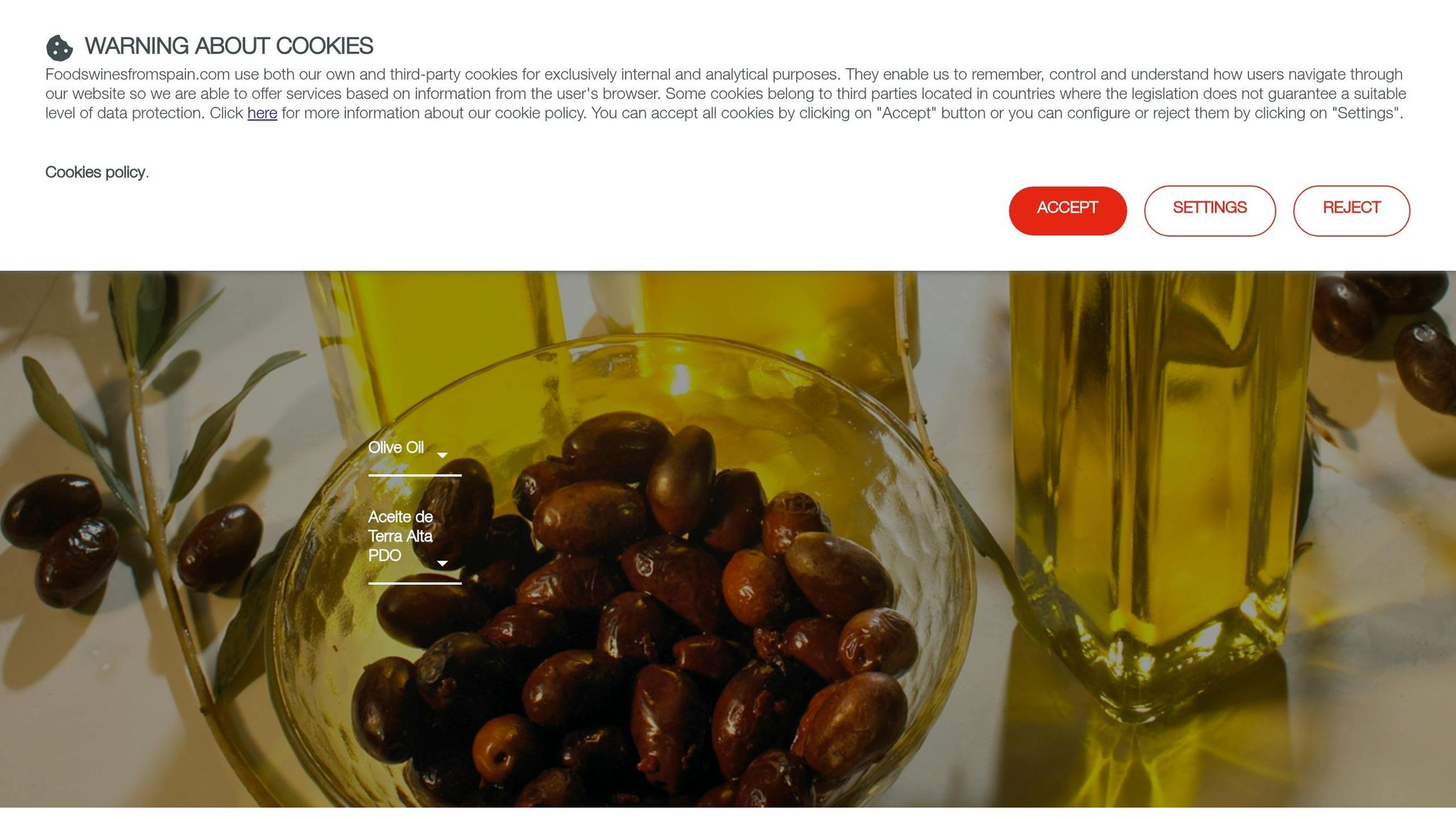
Terra Alta moves Catalonia in a softer direction, with Empeltre leading the way.
Protected Designation of Origin Status
Terra Alta holds the PDO "Oli de Terra Alta / Aceite de Terra Alta". It covers the Terra Alta county and several nearby municipalities in Ribera d'Ebre in southwestern Catalonia.
Signature Olive Varieties
Terra Alta is the only Catalan PDO where Empeltre is the main variety. It leads the blend, while Arbequina, Morruda, and Farga are also allowed.
Flavor Profile and Intensity
These oils are light to medium in intensity, with notes of almond and green walnut up front, plus gentle bitterness and pepper. You’ll also find aromas of artichoke, tomato, and banana, which give the oil its own personality. The bitterness and pepper stay low, so the overall feel is round and soft.
Harvest timing makes a clear difference. Early harvest oils lean greener and more bitter. Later harvest oils become sweeter, nuttier, and milder.
Best Culinary Uses in U.S. Kitchens
Terra Alta’s nutty, slightly sweet style makes it an easy everyday oil. It works well for sautéing vegetables, roasting sheet-pan dinners like Brussels sprouts or sweet potatoes, and finishing roasted chicken or pork chops with a light drizzle.
It also fits nicely in dishes that need a softer touch, like:
- Grain bowls
- Salads with nuts or roasted squash
- Bean or lentil stews
Those pairings play well with the oil’s mellow profile without drowning out the food.
4. Baix Ebre–Montsià
If Terra Alta leans soft and nutty, Baix Ebre–Montsià goes in a different direction. The oils here taste sharper, greener, and more forceful. That style comes from its native olives and the dry, wind-shaped conditions around the Ebro Delta.
Protected Designation of Origin Status
Baix Ebre–Montsià is an EU PDO for extra virgin olive oil from the Baix Ebre and Montsià districts of Tarragona, shaped by the Ebro Delta and the Mediterranean coast. That setting shows up clearly in the oil, especially through its three native varieties.
Signature Olive Varieties
Three native varieties define this PDO: Morruda (also called Morrut), Sevillenca, and Farga. Morruda makes up about 50% of the planted area, Sevillenca around 30–35%, and Farga a smaller share.
Flavor Profile and Intensity
Each variety pulls the blend in its own direction. Morruda brings strong green fruit, bitterness, and pungency. Sevillenca rounds things out with sweetness and almond notes. Farga adds medium intensity, herbal notes, and balance.
The dry mistral winds do a lot of the heavy lifting here. They help concentrate the fruit and raise polyphenols, which keeps the overall profile green, structured, and balanced.
Best Culinary Uses in U.S. Kitchens
In a home kitchen, these oils are easy to match with food once you know their style.
- Use Morruda-forward oils on grilled meats and bitter greens.
- Reach for Sevillenca-based oils with fish and vegetables.
- Use blends for sofrito, pasta, or bean purées.
Farther north, Empordà shifts the style in a softer, more aromatic direction.
5. Empordà
In northeastern Catalonia, Empordà makes green, aromatic olive oils shaped by the Tramuntana wind and the area's mix of coast and inland terrain. If Baix Ebre–Montsià leans more structured and herbal, Empordà shifts into a greener, more fragrant style.
Protected Designation of Origin Status
Empordà olive oil is sold under the PDO name Oli de l'Empordà (or Aceite de l'Empordà in Spanish). The designation was formally established in 2008 and covers the Alt Empordà and Baix Empordà counties, along with selected municipalities in Gironès and Pla de l'Estany.
Signature Olive Varieties
Argudell sits at the center of the blend, supported by Curivell, Llei de Cadaqués, and Arbequina. PDO rules state that Argudell must account for at least 51% of any certified blend, while Argudell and Arbequina together must make up more than 95% of the total.
Argudell is the defining olive of the area. Its sparse branches handle the strong local Tramuntana wind well, which helps explain why it fits this landscape so naturally.
Flavor Profile and Intensity
That mix of varieties, along with steady wind exposure, gives Empordà its own style. These oils are usually medium in intensity, clear, and straw-yellow to green in color. On the nose, you'll often find fennel, almond, anise, artichoke, and a light grassy note.
On the palate, bitterness and pungency stay in balance. The overall impression is a green, fruity oil with a clean finish.
Best Culinary Uses in U.S. Kitchens
Empordà's herbal and nutty profile makes it easy to use in day-to-day cooking. It's especially good as a finishing oil over roasted asparagus or grilled salmon. It also fits nicely on bruschetta, caprese, and tomato-basil pasta.
For bread dipping or a drizzle over white beans, Empordà adds character without taking over the plate.
That contrast stands out even more when all five Catalan PDOs are placed side by side.
Catalan Olive Oils Side by Side
Here’s the quick comparison. The table below lines up the five PDOs by variety, flavor, intensity, and best use in a U.S. kitchen.
| Region | Main Varieties | Flavor Profile | Intensity | Ideal U.S. Cooking Uses |
|---|---|---|---|---|
| Les Garrigues | Arbequina (at least 90%), Verdiell (up to 10%) | Fruity, green almond, grass, tomato, artichoke; early harvest is greener, spicier, and more bitter, while later harvest is sweeter and softer | medium to robust | Salad dressings, vinaigrettes, aioli, baking (cakes, cookies), cold soups |
| Siurana | Arbequina (primary), minor local varieties | Balanced, smooth, green almond and apple; early harvest is greener and more robust, while late harvest is sweeter and softer | Medium | Everyday sautéing, pan-seared fish or chicken, finishing drizzle over grain bowls or roasted vegetables |
| Terra Alta | Empeltre (primary), Arbequina, Morrut, Farga | Fruity, almond, green walnut; mild bitterness and spice, with a slightly sweeter impression later in the season | light to medium | Slow-roasted chicken, bean stews, white fish, bruschetta-style toasts |
| Baix Ebre–Montsià | Morruda/Morrut (about 50%), Sevillenca (30–35%), Farga (10–20%) | Green-fruity and intense early; moderately bitter, spicy, and astringent, with notes of cut grass, fennel, artichoke, and ripe fruit | medium to robust | Grilled steak or lamb, roasted kale or broccoli rabe, bold marinades, BBQ rubs, charred or smoked foods |
| Empordà | Argudell (predominant), Arbequina, Sevillenca, Farga | Medium-intensity, green-fruity and herbal; walnut, fresh-cut grass, green fruit, and artichoke; balanced bitterness and pungency | Medium | Shrimp, scallops, salmon, Mediterranean salads, grain salads |
Les Garrigues and Siurana are the most Arbequina-forward, so they tend to be the smoothest and fruitiest starting points. Put simply, Les Garrigues and Siurana lean softer and more familiar, while the other three PDOs show more local character and a stronger sense of place.
Harvest timing changes the style most in the Arbequina-led regions. In Les Garrigues and Siurana, early-harvest oils come across greener and more pungent, while late-harvest oils taste sweeter and milder. In Terra Alta, Baix Ebre–Montsià, and Empordà, the mix of cultivars and terroir usually shapes the oil more than harvest date does.
How Catalan PDO Oils Relate to Ultra Premium EVOO
Regional differences also help explain why Catalan PDO oils often match up well with Ultra Premium EVOO standards. These PDOs aren't just about where an oil comes from. They also set quality rules that overlap with what Ultra Premium programs look for.
Here’s the clearest example: standard EVOO permits up to 0.8% free acidity, while Les Garrigues requires acidity below 0.5%. And PDO rules across Catalonia usually call for olives to be processed within 24–48 hours of harvest.
Ultra Premium programs push things even further. They often require free fatty acids at 0.3% or lower and polyphenols of at least 130 ppm. Early-harvest Catalan oils can hit 600–1,400+ mg/kg in polyphenols, which puts them well above those targets.
The sensory side lines up too. PDO tasting panels and Ultra Premium programs both reject oils with defects and put a strong focus on fruitiness.
For U.S. shoppers, the most helpful label clues are:
- Harvest date
- Stated acidity
- A visible PDO seal
If you're looking for that same freshness-first style, Big Horn Olive Oil focuses on Ultra Premium EVOO that is sourced and cold-pressed to meet the same freshness and quality standards tied to Catalan PDO production.
Conclusion
Catalonia produces five distinct olive oil styles. Les Garrigues is green and peppery, Siurana is balanced and fruity, Terra Alta is soft and nutty, Baix Ebre–Montsià is bold and savory, and Empordà is fresh and fragrant.
The best pick comes down to how you plan to use it. Empordà or early-harvest Les Garrigues works well for finishing. Siurana fits everyday cooking. Baix Ebre–Montsià or Terra Alta pairs better with hearty dishes. That’s exactly why PDO status matters: it protects what makes each region’s oil different.
All five regions are PDO-certified, which means origin and production rules are fixed. Catalan PDO oils also follow the freshness-first standards tied to Ultra Premium EVOO, so they’re a natural fit for Big Horn Olive Oil readers.
FAQs
How do I choose the right Catalan olive oil for cooking?
Match the oil’s intensity to the dish. Go with milder oils, such as Arbequina, for light sauces, baking, or subtle dressings. Reach for more peppery oils when you’re searing, sautéing, or roasting.
Look for Extra Virgin olive oil, a clear harvest date, and dark glass bottles. Those details can help you spot a fresher oil and protect its regional character.
What does a PDO seal guarantee on Catalan olive oil?
A PDO seal means the entire process happens in one defined region, from growing and harvesting the olives to extraction and bottling.
It also shows that the oil is made using local methods and must meet strict quality standards. That includes chemical testing and sensory evaluation to confirm the oil is genuine and to help stop fraud.
How can I tell if an olive oil is early harvest or late harvest?
Check the label and the taste. Early-harvest olive oil, often picked in late October, is usually deep green, more aromatic, and more peppery. It also tends to have more bitterness and pungency.
Later-harvest oils, such as January harvests, are often sweeter and milder. When you read the bottle, look for the harvest date or year, not just the bottling date.