

Olive Oil: Symbol of Life and Light
Olive oil is more than a cooking ingredient - it’s a symbol of life, purity, and divine light with roots in ancient traditions. From fueling sacred lamps to inspiring art and literature, its significance spans thousands of years. Here’s a quick summary of its cultural and historical importance:
- Spiritual Symbolism: Used in religious rituals across Judaism, Christianity, and other Mediterranean traditions as a representation of divine presence and purity.
- Mythological Roots: Central to Greek and Roman myths, such as Athena’s olive tree gift to Athens, symbolizing peace and sustenance.
- Historical Uses: Essential in ancient economies, medicine, lighting, and daily life; valued as “liquid gold.”
- Artistic Inspiration: Featured in works by Homer, Vincent van Gogh, and religious art, symbolizing resilience, wisdom, and spiritual connection.
- Modern Relevance: Celebrated for its health benefits, olive oil continues to bridge ancient practices with contemporary wellness.
This enduring legacy connects us to humanity’s shared heritage, making olive oil a timeless emblem of nourishment, spirituality, and light.
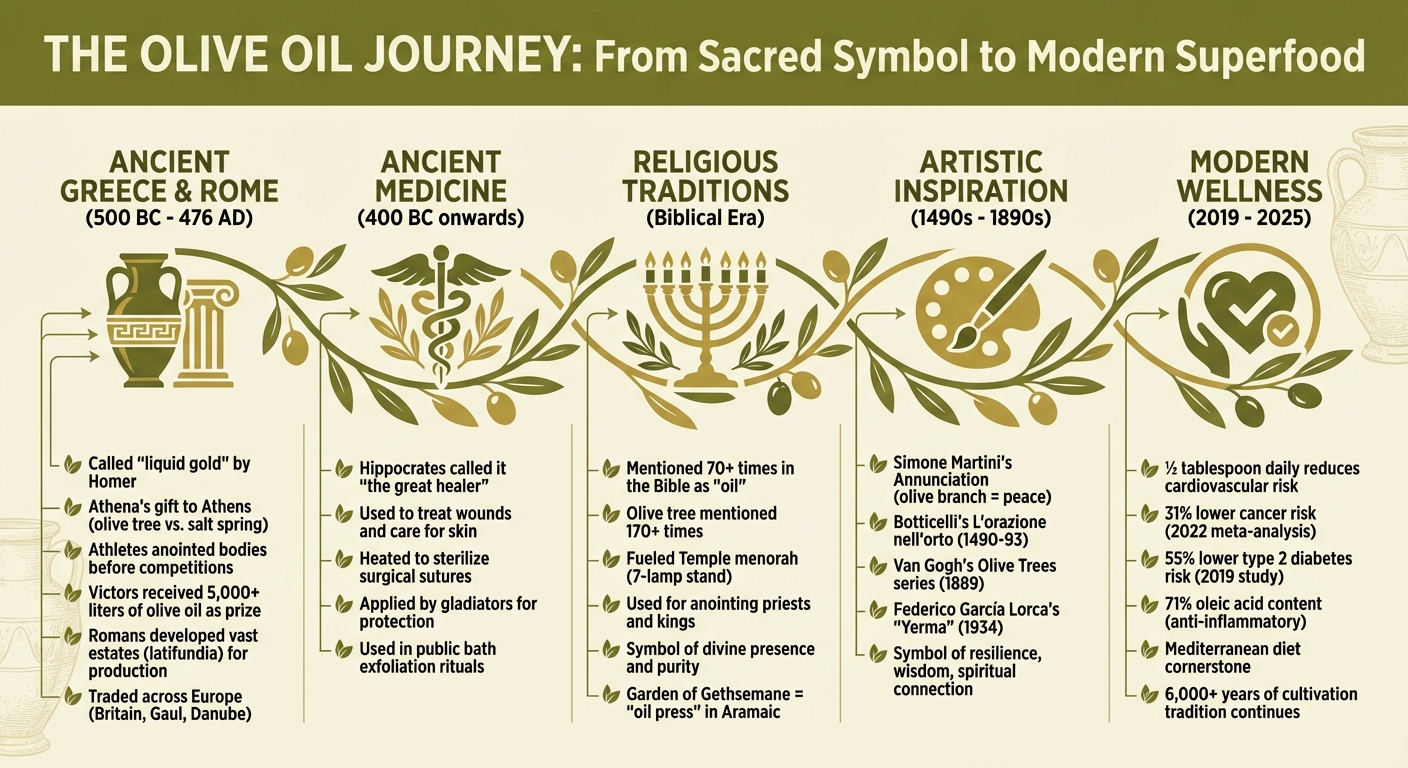
The Historical Journey of Olive Oil: From Ancient Symbol to Modern Wellness
Jesus and an Olive Press | The Garden of Gethsemane | Biblical Context Explained
sbb-itb-4066b8e
Olive Oil as a Symbol of Life in Ancient Civilizations
In the ancient Mediterranean world, olive oil was more than just a commodity - it was a symbol of vitality and prosperity, often referred to as "liquid gold". It played a central role in economies, served as a healing agent, and bridged the gap between humans and the divine. For both the Greeks and Romans, olive oil held a dual significance: it was a source of wealth and a spiritual emblem, shaping its mythological and medicinal importance.
Olive Oil in Greek and Roman Mythology
The origins of Athens are tied to the olive tree. According to legend, Athena and Poseidon competed to become the city's patron deity. Athena gifted an olive tree, while Poseidon offered a salt spring. The citizens chose Athena's olive tree, valuing its peaceful and life-sustaining qualities over Poseidon's symbol of power. From then on, the olive tree became sacred, and cutting one down was strictly forbidden.
This sacred status extended into Greek traditions, particularly in athletics. Greek athletes would anoint their bodies with olive oil before competitions, a practice that carried both spiritual and mythical significance. As Mazen Assaf explains:
To be oiled was to be prepared - physically, spiritually, mythically
.
Victors at events like the Panathenaic Games were rewarded with more than 5,000 liters of olive oil, a prize that reflected both material wealth and divine blessing. They also wore olive wreaths, symbolizing nature's recognition of human achievement.
The Romans, on the other hand, emphasized large-scale production and trade of olive oil. While the Greeks celebrated its spiritual essence, the Romans turned it into a thriving industry. They developed vast estates, known as latifundia, to produce olive oil, which was then traded across Europe. Roman distribution networks were so advanced that archaeologists have found olive oil amphorae in far-off regions like Britain, Gaul, and the Danube. As Assaf puts it:
To be Roman was to use olive oil - not only to consume it but also to embody its essence
.
Olive Oil in Ancient Medicine and Daily Use
The reverence for olive oil extended into its practical applications, particularly in medicine. Renowned physicians like Hippocrates called it "the great healer", using it to treat wounds, care for skin, and create antiseptics. Hippocratic doctors even heated olive oil to sterilize sutures during surgical procedures, showcasing an early understanding of its protective qualities.
Beyond medicine, olive oil was essential for everyday life. It fueled lamps, providing light in homes, and was used to soften fabrics, preserve wood and leather, and make soap. Public baths often incorporated olive oil for exfoliation rituals. Gladiators applied it to their bodies before entering the arena, both for better grip and as a symbolic layer of protection. Even philosophers like Plato praised a simple diet of olives and grains, associating it with health, self-sufficiency, and moral integrity. It’s clear that the olive tree was deeply woven into the fabric of Mediterranean life.
Olive Oil as Light in Religious Practices
Olive oil has always been more than just a practical commodity - it carries deep spiritual meaning, especially in religious ceremonies. Its role in daily life seamlessly extends into the sacred, symbolizing a connection between humanity and the divine. The Bible mentions "oil" over 70 times, highlighting its importance in ancient spiritual traditions. Beyond providing physical light, olive oil became a symbol of divine illumination and spiritual presence.
Olive Oil in Judeo-Christian Traditions
In Jewish tradition, olive oil played a central role in religious rituals, particularly in the Temple menorah - a seven-lamp stand that symbolized the presence of God. The Bible commands, "You shall charge the sons of Israel that they bring you clear oil of beaten olives for the light, to make a lamp burn continually" (Exodus 27:20). This practice underscored the sacredness of olive oil and its role in maintaining a connection to the divine.
In daily life, lighting a home with olive oil was also a marker of prosperity. Wealthier families could afford such illumination, while poorer households often went without. Beyond its use in lamps, olive oil was mixed with spices to create a sanctifying oil used for anointing priests, kings, and the tabernacle itself. In Christian tradition, this use of olive oil enhances the imagery of Jesus as the "light of the world", linking ancient practices to Christian theology.
Olive Oil in Other World Religions
While Judeo-Christian traditions provide the most detailed accounts, the spiritual significance of olive oil extended across the Mediterranean. In the ancient Near East, olive oil was cherished as a purifying substance and a source of steady, sacred light. Its use in temples and holy spaces made it a powerful symbol of divine presence. Over time, this symbolism of illumination found its way into art and literature, leaving a lasting impression on various cultures and their spiritual expressions.
Olive Oil in Literature and Art
Olive oil, deeply rooted in sacred traditions, has long served as a powerful symbol in literature and art, representing life, wisdom, and illumination. While the Bible mentions the olive tree over 170 times, its influence extends far beyond religious texts, inspiring countless works of poetry, paintings, and even modern installations.
Olive Oil in Classical and Modern Literature
From ancient rituals to modern narratives, olive oil has been a recurring metaphor for sustenance and restoration. In ancient Greek literature, Homer famously referred to olive oil as "liquid gold", a phrase that captured its immense value - both economic and life-sustaining. This metaphor laid the foundation for centuries of literary symbolism.
In the Quran, the "Verse of Light" (Surah An-Nur 24:35) features the "Blessed Olive Tree" as a metaphor for divine light, describing oil so pure it "almost glows without fire". Similarly, Jewish texts like Perek Shirah compare the Torah to olive oil, symbolizing divine wisdom flowing from above to enlighten the world. Across these traditions, olive oil serves as a vivid image of inner illumination and spiritual presence.
The Garden of Gethsemane, whose name translates to "oil press" in Aramaic, is one of literature’s most layered symbols. Rabbi Simon Jacobson explains: "The olive in us is that part of ourselves that thrives on struggle... Just like an olive... which yields its oil only when pressed, so, too, do we yield what is best in us only when pressed". This idea of pressing - extracting the essence through hardship - resonates deeply in both religious and secular literature.
Modern writers have adapted these themes with new interpretations. Spanish poet Federico García Lorca, in his play "Yerma", wrote: "The field was full of black olives, like sorrow itself", using olive groves to evoke themes of ancestral conflict and rural hardship. More recently, in July 2025, Mark Cole published "Olive Oil: Lessons from Italy", reflecting on Southern Italian olive groves as a metaphor for spiritual life. He writes: "Just as oil fuels the lamp, the Holy Spirit fuels our lives so we can be a light in the world". Despite evolving perspectives, the essence of the metaphor endures - olive oil as a source of illumination.
While literature captures the symbolic depth of olive oil, visual art brings its imagery to life.
Olive Oil in Visual Art Through History
For over 2,500 years, artists have depicted olive oil and its production. Ancient Greek pottery, such as the Anfora from Vulci (500 BC), featured scenes of olive harvesting, emphasizing its role in daily life - nutrition, medicine, and lighting. You can find a variety of fresh harvest olive oils that continue this tradition of quality and versatility today. These early depictions focused on practicality, but later art highlighted olive oil's spiritual and symbolic dimensions.
During the Gothic and Renaissance periods, painters often used olive imagery to convey divine messages. Simone Martini’s Annunciation featured an olive branch as a symbol of peace and heavenly communication. Similarly, Sandro Botticelli’s L'orazione nell'orto (1490-93) depicted Christ praying in Gethsemane, connecting the olive press to themes of sacrifice and spiritual refinement.
In the 19th century, Vincent van Gogh’s Olive Trees series brought a new perspective. Van Gogh viewed olive trees as symbols of resilience and sacred connection. He wrote: "Here there are some beautiful fields with olive trees with silver-gray leaves, like a blossomed willows. I'm never tired of the blue sky". His paintings captured the enduring strength of the olive tree, with its gnarled trunks reflecting lives shaped by struggle yet still bearing fruit.
Contemporary artists continue to explore olive oil’s symbolism in innovative ways. German artist Joseph Beuys, for instance, created Olivestone, an installation incorporating actual olive oil to represent ecological harmony and the bond between humans and nature. Even the olive branch itself has transcended art, becoming a global emblem of peace through its adoption by the United Nations.
From ancient pottery to modern installations, olive oil remains a visual and literary symbol of what sustains us - spiritually, physically, and emotionally. Its enduring presence in creative works continues to reflect its profound connection to human life and culture.
Olive Oil in Contemporary Culture
Olive Oil in Modern Cooking and Health
Olive oil, often called "liquid gold", remains a cornerstone of health-focused lifestyles today. Studies show that consuming just ½ tablespoon daily can reduce cardiovascular risk, while a 2022 meta-analysis revealed that higher olive oil intake is linked to a 31% lower risk of cancer.
Historically used to fuel sacred lamps, olive oil now symbolizes vitality and well-being. Its benefits are largely credited to its 71% oleic acid content, a monounsaturated fat known for combating inflammation and oxidative stress. For example, a 2019 study discovered that consuming 55 mL of enriched olive oil daily could lower the risk of type 2 diabetes by 55%.
Orlando Foods states: "Maybe it's time to treat olive oil not just as an ingredient - but as a ritual again."
Modern wellness trends have found creative ways to incorporate olive oil into daily routines. Some add a drizzle to their morning coffee to balance caffeine absorption and promote satiety, while others take a spoonful directly to support digestion and boost energy. The Mediterranean diet, renowned for its emphasis on quality ingredients and balanced nutrition, continues to inspire healthy living. Olive oil has even found a place in beauty routines as a natural moisturizer - a practice said to date back to Cleopatra herself.
By weaving its ancient roots into modern practices, olive oil continues to be a symbol of health and tradition.
Big Horn Olive Oil: Connecting Tradition to Today
The renewed interest in wellness has breathed new life into traditional olive oil production. Big Horn Olive Oil stays true to its roots with cold-pressed Ultra Premium EVOOs, maintaining free acidity levels below 0.8%. Their oils are pressed within two hours of harvest and delivered fresh within three months, ensuring that polyphenols and antioxidants remain intact.
From their Estate Reserve EVOO to single-source options starting at $8.99, Big Horn Olive Oil caters to a growing demand for transparency. Modern consumers value details like harvest dates, terroir, and polyphenol content, which connect each bottle to over 6,000 years of Mediterranean olive cultivation. By using dark glass bottles and prioritizing freshness, Big Horn preserves the essence of what ancient cultures cherished while aligning with today’s culinary and wellness priorities.
"By choosing high-quality olive oils, you're not just enhancing your meals; you're partaking in a tradition that dates back thousands of years." – Little Olive Co.
Conclusion
From ancient groves to modern kitchens, olive oil has stood as a symbol of civilization, peace, wisdom, and light. For thousands of years, it has enriched human culture - woven into myths like Athena's gift in Greek mythology, lighting sacred lamps in religious ceremonies, and inspiring artists who captured its essence in shades of green.
Its role in traditions, literature, and art reflects a shared acknowledgment of its importance across time and place. Olive oil has consistently represented abundance, beauty, and a deeper spiritual connection.
Today, this legacy seamlessly continues. Incorporating premium extra virgin olive oil into daily life connects us to centuries of tradition. The same oil that once illuminated ancient temples now supports modern wellness, bridging the past and present as both a symbol and a staple.
It serves as a reminder of our heritage and shared human values. Rooted in our story and thousands of years of history, olive oil remains a timeless emblem of nourishment, spirituality, and the natural beauty that has always been central to human life.
FAQs
Why did olive oil become a symbol of divine light?
Olive oil holds a special place in history, often seen as a symbol of divine light. In Greek mythology, it was closely tied to Athena, who offered it as a gift representing wisdom, prosperity, and divine favor. Beyond mythology, olive oil has been a cornerstone of religious and spiritual practices across Mediterranean societies, further linking it to ideas of purity and enlightenment.
What does the olive press symbolize in art and literature?
The olive press often represents change, plenty, and spiritual growth in art and literature. It symbolizes the act of drawing out life and light from olives, frequently used as a metaphor for personal growth, gaining wisdom, and the path to inner resilience.
How do I choose a truly fresh extra virgin olive oil?
When selecting olive oil, look for a harvest date on the bottle and aim for oils harvested within the current calendar year to ensure it's fresh. Choose opaque bottles, as these shield the oil from light and oxygen, which can compromise its quality over time. Also, confirm the label specifies 100% pure extra virgin olive oil - this ensures you're getting an unblended product without added seed oils, preserving both authenticity and flavor.