

Why Olive Oil Tourism Matters for Sustainability
If you compare five tourism models side by side, olive oil tourism often comes out ahead on low impact, stronger local spending, and better year-round spread. I see the main reason as simple: it uses working groves and mills instead of leaning on heavy new build-out or short, high-pressure visitor bursts.
Here’s the short version:
- Olive oil tourism links visits to farms, mills, tastings, and rural towns
- It is compared with mass coastal tourism, city-break tourism, wine tourism, and general agritourism
- The article uses 4 checks for every model:
- Footprint - land use, water use, waste, and biodiversity
- Local economic retention - how much visitor spending stays nearby
- Heritage and identity - how well place-based ways of life stay visible
- Seasonality - whether visits can spread past one peak season
My takeaway: olive oil tourism gives up volume, but it tends to do a better job of keeping money closer to growers, keeping pressure lower on land and infrastructure, and giving rural areas more than one income stream.
A few facts stand out:
- Olive trees can stay productive for centuries
- Some olive trees mentioned in the article are more than 2,600 years old
- Cruise passengers in coastal destinations may stay only a few hours in port, which limits local spending
- City breaks often pack a lot of demand into short stays and the same busy zones
"The Messinia Olive Odyssey" - Greece / Messinia
sbb-itb-4066b8e
Quick Comparison
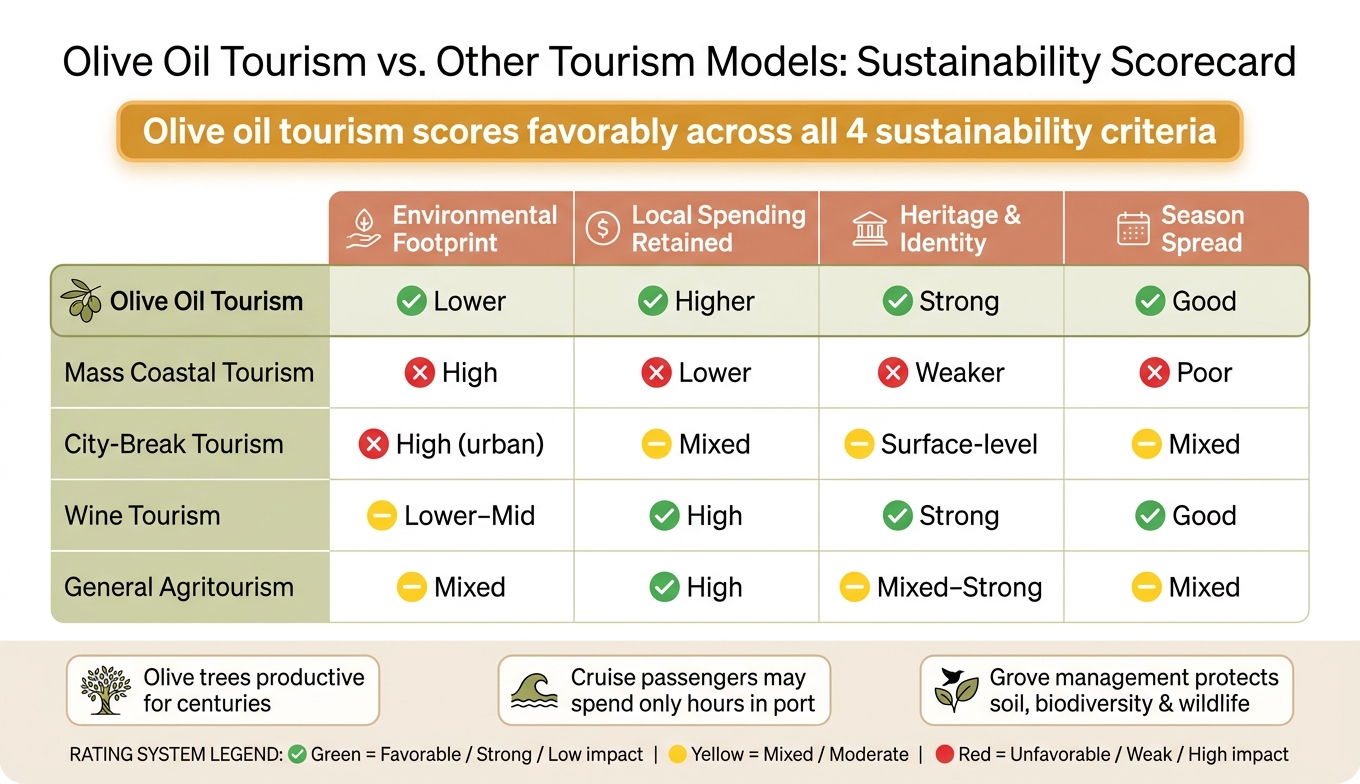
Olive Oil Tourism vs. Other Tourism Models: Sustainability Scorecard
| Tourism type | Footprint | Local spending kept nearby | Heritage and identity | Season spread |
|---|---|---|---|---|
| Olive oil tourism | Lower | Higher | Strong | Good |
| Mass coastal tourism | High | Lower | Weaker link to place | Poor |
| City-break tourism | High in busy urban areas | Mixed to lower | Often surface-level | Mixed |
| Wine tourism | Lower to mid | High | Strong | Good |
| General agritourism | Mixed | High | Mixed to strong | Mixed |
So if you want the direct answer, here it is: olive oil tourism matters because it can support rural jobs, keep more visitor dollars in local hands, and spread travel across more of the year without the same level of strain seen in coastal or city-heavy models.
1. Olive oil tourism
Environmental footprint
Olive oil tourism is built around working farms, which gives it a lighter physical footprint from the start. It uses existing groves and mills, so there’s usually little need for new buildings or major site changes. Common activities, like walks through ancient olive trees and cooking workshops, also keep land disruption low.
That matters even more when growers use careful grove management. Cover cropping, reduced tillage, and integrated pest management help protect soil health, native vegetation, and wildlife corridors.
With the right approach, grove management can support farm income while also helping the land hold up over time.
That low-impact setup also makes olive oil tourism easier to compare with tourism models that depend on new roads, buildings, or other infrastructure.
Local economic retention
Olive trees are perennial and can stay productive for centuries, which gives rural communities a stable farm base over the long term. When visitors spend money in these areas, more of that spending tends to stay close to growers, mills, and local towns, especially in places where olive trees are one of the few crops that can reliably grow.
Cultural preservation
Olive oil tourism is closely tied to place. DO and GI labels connect olive oil to specific landscapes and long-standing production methods, which helps protect local identity. In fragile landscapes, old groves also help hold soil in place and strengthen heritage.
Seasonality and visitor distribution
Harvest season brings in visitors, but tastings and workshops can run throughout the year. That helps spread demand beyond the summer rush.
Compared with tourism models that depend on a short peak window, olive oil tourism is easier to distribute across the calendar. It isn’t locked into one narrow season, which gives local operators more room to bring in guests over a longer stretch of the year.
2. Mass coastal tourism
Mass coastal tourism works in the opposite way from olive oil tourism. Instead of spreading demand across inland places and smaller sites, it packs visitors into a narrow shoreline that is often heavily built up.
Environmental footprint
Mass coastal tourism puts visitors, buildings, and waste on shorelines that are already under pressure. Its footprint is heavy. It relies on marinas, piers, sea defenses, and resort complexes that alter coastlines and increase exposure to sea-level rise and erosion. That matters because the very setting people come to enjoy can be worn down by the model built around it.
Energy use is also high. Transportation emissions from recreational vessels and ground transport add up fast. On top of that, this type of tourism creates waste and marine pollution that harm the destination itself.
Local economic retention
A big share of spending does not stay local in mass coastal tourism. Cruise passengers, for example, often spend only a few hours in port, which leaves little time for much local spending.
Seasonality and visitor distribution
Coastal tourism is highly seasonal. Crowds and costs pile up in a short peak period, which makes year-round jobs harder to maintain.
3. City-break tourism
City-break tourism runs on short, packed visits. People arrive fast, do a lot in a small window, and leave. That pace puts extra pressure on cities. And when you look at sustainability, the effects don’t stop at the city limits. They also touch nearby communities.
Environmental footprint
City-break tourism leans on dense networks of transport, hotels, and attractions. That means more energy use and more pressure on urban systems. Because stays are short but intense, accommodation, transit, and local services have to handle a steady churn of arrivals and departures. The result is concentrated demand in places that are already under strain.
Local economic retention
A lot of city tourism spending doesn’t stay with local residents or small businesses. Instead, money often moves to chains, transport providers, and short-stay services. So even when visitor numbers are high, neighborhood businesses and residents may see less of that spending than you’d expect.
Cultural preservation
City tourism can put culture on display, but that doesn’t always mean visitors get close to living food traditions or the people behind them. In many cases, the experience stays surface-level. Visitors see the city’s selection of olive oils and food scene, but not always the daily work, knowledge, and local ties that keep those traditions alive.
Seasonality and visitor distribution
City destinations tend to pull visitors into the same heavily visited urban zones. That can lead to crowding and strain on streets, transit, and public services. It also leaves little room to spread demand more evenly across the year.
Wine tourism offers a closer rural comparison, but it depends on different land use and harvest patterns.
4. Wine tourism
Wine tourism revolves around vineyards, wineries, and regional tasting trips. It’s the closest rural benchmark for olive oil tourism because both connect people to place, heritage, and food culture. That’s why it works as the clearest comparison point when judging olive oil tourism’s sustainability edge.
Environmental footprint
Olive oil tourism often comes with a lighter water and land profile. Sustainably managed groves use little water and help support soil health and biodiversity. Olive groves also work as agroforestry systems, which helps keep soils in better shape and supports biodiversity.
Local economic retention
Both models support jobs and help rural economies branch out beyond a single income source.
Cultural preservation
Wine tourism strengthens regional identity through landscape, history, and gastronomy. Olive oil tourism does something similar, but through heritage groves, long cultivation traditions, and monumental trees that can be more than 2,600 years old.
Seasonality and visitor distribution
Both models help spread demand beyond summer and support steadier visitation across the year. That also sets up the broader agritourism comparison that follows.
5. General agritourism
General agritourism is the broadest rural model in this comparison, so it works well as a baseline for judging olive oil tourism. It covers a lot of ground: pick-your-own farms, farm stays, mixed-use farms, and lower-impact activities like cycling, camping, and horse riding. For many farms, that range helps bring in income from more than one source.
Environmental footprint
General agritourism can look very different from one place to the next. That broad scope gives it flexibility, but it also means its sustainability profile is less consistent. Olive oil tourism, by contrast, stays tied to a fixed heritage landscape. General agritourism spans a much broader mix of land uses.
Still, the core point is the same in both models: outcomes depend on day-to-day practices. Waste reduction, natural resource conservation, and biodiversity protection matter in either case.
Local economic retention
Both models can keep more visitor spending inside rural communities. General agritourism supports farm diversification in a broad sense, while olive oil tourism often links spending more directly to local labels and place-based products.
Cultural preservation
General agritourism supports local culture through hands-on rural activities. Olive oil tourism leans on a more concentrated heritage: ancient groves, old oil mills (almazaras), and cultivation methods passed down across generations.
That gives olive oil tourism a tighter story to tell. The strongest experiences don’t just display that heritage. They pair tradition with a new layer of interpretation.
Seasonality and visitor distribution
General agritourism can still be shaped by the season. Olive oil tourism has an easier time stretching beyond harvest, thanks to tastings, workshops, and culinary visits.
These differences make the trade-offs in the next section easier to see.
Pros and Cons of Olive Oil Tourism vs. Other Tourism Types
Across these four measures, olive oil tourism gives up scale in exchange for lower impact, more money staying local, and stronger ties to place.
Its biggest strengths are pretty clear: short value chains, hands-on learning, and visitor spending that reaches rural communities more directly. Unlike mass coastal trips or fast city breaks, olive oil tourism leans toward slower visits rooted in the local landscape. The downside is just as clear. It operates on a smaller scale, and some of its best programming depends on the harvest season.
That’s why wine tourism is the best rural comparison. It’s the closest match, but it comes with stronger brand recognition and a more mature market.
General agritourism covers more ground, but it often doesn’t have the same clear identity. And that product focus is part of what makes olive oil tourism stick in people’s minds.
The table below sums up the main trade-offs.
| Tourism Model | Main Strengths | Main Limits |
|---|---|---|
| Olive Oil Tourism | Rural diversification, short value chains, educational depth | Limited geographic reach, harvest-dependent programming |
| Mass Coastal Tourism | High visitor volume, established infrastructure | Overcrowding, environmental strain, seasonal dependency |
| City-Break Tourism | Year-round demand, strong cultural infrastructure | Overtourism in historic centers, cultural homogenization |
| Wine Tourism | Brand recognition, mature market, luxury potential | Market saturation in some regions, less distinctive than emerging agritourism |
| General Agritourism | Broad appeal, diverse activities | Lacks product focus, fragmented quality standards |
Why Olive Oil Tourism Holds Up as a Sustainability Model
Olive oil tourism stands out against the criteria used in this article for three main reasons. It stays small by design, and that scale is a big part of why it works so well as a sustainability model. Looking at environmental footprint, local economic retention, cultural preservation, and seasonality, it tends to do better than mass-market tourism. More of the money visitors spend stays in rural communities. Heritage landscapes get support without the need for heavy infrastructure. And travelers get a direct link to the land behind the product.
That edge comes from how it works in practice. Visitors are drawn to working agricultural landscapes - ancient groves, family-run mills, and small cooperatives - where spending reaches producers more directly. Travel also spreads out more across the year instead of stacking demand into one summer rush. At the same time, producers get another income stream that helps them keep going, while visitors get direct access to local brands, know-how, and place-based stories. That kind of depth is hard for mass-market tourism to match.
Put together, these traits make olive oil tourism a strong fit for destinations focused on sustainability. It won't reach the same scale as mass coastal travel or city breaks. But when you look at environmental stewardship, community benefit, and year-round visitor distribution, it holds up well as a sustainability model.
FAQs
How does olive oil tourism help local farmers?
Olive oil tourism gives local farmers more ways to earn money through tours, tastings, and mill visits. For small and mid-sized producers, that extra income can make a big difference. It can help them stay in business while also driving more sales of their olive oil and related products.
It also helps people learn about long-standing farming methods and regional olive varieties. That kind of attention supports local heritage, protects biodiversity, and helps keep rural communities alive and working.
Is olive oil tourism only popular during harvest season?
No. Olive oil tourism is a year-round activity, not just something tied to harvest season.
People visit olive groves, join tastings, and take part in educational experiences throughout the year. And it does more than fill a calendar. It supports the social and economic life of rural areas and helps keep local heritage in motion.
What makes olive oil tourism more sustainable than other trips?
Olive oil tourism often has a lower-impact feel because it revolves around small, local experiences: mill visits, tastings, and harvest tours. Instead of funneling money out of town, those visits tend to keep more of the revenue in the community while backing farming practices that are more responsible.
There’s also a practical upside. When the focus stays on local products, transportation emissions can drop. And the ripple effect in rural areas is hard to miss, with support for jobs, hospitality, packaging, and partnerships across the community.