

Olive Oil vs. Canola Oil: Calorie Comparison
If you want to cut calories, switching between olive oil and canola oil will not do much. Olive oil has about 120 calories per tablespoon, and canola oil has about 125. That is a gap of only 5 calories.
Here’s the short version:
- Calories: almost the same
- Fat amount: both have about 14 g of fat per tablespoon
- Main difference: fat type, taste, and cooking use
- Olive oil: stronger taste, more natural plant compounds
- Canola oil: mild taste, more polyunsaturated fat
- What matters most: how much you pour
If you use 2 tablespoons instead of 1, you add about 240 to 250 calories from oil alone. So in most kitchens, portion size matters more than the oil you choose.
Olive Oil vs Canola Oil, which is healthier??
sbb-itb-4066b8e
Quick Comparison
| Compare | Olive Oil | Canola Oil |
|---|---|---|
| Calories per 1 tbsp | ~120 | ~125 |
| Total fat per 1 tbsp | ~14 g | ~14 g |
| Saturated fat | ~2 g | ~1 g |
| Main fat type | Monounsaturated | More polyunsaturated |
| Taste | Stronger, more noticeable | Mild, neutral |
| Best use | Dressings, finishing, roasting | Baking, light cooking |
So my takeaway is simple: this is almost a calorie tie. If I were choosing between them, I’d focus less on the 5-calorie gap and more on which oil fits the dish and helps me use a lighter pour.
Calories Per Tablespoon: The Numbers Side by Side
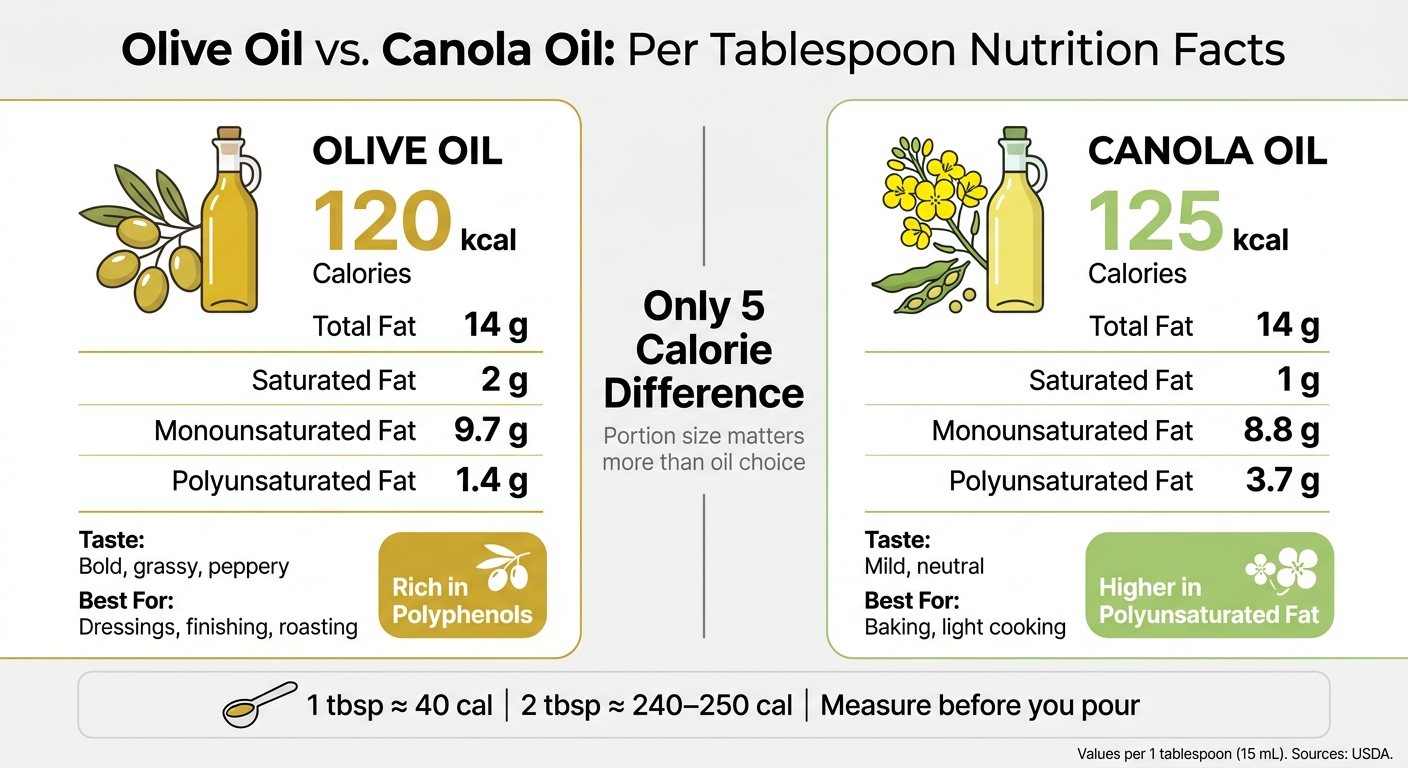
Olive Oil vs. Canola Oil: Calorie & Nutrition Comparison
Olive Oil: Calories and Fat Per Tablespoon
Olive oil has about 120 calories and 14 grams of fat per tablespoon. Most of that fat is monounsaturated fat. Per tablespoon, you’re also looking at about 2 g of saturated fat and roughly 1.3–1.4 g of polyunsaturated fat.
Canola Oil: Calories and Fat Per Tablespoon
Canola oil comes in at about 125 calories and 14 grams of fat per tablespoon. Compared with olive oil, it has more polyunsaturated fat and less saturated fat. That small calorie gap mostly comes down to slight weight differences per tablespoon.
Side by side, these numbers are almost the same.
Comparison Table: Calories and Fat Breakdown
| Nutrient (per 1 tbsp / 15 mL) | Olive Oil | Canola Oil |
|---|---|---|
| Calories | ~120 kcal | ~125 kcal |
| Total Fat | ~14 g | ~14 g |
| Saturated Fat | ~2 g | ~1 g |
| Monounsaturated Fat | ~9.7 g | ~8.8 g |
| Polyunsaturated Fat | ~1.4 g | ~3.7 g |
So if you're only looking at calories, this is pretty much a tie. The more useful difference shows up in the type of fat and how each oil performs when you cook with it.
Beyond Calories: Fat Type, Flavor, and Nutrition in Real Cooking
Calories are only one part of the story. They don't tell you how an oil tastes or how filling it feels once you're actually cooking with it. That's why flavor and fat makeup matter more than the tiny calorie difference. Since the calorie counts are almost the same, the bigger question is simple: how does each oil work in the kitchen?
Extra Virgin Olive Oil: Flavor and Nutritional Value
Extra virgin olive oil is minimally processed, so it keeps more than 200 compounds, including polyphenols like oleocanthal and hydroxytyrosol. Those antioxidants are mostly removed during the refining process used to make canola oil.
EVOO can taste grassy, peppery, or fruity. That stronger flavor often means a little goes a long way in dressings and as a finishing oil. In practice, you may use less of it and still feel more satisfied than you would with a neutral oil.
Canola oil plays a different role. It stays out of the way.
Canola Oil: Neutral Taste and Fat Composition
Canola oil is refined on purpose to taste neutral. That process removes most natural compounds and leaves behind a mild oil. This makes it a good fit for baking and other light recipes. But there's a tradeoff: it adds fat and calories without adding much flavor to the final dish. And because the taste is so mild, it's easy to pour more than you meant to.
Looking at fat composition, canola oil has less saturated fat than olive oil and more polyunsaturated fat. Those polyunsaturated fats are more sensitive to heat, and the neutral taste can make overpouring easier. That difference matters when you're picking the best oil for a given dish.
Choosing the Right Oil for Calorie-Conscious Cooking
Since the calorie count is almost the same, the better question is simple: which oil helps you cook with less? A teaspoon has about 40 calories, and a heavy pour can quickly double or triple a meal's oil calories.
When Olive Oil Works Best
Extra virgin olive oil works best when flavor does a lot of the heavy lifting. Think salad dressings, marinades, roasted vegetables, dips, and finishing dishes. Because EVOO has a bold taste, a little often goes a long way. That makes it easier to use smaller amounts without your food tasting flat.
Try using EVOO as a finishing oil on vegetables, grains, or lean proteins. You get more flavor from less oil, which can help keep portions in check.
That same flavor edge can also help you use less oil across the whole meal.
How to Keep Calories in Check with Either Oil
No matter which oil you pick, the same habits help keep calories under control. Measure oil before you pour it. A teaspoon, tablespoon, or spray bottle makes portion control much easier.
It also helps to think of oil as a light coating or a flavor base, not the main ingredient. That matters most with vegetables, grains, and lean proteins, where a small amount is often enough.
Conclusion: Same Calories, Different Strengths
The calorie gap here is basically a non-issue. Olive oil and canola oil both come in at about 120 calories per tablespoon. In day-to-day cooking, that difference is so small it won’t change much. So the better pick usually comes down to how you’re cooking and what kind of flavor you want, not calories by themselves.
Extra virgin olive oil keeps more polyphenols and antioxidants, while refining strips most of those out of canola oil. That means EVOO brings more helpful plant compounds along with a stronger, more noticeable taste.
Canola oil, on the other hand, has a mild, neutral flavor. It’s a better fit when you don’t want the oil taking over the dish.
What matters most for calorie intake is how much oil you use. Choose the one that suits the meal and makes it easier to use a lighter hand.
FAQs
Which oil is better for weight loss?
Olive oil is usually the better pick for weight loss. Both oils pack a lot of calories and have about the same amount per tablespoon. But olive oil has a few metabolic upsides that canola oil doesn’t.
It has more monounsaturated fat, which may help support metabolism, use stored fat for energy, and help you feel full longer. Olive oil also contains natural antioxidants and anti-inflammatory compounds that may help keep blood sugar steadier and curb cravings.
Does olive oil keep you fuller?
There’s no evidence in the research provided that olive oil keeps you fuller than other oils.
Olive oil and canola oil are both calorie-dense. Each has about 120 to 126 calories per tablespoon and is made up almost entirely of fat.
Since their calorie density and macronutrient profiles are so close, neither one stands out as better for satiety.
Can I use less oil without losing flavor?
There’s no meaningful low-calorie cooking oil. All oils are concentrated sources of fat, so they all pack a lot of calories into a small amount.
One of the easiest ways to cut calories without giving up flavor is to measure your oil instead of pouring it straight from the bottle. That small habit can make a big difference.
And with high-quality oils like Big Horn Olive Oil’s Ultra Premium Extra Virgin Olive Oils, you often need less to get the taste you want. Even a small amount can add rich, bold flavor.