

Olive Pomace in Pasta: Nutrition and Texture
Olive pomace can add fiber to pasta - but it can also mean a rougher, less appealing bite. In one study, a 7.5% pomace blend had about twice the fiber of its wheat-flour control: 6 g versus 3 g per 100 g of dry matter. That result is not a direct comparison with durum-semolina pasta.
The main tradeoffs are nutrition, flavor, and texture. Only food-grade pomace belongs in pasta, and small test batches help check water needs and cooking time. The study’s 7.5% blend is a tested recipe, not a rule for every product.
Quick Comparison
| What changes? | Conventional durum pasta | Olive-pomace pasta |
|---|---|---|
| Nutrition | Mostly carbohydrates, with moderate protein | Can add fiber, fat, and phenolics; amounts vary |
| Color and flavor | Golden, with mild wheat flavor | Darker, with a stronger olive note |
| Texture and cooking | Familiar firm bite | May be rougher or stickier; water needs vary |
| Best fit | A neutral base for sauces | Added fiber and olive flavor, with texture tradeoffs |
Higher phenolic levels do not prove health gains in people. Pomace also puts olive-processing residue to use, though the net impact depends on drying, transport, and processing.
1. Conventional Durum-Wheat Pasta
Nutrition
Refined durum pasta provides mostly carbohydrates, moderate protein, and little fat. USDA FoodData Central lists 371 calories, 13 g protein, 74.7 g carbohydrate, 3.2 g fiber, and 1.51 g fat per 100 g of dry pasta. Compare it with pomace pasta using the same dry-weight basis. Cooked weights vary with water absorption.
Check the label, too. Enriched pasta contains added iron and B vitamins, while eggs or whole grains change the nutrition baseline. Use this baseline as the reference for the pomace blend.
Color, Aroma, and Taste
Durum wheat carotenoids give pasta its pale yellow to golden color. Plain pasta has a mild wheat aroma and a neutral taste, which lets the sauce take center stage. Wheat variety, drying conditions, and added ingredients can all change this profile.
Taste each sample plain first. Sauce can hide the differences.
Texture and Cooking
Durum wheat’s protein network helps pasta hold its shape and develop a firm bite that holds together. Protein quality, extrusion, drying, and shape all affect the result. Al dente is a cooking target - not a guarantee. Follow the package directions, then start tasting near the lower end of the cooking range.
When comparing conventional pasta with the 7.5% pomace blend, keep dry weight, shape, water quantity, and salting consistent. This helps you assess firmness, stickiness, and dough structure without changing other factors.
Record each sample’s cooking time and judge it at the same target doneness. Stir occasionally and drain promptly. Overcooking and surface starch can cause stickiness that you might otherwise mistake for an ingredient effect.
sbb-itb-4066b8e
2. Durum-Wheat Pasta With 7.5% Olive Pomace
The 7.5% OP70 prototype shows a clear tradeoff: more fiber and phenolics, but lower texture acceptance. OP70 is olive pomace dried at 158°F (70°C). One detail matters here: the study used wheat flour, not semolina. Its findings compare the blend with a wheat-flour control - not directly with conventional durum pasta.
Nutrition
Per 100 g of dry pasta, the blend contained more fat, ash, fiber, and vitamin E than the control, but slightly less protein and carbohydrate. Energy increased modestly, along with bioactives and monounsaturated fats.
Color, Aroma, and Taste
The added pomace produced darker pasta with a more pronounced character. Appearance, color, shine, and aroma scored well. After tasting, though, panelists gave flavor and texture lower scores, reducing overall acceptance and buying intent.
Texture and Cooking
The 7.5% OP70 sample cooked evenly, but tasters still rated its texture below the control. Pomace fiber can absorb water and weaken the gluten-starch network, changing how the pasta feels when you bite into it.
Food-Grade Pomace and Home Cooking
These changes in structure help explain why home batches may need hydration adjustments. Compared with standard pasta, expect a darker color and a potentially rougher, stickier bite. Start with a small batch and adjust hydration before making a larger one.
Nutrition: Fiber, Fat, and Phenolic Compounds
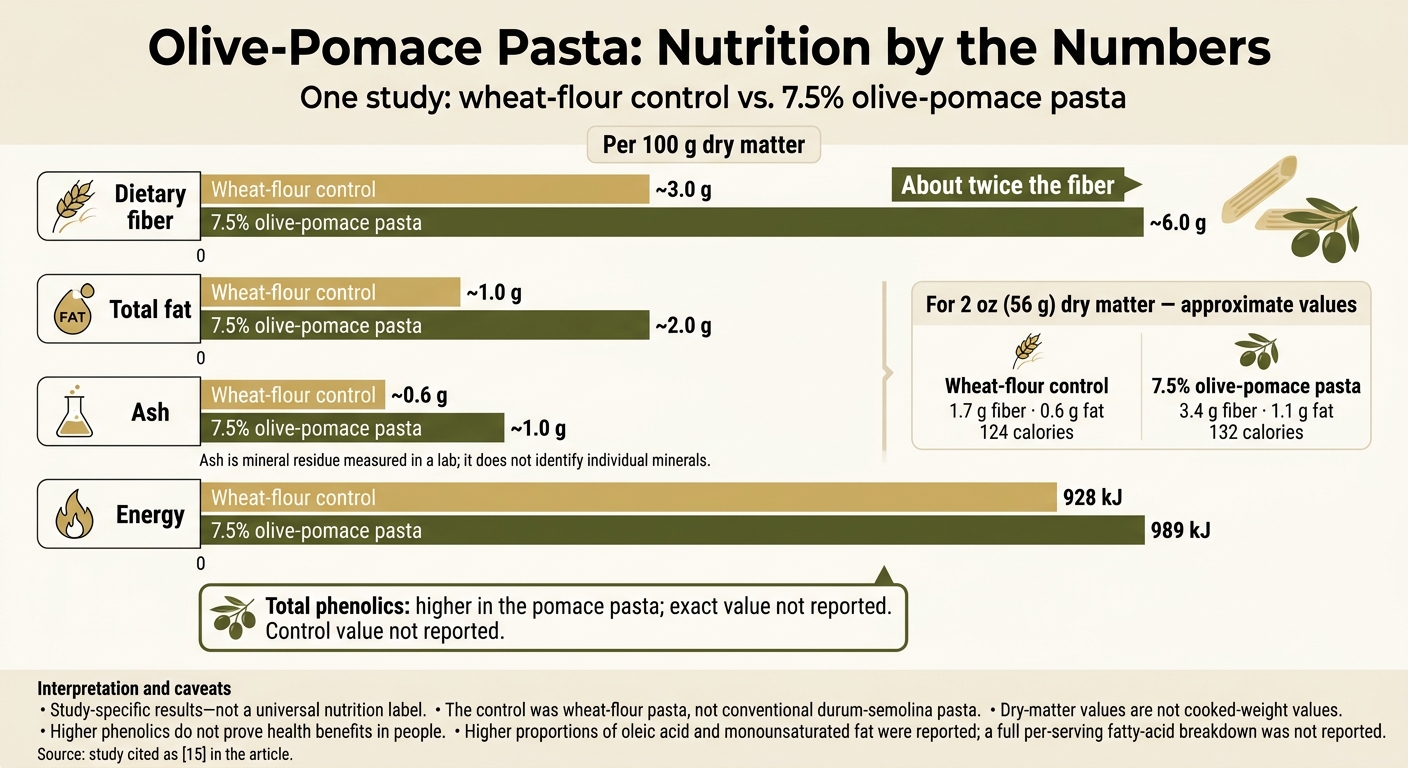
Olive-Pomace Pasta: Nutrition by the Numbers
Olive pomace changes more than pasta’s bite and color. In this study, pasta with 7.5% olive pomace contained more fiber, fat, ash, energy, and phenolics than the control. These are study-specific results, not a universal nutrition label. All values were measured per 100 g of dry matter.
The comparison uses the study’s wheat-flour control - not conventional durum-wheat pasta.
| Measure, per 100 g dry matter | Wheat-flour control | 7.5% olive-pomace pasta |
|---|---|---|
| Dietary fiber | ~3.0 g | ~6.0 g |
| Total fat | ~1.0 g | ~2.0 g |
| Ash | ~0.6 g | ~1.0 g |
| Energy | 928 kJ | 989 kJ |
| Total phenolics | Not reported | Higher; exact value not reported |
For 2 oz (56 g) of dry matter, that works out to about 1.7 g of fiber, 0.6 g of fat, and 124 calories for the control. The pomace pasta provides about 3.4 g of fiber, 1.1 g of fat, and 132 calories.
More total fat doesn’t automatically mean a better fatty-acid profile. The study found higher proportions of oleic acid and monounsaturated fat, but it did not report a full per-serving fatty-acid breakdown.
Ash is the mineral residue left after a sample is burned in a lab. It doesn’t tell you which minerals are present, and its amount varies with the olive source and processing.
Phenolic compounds are plant bioactives measured through lab tests. Pomace pasta may retain more phenolics and antioxidant activity after cooking than standard pasta. That does not prove health benefits in people.
These changes in composition also help explain the differences in bite and cooking behavior discussed next.
Cooking and Texture: Firmness, Stickiness, and Dough Structure
The extra fiber changes more than nutrition - it also changes how the dough holds water. Compared with standard durum pasta or extra virgin olive oil based dishes, pomace pasta trades some structure for more fiber. The dough may feel dry or crumbly, then turn sticky if you add too much water. Add water gradually. Firmness isn’t the same as elasticity: pasta can feel firm but still break more easily or have a rough texture.
In the study, 7.5% OP70 cooked evenly and was selected for further analysis. The 10% OP70 version had a granular texture after cooking and was rejected.
To compare batches fairly, use the same flour lot, pomace lot, shape, thickness, drying conditions, water volume, salt, and serving temperature. Record particle size, added water, mixing time, rest time, and each batch’s own best cooking point.
At home, cook a small portion first. Judge the core and bite, not just the timer. Results can vary, so pomace quality and grind size matter just as much as the formula itself.
Food-Grade Pomace and Home Cooking
Pomace quality affects both safety and texture, so start with the source. Use only food-grade pomace with documented human-food processing and lot traceability. Raw mill residue and material sold for gardening, compost, or fuel don’t belong in pasta.
Food makers should request a current specification and a lot certificate of analysis (COA). These should cover foreign material, particle size, microbes, heavy metals, pesticides, residual solvents where applicable, moisture or water activity, packaging, and shelf life.
Keep pomace sealed, cool, and dry under the supplier’s stated storage conditions. Record the date you open it, and reject any material that’s wet, moldy, infested, gritty, or rancid. Check that pits have been removed: hard fragments can damage equipment and pose dental or choking risks. These quality differences also affect how pasta cooks and feels when you eat it.
At home, follow the package directions, taste early, and drain promptly.
Olive oil adds fat and flavor; olive pomace adds fiber and solids. Durum-wheat pomace pasta still contains gluten. If you have celiac disease or other medical dietary needs, check ingredient and allergen labels. U.S. gluten-free labeling must meet FDA requirements, including less than 20 ppm gluten.
Summary: Pros, Cons, and Best Uses
The tradeoff is simple: more fiber and olive flavor, but less predictable texture.
| Feature | Conventional durum-wheat pasta | Olive-pomace pasta |
|---|---|---|
| Color and flavor | Golden color and mild wheat flavor | Darker color and stronger olive flavor |
| Nutrition | Depends on the wheat and recipe | Higher fiber and olive bioactives; health benefits remain unproven. |
| Cooking and bite | Predictable cooking and familiar firmness | Less predictable hydration; a firmer, rougher, or stickier bite. |
Choose conventional pasta for a familiar, neutral bite. Use pomace pasta when added fiber and a stronger olive note matter more than standard texture. Tomato, garlic, and herb sauces pair well. For your first batch, follow the package’s water and timing instructions rather than the rules you use for standard pasta.
For food makers, 7.5% is a tested formulation - not a universal target. Balance the inclusion level, particle size, moisture, flavor, and texture, then measure cooking loss and consumer acceptance.
Beyond the bowl, pomace provides a way to reuse olive-processing residue. Whether that reuse delivers a net environmental benefit still depends on drying, transport, processing, and alternative uses.
FAQs
How does pomace pasta compare with whole-wheat pasta?
Like whole-wheat pasta, pomace pasta has more fiber than standard pasta. It’s made by mixing food-grade dried pomace powder into the dough.
Pomace can make pasta darker, grittier, and firmer than standard pasta. It may also add a bitter taste. Both whole-wheat and pomace pasta work as a base for sauces, but pomace pasta needs careful texture and flavor testing. Standard wheat pastas have a more predictable consistency.
Can I improve pomace pasta’s texture without losing fiber?
Yes. Dried pomace powder adds fiber, but it can also make pasta feel gritty or firm and taste bitter. Tossing the cooked pasta with high-quality Ultra Premium Extra Virgin Olive Oil gives it a silky, glossy coating that helps soften a dry or chalky mouthfeel - while keeping the fiber content and desired al dente bite.
Does reheating change pomace pasta’s texture?
Reheating can change olive pomace pasta’s texture. Add about 1 tablespoon of water per serving to help keep it from drying out. Warm it in a covered skillet over low heat, stirring frequently, or microwave it in intervals, stirring between each for even heating. A little liquid or a drizzle of Big Horn Olive Oil before serving can help restore a silky texture, bring the dish together, and keep it flavorful.