

Polyphenols in Olive Waste: Functional Food Potential
Most of the olive’s phenolics do not end up in the oil. In three-phase milling, only about 1%–2% reaches the final oil, while much of the rest stays in mill wastewater, pomace, leaves, and pits.
If you want the short answer: olive leaves are the richest source by dry weight, mill wastewater is a strong source of hydroxytyrosol at scale, and pomace is the most useful middle ground for food ingredients. The main compounds are hydroxytyrosol and oleuropein, and the main limits are taste, process cost, and U.S. safety/GRAS needs.
Here’s what I’d take from the article right away:
-
Best sources
- Leaves: highest phenolic density, with oleuropein at about 2%–6% of dry weight
- OMWW: hydroxytyrosol at about 100–2,000 mg/L
- Pomace: broad phenolic mix and high volume
- Pits: lowest phenolic load
-
Best recovery routes for food use
- Ethanol-water extraction for leaves and pomace
- Membrane filtration for wastewater
- Resin cleanup when a cleaner extract is needed
- MAE, PLE, and enzymes to cut time or improve yield
-
What the health data says
- Lab and animal data show antioxidant, antimicrobial, and cell-protective effects
- Human data is still limited, but some trials show changes in blood pressure, oxidized LDL, gut microbiota, and inflammatory markers
- Most human studies are small and often last only 4–8 weeks
-
What matters for actual foods
- Extracts can help in oils, dairy, bakery, meat products, condiments, and coatings
- Direct pomace use can add bitterness, darker color, and texture changes
- Purified or encapsulated extracts look easier to use than raw byproducts
Quick comparison
| Byproduct | Main phenolics | Typical level | Best fit |
|---|---|---|---|
| Olive leaves | Oleuropein, verbascoside | 20,000–120,000 mg GAE/kg dry | High-phenolic extracts |
| OMWW | Hydroxytyrosol, tyrosol | 1–24 g GAE/L | Liquid-phase recovery |
| Olive pomace | Hydroxytyrosol, secoiridoids, flavones | 3,000–10,000 mg GAE/kg dry | Food ingredients at scale |
| Olive pits | Lignans, phenolic acids | 100–1,000 mg GAE/kg dry | Lower-priority source |
So, if I sum it up in one line: olive waste looks less like trash and more like a raw material for polyphenol ingredients - if producers can recover it cleanly, control flavor, and meet U.S. food-use rules.
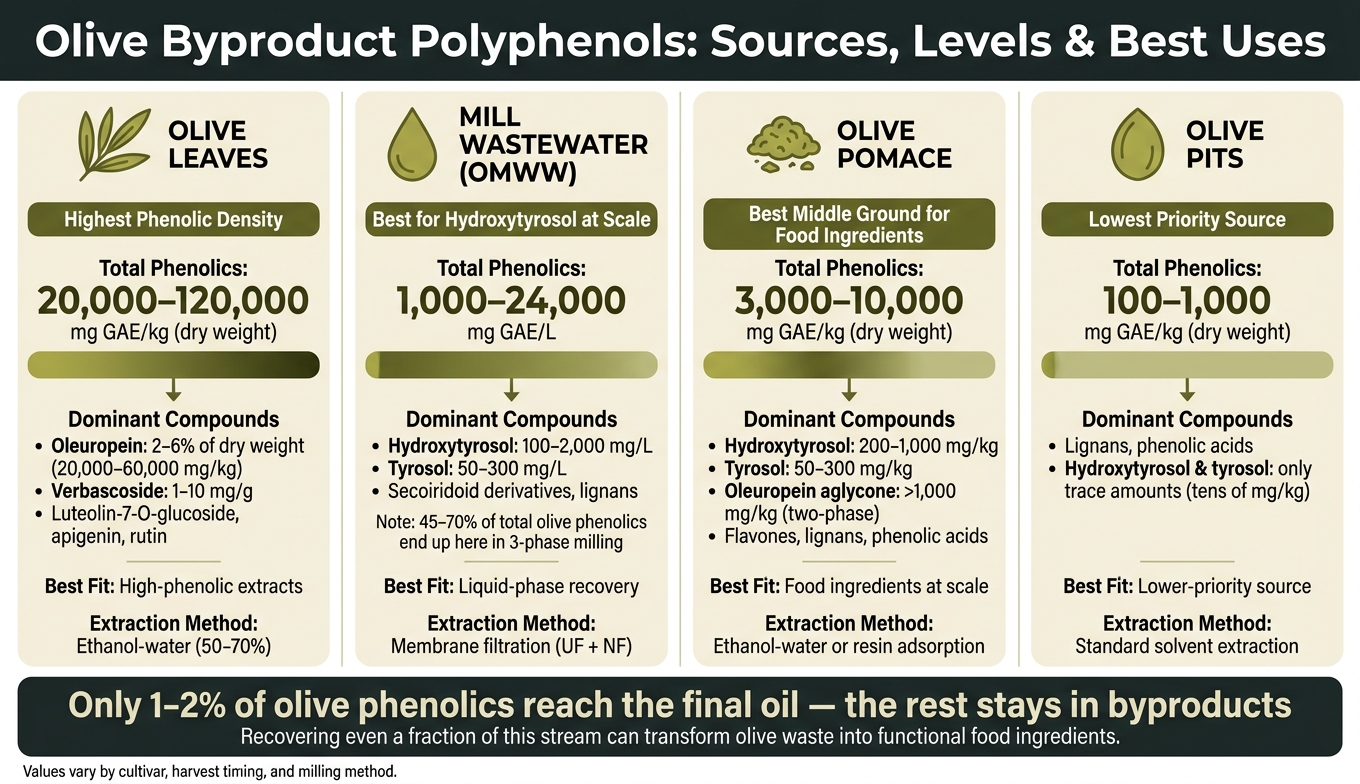
Olive Byproduct Polyphenols: Sources, Levels & Best Uses
Polyphenols Found in Olive Mill Wastewater, Pomace, Leaves, and Pits
Olive oil production creates four main byproduct streams: olive mill wastewater (OMWW), olive pomace, olive leaves, and olive pits. Each stream has its own phenolic profile, and the concentration can change a lot from one stream to another. If you're thinking about functional ingredient development, this is the first thing to look at: what compounds are there, and in what amounts?
OMWW is the liquid byproduct left after centrifugation. It contains a high share of water-soluble phenolics, especially hydroxytyrosol at about 100–2,000 mg/L and tyrosol at around 50–300 mg/L. Total phenolic content in OMWW ranges from 1 to 24 g gallic acid equivalents (GAE) per liter, depending on the milling setup and how much dilution occurs. Secoiridoid derivatives and lignans such as pinoresinol may also show up in the tens to low hundreds of mg/L in high-phenolic samples. In three-phase milling systems, about 45–70% of total phenolics can end up in this liquid stream. Pomace has a lower concentration, but its scale and compound diversity still make it worth close attention.
Olive pomace - the solid mix of skins, pulp, and pit fragments - has a broader phenolic spectrum. Total phenolics usually land between 3,000 and 10,000 mg GAE/kg dry weight. It contains hydroxytyrosol at 200–1,000 mg/kg and tyrosol at 50–300 mg/kg, along with oleuropein aglycone and other related secoiridoids that can go past 1,000 mg/kg in some two-phase pomace samples. Pomace also brings in flavones, lignans, and phenolic acids.
Olive leaves are the richest source on a dry-weight basis, and oleuropein is the main reason why. Dried leaves often contain 20,000–120,000 mg GAE/kg total phenolics, with oleuropein alone making up about 2–6% of dry leaf weight, or 20,000–60,000 mg/kg. Hydroxytyrosol is usually much lower in intact leaves, often in the tens to a few hundred mg/kg range. Verbascoside can reach 1–10 mg/g in some cultivars. Leaves also contain luteolin-7-O-glucoside, apigenin derivatives, and rutin in meaningful amounts.
Pits sit at the low end. Their total phenolics usually range from 100 to 1,000 mg GAE/kg dry weight. The phenolic fraction is made up mostly of lignans and phenolic acids, while hydroxytyrosol and tyrosol tend to appear only in the tens of mg/kg.
Which Byproducts Carry the Highest Phenolic Loads
If you compare the streams side by side, olive leaves have the highest phenolic density on a dry-weight basis, mostly because of their high oleuropein content. OMWW stands out for volume and liquid-phase concentration, which makes it a strong fit for hydroxytyrosol-rich extracts at industrial scale. Pomace falls in between: lower concentration than leaves, but available in large amounts and packed with a broader mix of compound classes.
| Byproduct | Total Phenolics | Dominant Compounds |
|---|---|---|
| Olive leaves | 20,000–120,000 mg GAE/kg (dry) | Oleuropein, verbascoside, luteolin glucosides |
| OMWW | 1,000–24,000 mg GAE/L | Hydroxytyrosol, tyrosol, secoiridoid derivatives |
| Olive pomace | 3,000–10,000 mg GAE/kg (dry) | Oleuropein aglycone, hydroxytyrosol, flavones, lignans |
| Olive pits | 100–1,000 mg GAE/kg (dry) | Lignans, phenolic acids, trace secoiridoids |
Values vary by cultivar and processing.
Phenolic composition also changes with cultivar, harvest timing, and milling method. Earlier-harvested, greener olives usually contain more oleuropein and more total phenolics. Two-phase mills keep more water-soluble phenols in wet pomace, while three-phase mills push a larger share into OMWW.
Why Olive Byproducts Fit Circular Food Systems
OMWW is hard to discard without treatment because it has a heavy biochemical oxygen demand and becomes phytotoxic at high concentrations. Pomace has its own hurdle: it needs drying and extra processing before it can be sold or put to use. Polyphenol recovery helps on both fronts. It cuts the waste burden and creates ingredients with antioxidant potential.
A big share of olive phenolics never makes it into the oil in the first place. In a three-phase mill, only about 1–2% of the olive's phenolics reach the final oil. The rest stays behind in OMWW and pomace. Even pulling back a small part of that stream for functional food ingredients can change how the olive industry uses its raw material. That composition profile is what shapes the extraction method chosen next.
sbb-itb-4066b8e
Extraction and Recovery Methods for Food Use
Recovering polyphenols from olive waste for food use is a balancing act. You want good yield, but you also need a process that fits food-grade standards. And because olive mill wastewater, pomace, and leaves don’t contain the same phenolics in the same amounts, one method won’t fit every stream.
Ethanol-Water and Conventional Solvent Extraction
Ethanol-water extraction is the most common method for olive pomace and leaves. For food ingredients, ethanol-water is the standard choice. Most studies report the best phenolic yields at 50–70% ethanol (v/v) because that range gives a good polarity balance for both simple phenols and more complex secoiridoids. Common process conditions fall between 30–60 °C with contact times of 30 minutes to 3 hours, often with agitation.
In lab work, researchers often test solvents that are not meant for direct food use. Those solvents can push analytical yield higher, but that doesn’t make them a fit for foods or beverages. Methanol is toxic. Acetone and ethyl acetate come with tighter residue limits for ingredient use, so any residual solvent has to be controlled.
Membrane, Microwave, Pressurized, Resin, and Enzymatic Methods
For olive mill wastewater (OMWW), membrane processing offers a way to concentrate polyphenols without adding organic solvents. A common setup starts with microfiltration or ultrafiltration to remove solids and large molecules. After that, nanofiltration - and in some cases reverse osmosis - concentrates lower-molecular-weight phenolics such as hydroxytyrosol and tyrosol. Depending on the feed and pre-treatment, nanofiltration retentates can reach 1–5 g GAE per liter. That solvent-free route works well for food-grade processing when the system uses approved materials.
Microwave-assisted extraction (MAE) and pressurized liquid extraction (PLE) shorten extraction time and cut solvent use compared with standard maceration. MAE heats the solvent and plant matrix fast, which disrupts cell structures and speeds up polyphenol release, often in only 20–30 minutes. PLE works under elevated pressure - 50–150 bar - and at temperatures usually between 50 and 150 °C so the solvent stays liquid and mass transfer improves. Both methods can run with ethanol-water, but temperature control matters. If the process gets too hot, sensitive phenolics can degrade.
Resin adsorption is often used after the main extraction step to clean up the extract. Polymeric resins such as Amberlite XAD-7 or SEPABEADS bind phenolics from crude extracts or OMWW concentrates, while sugars, salts, and off-flavor compounds move through. The bound phenolics are then released with 70–80% ethanol, producing a cleaner fraction. Depending on the starting material and the resin, phenolic purity can increase to 30–60% by weight.
Enzymatic pre-treatment can also help, especially for pomace and leaves. Enzymes such as cellulases, pectinases, and hemicellulases break down cell walls and free bound phenolics before extraction. These treatments usually run at 40–55 °C and pH 4–5.
Yield, Enrichment, and Resource Use
The methods below differ in yield, purity, and food-use fit.
| Waste Stream | Extraction Method | Solvent or Conditions | Typical Yield or Concentration | Food-Use Fit (U.S.) | Sustainability Notes |
|---|---|---|---|---|---|
| Olive pomace / leaves | Ethanol-water maceration | 50–70% ethanol (v/v), 30–60 °C, 30 min–3 hrs | 5–20 mg GAE/g dry matter | High - food-grade solvents | Scalable; moderate solvent use |
| Olive pomace / leaves | Microwave-assisted extraction (MAE) | 50–70% ethanol-water, 60–120 °C, 5–30 min | Comparable or higher than conventional | High - food-grade solvents compatible | Reduced time and solvent volume |
| Olive pomace / leaves | Pressurized liquid extraction (PLE) | Ethanol-water, 50–150 °C, 50–150 bar, 10–30 min | Comparable or higher than conventional | High - with food-grade solvents | Lower solvent use; faster throughput |
| OMWW | Membrane filtration (UF + NF) | Solvent-free separation, 20–35 °C, 2–30 bar | 1–5 g GAE/L in retentate | High - no organic solvents | Enables water recovery; reduces COD |
| OMWW / pomace extracts | Resin adsorption + ethanol desorption | Polymeric resin, 70–80% ethanol eluent | 30–60% phenolics by weight (purified) | High - food-grade eluents | Resin reuse reduces waste |
| Olive pomace / leaves | Enzymatic pre-treatment + extraction | Cellulase/pectinase, 40–55 °C, pH 4–5, 30 min–several hrs | Increased yield versus control extraction | Moderate - food enzymes with GRAS notices | Mild conditions; enzyme inactivation required |
Values vary with raw material quality and process setup.
There’s a clear tradeoff here. Standard maceration is familiar and easy to scale, but it takes more time. MAE and PLE move faster and use less solvent per unit of extract, which can trim energy demand. Membrane processing also does more than separate phenolics. It lowers the chemical oxygen demand (COD) of OMWW, which can cut disposal costs and reduce the burden tied to waste handling.
In practice, mixed systems often make the most sense. For example, membrane concentration followed by resin purification can produce stable, food-ready concentrates. Those process decisions shape not just yield, but also how easily an extract can move into bioactivity testing and later formulation.
Bioactivity Evidence and Functional Food Applications
Recovered olive-leaf, pomace, and wastewater extracts only matter if they still do something useful at doses that fit actual foods. That’s the core issue: can these compounds make it through processing, formulation, and normal serving sizes without losing their effect?
In Vitro and Animal Evidence on Oxidative Stress, Inflammation, and Metabolic Markers
Lab studies point to antioxidant activity from olive-waste polyphenols. In cell models, olive-leaf phenolics protected renal cells from cadmium-induced oxidative stress. Other olive-leaf extracts also changed immune-cell signaling in vitro.
Animal work adds some support. In rats fed high-fat diets, extracts rich in hydroxytyrosol and oleuropein helped reduce problems tied to lipid metabolism and liver injury. Even so, the evidence base is still fairly small.
Human Trials, Dosing, and Key Limitations
Human data are still limited, but there’s enough to spot a few patterns. The clearest findings come from olive leaf extract and hydroxytyrosol-rich food products. A meta-analysis covering 819 subjects found that OLE supplementation at 500 mg/day reduced systolic blood pressure by 11.5 mmHg on average. A separate analysis in hypertensive individuals showed drops of 4.81 mmHg systolic and 2.45 mmHg diastolic.
There are also early signs on metabolic and inflammation-related markers. One randomized controlled trial in 88 adults used 150 g/day of yogurt with an olive pomace polar lipid extract for 8 weeks. The study reported modulated IL-6 and IL-10, along with lower thrombotic markers. Another trial in 62 adults tested hydroxytyrosol-enriched biscuits at 90 g/day for 8 weeks and found reduced oxidized LDL cholesterol and improved gut microbiota.
The table below shows where the data look most solid and where results still seem tied to the food format used.
| Waste Source | Extract Composition | Model or Participants | Dose or Exposure | Main Outcomes | Strength of Evidence |
|---|---|---|---|---|---|
| Olive Leaf | Oleuropein, hydroxytyrosol | 819 subjects (Meta-analysis) | 500 mg–5 g/day | Reduced SBP, DBP, and triglycerides | Moderate-High (Meta-analysis) |
| Olive Pomace | Hydroxytyrosol (in biscuits) | 62 adults | 90 g/day, 8 weeks | Reduced oxidized LDL-C; improved gut microbiota | Moderate (Human RCT) |
| Olive Leaf | Phenolic-rich extract | Renal cells (In vitro) | Low-dose cadmium exposure | Cytoprotection against oxidative stress | Low (In vitro) |
| Olive Leaf | Oleuropein-rich extract | Rats | High-fat diet | Improved lipid metabolism and liver health | Moderate (Animal) |
Values vary by extract composition and study design.
There’s a catch, though. Most human trials run only 4–8 weeks, sample sizes are small, and reporting on exact bioactive intake is uneven. In plain English, studies don’t always say clearly how much hydroxytyrosol or oleuropein people actually consumed. That makes side-by-side comparison harder than it should be.
Food Applications, Sensory Effects, and U.S. Regulatory Considerations
Bioactivity by itself won’t sell a food product. If the ingredient tastes bitter, changes the color, or falls apart during storage, it becomes a tough sell fast.
Olive-waste polyphenol extracts have been tested in olive oil, dairy, bakery, and meat products. In oils, these extracts act as natural antioxidants and improve oxidative stability during heating. In baked snacks and fish burgers, they can help extend shelf life by slowing lipid oxidation.
Direct pomace addition is tougher to handle because it can change both texture and flavor. The main problems are bitterness and color shifts. To work around that, researchers have looked at encapsulation, especially spray-drying, to help protect phenolic stability during digestion. Fermentation is another option, and it may reduce bitterness while keeping bioactivity in place.
In the U.S., commercial use also has to clear a practical hurdle: safety. Any product aimed at the food market needs safety data and GRAS support for the intended use in the target food.
Sustainability, Market Relevance, and Conclusion
Environmental and Economic Tradeoffs of Recovery
After extraction and bioactivity, the big issue is scale. Olive mill wastewater and pomace come with high organic loads and phytotoxic phenolics. When producers recover polyphenols, they can cut COD and phytotoxicity while turning a waste stream into functional ingredients.
That sounds promising. But there’s a catch: taking advanced extraction methods from the lab to commercial volumes comes with real techno-economic costs. That weight still slows near-term adoption.
How Olive Waste Extracts Could Complement Premium Olive Products
The scale question is also a market question. An ingredient has to fit premium food products without hurting taste, texture, or overall sensory quality.
Researchers at the University of Bari Aldo Moro describe olive pomace as a strong source of functional compounds for a more circular olive-oil chain. In practice, that means phenolic-rich extracts could sit alongside premium extra virgin olive oils in products such as:
- Functional dressings
- Polyphenol-enriched condiments
- Grain-based foods
- Edible coatings for fruit
These formats line up well with health-focused consumer demand.
Conclusion: What Current Evidence Supports
Current evidence points most clearly to olive byproducts - especially pomace, leaves, and mill wastewater - as viable sources of functional ingredients. Purified extracts look like the more practical path because they keep bioactivity while sidestepping the sensory and textural issues that come with direct pomace use.
In the U.S., there are still regulatory hurdles around standardized dosing and health claim substantiation. For now, the clearest near-term drivers are waste reduction and ingredient recovery.
FAQs
Why are olive leaves richer in polyphenols than olive oil?
Olive leaves contain more polyphenols because these compounds are mostly stored in the plant’s tissues.
When olives are processed into oil, a large share of those polyphenols is lost or reduced. That means olive oil is a less concentrated source than olive leaves.
Which olive byproduct is most practical for functional food use?
Olive pomace is the most practical byproduct for use in functional foods because it contains high levels of phenolic compounds, fatty acids, and dietary fiber.
That mix matters. It can improve a food’s nutritional profile, help extend shelf life, and add health-related value.
Are olive waste polyphenol extracts approved for food use in the U.S.?
Not yet. In the U.S., olive waste polyphenol extracts are not officially approved for use in food.
That said, they’re still seen as useful bioactive compounds with possible applications in food, packaging, and pharmaceuticals.