

Olive Tree Folklore: Stories from Ancient Greece
The short answer: in ancient Greece, the olive tree was not just a plant. I’d sum it up as a food source, a sacred gift, a public symbol, and a prize of honor all at once.
If you want the full picture fast, here it is:
- Myth: Athena won Athens by giving the city an olive tree, while Poseidon gave a salt spring.
- Law: sacred olive trees, called moriai, were protected by the state, and harming them could bring exile, loss of property, or death.
- Meaning: Greeks tied the tree to wisdom, peace, long life, and protection.
- Daily use: extra virgin olive oil fed homes, lit lamps, treated the body, and was used in worship.
- Public honor: Olympic victors wore wild olive wreaths, and Panathenaic winners received amphorae filled with sacred oil.
- Scale: Athens used more than 75,000 liters of olive oil for about 2,100 Panathenaic prize jars, with each amphora holding 36 liters.
What stands out to me is how one tree connected myth, religion, politics, and everyday life. Even the story of Athena’s burned tree growing back after the Persian sack of 480 BCE helped show the olive tree as a sign of endurance.
So if you’re asking what olive tree folklore meant in ancient Greece, the plain answer is this: it gave Greeks a shared image for civic pride, divine favor, and daily survival.
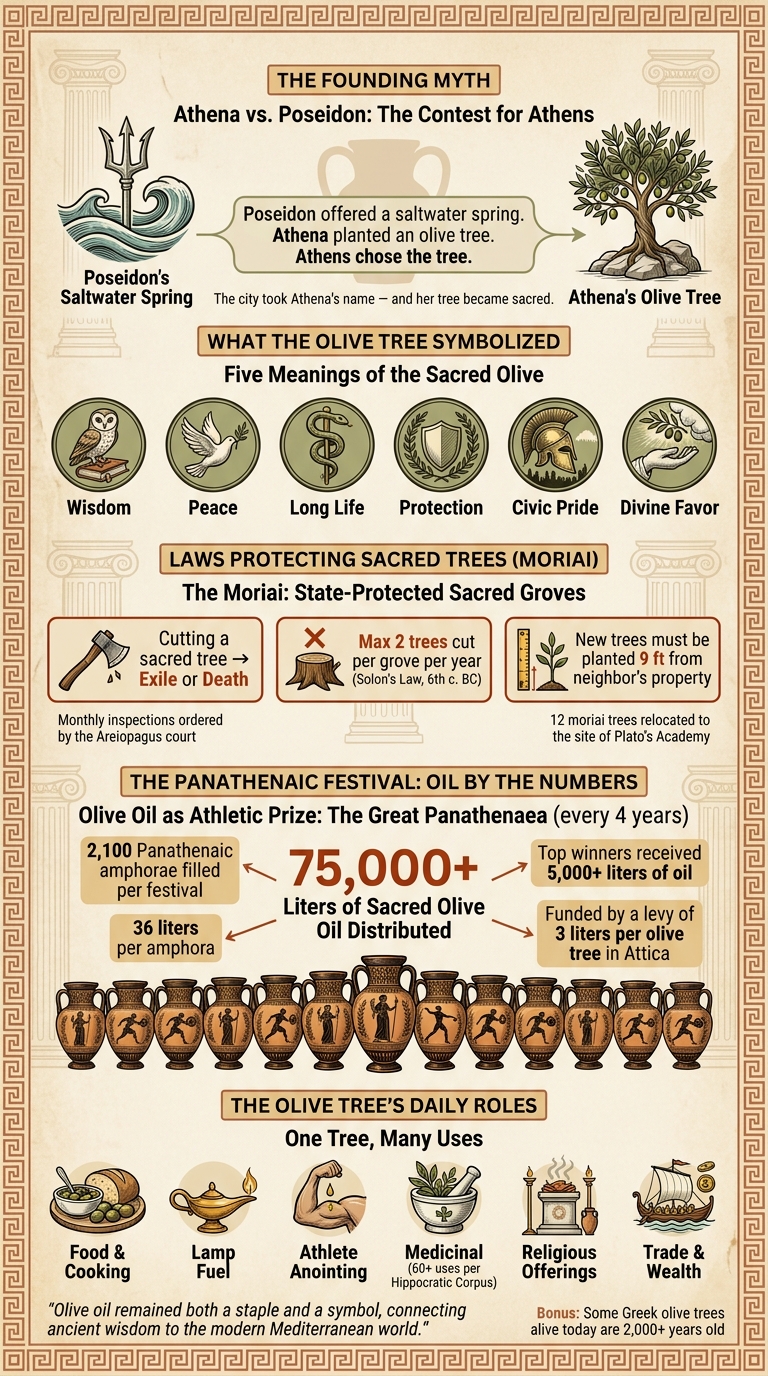
Ancient Greek Olive Tree: Sacred Symbols, Laws & Festival Scale
What Is The Myth Of Athena And The Olive Tree?
sbb-itb-4066b8e
Athena's Gift: The First Olive Tree in Athens
The founding myth of Athens begins with a contest between Athena and Poseidon.
The Contest Between Athena and Poseidon
The story unfolds on the Acropolis, which was then called Kekropia. There, Poseidon and Athena competed for the patronage of the city before King Cecrops. Poseidon struck the rock with his trident and brought forth a saltwater spring known as the Erechtheida Sea. Athena answered by planting an olive tree, and it grew at once.
Athens then took its name from Athena. The myth also gave people an answer for the city's poor water supply: it was Poseidon's curse. That link between divine anger and daily life helped keep the story alive long after the early days of the Acropolis.
Why the Athenians Chose the Olive Tree
Athena's gift won because the olive tree gave people more than one thing at once. It offered food, oil, wood, light, and trade value. So the tree was not just useful in a basic sense. It became a sacred public symbol tied to the life of the city.
Sacred Groves and the Laws That Protected Athena's Trees
The myth did not remain just a tale. It shaped how Athens treated its land and its trees. Sacred olive trees called moriai were believed to be direct descendants of Athena's first tree. They were declared state property and placed under the protection of the Areiopagus, Athens' high court. The court even appointed inspectors to check the groves every month.
The penalties were severe. Cutting down or uprooting a sacred tree could lead to banishment, loss of property, or death. Under Solon's 6th-century BC agricultural reforms, no more than 2 olive trees could be cut down each year in a single grove, and new trees had to be planted at least 9 feet from a neighbor's property line. On the Acropolis, an open-air structure called the Pandroseion was built to house and honor the original sacred tree. It was later folded into the Erechtheion temple.
Over time, that sacred status helped shape Greek ideas about honor, protection, and public ritual.
Sacred Olive Tree Stories in Greek Folklore
Beyond the laws that protected it, folklore turned the olive tree into a living sign of divine favor.
The Olive Tree That Survives Destruction and Grows Back
A famous story comes from 480 BCE, when Xerxes' Persian army burned the Acropolis. This was the clearest test of the tree's sacred standing. Athena's tree was burned down to a charred stump. According to Herodotus, that stump put out a new shoot about 3 feet high on the same day.
Greeks did not treat that regrowth as a random event. They saw it as a sign that Athena's power still stood, even after ruin.
The Moriai and the Belief in Descendant Trees
Later stories extended Athena's tree into the moriai, sacred descendant trees planted across Attica. The idea is striking: one holy tree did not remain just one tree. It became a line of connected trees, each tied back to Athena's gift.
Twelve of these were moved to the sanctuary of Akademos, which later became the site of Plato's Academy.
What These Stories Say About Wisdom, Peace, and Protection
These stories gave the olive tree more than religious meaning. They tied it to wisdom, peace, and protection in daily public life. That is why the tree and its oil showed up in ritual, prize awards, and civic honor.
What the Olive Tree Stood For in Ancient Greek Life
Athena's tree, the burning of the Acropolis, and the moriai gave the myth a public role. From there, the olive tree showed up almost everywhere in Greek life - in diplomacy, in the home, in ritual, and in public honor.
Peace, Prosperity, and Long Life
The olive tree did not stay inside myth for long. It moved straight into public life. Greek envoys carried olive branches when they wanted to show peaceful intent. People knew the signal at once.
That meaning fit the tree itself. Olive trees are evergreen and can live for an astonishingly long time. Some in Greece are thought to be more than 2,000 years old. A tree like that becomes more than a plant. It starts to stand for endurance, continuity, and the idea that one generation hands something on to the next.
It also mattered in daily survival. Olive oil stood alongside grain and grapes as a basic Mediterranean staple. It fed households, supported trade, and became valuable enough to be given out as a prize.
Olive Oil in Rituals, Offerings, and Household Use
Olive oil was woven into daily routines and sacred practice at the same time. People used it to light homes as lamp fuel, anoint athletes, wash the dead, and pour over sacred statues in religious rites. That is a striking range. One substance could move from the kitchen to the gymnasium to the sanctuary without losing its worth.
The Hippocratic Corpus lists more than 60 medicinal uses for olive oil. That helps explain why it held such a strong place in Greek life. It was useful in the house, in healing, and in worship. Few things carried that much weight across so many parts of life.
That same worth comes into focus at festivals, where olive products became public rewards.
Olive Wreaths, Honor, and Public Recognition
The kotinos - a wreath made from wild olive branches - was awarded to Olympic victors.
"The olive crown [is] a symbol of divine blessing: the winner won, not from personal and human skill alone... but because the gods and forces of Nature had decided to aid them." - Mira Karakitsou, Author
The Greeks also kept a clear line between two kinds of olive. The cultivated olive (elaia) was used for food and oil. The wild olive (kotinos) was kept for these sacred wreaths. That distinction mattered. To win the wreath was not just to beat other athletes. It meant the gods had favored you.
Peace, prosperity, long life, honor, and purification all came together in the olive tree. That is why it became both a civic emblem and a sacred one. At festivals, those ideas were not abstract - people saw them in olive oil prizes and olive wreaths.
Festivals, Olive Oil Prizes, and the Modern Legacy
The Panathenaic Festival and Sacred Olive Oil Amphorae
Athletic honor in Athens went beyond olive wreaths. Victors could also receive sacred olive oil.
Athens did this at the Great Panathenaea, the city’s biggest sporting and religious festival, held every four years in honor of Athena. The prizes were Panathenaic amphorae - tall painted storage jars with Athena shown on one side and the athletic event on the other.
These prizes carried more than oil. They turned Athena’s sacred tree into a public mark of honor. The oil came from the moriai, the state-owned sacred groves said to descend from Athena’s first gift on the Acropolis.
The scale was huge. One festival needed more than 75,000 liters of olive oil to fill 2,100 prize amphorae, with each amphora holding 36 liters. Some winners received more than 5,000 liters of olive oil as a prize. Athens paid for this through a levy of 3 liters of oil per olive tree in Attica.
That amount of oil did two things at once. It linked athletic victory to Athena’s gift, and it showed off Athens’ wealth and civic pride in plain view.
How Ancient Olive Folklore Still Shapes Olive Oil Culture
That old tie between quality, ritual, and prestige still carries into the present. You can still hear echoes of it in the way olive oil is discussed now.
For example, the ancient preference for oil from the first pressing of green olives lines up with modern extra virgin olive oil (EVOO) standards, which focus on low acidity and rich flavor.
Ancient uses mattered too. Olive oil served as prize oil, anointing oil, lamp fuel, and balm. Because of that, people tied it to honor, vitality, purity, and healing.
Conclusion: What These Olive Tree Stories Reveal
Taken together, these stories show how the olive tree became a lasting emblem of Athena, Athens, and Greek identity. From Athena’s contest with Poseidon to the moriai groves protected by law, and from olive wreaths to festival amphorae filled with sacred oil, the olive tree linked myth, daily life, and civic honor in a way few things in the ancient world could.
"Olive oil remained both a staple and a symbol, connecting ancient wisdom to the modern Mediterranean world." - Nisha Zahid, Journalist, Greek Reporter
The olive tree’s folklore lasted because it gave Greeks one shared symbol for wisdom, peace, and civic pride.
FAQs
Why was the olive tree sacred to Athena?
The olive tree was sacred to Athena because it was the gift that won her patronage of Athens over Poseidon.
While Poseidon offered a saltwater spring, Athena planted the first olive tree. That gift gave the people food, oil, light, medicine, and prosperity. It showed her wisdom and turned the tree into a symbol of peace, nourishment, and the city’s identity.
What were the moriai in ancient Athens?
In ancient Athens, the moriai were sacred olive trees treated as property of the state. According to legend, they descended from the first olive tree Athena gave to the city.
Because of that divine connection, the trees were protected by law. They were fenced off and monitored by state inspectors. Damaging or uprooting one wasn't just illegal. It was a serious act of impiety that could lead to harsh punishment.
Why did olive oil matter so much in Greek festivals?
Olive oil sat at the heart of ancient Greek festivals because it linked religious life with athletic life.
People used it to anoint statues, leaders, and supplicants. They also poured it out as a libation to honor gods and ancestors.
It showed up just as clearly in sport. Athletes rubbed it on their bodies before competition, then used it to cleanse themselves afterward.
For victors, olive oil meant even more. Winners received wild olive crowns and large amounts of olive oil as marks of divine favor, glory, and the city’s prosperity.