

Organic Certification Process for Balsamic Vinegar
If I want to sell balsamic vinegar as organic in the U.S., I need more than organic ingredients. I need the right organic percentage, certified suppliers, records that trace each lot, an Organic System Plan, label approval, and yearly renewal.
Here’s the short version:
- 100% organic = all ingredients must be certified organic
- Organic = 95% or more organic ingredients, not counting water and salt
- Made with organic ... = 70% or more organic ingredients, but no USDA Organic seal
- Below 70% = no front-label organic claim; only organic ingredients can be named in the ingredient list
I also need to make sure that:
- every supplier certificate is current
- organic and non-organic product stay separate
- cleaning, batching, and bottling records are in place
- labels match the approved claim category
- records are kept for at least 5 years
For imports, the paper trail matters just as much as the product itself. If I bring in balsamic vinegar from Italy, I need certificates, shipment records, and lot links that show where the product came from and how it moved through the supply chain.
The process is simple on paper: prepare records, apply through a USDA-accredited certifier, pass review and inspection, fix any issues, get certified, and renew each year.
| Claim | Organic content | USDA seal | Main rule |
|---|---|---|---|
| 100% Organic | 100% | Yes | All ingredients must be organic |
| Organic | 95%+ | Yes | Up to 5% non-organic only if allowed |
| Made with organic ... | 70%+ | No | Up to 3 organic ingredients or food groups on front |
| Below 70% | Under 70% | No | Organic only in ingredient list |
Bottom line: if I can prove the formula, the source, the handling, and the label, I can certify balsamic vinegar as organic in the U.S.
Prepare Your Operation Before You Apply
Before you apply, get your ingredient files, process controls, and supplier records in order. Missing paperwork can slow down the certification review.
Verify Organic Ingredients and Supplier Documents
Gather current organic certificates for every organic ingredient and supplier. That includes grape must, wine vinegar, bulk balsamic, and any organic flavoring ingredients like fruit infusions or essential oils. Your records should cover the full path from grape must intake through finished bottling. Supplier certificates also need to be current at the time of inspection.
Next, review every non-agricultural additive and processing aid against the National List and NOP limits. The label claim matters here:
- For "100% organic," all ingredients and processing aids must be organic.
- For "organic," non-agricultural ingredients and processing aids are allowed only if they appear on the National List and were not produced using excluded methods such as GMOs, ionizing radiation, or sewage sludge.
Keep supplier confirmations, technical data sheets, and product labels in your organic file. This paperwork gives you a clear map of where organic and non-organic materials must stay apart.
Set Up Segregation, Sanitation, and Traceability
Use clearly marked receiving, storage, blending, aging, infusing, and bottling areas. Tanks, barrels, and equipment should be labeled so organic and non-organic product stay separate in storage, handling, and records.
If you use shared equipment, you need written cleaning and changeover procedures. Record each cleaning step, including the product run before the organic batch and line-clearance checks that show the equipment is clean and empty.
Traceability should follow each lot from intake to the finished bottle. Give each incoming organic ingredient its own lot code, then carry that code through batch records, aging logs, blending records, and finished product records. Periodic inventory reconciliation helps confirm that the amount purchased, processed, and sold lines up. USDA records must be kept for at least five years.
Document all of these controls in your Organic System Plan.
Build an Organic System Plan for Balsamic Vinegar
The OSP pulls your records and controls into one plan that can be reviewed. Lay out the process flow for your balsamic vinegar operation, from receiving organic grape must and wine vinegar through concentration, fermentation, aging, blending, infusing, filtration, and bottling.
For each step, show where organic and non-organic materials could come into contact and explain how you prevent commingling or contamination. Be specific. If a shared tank, hose, or bottling line could cause mix-ups, say how you control it.
List each organic SKU, its ingredient percentages, and its approved label category. List every ingredient by percentage, while excluding water and salt from the organic calculation, and identify any allowed non-organic inputs. For flavored or infused balsamic vinegars, note whether the flavoring ingredients are organic or allowed under the label category you plan to use. Keep the related supplier certificates and technical data on file.
Your OSP should also include written procedures for sanitation, pest management, and labeling checks. In the sanitation section, identify the cleaning agents used, their concentrations, any rinsing or purge steps, and the logs you keep. Pest management should start with physical barriers and traps, with any chemical controls recorded as allowed substances. Labeling checks should show how you confirm the right organic category and seal before bottling. Then connect these procedures to SOPs, training records, and record templates so your audit trail is complete.
sbb-itb-4066b8e
Step-by-Step Organic Certification Process
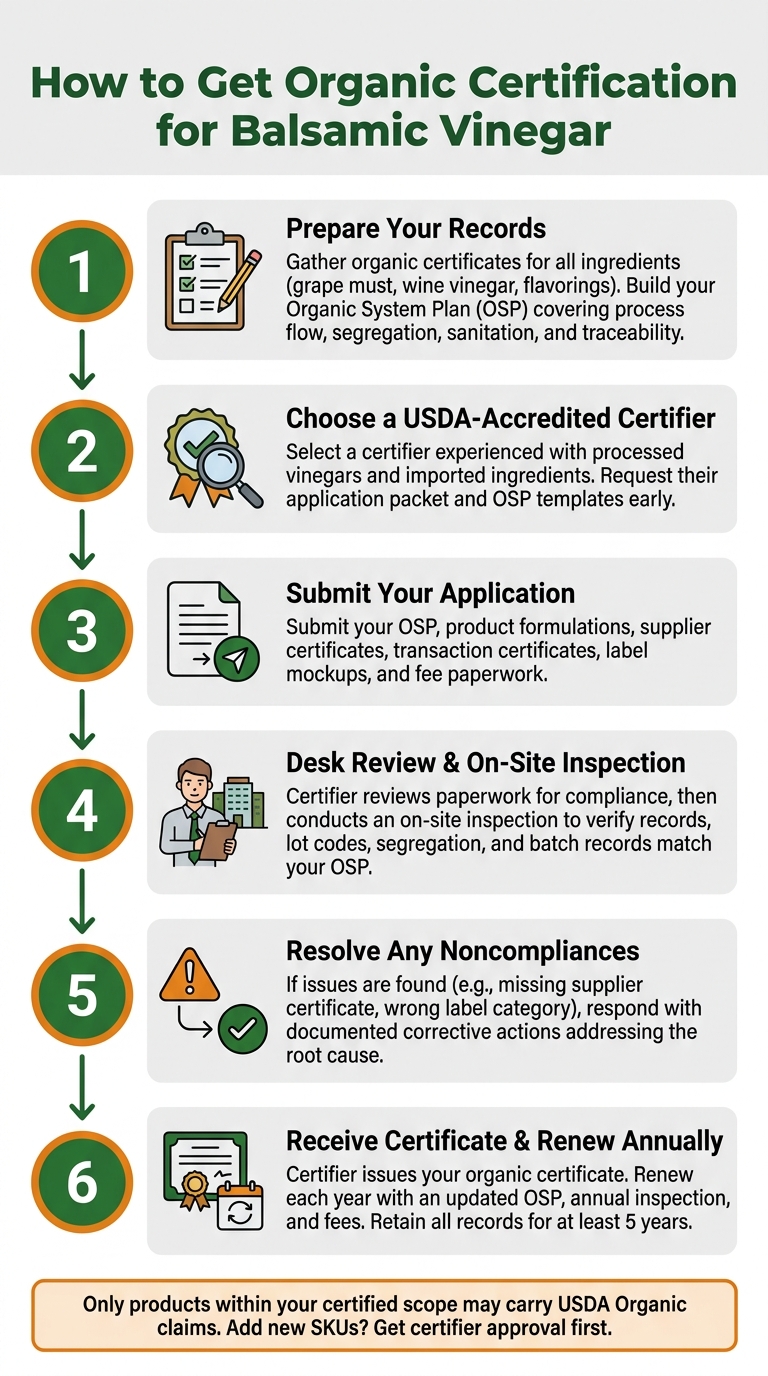
Organic Certification Process for Balsamic Vinegar: Step-by-Step Guide
With your Organic System Plan in place and your records in order, you can move into the formal certification process. USDA handles organic certification as a yearly cycle: application, review, inspection, corrective action, and certificate issuance. Your OSP is the main file the certifier reviews.
Choose a USDA-Accredited Certifier and Submit Your Application
Start by contacting a few USDA-accredited certifying agents before you apply. Check that the certifier is approved for handling and processing operations and has experience with imported ingredients and processed vinegars. It also helps to ask about timelines, fees, and which certificates from Italian certifiers they accept.
Ask for the certifier's application packet and OSP templates as early as you can. If your internal paperwork matches their format, review tends to go more smoothly. When you submit your application, include your completed OSP, product formulations for each balsamic SKU, current organic certificates from suppliers, transaction certificates and batch records for each shipment, label mockups that show the planned organic claim category, and the fee paperwork.
After submission, the certifier reviews the paperwork before setting the inspection date.
Complete the Review, Inspection, and Corrective Actions
The certifier begins with a desk review to see whether your written plan meets the rules. They look at whether ingredients sold as organic are backed by valid certificates, whether nonorganic inputs meet National List rules, and whether your draft labels match your formulation and claim category. If that review goes through, the certifier schedules the inspection.
Next comes the on-site inspection. An inspector visits your facility to confirm that the controls in your documents match what is happening on the ground. They also audit batch records, lot codes, and shipping records from intake through the finished bottle.
For balsamic operations, common noncompliances include:
- A flavor infusion labeled "organic" without a current supplier certificate
- Missing transaction certificates that link a specific Modena shipment to a certified producer
- Using the wrong claim category for the product's organic content
If you get a noncompliance notice, answer with documented corrective actions that fix the root cause. For example, if a supplier certificate is missing, you would get the valid certificate, update your supplier approval procedure, and revise the OSP to show that new verification step. If the issue is labeling, you either reformulate to meet the planned category or change the label to the right category and send updated proofs back to the certifier.
Receive Certification and Renew It Each Year
Once all noncompliances are cleared, the certifier issues your organic certificate. That certificate lists your operation's legal name, the certifier's name, and a scope that covers handling, processing, and repackaging of certified balsamic vinegar. Only products and activities inside that scope can carry USDA organic claims. If you add new products, you need certifier approval before marketing them as organic.
After certification, your label claims still need to stay inside the approved scope. Certification is not a one-time approval. Each year, you must submit an updated OSP that sums up any changes, pay annual certification and inspection fees, and complete an annual inspection. Keep all compliance records for at least 5 years. Those approvals decide which organic label category you can use.
Labeling Rules for Organic Balsamic Vinegar
Once certification is done, the label has to match the approved formula. This is where a lot of brands slip up. The product may be fine, but if the front label, ingredient list, or certifier line is off, you can run into trouble.
How to Choose the Correct Organic Label Category
Use your documented organic percentage to choose the right front-label claim. Organic percentage is calculated by weight or fluid volume, excluding water and salt.
After you set the category, review the ingredient statement and certifier line. A quick check now can save a costly reprint later.
Use this chart to confirm the claim before printing.
Comparison Table: Organic Label Categories for Balsamic Vinegar
The table below shows the main U.S. label categories for balsamic vinegar, along with the seal and certifier rules that go with each one.
| Label Category | Min. Organic % (excl. water & salt) | USDA Organic Seal Allowed? | Front-Label Wording Options | Certifier statement required? |
|---|---|---|---|---|
| 100% Organic | 100% | Yes | 100% organic balsamic vinegar | Yes |
| Organic | ≥95% | Yes | Organic balsamic vinegar | Yes |
| Made with organic … | ≥70% | No | Made with organic [up to 3 ingredients or food groups] | Yes |
| Below 70% (ingredient list only) | <70% | No | No organic claim on the front panel; organic ingredients may appear only in the ingredient list | No |
If the product is below 70% organic, don't make any front-panel organic claim. In that case, organic ingredients may appear only in the ingredient statement.
For infused balsamic vinegars, every added ingredient and processing aid counts toward the calculation.
Required Label Elements and Common Mistakes
Every packaged organic balsamic vinegar with more than one ingredient needs an ingredient statement, and the ingredients must appear in descending weight order. Each organic ingredient must be clearly marked. You can do that by using the word organic in the ingredient name or by marking organic ingredients with an asterisk plus an explanatory note.
You also need to show the handler or distributor name and address. Then place Certified organic by [Certifier] directly below that information, with no text in between. A certifier logo on its own does not replace that statement.
Common mistakes usually come down to a few things:
- Using the wrong claim category or seal for the formula.
- Using prohibited nonorganic ingredients or flavors while showing the USDA Organic seal.
- Placing the certifier statement in the wrong spot. It must appear directly below the handler information with no intervening text.
Before printing, check the front-label claim, the ingredient statement, and the certifier line one more time.
Conclusion: Key Steps to Certify Balsamic Vinegar as Organic
Organic certification for balsamic vinegar comes down to a few core pieces: compliant ingredients, controlled handling, a complete Organic System Plan, and labels that line up with the approved formula.
Once the label gets approved, the focus changes. At that point, the day-to-day job is staying in compliance all year. That means keeping records up to date, renewing on time, and making sure every label matches the approved formula.
There’s also a recordkeeping rule you can’t gloss over. Under 7 CFR §205.103, certified operations must retain records for at least 5 years.
Keep records current, renew annually, and match every label to the approved formula.
FAQs
How long does organic certification usually take?
Organic certification usually starts with a 36-month transition period. During that time, the land must stay free of prohibited substances before any crops grown on it can qualify as organic.
Once that period is complete, the rest of the process moves through a few clear steps: submitting an Organic System Plan, completing an on-site inspection, and going through final review. After approval, certification must be renewed every year.
Do imported Italian shipments need extra organic documents?
Yes. Imported organic balsamic vinegar needs specific paperwork to enter the United States. Since the USDA’s Strengthening Organic Enforcement rule took full effect in March 2024, each shipment must have an electronic NOP Import Certificate filed in the Organic Integrity Database.
That rule applies to brokers, traders, and importers. In plain English, the paper trail now has to be much tighter. The goal is to add traceability and fraud prevention on top of existing EU organic rules and Modena PGI standards.
What happens if my formula or label changes after approval?
If your formula or label changes after certification, you need to update your Organic System Plan (OSP) and tell your certifying body so you stay in compliance.
This isn’t a one-and-done process. Certification depends on continued review, so any change to your production process, ingredients, or labeling needs to be checked and approved.
If your records aren’t up to date, or your operation falls out of compliance, you could face penalties, suspension, or even lose your certification.