

Packaging Standards for Premium Olive Oil
Proper packaging is critical for preserving the quality of premium olive oil like Extra Virgin Olive Oil (EVOO). Factors like light, oxygen, and heat can degrade its flavor and nutritional value quickly. Here’s what you need to know:
- Packaging Materials: Dark glass bottles are the best option, as they block up to 90% of UV rays. Alternatives like tin cans and bag-in-box systems also protect oil well, while PET plastic has limited protection and risks oxidation.
- Tamper-Proof Seals: EU and USDA rules require seals that cannot be resealed after opening to ensure product integrity.
- Labeling Requirements: Labels must include grade (e.g., "Extra Virgin"), origin, and storage instructions like "store away from light and heat." Misleading claims, such as standalone acidity levels, are prohibited.
- Container Size: Retail containers are capped at 5 liters to ensure quality during storage and handling.
- Testing and Traceability: Producers must test for chemical and sensory quality, maintain detailed batch records, and follow strict international standards (e.g., IOC, USDA).
Key takeaway: Proper packaging and labeling are essential to protect olive oil from degradation and ensure compliance with global standards.
Bag in Box for Extra Virgin Olive Oil – Benefits, Sustainability, and Comparison
sbb-itb-4066b8e
Core Packaging Standards and Regulatory Requirements
In the U.S., olive oil packaging must comply with USDA grading and labeling standards. These standards define four grades - U.S. Extra Virgin, U.S. Virgin, U.S. Olive Oil, and U.S. Refined Olive Oil - each with specific chemical and sensory requirements that packaging must uphold. These grades form the basis for hygiene and packaging protocols.
Producers are also required to adhere to USDA container and sanitation guidelines, which establish minimum requirements for container durability and cleanliness. These rules are critical for ensuring food safety for all olive oil sold in the U.S..
Sealed Containers and Tamper-Proof Protection
Tamper-evident seals are a key component of olive oil packaging. EU regulations, which are widely considered a global benchmark, mandate that consumer packaging include an opening mechanism that cannot be resealed after its first use:
"Such packaging shall be fitted with an opening system that can no longer be sealed after the first time it is opened and shall be labelled in accordance with this Regulation." - Commission Delegated Regulation (EU) 2022/2104
This requirement helps maintain the quality of premium EVOO, like Big Horn Olive Oil, by ensuring that the oil's chemical and sensory properties - critical for grades such as Extra Virgin - are preserved from production to consumption.
Container Size and Labeling Regulations
Regulations also address container size and labeling clarity. For retail consumers, EU standards limit container sizes to a maximum of 5 liters (roughly 1.32 gallons) - a guideline often adopted globally. While larger containers may be allowed for institutional use in settings like restaurants or hospitals, consumer packaging must adhere to this size restriction.
Labeling is equally precise under USDA rules. For example, olive oil labeled as "U.S. Extra Virgin" must meet strict criteria, including a free fatty acid content of no more than 0.8 grams per 100 grams, a median defect score of zero, and a fruitiness score above zero. The Principal Display Panel (PDP) must clearly identify the product (e.g., "Extra Virgin Olive Oil") in bold lettering, while any additional mandatory details that don't fit on the PDP must appear on the information panel, typically located directly to the right of the PDP.
Packaging Materials for Premium Olive Oil
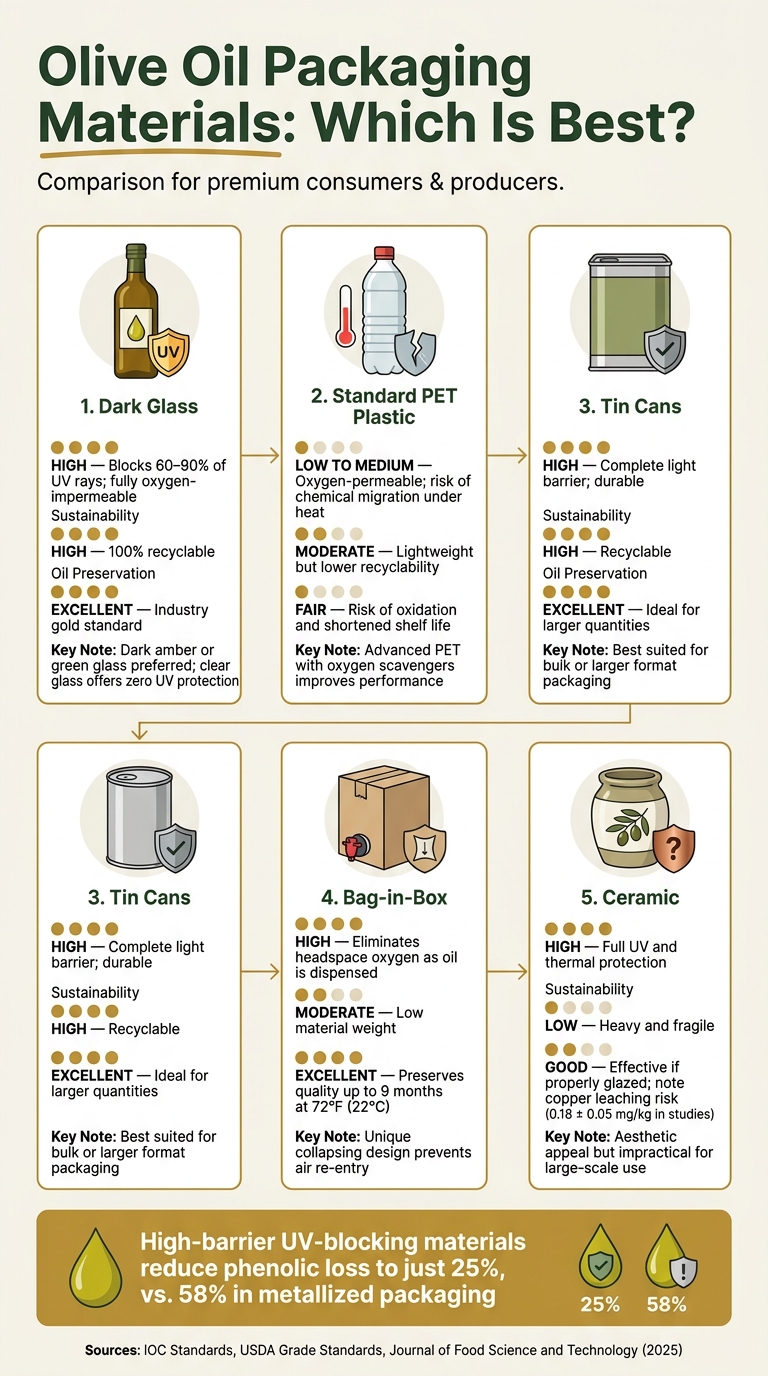
Olive Oil Packaging Materials Compared: Protection, Sustainability & Preservation
When it comes to olive oil, packaging does more than just transport the product - it plays a key role in preserving its freshness, flavor, and beneficial compounds. Here's a closer look at the pros and cons of different packaging materials.
Glass Bottles: The Preferred Choice
Glass remains the top choice for premium olive oil packaging. Its chemical stability and impermeability ensure that the oil stays free from unwanted odors, chemical reactions, or gas exchange. This makes it one of the safest options available.
"Dark glass is the gold standard for olive oil packaging." - Jill Myers, Founder, Women in Olive Oil
The color of the glass matters just as much as the material itself. Dark amber or green glass can block 60% to 90% of UV rays, which protects the oil's polyphenols and slows down oxidation. This helps maintain both the flavor and nutritional quality of extra virgin olive oil. On the other hand, clear glass offers no UV protection and is usually reserved for oils meant to be consumed quickly, such as seasonal varieties.
In recent years, ECO glass lightweighting has emerged as a trend. By reducing the amount of glass used - particularly in the bottle's base - manufacturers can lower the environmental impact of glass production while still maintaining a premium aesthetic. This innovation addresses the higher carbon footprint associated with glass compared to recycled plastic.
PET and Other Packaging Options
Plastic, specifically PET, is another option but comes with notable drawbacks. Heat exposure can cause chemicals to migrate from PET into the oil, potentially compromising its quality. Additionally, PET's permeability to oxygen can lead to faster oxidation, shortening the oil's shelf life.
"Plastic is one of the least ideal materials for packaging olive oil... it can accelerate oxidation and reduce shelf life." - Vincent Ricchiuti, COO and Co-founder, Enzo Olive Oil
That said, advancements in PET technology have made some improvements. High-quality PET infused with oxygen scavengers can significantly reduce oxygen exposure, helping to better preserve antioxidants. Using colored PET bottles (like blue or white) with active barrier technology can also provide better protection.
Other alternatives include tin cans and bag-in-box systems. Tin cans offer a complete light barrier and are durable, making them ideal for larger quantities of olive oil. Meanwhile, bag-in-box systems are highly effective at preserving oil quality for up to nine months at room temperature (about 72°F / 22°C). A unique feature of this packaging is its ability to eliminate headspace oxygen as the oil is dispensed, which helps prevent deterioration.
Packaging Materials Comparison
Here's a quick comparison of the main packaging options:
| Material | Protection Level | Sustainability | Oil Preservation |
|---|---|---|---|
| Dark Glass | High – Blocks UV and is oxygen-impermeable | High – 100% recyclable | Excellent – Considered the gold standard |
| Standard PET | Low to Medium – More oxygen permeable | Moderate – Lightweight | Fair – Risk of oxidation and chemical migration |
| Tin Cans | High – Provides complete light barrier | High – Recyclable | Excellent – Well-suited for larger formats |
| Bag-in-Box | High – Eliminates headspace oxygen | Moderate – Low material weight | Excellent – Comparable to dark glass storage |
| Ceramic | High – Offers full UV and thermal protection | Low – Heavy and fragile | Good – Effective if properly glazed |
Each material has its strengths and weaknesses, but the ultimate choice often depends on balancing preservation, sustainability, and practicality.
Labeling Compliance and Consumer Transparency
Accurate labeling goes far beyond aesthetics - it's a critical part of ensuring product integrity and consumer trust. For premium olive oil, the label serves as a legal document, adhering to strict regulations that guarantee transparency about quality and origin. These rules protect consumers and ensure that essential details are clearly communicated.
Required Label Elements
One of the most important components is the grade designation, which must meet USDA standards. Categories include U.S. Extra Virgin, U.S. Virgin, U.S. Olive Oil, and U.S. Refined Olive Oil.
"U.S. Extra Virgin Olive Oil is virgin olive oil which has excellent flavor and odor (median of defects equal to zero and median of fruitiness greater than zero) and a free fatty acid content, expressed as oleic acid, of not more than 0.8 grams per 100 grams." - USDA
For Extra Virgin and Virgin olive oils, the label must indicate the place of origin, specifying where the olives were harvested and milled. If these locations differ, both must be disclosed (e.g., "extra virgin olive oil obtained in Italy from olives harvested in Spain"). Additionally, storage instructions like "store away from light and heat" are mandatory.
Terms such as "first cold pressing" and "cold extraction" have precise definitions. "First cold pressing" applies only to oils extracted below 81°F (27°C) using traditional hydraulic presses, while "cold extraction" refers to oils processed below 81°F (27°C) through percolation or centrifugation.
These labeling standards not only ensure compliance but also build consumer confidence in the product's quality.
Avoiding Misleading Packaging Claims
One frequent mistake is listing acidity as a standalone measure of quality. According to the European Commission:
"Reference to acidity in isolation wrongly suggests a scale of absolute quality which is misleading for consumers since this factor represents a qualitative value only in relation to the other physico-chemical parameters." - European Commission
If acidity is mentioned, it must be accompanied by other indicators like peroxide value, wax content, and UV absorption. For blends of olive oil and other vegetable oils, the label must clearly state "Blend of vegetable oils and olive oil" and specify the percentage of olive oil. Visual elements like olive imagery are only allowed if olive oil makes up more than 50% of the blend.
The USDA also enforces a "limiting rule": an olive oil cannot claim a higher grade if it fails to meet even one requirement - chemical, physical, or sensory - for that grade.
Clear, detailed disclosures on labels are essential to maintaining authenticity and preventing consumer confusion.
| Labeling Element | Requirement |
|---|---|
| Grade Designation | Must meet USDA chemical and sensory standards |
| Place of Origin | Required for Extra Virgin and Virgin; must list harvest and mill locations |
| Storage Instructions | Must include "store away from light and heat" |
| Acidity (if listed) | Must pair with peroxide value, wax content, and UV absorption |
| Cold Processing Terms | Use only if extraction occurs below 81°F (27°C) |
| Blend Disclosure | Must specify olive oil percentage if blended with other oils |
Quality Assurance and Packaging Integrity Verification
Maintaining the highest standards in packaging and labeling is just the starting point. Ensuring the quality and integrity of olive oil requires ongoing vigilance, combining rigorous testing, thorough inspections, and meticulous recordkeeping. These steps are critical to delivering olive oil that remains true to its quality from production all the way to the consumer.
Seal and Tamper-Evidence Testing
A properly functioning seal is essential for preserving olive oil. One effective way to test seal integrity is by monitoring for oxidation. If oxygen enters through a damaged seal, it can lead to oxidation, which is reflected in measurable changes in Free Fatty Acids (FFA), Peroxide Value (PV), and UV absorption levels (K232 and K270).
Manufacturers also test for potential contaminants from packaging materials. Advanced methods like GC-MS and ICP-MS are used to detect harmful substances such as phthalates and heavy metals. For example, a 2025 study in the Journal of Food Science and Technology examined olive oil from the 2021/2022 and 2022/2023 Spanish harvests. The findings revealed that oils stored in ceramic containers contained lead levels of 0.1 ± 0.03 mg/kg, meeting the regulatory limit, while copper levels reached 0.18 ± 0.05 mg/kg, exceeding the 0.1 mg/kg threshold. Additionally, DEHP contamination was found in 33% of the 18 commercial samples tested, regardless of whether the oil was stored in PET, glass, porcelain, or cardboard containers.
To catch what chemical tests might miss, trained sensory panels conduct evaluations based on IOC standards. These panels are skilled at identifying off-flavors or defects that could compromise the oil’s quality.
These testing protocols are seamlessly integrated into broader traceability systems.
Batch Traceability and Recordkeeping
After seal testing, detailed traceability records ensure the product’s quality is maintained throughout its journey. Traceability links each bottle to its origins, documenting details like the specific olive cultivars, harvest dates, extraction methods, and storage conditions. This level of documentation is crucial, as olive oil quality can deteriorate during distribution.
Guidelines like the IOC's Quality Management Guide for Packing Plants (T.33-2/Doc. No 4) and the "Guide for Verifying the Conformity of a Previously Declared Commercial Category" (COI/GVCC/Doc. No 1) provide a framework for maintaining these records. Producers monitor biochemical markers, such as DAG levels and PPP content, to ensure the oil matches its labeled grade. Ultra Premium standards, for instance, require a Peroxide Value of ≤ 9 mEQ O₂/kg and DAG levels of ≥ 90%, which are stricter than standard IOC limits.
Producers use batch records to verify these critical metrics at every stage, correlating them with independent third-party lab results. This ensures that the olive oil remains at its declared quality throughout its journey from the producer to the consumer.
At Big Horn Olive Oil, we incorporate these rigorous quality assurance measures and traceability practices into every step of our packaging process. This dedication ensures that our Ultra Premium Extra Virgin Olive Oil consistently upholds international standards, delivering exceptional quality right to your table.
Standards and Certifications for Olive Oil Packaging
Certifications from respected organizations confirm adherence to strict packaging protocols, ensuring consistent quality. Both international and domestic standards form the backbone of these quality assurance processes.
International Olive Council (IOC) Standards
The IOC's Trade Standard Applying to Olive Oils and Olive-Pomace Oils (COI/T.15/NC No 3/Rev.21/2025) sets the benchmarks for classifying olive oils and determining what can legally appear on labels. For Extra Virgin Olive Oil (EVOO), the standard specifies:
- Free acidity: no more than 0.8%
- Peroxide value: maximum of 20 mEq O₂/kg
- K270 extinction coefficient: not exceeding 0.22
In addition to these chemical requirements, the IOC provides bottlers with practical resources such as the Quality Management Guide for Packing Plants (T.33-2/Doc. No 4) and the Best Practice Guidelines for Storage (COI/BPS/Doc. No 1). These documents outline procedures to maintain compliance during bottling and storage. For consumer packaging, the IOC restricts container sizes to no more than 5 liters.
The USDA follows similar criteria, augmenting them with U.S.-specific inspection protocols.
USDA Standards and Testing Methods
In the U.S., the USDA incorporates IOC standards while adding its own inspection measures. These include container inspections and laboratory testing to ensure that the product inside matches the information on the label.
Packaging Standards Compliance Checklist
The following checklist summarizes key packaging requirements based on IOC and USDA standards, along with steps to verify compliance:
| Requirement | Verification Step | Standard Source |
|---|---|---|
| Seal Integrity | Ensure tamper-proof opening cannot be resealed after first use | IOC / EU 2022/2104 |
| Container Condition | Visually inspect for leaks, dents, or contamination | USDA Condition of Container Manual |
| Volume Limits | Confirm retail containers are ≤ 5 liters (approximately 1.32 gallons) | EU 2022/2104 |
| Storage Labeling | Verify "store away from light and heat" is clearly visible | EU 2022/2104 |
| Grade Accuracy | Conduct lab tests for free fatty acid (≤ 0.8%) and peroxide values | USDA Grade Standards |
| Origin Disclosure | Check that the geographical harvest area and extraction mill are listed (EVOO) | EU 2022/2104 |
| Traceability | Verify packaging plant's alphanumeric ID and batch code | EU 2022/2104 |
| Field of Vision | Ensure the legal name and origin are grouped together on the label | EU 2022/2104 |
Additionally, if acidity levels are mentioned on the label, other key metrics like peroxide value, wax content, and UV absorption figures (K232, K268/K270, and ΔK) must appear in the same visual field. This rule ensures transparency and helps consumers make informed decisions about the oil's quality.
At Big Horn Olive Oil, we take these standards even further. Our Ultra Premium Extra Virgin Olive Oil undergoes rigorous testing to maintain a peroxide value of ≤ 9 mEq O₂/kg, significantly below the legal limit. This commitment ensures that every bottle reflects the excellence we promise.
Conclusion and Key Takeaways
Strict packaging standards play a crucial role in maintaining the exceptional quality of olive oil. These standards shield premium olive oil from light, oxygen, and heat, which can degrade its flavor, health properties, and shelf life. Measures like tamper-proof seals, container size limits, chemical testing, and batch traceability ensure that the quality promised on the label is faithfully delivered.
Research highlights the importance of proper packaging, with high-barrier UV-blocker materials reducing phenolic loss to just 25%, compared to 58% in metallized packaging. This difference significantly impacts not only the oil's flavor and nutritional value but also its overall longevity.
Such regulations provide a clear framework for maintaining quality while encouraging continuous improvement. Accurate origin labeling, verified chemical standards, and tamper-evident seals reinforce a commitment to delivering a product consumers can trust.
At Big Horn Olive Oil, we go above and beyond industry standards. Our Ultra Premium EVOO adheres to a peroxide value of ≤ 9 mEq O₂/kg, far below the legal limit, reflecting our dedication to excellence. From rigorous chemical testing to secure packaging, every bottle is crafted to exceed expectations and uphold the highest standards of quality.
FAQs
How can I tell if an olive oil bottle’s packaging is truly protective?
To keep olive oil fresh and protected, the packaging material plays a crucial role. Dark glass bottles in amber or green are great choices since they filter out UV light and help prevent photo-oxidation. Aluminum cans are another excellent option, as they completely block both light and air. For larger quantities, bag-in-box systems work well because their collapsible liners minimize exposure to oxygen. Steer clear of clear plastic or glass unless they are paired with an opaque label or enclosed in a box.
What should I look for on the label to confirm it’s real extra virgin olive oil?
To make sure you're getting genuine extra virgin olive oil, start by checking the label for the words "Extra Virgin" prominently displayed. A harvest date is also important - it tells you when the olives were picked, giving you an idea of the oil’s freshness. Look for quality seals from trusted organizations, such as the California Olive Oil Council (COOC), as these indicate the oil has undergone strict testing for purity and freshness. Finally, opt for oil packaged in dark glass bottles, which help shield it from light and preserve its quality.
Why do some producers use stricter test limits than the legal standards?
Producers often impose stricter testing limits than what the law requires to reinforce trust in the quality and consistency of their olive oil. These elevated standards act as a safeguard, minimizing risks such as contaminants or premature oxidation that can occur during production or storage. By going beyond the legal baseline, they ensure the premium quality that consumers expect from extra virgin olive oil.