

PDO and PGI Certifications: Quick Guide
Looking for a quick way to understand PDO and PGI certifications? These EU-backed labels ensure olive oil quality and origin, protecting products from fraud and mislabeling. Here's what you need to know:
- PDO (Protected Designation of Origin): Every production step must occur in a specific region. It’s the stricter certification, requiring all raw materials and processes to stay local.
- PGI (Protected Geographical Indication): At least one production stage must happen in the region. This allows some flexibility in sourcing and processing while maintaining a regional link.
Both certifications guarantee quality, transparency, and legal protection. If you prioritize stricter regional ties, choose PDO. For a more flexible option, go with PGI. Look for the official EU logos on olive oil labels for assurance.
Quick Comparison:
| Feature | PDO | PGI |
|---|---|---|
| Production | 100% local processes | At least one stage local |
| Raw Materials | Must come from the region | Can be sourced elsewhere |
| Quality Standards | Stricter requirements | Less rigid |
| Flexibility | Low | Higher |
Both certifications support quality olive oil while protecting regional heritage and consumer trust.
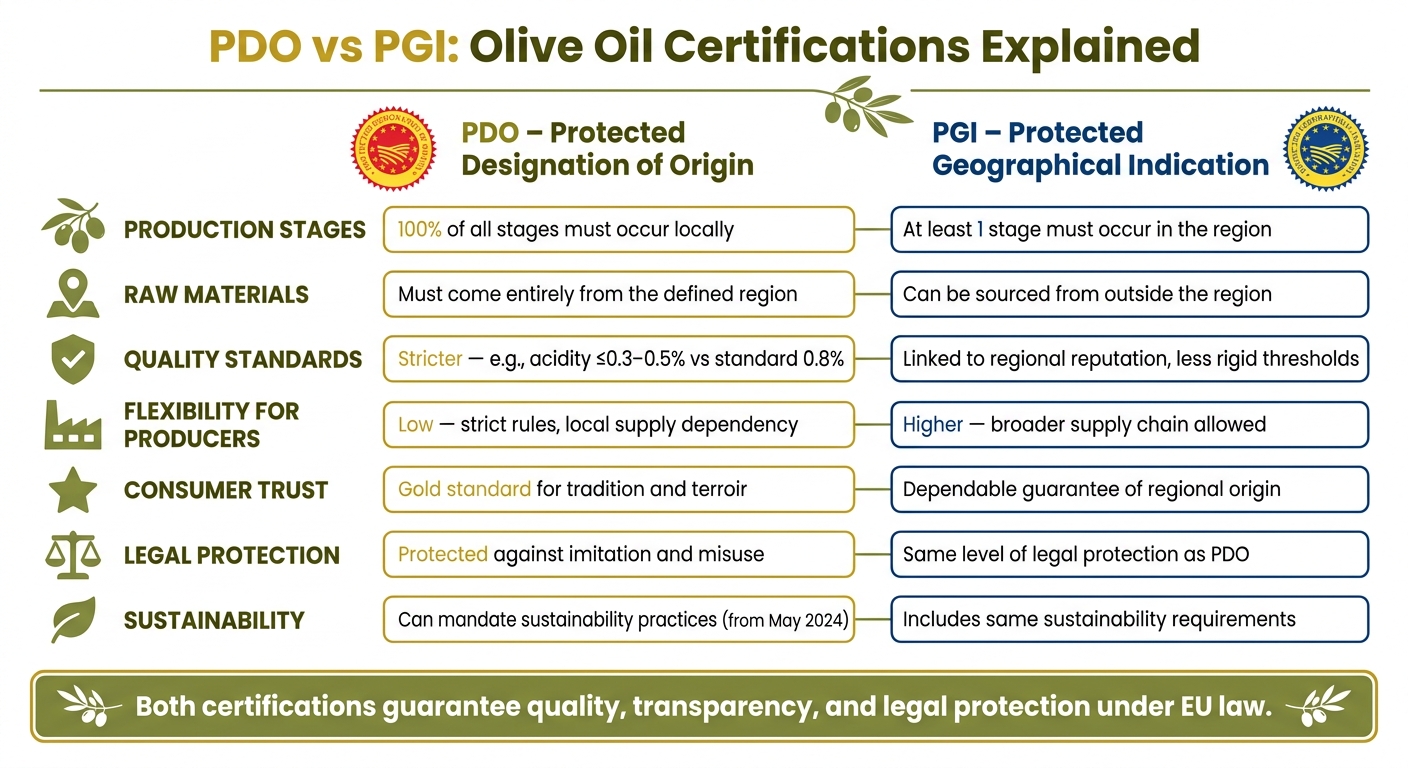
PDO vs PGI Olive Oil Certification: Side-by-Side Comparison
PDO vs. PGI: Safeguarding Culinary Heritage
sbb-itb-4066b8e
1. Protected Designation of Origin (PDO)
PDO certification is the more stringent of the two olive oil certifications. To earn the PDO label, every step in the production process - growing the olives, pressing them, and bottling the oil - must occur within a single, specifically defined geographic area. No part of the process can take place outside these boundaries.
Geographic Scope
The geographic limits are clearly outlined in a product specification that includes details about municipalities, terrain, and climate. For instance, the Montes de Toledo PDO spans 128 municipalities in Toledo and Ciudad Real, meaning only olive oil produced entirely within these areas qualifies for the certification.
Production Requirements
PDO regulations go beyond geography, dictating the types of olives used, how they are harvested, and how the oil is processed. For Montes de Toledo, the rules require 100% Cornicabra olives. These must be hand-harvested, delivered for processing within 24 hours, and mixed in a single cycle lasting no more than 60 minutes at temperatures below 86°F (30°C).
Quality Assurance Standards
PDO-certified extra virgin olive oil (EVOO) must adhere to strict chemical and sensory criteria. These include free acidity levels of ≤0.8%, K₂₃₂ values of ≤2.50, and K₂₇₀ values of ≤0.22. Additionally, the oil must be free of sensory defects and exhibit a fruity aroma, all verified by authorized inspection bodies.
Labeling Rules
PDO labels carry specific information to ensure transparency and traceability. They must include the EU PDO logo, the registered product name, and a statement confirming the oil is "obtained directly from olives and solely by mechanical means." Other required details include the origin, the packaging plant's identification number, and storage instructions. Some PDOs, like Montes de Toledo, also feature a secondary inspection seal for added assurance. These labeling requirements reflect the rigorous standards that set PDO-certified olive oils apart.
"The use of corresponding EU symbols on the labels of such products provides consumers with clear and concise information on their origin." - EUR-Lex Summary
2. Protected Geographical Indication (PGI)
PGI certification requires that at least one stage of production takes place in the designated geographic area. While it shares similarities with PDO, PGI offers more flexibility by allowing other stages of production to occur outside the region. This makes it a less restrictive standard but still part of the same quality-focused framework.
"A PGI indicates a link with the area in at least one of the stages of production, processing or preparation." - EUR-Lex
Geographic Scope and Production Requirements
The PGI designation ties a product to a specific region, but its connection is less rigid compared to PDO. For example, olives or raw materials can come from outside the designated area, as long as one key stage - such as processing or preparation - happens locally. This approach maintains the product’s regional character while allowing for greater flexibility in sourcing and production.
Quality Assurance Standards
Products with PGI certification must adhere to detailed specifications that highlight qualities or a reputation linked to the region. Certification bodies or public authorities oversee compliance, ensuring the product meets these standards. This process helps maintain trust in the designation and the product’s connection to its geographic origin.
Labeling Rules
In the European Union, PGI-certified products must include either the full term "protected geographical indication" or the official blue and yellow EU PGI symbol on their labels. Packaging and marketing materials must avoid misleading claims about the product's origin or quality. Additionally, registered PGI names are protected against imitation, even when terms like "style", "type", or "method" are used alongside the name. These labeling rules play a key role in safeguarding authenticity and consumer confidence in the olive oil market.
Pros and Cons
Both PDO and PGI certifications come with their own set of advantages and challenges for both producers and consumers. Here's a quick side-by-side comparison to break it down:
| Feature | PDO | PGI |
|---|---|---|
| Authenticity | Strongest connection to origin - all production stages occur locally | Solid connection to origin - at least one production stage must be local |
| Raw Material Sourcing | 100% of materials must come from the defined region | Materials can be sourced outside the region |
| Quality Standards | Generally stricter than EU law (e.g., acidity levels below 0.3–0.5% compared to the standard 0.8% for EVOO) | Linked to regional reputation but with less rigid chemical thresholds |
| Flexibility for Producers | Low - strict rules and potential vulnerability to local supply shortages | Higher - allows for scaling production while maintaining regional branding |
| Consumer Trust | Regarded as the "gold standard" for tradition and terroir | Seen as a dependable guarantee of origin, with more production flexibility |
| Legal Protection | Shields against imitation, misuse, and evocation | Offers the same level of legal protection as PDO |
| Sustainability Options | Can mandate sustainability practices in product specifications starting May 2024 | Includes the same sustainability requirements |
For instance, consider Kalamata PDO olive oil. It’s entirely produced in Kalamata, Greece, using specific local olive varieties, with every stage of production taking place within the designated area. This ensures a high level of authenticity and strict quality standards that often surpass general EU requirements.
PGI, by contrast, provides producers with more flexibility, making it easier for them to operate across a broader supply chain. However, this flexibility can dilute the certification's connection to the region.
One key downside for both certifications is the cost. Compliance verification and administrative fees can be expensive, posing challenges for smaller producers.
Conclusion
PDO and PGI certifications serve as legal assurances of olive oil's origin and quality. While PDO demands that every stage of production happens locally, PGI requires a significant regional connection but allows more flexibility in production.
If you're seeking the highest level of regional authenticity, go for PDO-certified oils. On the other hand, PGI offers verified quality with a bit more production leeway. Either way, the official EU PDO or PGI symbols on the label are your guarantee of genuine quality and origin.
Choosing certified olive oil also means supporting traditional farming communities, helping to preserve generations of expertise and production methods.
Brands like Big Horn Olive Oil uphold these standards by offering ultra-premium extra virgin olive oils that celebrate true regional heritage.
FAQs
How can I verify a PDO or PGI olive oil is authentic?
To ensure an olive oil with PDO or PGI status is genuine, look for the official EU PDO or PGI logo on the bottle. Check that the regional name aligns with the certification and verify the presence of a unique alpha-numeric code. You can cross-check these details using official EU databases or through recognized certifying authorities.
Do PDO or PGI labels guarantee the olive oil is extra virgin?
PDO and PGI certifications focus on ensuring that olive oil comes from a specific region and meets certain quality standards tied to its origin. However, they don’t automatically mean the oil is extra virgin. That classification is determined independently through both chemical analysis and sensory evaluations.
Will PDO or PGI olive oil taste different from non-certified oils?
PDO and PGI-certified olive oils often stand out in taste compared to non-certified options, thanks to their adherence to strict production standards. PDO (Protected Designation of Origin) oils are deeply tied to their specific region and traditional methods, delivering flavors that reflect their origin. On the other hand, PGI (Protected Geographical Indication) oils offer more flexibility in sourcing ingredients, which can result in a broader range of flavor profiles. In the end, the taste comes down to personal preference and the unique practices behind each oil, regardless of certification.