

P.D.O. vs. I.G.P.: Key Differences
When choosing balsamic vinegar, you'll often see P.D.O. (Protected Designation of Origin) and I.G.P. (Protected Geographical Indication) labels. These certifications ensure quality and origin but differ in production rules, ingredients, and aging processes:
- P.D.O.: Every step (grape growing, production, aging) occurs in Modena or Reggio Emilia, Italy. Made only from cooked grape must, it requires 12+ years of aging (25+ years for "Extra Vecchio"). No additives allowed.
- I.G.P.: At least one production stage happens in Modena, but ingredients (like wine vinegar) can come from outside. Aging starts at 60 days (3+ years for "Invecchiato"). Allows up to 2% caramel for color.
Key Takeaway: P.D.O. is ideal for finishing dishes with its rich, mellow flavor, while I.G.P. works better for everyday cooking due to its lighter texture and tangy taste.
Quick Comparison
| Feature | P.D.O. | I.G.P. |
|---|---|---|
| Ingredients | 100% cooked grape must, no additives | 20% grape must, 10% wine vinegar, caramel allowed |
| Production Location | Entirely in Modena or Reggio Emilia | At least one stage in Modena |
| Minimum Aging | 12 years (25+ for Extra Vecchio) | 60 days (3+ years for Invecchiato) |
| Flavor & Texture | Thick, mellow, lower acidity (4.5%-5%) | Lighter, tangy, higher acidity (6%) |
Choose based on your needs: P.D.O. for gourmet dishes or I.G.P. for versatile, everyday use.
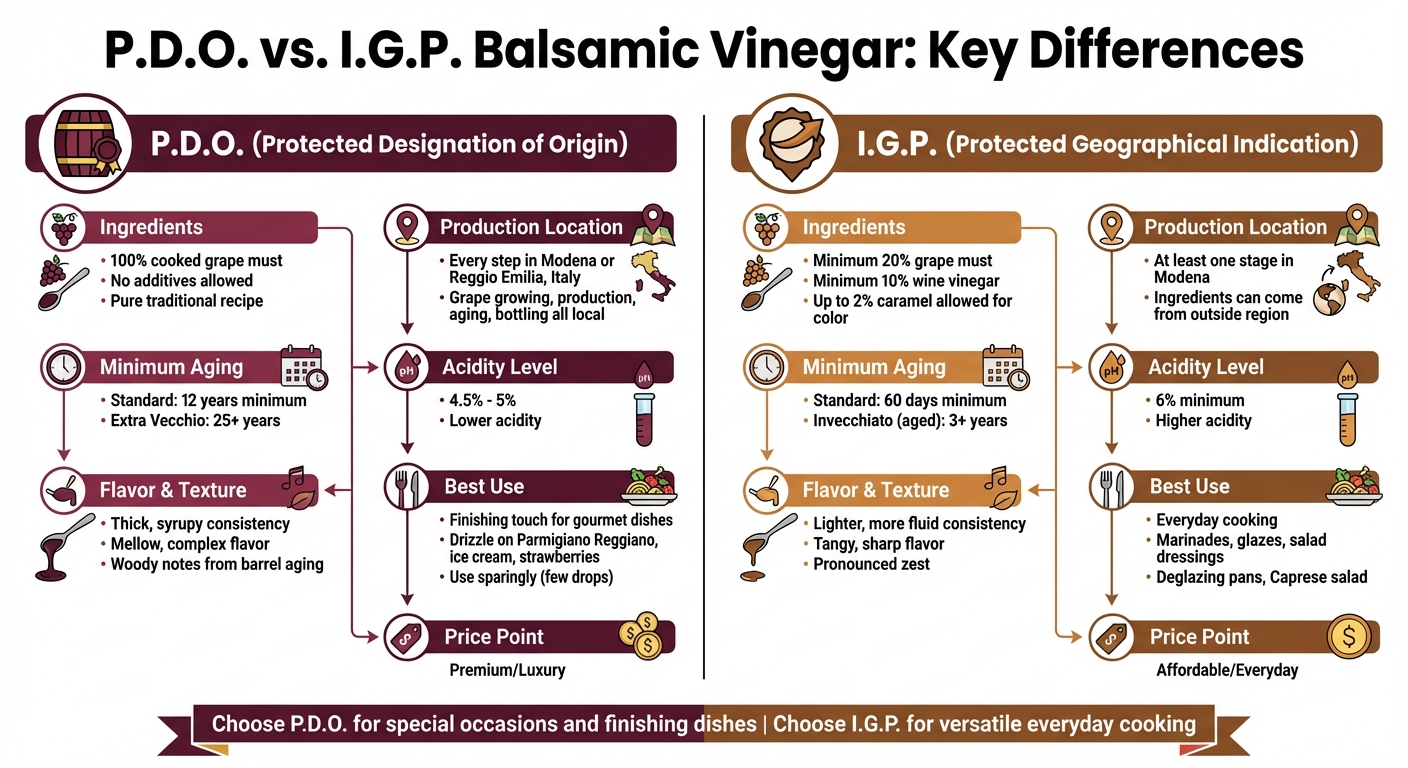
P.D.O. vs I.G.P. Balsamic Vinegar Comparison Chart
PDO vs. PGI: Safeguarding Culinary Heritage
sbb-itb-4066b8e
P.D.O. Certification Requirements for Balsamic Vinegar
P.D.O. certification represents the gold standard for balsamic vinegar, ensuring that traditional methods are upheld and quality remains uncompromised.
Geographic Requirements
To qualify for P.D.O. certification, every step of production - grape cultivation, processing, aging, and bottling - must take place in Modena or Reggio Emilia, Italy. The region's specific climate and traditional vinegar lofts, known as acetaie, play a crucial role in achieving the natural temperature swings necessary for proper aging.
"The grapes used to make 'Traditional Balsamic Vinegar of Modena' must be grown within the traditional boundaries of the province of Modena." – Consorzio Aceto Balsamico Tradizionale di Modena
Grape production is tightly controlled, with a limit of 16 tonnes per hectare (around 7 short tons per acre) to maintain the quality of the final product. These geographic restrictions are what set P.D.O. balsamic vinegar apart from its I.G.P. counterpart.
Ingredient and Production Standards
P.D.O. balsamic vinegar is made solely from cooked grape must - no wine vinegar, caramel, or additives are allowed. Approved grape varieties include Lambrusco, Trebbiano, Ancellotta, Sauvignon, Sgavetta, Berzemino, and Occhio di Gatta.
The process begins with cooking fresh grape must over a direct flame at a minimum of 176°F (80°C) for 12 to 24 hours, reducing the volume to about 30%. Grapes must reach a minimum sugar content of 15° Brix before harvesting. After cooking, the must undergoes natural alcoholic and acetic fermentation in the acetaie. It then matures through a system called a batteria, where it is transferred between barrels of decreasing size. Each batteria includes at least three barrels, though most have five to seven, made from local woods like oak, chestnut, mulberry, cherry, juniper, acacia, or ash. These precise steps ensure the vinegar meets P.D.O. standards.
Aging Requirements
Aging plays a defining role in P.D.O. balsamic vinegar. The "Affinato" classification requires a minimum of 12 years of aging, while the "Extravecchio" designation demands at least 25 years.
To ensure quality, the final product must meet specific analytical criteria, including a density of at least 1.240 at 68°F (20°C) and total acidity of no less than 4.5°. Additionally, expert tasters perform a sensory evaluation to confirm its excellence. Each bottle is sealed with a numbered, non-reusable seal to guarantee authenticity. These strict requirements set the benchmark for P.D.O. certification, highlighting the differences from the more flexible I.G.P. standards.
I.G.P. Certification Requirements for Balsamic Vinegar
I.G.P. certification offers more flexibility compared to P.D.O., allowing for broader sourcing and production methods while still maintaining a tie to the region. Here's a closer look at the geographic criteria, ingredient standards, and aging rules that define I.G.P. certification.
Geographic Connection
Unlike P.D.O. certification, which mandates that every step of production happens in Modena or Reggio Emilia, I.G.P. rules are less restrictive. For I.G.P. balsamic vinegar, at least one key production stage - such as the final acetification or aging in traditional casks - must take place in Modena. Other steps, like sourcing the grape must, can occur outside the region.
Permitted Ingredients
To meet I.G.P. standards, balsamic vinegar must include at least 10% wine vinegar and 20% concentrated grape must. The use of caramel is allowed to enhance color and aroma, as long as it doesn’t exceed 2% of the total volume. Sulfites are also permitted as preservatives. Additionally, I.G.P. regulations require a minimum acidity level of 6%, which is higher than the 4.5%–5% typically required for P.D.O. balsamic vinegars.
Aging and Production Flexibility
I.G.P. balsamic vinegar must be aged for at least 60 days. For products labeled as "aged" or "extra aged", a minimum maturation period of 3 years is required. This shorter aging period contrasts with the longer times demanded for P.D.O. certification.
Key Differences Between P.D.O. and I.G.P.
The main differences between P.D.O. and I.G.P. balsamic vinegars come down to their ingredients and the time they spend aging. Here's how they compare:
P.D.O. balsamic vinegar is made exclusively from 100% cooked grape must with no additives, resulting in a product that stays true to traditional methods. On the other hand, I.G.P. balsamic vinegar includes a blend of at least 20% cooked or concentrated grape must, at least 10% wine vinegar, and up to 2% caramel to maintain color consistency.
When it comes to aging, P.D.O. vinegar must mature for at least 12 years, with some varieties, like Extra Vecchio, aging for 25 years or more. In contrast, I.G.P. vinegars require a minimum aging period of just 60 days, though those labeled "Invecchiato" indicate aging of over 3 years.
Comparison Table
| Aspect | P.D.O. | I.G.P. |
|---|---|---|
| Ingredients | 100% cooked grape must, no additives | At least 20% grape must, 10% wine vinegar, up to 2% caramel allowed |
| Minimum Aging | Minimum 12 years (Extra Vecchio: 25+ years) | Minimum 60 days ("Invecchiato": over 3 years) |
Taste, Texture, and Culinary Uses
The meticulous production process of each vinegar plays a key role in shaping its taste and texture.
P.D.O. balsamic vinegar is known for its thick, luxurious texture and complex, mellow flavor. Aging in wooden barrels for 12 to 25 years infuses it with subtle woody notes. With a lower acidity level of 4.5% to 5%, it highlights both sweet and savory flavors beautifully.
On the other hand, I.G.P. balsamic vinegar is lighter and more fluid, with a sharper, tangier taste due to its higher acidity (minimum 6%). The required addition of wine vinegar gives it a pronounced zest that complements richer dishes.
"Traditional Balsamic Vinegar DOP is not just a simple vinegar, but a real culinary jewel." - Enoteca Ferrari
These differences influence how each type is used in the kitchen. P.D.O. balsamic is best reserved as a finishing touch to preserve its delicate aromas. Just a few drops can elevate dishes like Parmigiano Reggiano, vanilla ice cream, fresh strawberries, or roast beef, allowing its bold flavor to shine.
Meanwhile, I.G.P. balsamic is the go-to choice for everyday cooking. Its fluidity and higher acidity make it perfect for marinades, deglazing pans, and crafting glazes. It’s also an excellent addition to salads like Caprese or for enhancing grilled dishes with its sweet-tangy balance.
For those seeking a middle ground, look for I.G.P. "Invecchiato" (aged) varieties. These are aged for at least 3 years - compared to the standard 60 days - resulting in a slightly thicker texture and a more refined flavor, while still being versatile enough for daily use.
At Big Horn Olive Oil, we embrace the unique qualities of both P.D.O. and I.G.P. balsamic vinegars, helping you bring authentic, rich flavors to your table.
Price and Quality Considerations
When it comes to P.D.O. and I.G.P. balsamic vinegars, their distinct production methods play a key role in both pricing and how they're best used.
P.D.O. vinegars are crafted using traditional, labor-intensive methods and undergo extensive aging. This meticulous process results in a premium price tag. On the other hand, I.G.P. vinegars are produced on a larger scale with a quicker process, making them a more budget-friendly option for everyday cooking needs.
These price differences can guide you in choosing the right balsamic for your kitchen. For daily cooking - whether you're tossing salads, preparing marinades, or adding flavor to a dish - I.G.P. balsamic offers great value. Its affordability and availability in larger quantities make it perfect for recipes that call for multiple tablespoons. When shopping for I.G.P. balsamic, check the label to ensure grape must is listed as the primary ingredient, not wine vinegar.
P.D.O. balsamic, however, is a different story. A 25-year aged dark balsamic is a gourmet product meant for special occasions or dishes where just a few drops can elevate the flavor. Its rich, concentrated taste means you use less, which helps offset its higher cost.
"If you are looking for a versatile balsamic for everyday use, the IGP is the right choice. If instead you want a real gourmet balsamic that will take your dishes to a new level, you should opt for the Tradizionale DOP." - Enoteca Ferrari
At Big Horn Olive Oil, we proudly source authentic balsamic vinegars from Modena, Italy. Whether you're stocking up for everyday meals or searching for that perfect finishing touch for a gourmet creation, we ensure you're getting the real deal every time.
Conclusion
Understanding the distinctions between P.D.O. and I.G.P. certifications can help you make smarter choices in the kitchen.
P.D.O. balsamic vinegar represents a commitment to tradition, with strict production methods and lengthy aging that result in a refined, artisanal product. On the other hand, I.G.P. balsamic offers more flexibility in production while maintaining a regional connection, making it ideal for everyday use.
These certifications ensure transparency, protecting you from products that rely on additives like corn starch, sugars, or artificial colors. With them, you can feel confident that you're purchasing genuine balsamic vinegar.
Choosing the right certification for your needs is key. It helps you avoid wasting a delicate, aged P.D.O. vinegar in high-heat cooking or expecting I.G.P. to provide the depth of flavor needed for finishing dishes. Whether you're reaching for I.G.P. balsamic to enhance a simple salad or saving P.D.O. for drizzling over aged Parmigiano-Reggiano, you can trust the quality behind these labels.
At Big Horn Olive Oil, we source authentic balsamic vinegars straight from Modena, Italy, ensuring that what’s in your bottle lives up to its promise. When shopping, keep an eye out for these certifications - they’re your assurance of quality and authenticity.
FAQs
How can I spot real P.D.O. vs I.G.P. on the label?
To spot genuine P.D.O. (Protected Designation of Origin) balsamic vinegar, check for labels such as "Aceto Balsamico Tradizionale di Modena" or "di Reggio Emilia", along with the DOP certification symbol. This guarantees it’s traditional balsamic vinegar, aged for at least 12 years. For I.G.P. (Protected Geographical Indication) balsamic vinegar, look for the term "Balsamic IGP" on the label. It will list ingredients like grape must and wine vinegar and typically undergoes a shorter aging process of about 60 days or more.
When should I use P.D.O. instead of I.G.P. in cooking?
When you want to stick to traditional Italian methods and ensure top-notch quality, P.D.O. (Protected Designation of Origin) balsamic vinegar is the way to go. This label guarantees that the vinegar is crafted entirely in Modena or Reggio Emilia, using specific grape varieties and following strict aging processes - often for over 12 years. It’s a hallmark of authenticity.
On the other hand, I.G.P. (Protected Geographical Indication) balsamic vinegar has less stringent requirements. While it’s a fine option, P.D.O. balsamic vinegar stands out for recipes that demand the highest level of quality and tradition.
Why is P.D.O. balsamic so much more expensive?
P.D.O. (Protected Designation of Origin) balsamic vinegar comes with a hefty price tag, and for good reason. Its cost reflects the rigorous standards and time-intensive process behind every bottle. To earn the P.D.O. label, this vinegar must be produced in Modena or Reggio Emilia, Italy, following traditional methods passed down for generations. Plus, it has to be aged for a minimum of 12 years - sometimes even longer.
The combination of limited production, strong demand, and certification that safeguards it from imitations drives up the price. But what you're paying for is more than just vinegar - it's a product steeped in craftsmanship, heritage, and authenticity.