

Peroxide Value Thresholds: What Buyers Should Know
When buying olive oil, peroxide value (PV) is a key indicator of quality and oxidation. A lower PV typically signals better oil quality, but it’s only part of the story. Here’s what you need to know:
- What is PV? It measures initial oxidation by calculating hydroperoxides in the oil. Extra Virgin Olive Oil (EVOO) must have a PV ≤20 meq O₂/kg, but top producers aim for ≤12 meq O₂/kg or lower.
- Why it matters: High PV can mean the oil is degrading, losing nutrients like polyphenols and antioxidants. However, very low PVs may also mask advanced oxidation.
- Storage and time: PV increases over time, especially with poor storage. Always check the harvest date, not just the "best by" date.
- Other quality markers: PV alone isn’t enough. Look for Free Fatty Acidity (FFA), Totox value (combines PV and secondary oxidation markers), and polyphenol content for a full picture.
- Global standards: IOC and EU set PV limits at ≤20 meq O₂/kg, while Australia and New Zealand enforce stricter limits (≤15 meq O₂/kg). Ultra-premium oils often achieve ≤9 meq O₂/kg.
Takeaway: Use PV as a starting point, but pair it with other quality indicators like FFA and polyphenol levels. Opt for oils with clear lab reports, low PVs, and proper storage to ensure better taste and nutritional value.
Interpreting Olive Oil Test Results
sbb-itb-4066b8e
Common Misconceptions About Peroxide Value
Misunderstanding peroxide value (PV) can lead to poor choices, especially when selecting oils that might already be degraded.
Peroxide Value vs. Other Quality Indicators
It might sound counterintuitive, but an extremely low PV can sometimes signal advanced oxidation. As oxidation progresses, the primary oxidation compounds break down into secondary products, which can cause the PV to drop - even as the oil itself becomes more degraded.
"Evaluating oil quality based on only PV can be misleading. Because low PV does not necessarily indicate low level of oxidation, it could be due to the advanced level of oil oxidation during which primary oxidation compounds transform into secondary products." - Nurham Turgut Dunford, Professor, Oklahoma State University
Refined oils often show very low PVs, but this is due to the heat or chemical processes used during refinement. These treatments strip the oil of its flavor, aroma, and nutritional value, creating a false sense of quality.
"The refinement process uses heat and or chemicals to make oil odorless, tasteless, and colorless, removing all products susceptible to oxidation thereby eliminating peroxide levels." - Jennifer Angelopoulos, The Furies Olive Oil
Additionally, PV doesn't reveal flavor defects like "fusty", "musty", or "winey" notes, which result from poor fruit handling. These flaws are detected by expert sensory panels, not by chemical tests. PV also doesn't measure Free Fatty Acidity (FFA), which highlights the condition of the olives at harvest, or polyphenol content, which determines antioxidant strength and stability over time.
| Indicator | What It Measures | EVOO Standard (IOC) | High-Quality Target |
|---|---|---|---|
| Peroxide Value (PV) | Initial oxidation/oxygen exposure | ≤ 20 meq/kg | < 12 meq/kg |
| Free Fatty Acidity (FFA) | Fruit damage/fermentation | ≤ 0.8% | < 0.3% |
| K232 (UV) | Primary oxidation | ≤ 2.50 | Lower is better |
| K270 (UV) | Secondary oxidation/refining | ≤ 0.22 | Lower is better |
| Sensory Analysis | Taste and aroma defects | Zero defects | Fruity, Bitter, Pungent |
For a more complete picture of oxidation, consider the Totox value, which combines PV and the p-Anisidine Value (AV) using the formula: (2 × PV) + AV. This calculation accounts for both early- and late-stage oxidation, providing a broader assessment of the oil's quality.
Understanding these nuances helps you make better decisions about oil quality and how factors like time and storage affect PV.
How Time and Storage Affect Peroxide Value
Oxidation is an ongoing process, and storage conditions play a major role in PV readings. It’s important to remember that PV is just a snapshot of the oil's condition at a specific moment. Oxidation begins immediately after pressing.
"The PV on the Certificate of Analysis from when they made the oil is a snapshot in time. Six months later we may run another PV test." - Gay Timmons, Founder, Oh Oh Organic
This is why the harvest date is far more critical than the "best by" date. Even oils with low initial PVs can see dramatic increases if stored improperly. For example, an oil with a PV of 7 meq/kg right after pressing could rise to over 15 meq/kg by the time it reaches your kitchen. To maintain quality, store olive oil between 60°F and 72°F in dark glass or BPA-free tins. Once opened, aim to use it within one to two months.
International Standards for Peroxide Value
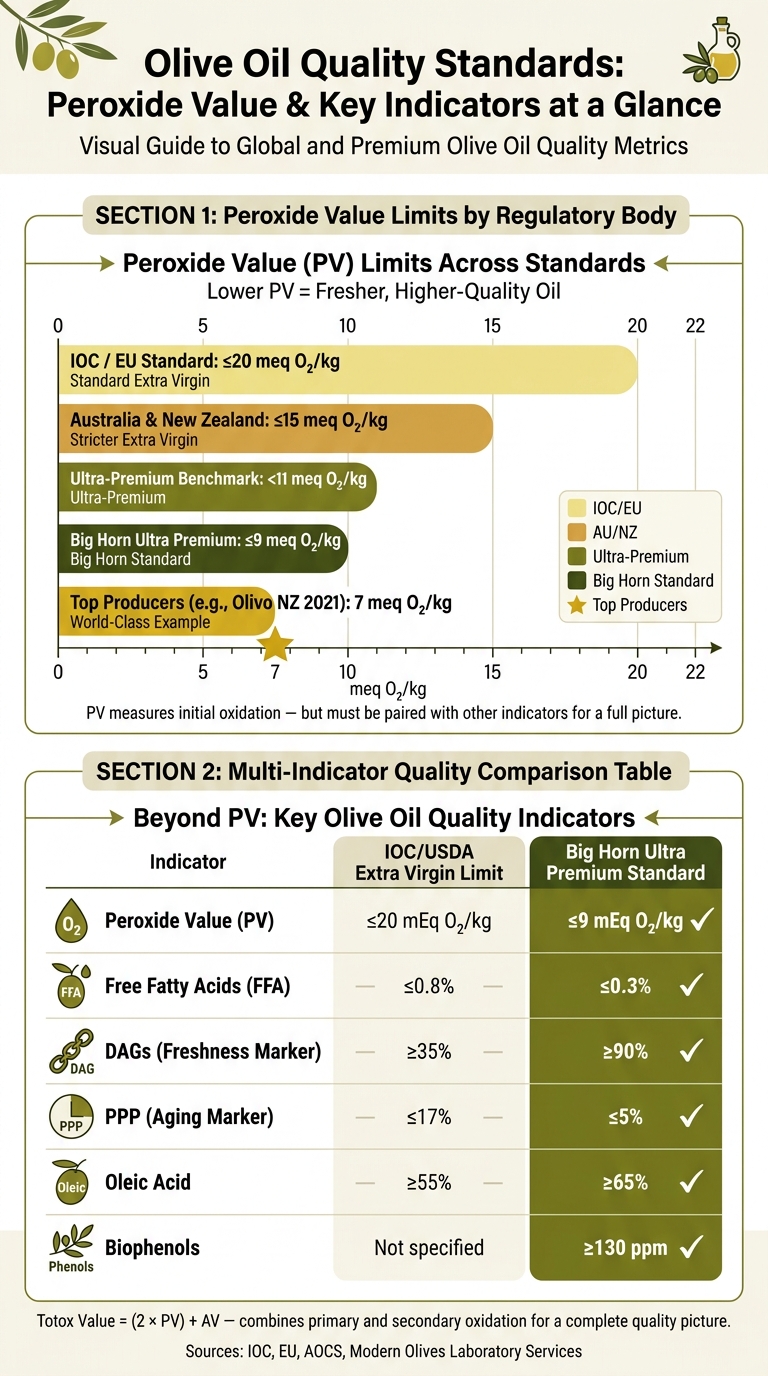
Olive Oil Quality Standards: Peroxide Value & Key Indicators at a Glance
Regulatory bodies around the world set specific peroxide value (PV) limits to classify extra virgin olive oil (EVOO). Knowing who sets these guidelines - and why they matter - can help you determine whether an oil meets high-quality benchmarks or just qualifies as extra virgin.
Peroxide Value Limits by Regulatory Body
The International Olive Council (IOC) and the European Union (EU) both define the maximum PV for extra virgin olive oil as ≤20 meq O₂/kg. However, other regions, like Australia and New Zealand, enforce stricter limits, capping it at 15 meq/kg for EVOO certification.
| Regulatory Body | Max PV (meq O₂/kg) | Quality Tier |
|---|---|---|
| International Olive Council (IOC) | ≤20 | Standard Extra Virgin |
| European Union (EU) | ≤20 | Standard Extra Virgin |
| Australia & New Zealand | ≤15 | Standard Extra Virgin |
| Ultra-Premium Benchmark | <11 | High-Quality / Ultra-Premium |
While these legal thresholds ensure a baseline level of quality, many producers aim for significantly lower peroxide values to deliver a superior product.
Voluntary Standards That Go Beyond Legal Limits
Legal limits represent the minimum acceptable quality, but some producers go the extra mile to achieve peroxide values well below the IOC’s 20 meq/kg cap. For example, ultra-premium EVOO often boasts PV levels under 11 meq/kg, with top-tier producers achieving as low as 7 meq/kg. This level of excellence is achieved through meticulous practices like careful harvesting, rapid milling, and controlled storage conditions.
A standout example comes from New Zealand’s Olivo, which in 2021 produced an EVOO with a PV of just 7 meq/kg and a Free Fatty Acid (FFA) level of 0.1%. These figures not only fall well below IOC and New Zealand regulations but also classify the oil as high quality.
Organizations like the California Olive Oil Council (COOC) encourage producers to exceed legal PV requirements. For consumers, lower PV levels often indicate fresher oil with higher polyphenol content, better flavor stability, and a longer shelf life. These voluntary, stricter standards help buyers identify oils that go beyond basic compliance, offering unparalleled freshness and quality.
How to Use Peroxide Value When Buying Olive Oil
Knowing the international standards is just the beginning. The real challenge lies in applying this information when selecting high-quality olive oil. Let’s break down how to use this knowledge effectively while shopping.
Why You Should Not Rely on Peroxide Value Alone
A low Peroxide Value (PV) can be reassuring, but it doesn’t always tell the whole story. Over time, hydroperoxides in oil degrade into aldehydes and ketones, meaning a low PV could hide advanced oxidation.
Here’s how relying on a single parameter like PV can be misleading compared to a more comprehensive analysis:
| Parameter | Single-Parameter Decision | Multi-Parameter Decision |
|---|---|---|
| Peroxide Value (PV) | May suggest freshness but could mask rancidity | Shows initial oxidation; validated with p-Anisidine Value (AV) |
| Free Fatty Acids (FFA) | Indicates fruit quality but not oxidation state | Confirms stability and olive handling quality |
| p-Anisidine Value (AV) | Captures secondary oxidation but misses early issues | Verifies low PV reflects true freshness |
| Polyphenols | Suggests antioxidant potential but not freshness | Confirms resistance to future oxidation |
| Sensory Notes | No chemical test replaces taste and smell | Ensures no musty, rancid, or off-flavors are present |
To get a fuller picture, check both PV and AV in lab reports. These values together allow you to calculate the Totox value: Totox = (2 × PV) + AV. A lower Totox value indicates better oxidative stability. Additionally, focus on polyphenol content. The European Food Safety Authority (EFSA) requires at least 250 mg/kg for specific health claims, but most shelf-stable oils only have 80–150 mg/kg.
With this understanding, let’s look at how to interpret PV data from labels and lab reports.
How to Read PV Data on Labels and Lab Reports
When reviewing a label or Certificate of Analysis (CoA), pay attention to these details:
- Units: PV is measured in milliequivalents of active oxygen per kilogram of oil (meq O₂/kg). Missing or incorrect units could signal unreliable testing.
-
Test date vs. purchase date: As Gay Timmons, Founder of Oh, Oh Organic, explains:
This highlights the importance of the harvest date over the best-before date. A CoA from 12 months ago won’t tell you much about the oil’s current condition."The PV on the Certificate of Analysis from when they made the oil is a snapshot in time. Six months later we may run another PV test."
- Other critical data: A reliable lab report should include FFA (ideally below 0.3% for premium oils), UV absorption values (K232 and K270) to detect refinement or blending, and polyphenol levels. If only PV is listed, ask for the full CoA to verify these additional parameters. Brands like O-Liv set a standard by publishing CoAs for every batch, including PV, FFA, and phenolic content.
Lastly, check the packaging. Dark glass bottles or BPA-free tins protect the oil from light and oxygen, helping to maintain its quality as indicated by PV and other markers.
How Big Horn Olive Oil Meets High Peroxide Value Standards
Big Horn Olive Oil's Production Practices for Low PV
Producing olive oil with low peroxide values (PV) requires careful attention at every stage, from the orchard to the final bottling. Big Horn Olive Oil follows the Ultra Premium Extra Virgin Olive Oil standard, which demands a PV of ≤9 mEq O₂/kg and free fatty acids (FFA) of ≤0.3%. These standards are verified by Modern Olives Laboratory Services, a trusted third-party lab recognized by the American Oil Chemists' Society. For context, these thresholds are much stricter than the IOC/USDA limits of ≤20 mEq O₂/kg for PV and ≤0.8% for FFA, setting the bar for what qualifies as ultra-premium olive oil.
This commitment to quality starts right after the olives are harvested. To limit oxidation, the olives are milled within 2–4 hours of being picked. The mechanical extraction process, which uses a hammer mill, malaxer, and centrifuge, is carefully controlled to stay below 80°F (approximately 27°C). This low-temperature process helps preserve biophenols - natural antioxidants that slow down oxidation. Additionally, water contact during centrifugation is minimized to retain these healthful compounds.
"Biophenols are healthful antioxidant substances which aid in slowing down the natural oxidative processes." - bhooc.com
After extraction, the oil is stored in stainless steel tanks and bottled in dark glass to shield it from light, which can accelerate oxidation. To ensure freshness, every bottle contains oil harvested within the last 14 months. By sourcing olives from both hemispheres, Big Horn ensures fresh-harvest oil is available twice a year.
These precise measures not only keep PV levels low but also enhance the flavor and nutritional profile of the olive oil.
What Buyers Get When Choosing Big Horn Olive Oil
The attention to detail in production results in olive oil that stands out for its flavor and extended shelf life. Here's how Big Horn Olive Oil compares to standard extra virgin olive oils:
| Metric | IOC/USDA Extra Virgin Limit | Big Horn Ultra Premium Standard |
|---|---|---|
| Peroxide Value | ≤20 mEq O₂/kg | ≤9 mEq O₂/kg |
| Free Fatty Acids | ≤0.8% | ≤0.3% |
| DAGs (freshness marker) | ≥35% (AOA standard) | ≥90% |
| PPP (aging marker) | ≤17% (AOA standard) | ≤5% |
| Oleic Acid | ≥55% | ≥65% |
| Biophenols | Not specified | ≥130 ppm |
With a lower oxidation baseline, Big Horn Olive Oil delivers a vibrant flavor profile - featuring enhanced fruitiness, a pleasant bitterness, and a peppery finish. These qualities are paired with higher polyphenol content, which is known to support heart health and reduce inflammation. To enjoy peak freshness, it's recommended to consume an opened bottle within 4 months.
Big Horn Olive Oil also stands out for its transparency:
"Unlike other producers, we aim for full transparency about how our olive oils are sourced and what our extraction processes are." - bhooc.com
This dedication to quality extends beyond olive oil to their aged balsamic vinegars from Modena, Italy. While PV is specific to oils, Big Horn applies the same rigorous standards to their vinegars, ensuring traditional methods are followed and artificial additives are avoided. This consistency allows buyers to make informed choices, backed by reliable data and full transparency.
Conclusion: Using Peroxide Value to Make Better Buying Decisions
Peroxide value (PV) is a helpful starting point when evaluating olive oil, but it only tells part of the story. A low PV suggests minimal primary oxidation, but it doesn't reveal much about secondary oxidation, the quality of the olives used, or how stable the oil will be over time. To get a clearer picture, PV should be paired with other indicators like free fatty acid (FFA) levels, polyphenol content, and the Totox value - a calculation that combines PV and anisidine value (AV) as (2 × PV) + AV.
It's also important to check the test or harvest date alongside any chemical data. Without this context, lab results become less meaningful, as they may not reflect the oil's current condition. Freshness and transparency go hand in hand when assessing quality.
Producers who share detailed lab results, including PV, FFA, polyphenols, and harvest dates, make it easier to trust their product. For instance, Big Horn Olive Oil demonstrates this transparency by relying on third-party verification from Modern Olives Laboratory Services and adhering to an Ultra Premium standard of ≤9 mEq O₂/kg for PV. This level of openness ensures that buyers can make informed decisions.
Ultimately, PV is just one piece of the puzzle. To choose olive oil that's fresh, flavorful, and worth the investment, consider all quality indicators - PV, FFA, polyphenols, harvest dates, and even packaging and storage conditions. By taking this comprehensive approach, you can confidently select an olive oil that meets your expectations for quality and taste.
FAQs
What’s a “good” peroxide value for fresh EVOO?
A "good" peroxide value for fresh Extra Virgin Olive Oil (EVOO) is considered to be below 20 milliequivalents of active oxygen per kilogram (meq O₂/kg). However, for consumer products, safety standards often suggest aiming for values closer to 10 meq O₂/kg. Lower peroxide values not only reflect fresher oil but also indicate better preservation of its flavor and potential health benefits.
Can a very low PV still mean the oil is old or rancid?
A very low peroxide value is often a sign of high quality and freshness in oil. But don’t let that fool you - it doesn’t necessarily mean the oil isn’t old or rancid. Even with a low peroxide value, oxidation and rancidity can occur if the oil hasn’t been stored correctly or has gone past its shelf life. Proper storage is crucial to preserving the oil’s quality.
Which lab tests should I check besides PV?
In addition to the peroxide value (PV), it's essential to consider other key tests to assess olive oil quality. These include:
- UV absorption tests (K232, K270, ΔK): These measurements help identify the presence of oxidation products and other impurities that can affect the oil's freshness and purity.
- Free fatty acidity (FFA): This parameter indicates the oil's acidity level, which is a marker of its degradation and overall quality.
- Sensory evaluation: A trained panel assesses the oil's flavor, aroma, and other sensory attributes to detect defects and confirm its authenticity.
- Fatty acid profiling: This analysis determines the composition of fatty acids in the oil, ensuring it meets the expected standards and hasn't been adulterated.
Each of these methods provides a deeper understanding of the oil's condition, ensuring it meets quality benchmarks.