

Polyphenols in Olive Oil and Lipoprotein Function
If you want the short answer: high-polyphenol extra virgin olive oil seems to help lipoproteins more than low-polyphenol or refined olive oil. In studies, it most often lowers oxidized LDL, may slightly increase HDL-C, and can improve HDL’s cholesterol efflux capacity. The main point is simple: the phenolic content of the oil matters more than just how much oil you use.
Here’s what I’d take from the article right away:
-
Extra virgin olive oil (EVOO) has much more phenolic content than refined olive oil
- About 232 ± 15 mg/kg vs. 62 ± 12 mg/kg
-
High-polyphenol oils show the clearest effects on lipoprotein markers
- In EUROLIVE, oxidized LDL fell by 3.21 U/L
- HDL-C went up by 1.74 mg/dL with high-polyphenol oil
-
HDL function may matter more than HDL-C alone
- One crossover trial found cholesterol efflux capacity increased 3.05%
-
Phenolic density may beat serving size
- 8 g/day of oil with 1,021 mg/kg polyphenols outperformed 20 g/day of oil with 414 mg/kg
-
Results are stronger for short-term blood markers than long-term heart outcomes
- Many trials lasted only 3 to 12 weeks
So if I were boiling this down for a home cook, I’d say this: pick high-phenolic EVOO, store it well, and use it in place of saturated fats. That’s where the studies point, even though the research still has limits.
| What the article shows | Main takeaway |
|---|---|
| LDL oxidation | High-polyphenol EVOO tends to lower it |
| HDL cholesterol | Usually small increases |
| HDL function | May improve, but not in every trial |
| Oil type | EVOO beats refined olive oil for phenolic content |
| What matters most | Phenolic density, dose, and what the oil replaces |
Bottom line: I’d read this article as support for high-phenolic EVOO as the better pick for lipoprotein health, with the clearest effects seen in oxidized LDL and some signs of better HDL function.
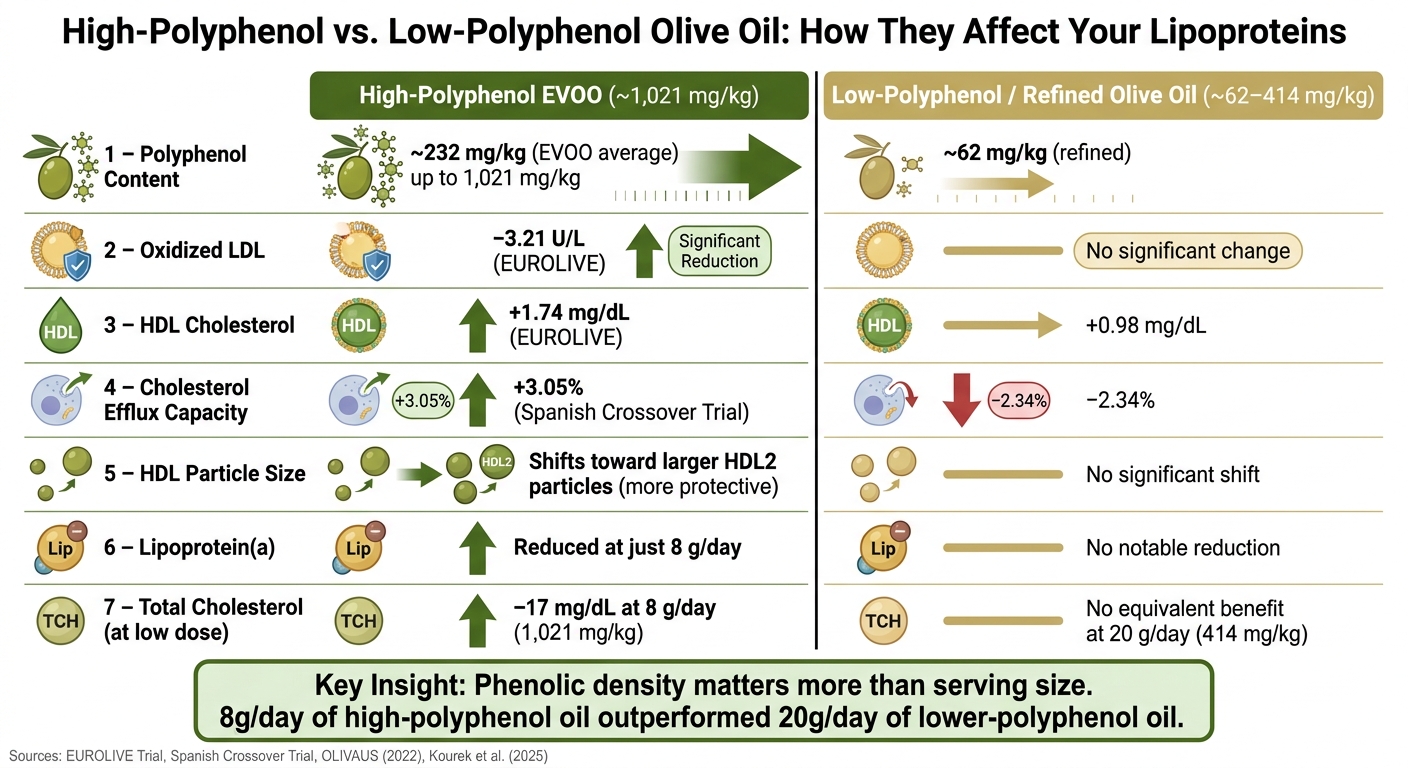
High-Polyphenol vs. Low-Polyphenol Olive Oil: Lipoprotein Effects Compared
Does Olive Oil Help Your Arteries? What New Research Really Shows | The Artery Report
sbb-itb-4066b8e
Polyphenol Content in Extra Virgin Olive Oil
Studies usually report polyphenol content in mg/kg. And the numbers can swing a lot from one oil to another.
Why? Harvest timing, processing, and storage all change the final polyphenol level. So when you look at study results, the phenolic dose in the oil matters a lot.
Which Phenolics Are Most Studied
The phenolics most often used as markers in trial comparisons are hydroxytyrosol, tyrosol, oleuropein derivatives, oleocanthal, and oleacein.
In lipoprotein studies, researchers look at phenolic dose to help judge changes in LDL oxidation and HDL function. That point matters, because two oils may both be labeled extra virgin olive oil while delivering very different phenolic exposures.
How Phenolic Level Affects Study Outcomes
Phenolic density matters more than serving size alone. Put simply, more oil doesn't always mean a stronger effect.
High-phenolic oils have shown stronger effects on cholesterol efflux and HDL function than low-phenolic oils, even when people consumed more of the lower-phenolic oil. That's a big deal, because it helps explain why study results don't always line up neatly.
A good example comes from a clinical trial: participants consuming just 8 grams per day of a high-phenolic oil (1,021 mg/kg) saw an average total cholesterol reduction of 17 mg/dL, while those consuming 20 grams per day of a lower-polyphenol oil (414 mg/kg) did not see the same benefit. In plain English, the phenolic density may matter more than dose alone, and it may drive better lipid responses than volume alone.
Study methods also vary, which makes direct comparison tough. Differences in oil composition, dose, and trial design can change the outcome, so those details matter when judging the strength of the evidence.
What the Research Shows for LDL, HDL, and Other Lipoprotein Markers
LDL Oxidation and Atherogenic Risk Markers
One of the clearest patterns in clinical trials is this: high-polyphenol olive oil lowers oxidized LDL. That matters because oxidized LDL is linked with plaque buildup in arteries.
The EUROLIVE study stands out here. People who used high-polyphenol virgin olive oil saw oxidized LDL fall by an average of 3.21 U/L, while those using refined, low-polyphenol oil saw no change. The high-polyphenol oil also made LDL more resistant to oxidation. On top of that, trials found gains in other atherogenic markers, including total-to-HDL and LDL-to-HDL ratios.
| Study | Endpoint Measured | Result |
|---|---|---|
| EUROLIVE (high-polyphenol) | Oxidized LDL | −3.21 U/L |
| EUROLIVE (low-polyphenol) | Oxidized LDL | No change |
| Med Sci Monit | LDL Cholesterol | −30 mg/dL |
A useful way to read these results: LDL oxidation tends to improve first. HDL changes are often smaller, but they can tell you more about how lipoproteins are working than a plain cholesterol number can.
HDL Cholesterol and HDL Function
Most trials show only small rises in HDL cholesterol. But the bigger story is HDL function, especially its ability to pull cholesterol out of macrophages in artery walls.
In EUROLIVE, high-polyphenol oil increased HDL-C by 1.74 mg/dL, compared with 0.98 mg/dL for low-polyphenol oil. A Spanish crossover trial found a 3.05% increase in cholesterol efflux capacity after just three weeks on high-polyphenol oil. Low-polyphenol oil, by contrast, was linked to a 2.34% decrease in that same measure. High-phenolic oil also shifted HDL toward larger HDL2 particles, which tend to do a better job removing cholesterol.
OLIVAUS found higher HDL-C too, but no significant change in efflux capacity over three weeks. So the picture isn't perfectly neat. Trial length and who was enrolled seem to shape the outcome.
| Study/Trial | HDL Endpoint | Result |
|---|---|---|
| EUROLIVE (high-polyphenol) | HDL-C | +1.74 mg/dL |
| EUROLIVE (low-polyphenol) | HDL-C | +0.98 mg/dL |
| Spanish Crossover Trial | Cholesterol efflux capacity | +3.05% |
| OLIVAUS (2022) | HDL-C / efflux capacity | HDL-C increased; no significant efflux change |
That's why particle size and lipoprotein(a) get so much attention. They help show whether the shift is functional, not just a bump on a lab report.
Particle Subclasses, Lp(a), and Insulin Resistance Indices
Researchers also look at HDL and LDL subclasses, along with lipoprotein(a), because these markers can show risk more clearly than standard cholesterol totals alone.
High-polyphenol EVOO can shift HDL toward larger, more protective HDL2 particles and away from smaller HDL3 particles. New clinical evidence also suggests that high-phenolic EVOO can lower atherogenic lipids, including lipoprotein(a), even at a low daily dose of 8 g. In a 2025 study, 8 g per day of high-phenolic EVOO (1,021 mg/kg) improved cholesterol markers more than 20 g of lower-phenolic oil (414 mg/kg).
| Study | Population | Intervention | Endpoint | Result |
|---|---|---|---|---|
| Hernaez et al. | European males | 25 mL/day (high-polyphenol) | HDL subclasses (HDL2 vs. HDL3) | HDL2 ↑ / HDL3 ↓ |
| Kourek et al. (2025) | Hyperlipidemic patients | 8 g/day (1,021 mg/kg) | Lipoprotein(a) & atherogenic lipids | Improved/reduced |
Put simply, high-phenolic EVOO may affect more than standard LDL and HDL numbers. It may also shift the broader metabolic picture, which is why dose, oil quality, and study setup matter so much when judging the data.
How to Read the Evidence
Those lipid effects are real. But how much weight you give them depends a lot on how the studies were run.
Right now, the strongest support points to lower LDL oxidation and better HDL function. Even so, study design still matters. A lot.
Strengths of the Current Evidence
Randomized crossover trials give the clearest signal here because each person can act as his own comparison. That cuts down on between-person differences and makes the results easier to trust. Controlled feeding trials also help because they lock in the dose and composition of the oil, so comparisons are cleaner.
A 2023 meta-analysis of 34 randomized controlled trials involving 1,730 participants found consistent, dose-dependent drops in LDL cholesterol from olive oil. EUROLIVE is another strong example. It used a crossover design with 200 healthy men who tested low-, medium-, and high-polyphenol oils.
That’s why human crossover trials carry the most weight in this part of the evidence.
Limits and Open Questions
There’s still a catch: most trials are short, small, and not built to track long-term cardiovascular outcomes. Many last just 3 to 12 weeks and include as few as 26 to 30 participants. That’s enough to spot biochemical shifts, like changes in LDL oxidation or HDL efflux. It’s not enough to prove fewer heart attacks or other long-term events.
There’s also no single cutoff for what counts as “high-polyphenol” olive oil. The European Food Safety Authority (EFSA) uses a benchmark of 5 mg of hydroxytyrosol and its derivatives per day to help protect blood lipids from oxidative stress. But studies don’t all define or measure phenolic dose the same way. That makes side-by-side comparison a bit messy.
Another wrinkle: people don’t all respond the same way. Responses tend to be stronger in hyperlipidemic patients than in healthy volunteers. And what olive oil replaces matters too. If you just add it to an unchanged, high-saturated-fat diet, you may not see the same lipoprotein gains seen when olive oil takes the place of less healthy fats.
So, in plain English, the practical things to watch are:
- Oil quality
- Dose
- What the oil replaces in the diet
| Study Design | Evidence Strength | What It Tells You |
|---|---|---|
| Randomized Crossover | High | Best for cause-and-effect on LDL oxidation and HDL efflux |
| Controlled Feeding | High | Precise control over phenolic dosage |
Conclusion: What Olive Oil Polyphenol Research Means for Heart-Conscious Home Cooks
High-phenolic extra virgin olive oil is the type most often tied to better lipoprotein markers. In plain English, the pattern in the research is pretty clear: high-phenolic EVOO helps more than low-phenolic oil. It seems to improve lipoprotein behavior by lowering LDL oxidation and helping HDL function, while low-phenolic oils show little measurable effect. So the main issue isn’t whether EVOO can help. It’s which bottle you buy and how you use it.
Key Takeaways from the Studies
EUROLIVE showed that high-polyphenol olive oil lowered oxidized LDL and increased HDL-C, while low-polyphenol oil did not. That points to one main idea: phenolic density drives the lipoprotein effect.
For home cooks, that shifts the focus from “just use olive oil” to use the right olive oil in the right way. Go for fresh, early-harvest, high-phenolic EVOO, and use it to replace saturated fats rather than pile it on top of them. That makes selection and substitution matter more than portion size by itself.
If heart health is the goal, high-phenolic EVOO is the most practical evidence-based pick. Use it daily, swap it in for saturated fats, and treat it less like a finishing extra and more like a core part of how you cook.
FAQs
How can I tell if an olive oil is high in polyphenols?
Look for a lab-verified polyphenol count in the range of 250 mg/kg to 1,000+ mg/kg. As a rule of thumb, oils with more polyphenols tend to taste bolder too, with some bitterness and that peppery kick in the back of your throat.
Also, check the harvest date or crush date. Don’t rely only on the best-by date. For the best results, use the oil within 9 months of harvest.
A few packaging and production details matter as well:
- Dark glass or tin helps shield the oil from light
- Cold-pressed oil can help keep more polyphenols in the bottle
Do I need a large daily amount for lipoprotein benefits?
No. Polyphenol concentration matters more than the total amount of oil you consume.
Research shows that high-polyphenol oils can improve lipoprotein function and cholesterol levels even in smaller servings. You’ll often see 20 grams - about 1.5 tablespoons - mentioned as the target amount. But highly concentrated premium oils may deliver benefits with as little as 8 grams, or about 2 teaspoons, per day.
Will high-polyphenol EVOO help if I keep eating the same saturated fats?
Not by much. High-polyphenol extra virgin olive oil works best when it replaces saturated fats like butter, margarine, or mayonnaise, instead of being added on top of a diet that’s already high in saturated fat.
That simple swap can help improve cholesterol levels and support better lipid metabolism as part of a heart-healthy lifestyle.