

EVOO Polyphenols and Cholesterol Efflux Mechanisms
Extra Virgin Olive Oil (EVOO) polyphenols, like hydroxytyrosol and tyrosol, support heart health by improving cholesterol removal from cells and protecting HDL (the "good" cholesterol). These compounds boost key proteins like ABCA1, which help transport cholesterol for elimination, and shield HDL from oxidative damage, ensuring it functions effectively. Studies show consuming EVOO with high polyphenol content (e.g., 500 mg/kg) can improve cholesterol efflux by up to 24.57% and enhance HDL particle size and fluidity.
Key takeaways:
- Polyphenols in EVOO, especially hydroxytyrosol and tyrosol, help clear cholesterol from arterial walls.
- They activate transport proteins (ABCA1, ABCG1, SR-B1) essential for cholesterol removal.
- High-quality EVOO polyphenols protect HDL from oxidative stress, preserving its function.
- Aim for EVOO with at least 500 mg/kg polyphenols and consume 1.5–2 tablespoons daily for optimal results.
For the best impact, choose high-polyphenol EVOO labeled "early harvest" or "high-phenolic", and use it raw to retain its properties.
Research on EVOO Polyphenols and Cholesterol Efflux
HDL-Mediated Efflux in Cell Studies
Research using THP-1-derived and human monocyte-derived macrophages has shown that extra virgin olive oil (EVOO) and its polyphenolic compounds can boost cholesterol efflux by about 40%–44%. Additionally, they enhance serum- and HDL-mediated efflux by up to 24.57%.
"Polyphenols contained in EVOO are responsible for inhibiting lipoproteins oxidative damages and promoting reverse cholesterol transport process via ABCA1 pathway."
– Hicham Berrougui, Department of Medicine, University of Sherbrooke
In J774 macrophages, researchers found a strong dose-response relationship (r² = 0.95) between the concentration of EVOO phenolic compounds and ABCA1-dependent cholesterol efflux. This means that higher levels of polyphenols directly lead to better cholesterol removal, emphasizing their potential to support heart health.
Digging deeper, the roles of specific polyphenols like tyrosol and hydroxytyrosol provide more insight into how these compounds work at the molecular level.
How Tyrosol and Hydroxytyrosol Affect Efflux
Among EVOO polyphenols, tyrosol and hydroxytyrosol stand out for their ability to enhance cholesterol efflux. In a 2015 study led by Berrougui and colleagues, treating J774 macrophages with purified tyrosol and hydroxytyrosol (at concentrations ranging from 0 to 25 µM) resulted in a concentration-dependent rise in ABCA1 expression, which is crucial for apoA-I-mediated cholesterol efflux.
These polyphenols work by increasing the expression of key transport proteins. For instance, a 12-week human study observed that EVOO consumption boosted ABCA1 mRNA transcription by 16.08% and ABCG1 mRNA transcription by 35.79% in monocyte-derived macrophages. Interestingly, not all olive oil compounds have this effect - oleuropein and oleocanthal showed little to no impact on ABCA1 protein levels, highlighting the unique contributions of tyrosol and hydroxytyrosol.
In addition to boosting transporter expression, the triterpenic compound erythrodiol plays a key role by stabilizing ABCA1. At a 10 µM concentration, erythrodiol significantly slowed ABCA1 degradation - after 60 minutes, about 90% of the protein remained intact, compared to just 50% under control conditions. This dual mechanism of increasing transporter levels and preserving protein stability helps explain the strong improvements in cholesterol efflux linked to EVOO polyphenols.
sbb-itb-4066b8e
Does Olive Oil Help Your Arteries? What New Research Really Shows | The Artery Report
How EVOO Polyphenols Affect Lipid Transport Proteins
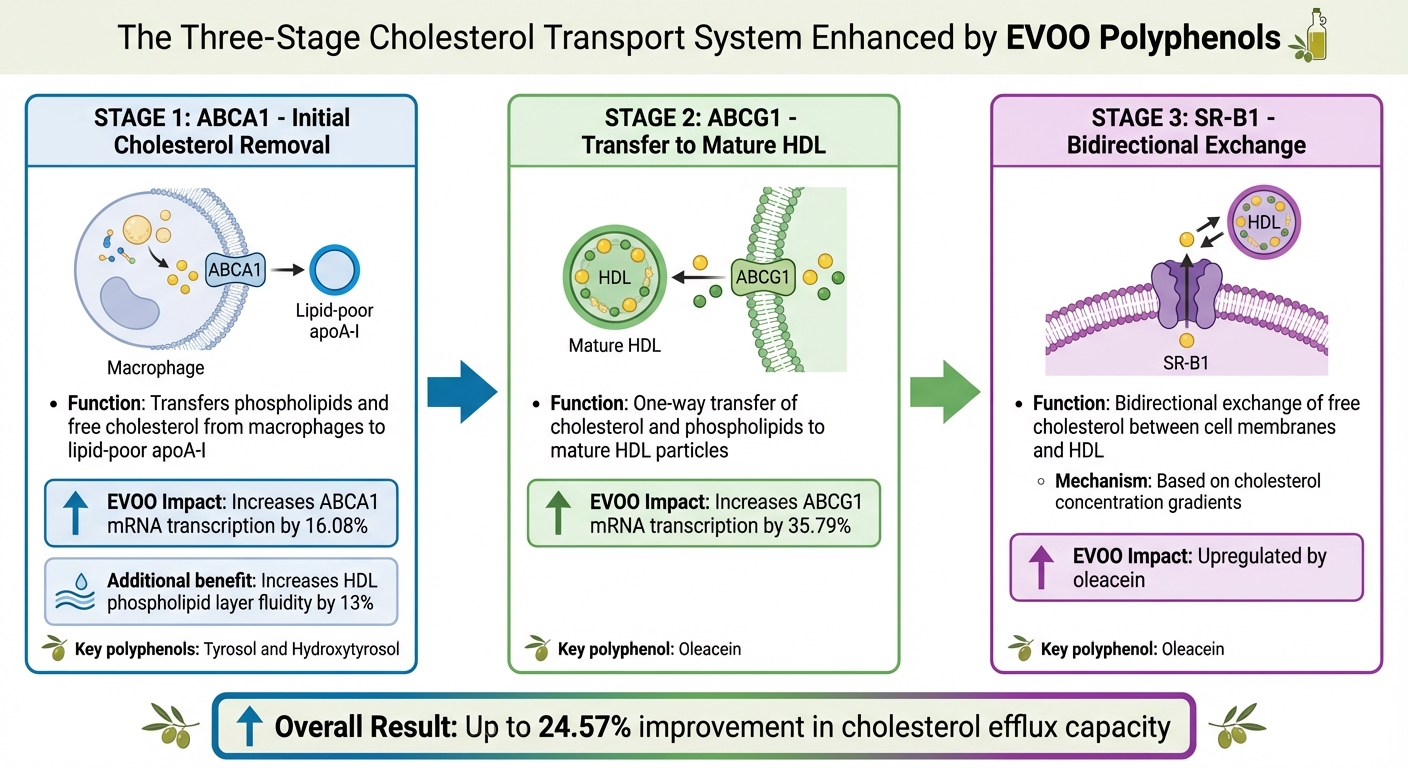
How EVOO Polyphenols Enhance Cholesterol Removal Through Three Key Transport Proteins
ABCA1 in Cholesterol Transport
EVOO polyphenols play a key role in managing cholesterol transport by influencing specific proteins. One standout is ABCA1 (ATP-binding cassette transporter A1), which is essential for the first stage of cholesterol removal from cells. This protein transfers phospholipids and free cholesterol from macrophages to lipid-poor apoA-I, laying the groundwork for forming HDL particles. These HDL particles are responsible for carrying cholesterol away from arterial walls, reducing the risk of buildup.
Research highlights how EVOO polyphenols activate ABCA1 through LXRα signaling. For instance, a 12-week study conducted at the University of Sherbrooke's Research Center on Aging demonstrated that consuming just 25 ml (roughly 1.7 tablespoons) of extra virgin olive oil daily increased ABCA1 mRNA transcription in human monocyte-derived macrophages. The study also revealed that EVOO polyphenols improved HDL's ability to accept cholesterol by increasing the fluidity of HDL's phospholipid layer by 13%. This enhanced fluidity makes HDL particles more efficient at picking up cholesterol, showcasing the broad impact of EVOO polyphenols on cholesterol clearance.
ABCA1, ABCG1, and SR-B1: Different Roles
The benefits of EVOO polyphenols don't stop with ABCA1. They also influence other key lipid transporters, including ABCG1 and SR-B1, which handle the next stages of cholesterol transport. While ABCA1 kickstarts the process, ABCG1 helps transfer cholesterol and phospholipids to mature HDL particles in a one-way flow. Meanwhile, SR-B1 facilitates a bidirectional exchange of free cholesterol between cell membranes and HDL, depending on cholesterol concentration gradients.
"ABCG1 and SR-BI are key mediators of macrophage cholesterol efflux to mature HDL." – Hicham Berrougui, University of Sherbrooke
The polyphenol oleacein, found in EVOO, specifically boosts the expression of both ABCG1 and SR-B1 in human macrophages. This helps reduce lipid deposits and prevents the formation of foam cells. By upregulating these transporters, EVOO polyphenols enhance cholesterol removal at multiple stages. Together, ABCA1, ABCG1, and SR-B1 form a coordinated system that works more effectively with the support of EVOO polyphenols, ensuring a more robust cholesterol-clearing process.
EVOO Polyphenols Under Oxidative Stress Conditions
Restoring Efflux in Stressed Macrophages
Oxidative stress, like exposure to iron/ascorbate, can wreak havoc on macrophages. It reduces ABCA1 expression, increases reactive oxygen species (ROS), and drives lipid peroxidation. These changes destabilize cell membranes and disrupt the reverse cholesterol transport process, which is critical for maintaining cardiovascular health.
Enter EVOO polyphenols. These compounds have shown the ability to reverse the damage caused by oxidative stress. In a study from October 2015, researchers at the University of Sherbrooke exposed THP-1-derived macrophages to 0.2 mM iron/ascorbate to induce oxidative stress. However, when the cells were pretreated with 320 μg/mL of EVOO phenolic compounds for 6 hours, the results were striking: HDL's cholesterol efflux capacity was restored to baseline levels. This recovery happened because the polyphenols reduced intracellular ROS and boosted ABCA1 expression, undoing the oxidative damage.
"Polyphenols contained in EVOO are responsible for inhibiting lipoproteins oxidative damages and promoting reverse cholesterol transport process via ABCA1 pathway." – Hicham Berrougui, University of Sherbrooke
By reducing oxidative stress, EVOO polyphenols don't just repair cellular mechanisms - they also help preserve HDL function, which is key for cardiovascular health.
Preventing HDL Oxidation
EVOO polyphenols do more than restore macrophage function - they also shield HDL particles from oxidative damage. Oxidation makes HDL rigid, reducing its ability to accept cholesterol. It can also lead to a triglyceride-rich HDL core, destabilizing the particle and weakening its protective role in cardiovascular health.
These polyphenols bind directly to HDL particles, particularly through metabolites like hydroxytyrosol sulfate, offering targeted antioxidant protection. This binding significantly enhances HDL's resistance to lipid peroxidation. For instance, EVOO polyphenols can extend the oxidation lag phase by 1.42- to 2.39-fold and reduce the formation of conjugated dienes - a marker of oxidation - by up to 7.71-fold. Even more impressive: for every 1 ppb increase in hydroxytyrosol sulfate bound to HDL, cholesterol efflux capacity improves by 15.6%.
Through these mechanisms, EVOO polyphenols not only protect HDL from oxidative damage but also enhance its functionality, further supporting cardiovascular health.
Animal and Human Study Results
Reverse Cholesterol Transport in Animal Models
Animal research has provided clear evidence that polyphenols in extra virgin olive oil (EVOO) enhance the reverse cholesterol transport process, from macrophages all the way to fecal excretion. In a study conducted in August 2020 by Lídia Cedó and Joan Carles Escolà-Gil at the Institut d'Investigacions Biomèdiques IIB Sant Pau, female C57BL/6 mice were given daily doses of 150 µL phenol-enriched virgin olive oil (FVOO) containing 500 mg/kg of phenolic compounds for 14 days. Using radiolabeled macrophages, researchers tracked cholesterol movement and found increased excretion through feces.
The results were impressive. FVOO more than doubled the excretion of macrophage-derived bile acids in feces compared to refined olive oil (0.22% versus 0.10%). Even when the phenolic extract was administered without the oil matrix, fecal bile acid recovery increased to 0.18% compared to 0.10% in saline-treated controls. Additionally, FVOO boosted HDL levels to 71 mg/dL and apolipoprotein A1 levels to 126 mg/dL, correlating with increased ABCA1 protein expression.
"Our data provide direct evidence of the crucial role of OO PCs in the induction of macrophage-specific RevCT in vivo." – Lídia Cedó et al., Institut d'Investigacions Biomèdiques IIB Sant Pau
These findings in animal models pave the way for clinical trials to better understand how EVOO polyphenols affect HDL function in humans.
HDL Function in Human Studies
Human studies have further confirmed the benefits of EVOO polyphenols, particularly in enhancing cholesterol efflux capacity. In October 2012, Abdelouahed Khalil and his team at the University of Sherbrooke conducted a study involving 26 healthy participants who consumed 25 mL/day of EVOO for 12 weeks. The results showed that HDL's ability to remove cholesterol from monocyte-derived macrophages improved by 9.8% to 24.57%, depending on the cell type. Additionally, HDL phospholipid layer fluidity increased by 13%, and the expression of ABCA1 and ABCG1 transporters in macrophages rose by 16.08% and 35.79%, respectively.
Similar outcomes were observed in the EUROLIVE study, which highlighted how high-polyphenol intake enhances HDL's cholesterol efflux capacity.
More recent research emphasizes that the concentration of polyphenols is more impactful than the volume of EVOO consumed. A trial conducted between 2021 and 2022 at Messinia General Hospital in Greece compared two groups of hyperlipidemic patients. One group consumed 20 g/day of EVOO with 414 mg/kg phenolics, while the other consumed 8 g/day of EVOO with 1021 mg/kg phenolics. Despite both groups consuming approximately the same total polyphenols (~8.3 mg/day), the group with the higher polyphenol concentration and lower dose showed better improvements in total cholesterol (p = 0.045) and a significant increase in HDL levels (p < 0.001).
"Olive oil polyphenols promote the main HDL antiatherogenic function, its cholesterol efflux capacity." – Álvaro Hernáez, Cardiovascular Risk and Nutrition Research Group
These findings highlight the cardiovascular benefits of EVOO polyphenols and stress the importance of choosing extra virgin olive oil with a high polyphenol concentration. If you're looking to experience these benefits yourself, consider exploring premium options like those available from Big Horn Olive Oil.
Conclusion
Polyphenols in extra virgin olive oil (EVOO) play a key role in protecting heart health by improving cholesterol efflux through several pathways. Specifically, compounds like hydroxytyrosol and tyrosol boost the ABCA1 protein, which is essential for moving cholesterol out of macrophages and back to the liver for elimination. This process is central to EVOO's ability to regulate cholesterol levels. Additionally, EVOO polyphenols safeguard HDL particles from oxidative damage, help maintain their membrane fluidity, and create an anti-inflammatory environment in immune cells, reducing the buildup of atherosclerotic plaques.
However, the effectiveness of these benefits hinges on consuming enough polyphenols. The European Food Safety Authority advises a daily intake of at least 5 mg of hydroxytyrosol and related compounds to protect lipids from oxidative harm. Unfortunately, many commercial olive oils lack the necessary polyphenol concentration to meet this threshold with a practical serving size. This makes choosing EVOO with high polyphenolic content essential.
For optimal results, aim to consume 1.5–2 tablespoons (20–25 mL) of high-quality EVOO daily. Look for labels such as "high-phenolic", "early harvest", or oils with a phenolic content of at least 500 mg/kg. To retain heat-sensitive polyphenols, use EVOO raw, such as in salads or drizzled over dishes. For high-quality options, consider oils like those from Big Horn Olive Oil, which are cold-pressed within two hours of harvesting and shipped within three months to ensure maximum polyphenol retention.
FAQs
How can I tell if an EVOO is truly high in polyphenols?
To find an extra virgin olive oil (EVOO) rich in polyphenols, check for products that specify their polyphenol content - ideally around 366 mg/kg. Oils that emphasize their phenolic profile are often linked to enhanced health benefits because of their higher polyphenol levels.
Does cooking EVOO destroy the polyphenols that support cholesterol efflux?
Cooking extra virgin olive oil (EVOO) at high temperatures, like when frying or microwaving, can break down its polyphenols - key compounds that help with cholesterol management. To keep these beneficial elements intact, it’s better to use EVOO at lower temperatures or drizzle it over your food after cooking.
Who should be cautious about increasing EVOO intake for cholesterol benefits?
People with olive allergies or those who experience gastrointestinal issues should be cautious about adding more extra virgin olive oil (EVOO) to their diet. Although the article emphasizes its positive impact on cholesterol, consuming too much can cause unwanted side effects for these groups.