

Private Label Quality Seal Criteria Explained
If the product, paperwork, and label do not match, the seal can fail. That is the core rule.
I’d sum the article up like this: a private label quality seal is not about who owns the brand. It is about whether a product meets set testing, sourcing, and labeling rules. For U.S. olive oil, that usually means FFA at or below 0.8%, zero median defects, and fruitiness above 0. For balsamic vinegar, the main checks are usually origin records, aging proof, and label claims that match the file.
Here’s the short version:
- Private label = your brand name on the product
- Quality seal = proof the product met a set standard
- Seal review usually checks:
- Composition
- Traceability
- Label control
- Olive oil seals often depend on:
- Chemical tests
- Sensory panel results
- Lot records
- Balsamic vinegar seals often depend on:
- Origin certificates
- Aging records
- Regional claim support
- Approval is not one-and-done:
- New batch testing
- Annual review
- Current COAs and labels
What stood out to me is how strict the failure points are. For example, one olive oil metric over the limit can block grade status. And if a label says “Extra Virgin” but the test file does not support it, that mismatch alone can trigger a problem.
A few points matter most:
- Testing without records is not enough
- Records without matching labels are not enough
- A premium claim without proof is not enough
If you want the article boiled down to one sentence, here it is: seal eligibility comes down to tested quality, traceable sourcing, and label claims backed by records.
Our Seals of Certification that you can look for on every bottle
sbb-itb-4066b8e
Quick Comparison
| Product | Main seal checks | Common proof needed | Common failure point |
|---|---|---|---|
| EVOO | FFA, sensory defects, fruitiness, batch control | Lab tests, sensory panel results, COA, lot records | FFA above 0.8% or any confirmed defect |
| Balsamic vinegar | Origin, aging, production claim support | Origin certificates, aging records, supply records | Label claims not backed by source or age records |
So if I were reviewing this article for the fastest takeaway, I’d say this: the seal is only as good as the match between the bottle, the test results, and the paper trail.
Core Criteria for Private Label Quality Seal Eligibility
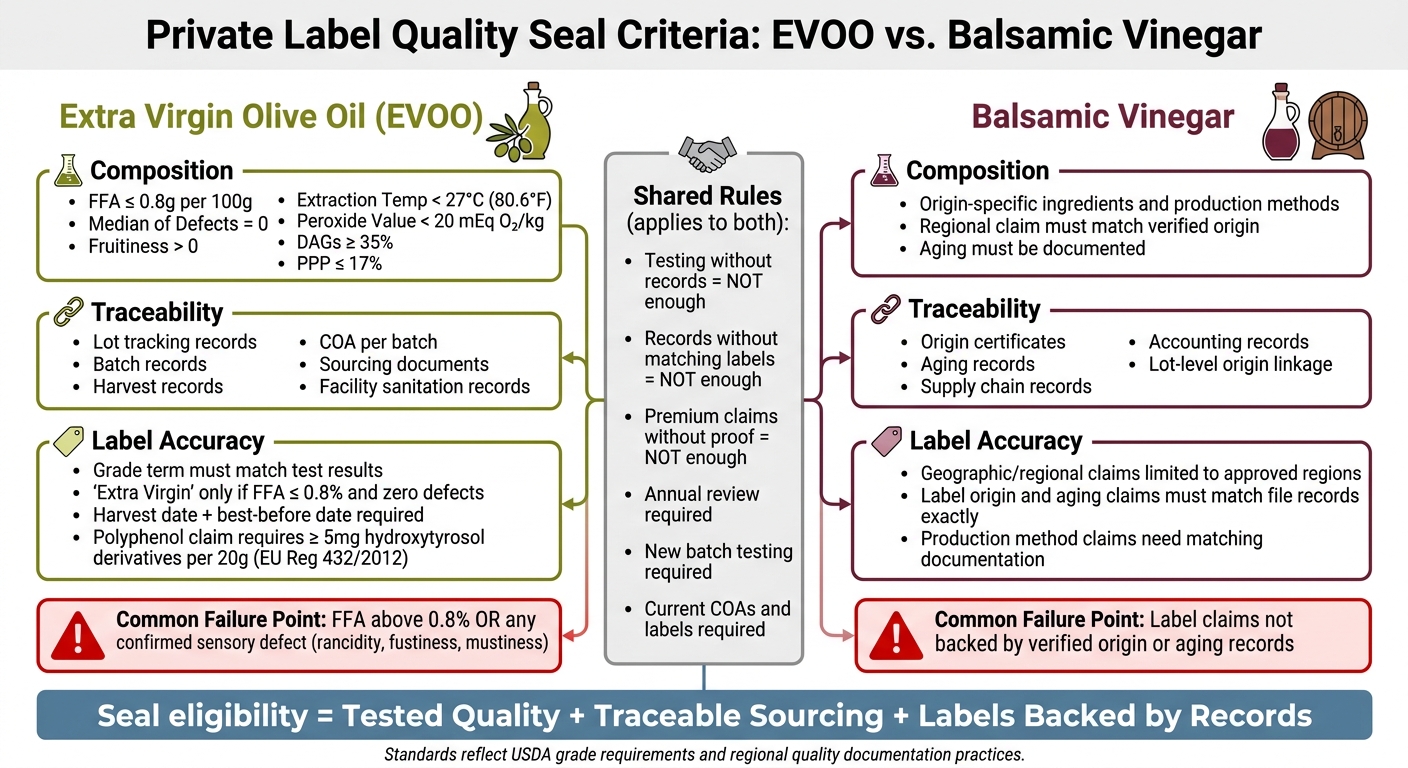
Private Label Quality Seal Criteria: EVOO vs Balsamic Vinegar
Building on the earlier review, eligibility comes down to three checks you can verify: composition, traceability, and label accuracy.
Composition, Purity, and Sensory Standards
For EVOO, the composition rules are strict. The oil must have a free fatty acid (FFA) content of no more than 0.8g per 100g, a median of defects of zero, and a median of fruitiness greater than zero. Under USDA limiting rules, a single failed metric is enough to knock the product out of grade.
| Olive Oil Grade | Max FFA (per 100g) | Median of Defects | Sensory Requirement |
|---|---|---|---|
| U.S. Extra Virgin | 0.8g | 0 | Fruitiness > 0; excellent flavor/odor |
Thresholds and sensory criteria in this table reflect USDA grade standards and related quality documentation practices.
Balsamic vinegar follows the same basic idea: the claim has to match the proof. But here, the paperwork leans more on origin and aging. If a balsamic product makes a regional claim, it needs origin certificates and aging records that support that claim at every step.
Traceability, Sourcing, and Facility Controls
Once composition clears review, traceability becomes the next gate. Seal programs do not stop at the finished bottle. They also look at how the product moved through the system. That means lot tracking, batch records, and sourcing documents must be in place so each unit can be traced back to its source. If a batch cannot be traced, it fails review.
Facility controls matter here too. Reviewers look at sanitation, contamination prevention, and the USDA process manuals used during review.
Labeling Rules and Seal-Use Requirements
After sourcing records are checked, the label has to line up with the file exactly. The tested product, the approved formula, and the label all need to say the same thing. Grade terms, ingredient statements, and origin claims must match the records on file. For example, using "Extra Virgin" on oil that is above 0.8g FFA breaks the grade standard.
The table below shows how the main rule sets differ for private label olive oil and balsamic vinegar.
| Seal Category | Composition Rules | Documentation Required | Testing | Label Restrictions |
|---|---|---|---|---|
| USDA Grade / Regulatory | FFA thresholds and sensory defect limits | Batch records and USDA inspection score sheets | Chemical and sensory panel | Grade terminology must match test results |
| Regional Quality (e.g., PDO) | Origin-specific ingredients and methods | Supplier origin certificates and aging records | Origin verification and density checks | Geographic claims are limited to approved regions |
Thresholds, documentation, and testing expectations in this table reflect USDA grade standards and regional quality documentation practices.
How to Qualify for a Private Label Quality Seal
Once the standard is clear, the next step is proving the product meets it.
Check Product Readiness Against the Target Standard
Pick the standard that fits your supply chain, then test the product against it. The standard should line up with the product’s origin and the certification route you plan to use.
Readiness usually comes down to two checks: chemical testing and sensory testing. On the chemical side, measure the product against the strictest published thresholds. OOCC/CDFA uses some of the toughest limits: FFA ≤ 0.5%, PV ≤ 15 meq O₂/kg, PPP ≤ 17%, and DAGs ≥ 35%. It helps to run DAGs and PPP early. If DAGs come in low or PPP comes in high, that points to degradation and can knock the product out of seal eligibility.
If the product passes both chemistry and sensory review, the next step is the paperwork: sourcing records and label control.
Build Compliant Sourcing, Records, and Labels
Each lot should be backed by harvest records and origin documents. For balsamic, connect every lot to origin and aging records so the file holds up if someone checks it later.
On the sensory side, do an internal blind pre-check before you send samples to a third-party panel. That extra step can save time and money. Any confirmed defect, including rancidity, fustiness, or mustiness, disqualifies Extra Virgin status.
"For an olive oil to be deemed extra virgin olive oil it must have zero defects, and some fruitiness." - California Olive Ranch
Before submission, check grade terms and origin claims against the latest test results and sourcing records. If the label says one thing and the file says another, that’s where trouble starts.
Apply, Fix Gaps, and Keep Certification Current
Submit samples from the newest harvest for third-party chemical and sensory testing. Fresh samples matter because the product has to keep its quality through shelf life.
If the review turns up a gap, fix it and resubmit the updated documents. Pretty simple in theory, but this is where lot-level detail matters.
Review approval every year using test results from the latest harvest. Seal readiness depends on verified sourcing, current testing, lot-level traceability, and label claims that match the file.
Use the checklist below to confirm EVOO and balsamic requirements before submission.
Checklist for Premium Olive Oil and Balsamic Private Labels
EVOO-Specific Quality Checks
For premium EVOO, the quality check starts with the numbers. Check free acidity, peroxide value, and freshness markers against the seal standard. Keep extraction below 27°C (80.6°F). Then add certified sensory-panel testing to make sure the flavor stays consistent from batch to batch.
If you want to make a high-polyphenol claim, there's a clear line to meet. The oil must contain at least 5 mg of hydroxytyrosol derivatives per 20 g under EU Regulation 432/2012.
Labeling matters too. Show both the harvest date and best-before date on the label. And use dark glass or metal tins to help protect the oil from UV exposure.
| Parameter | Premium EVOO Target | Regulatory Minimum |
|---|---|---|
| Free Acidity | 0.2%–0.3% | < 0.8% |
| Peroxide Value | < 20 mEq O₂/kg | - |
| Extraction Temp | < 27°C (80.6°F) | - |
| Polyphenols (health claim) | > 5 mg/20 g | N/A |
| Shelf Life | 18–24 months from harvest | Varies by packaging |
Balsamic works the same way in one key sense: every label claim needs a paper trail.
Balsamic Vinegar Origin and Aging Checks
With balsamic, the focus shifts from chemistry to proof of origin and aging. The seal depends on documented origin and aging, not just flavor.
Keep storage and records that prove origin and aging claims, backed by origin records, test results, and accounting records. If the label makes a specific origin, aging, or production claim, the file needs matching records.
Recurring Monitoring After Approval
Approval isn't the finish line. Run the same checks on every new batch.
Each batch should come with a Certificate of Analysis (COA) to confirm acidity stays below 0.8% and that the other parameters stay within program limits. Labels should also be reviewed before each new production run.
Test each new batch, review each label, and keep records current.
Conclusion: What Determines Seal Eligibility
Once the tests, records, and labels are checked, the decision comes down to one plain issue: do they match? Seal eligibility rests on that alignment. The product, the records, and the label all need to line up with the standard.
For premium EVOO, approval still depends on passing the required chemical and sensory tests. But strong test results alone aren’t enough. If handling and sanitation records don’t back them up, the product can still fail.
Facility controls also matter. They need to show proper sanitation, prevention of contamination, and inspection records that are kept up to date and done the same way over time.
For balsamic vinegar, the label has to match the verified origin, production details, and test records.
Key Points to Carry Forward
The easiest way to stay eligible is to make sure every claim is supported by current evidence. Seal eligibility is maintained through current testing, accurate records, and packaging that protects quality after approval.
FAQs
What can cause a seal application to fail?
A seal application can fail for chemical, sensory, or administrative reasons.
That means an oil might pass lab chemistry tests and still get turned down. Why? Because experts may find major flavor defects, detect no measurable fruitiness, or spot signs of adulteration.
Paperwork can also sink an application. Common issues include:
- Missing documentation
- Not submitting the required chemical data within 60 days of testing
- Poor traceability records
In plain English, it’s not just about what’s in the bottle. It’s also about how the oil tastes, how it’s verified, and whether the records back up the claim.
How often does a private label product need retesting?
Retesting rules for private label products can differ a lot. It depends on the product itself, the regulations that apply, and the standards in that market. In some cases, periodic batch testing is required to stay compliant.
A smart approach is to base retesting on ongoing quality data, not just the calendar. That means looking at signals like accuracy trends and lot rejection frequency to decide when another round of testing makes sense. Some certification programs also require annual on-site audits and periodic retesting.
What records should I keep for seal approval?
Keep the Private Label Entity Submission forms from the Seal Certification Kit complete and up to date, especially the Private Label Entity Olive Oil Register Form.
Producers take care of the chemical and sensory analysis records. But private label entities still need to keep their paperwork accurate, organized, and ready to submit. That paper trail supports traceability, compliance, and good standing.