

How Quality Seals Affect Olive Oil Prices
Why are some olive oils more expensive than others? It often comes down to quality seals like PDO (Protected Designation of Origin) and PGI (Protected Geographical Indication). These certifications guarantee that the oil meets strict production and origin standards, ensuring better quality and authenticity. Without these seals, consumers risk buying mislabeled or diluted oils, which are common in the market.
Here’s what you need to know:
- PDO-certified oils: Every production step happens in a specific region, using local olives and methods.
- PGI-certified oils: At least one production stage occurs in the designated area.
- Certified oils often cost 20–50% more but offer higher quality, better taste, and verified origins.
- Fraud is rampant - up to 80% of olive oil globally is mislabeled, with some bottles being blends of cheaper oils.
Certifications not only protect buyers but also help producers justify premium prices by emphasizing quality over mass production. If you’re paying $3 for olive oil, it’s likely not genuine extra virgin. Look for seals, harvest dates, and dark bottles to ensure you're getting what you pay for.
15 Olive Oil Brands to AVOID at All Costs (And How to Spot Real Olive Oil)
sbb-itb-4066b8e
The Problem: Fake Labels and Pricing Confusion
Fraud is rampant in the olive oil industry. In fact, experts estimate that as much as 80% of olive oil sold globally is mislabeled. A study from UC Davis revealed that 69% of imported olive oils labeled as "extra virgin" failed to meet international sensory standards. By comparison, only 10% of California-produced oils fell short of these benchmarks.
Why Buyers Pay Too Much for Poor-Quality Oils
Dishonest producers often mix extra virgin olive oil with cheaper oils like sunflower, canola, or soybean oil, then falsely label the blend as "extra virgin". Some even go so far as to add industrial chlorophyll to color low-grade oils and beta-carotene to mimic the flavor of authentic olive oil. In other cases, lower-quality oils, including "virgin" or even "lampante" oil (which isn't safe for consumption without refining), are marketed as premium extra virgin olive oil to fetch higher prices.
Authorities have taken action against these fraudulent practices. For example:
- April 2008: Italian officials arrested 40 individuals and seized 25,000 liters of adulterated oil before it could be exported.
- December 2023: Police in Spain and Italy arrested 11 people for tampering with over 260,000 liters (68,000 gallons) of oil across regions like Sicily, Tuscany, and Ciudad Real.
- June 2017: Italy’s Antitrust Authority fined Lidl and major producers, including Bertolli and Carapelli, nearly €1 million (about $1.1 million) for mislabeling lower-grade oils.
The fallout? Consumers often pay $15 to $25 per bottle for what is essentially flavored vegetable oil. Without third-party certifications like PDO (Protected Designation of Origin) or PGI (Protected Geographical Indication), it’s nearly impossible for buyers to verify quality or authenticity just by looking at the label. Misleading terms like "Premium Quality" or "Imported from Italy" offer no guarantee of purity, origin, or compliance with strict standards. This widespread fraud not only deceives buyers but also disrupts market pricing and erodes trust in the industry.
Effects on Market Prices and Buyer Confidence
Between September 2016 and December 2019, the Joint Research Center tracked 32 major olive oil fraud cases. Of these, 16 involved substitution with cheaper oils, and 11 were tied to false labeling. A 2013 report revealed that one in four olive oils tested in Spain and nearly one in three in Canada failed official fraud tests. These incidents, though scattered, collectively distort pricing and mislead consumers about what they’re actually buying.
"Much of the extra virgin Italian olive oil flooding the world's market shelves is neither Italian, nor virgin." - Forbes
When a fraudulent brand is exposed, it casts doubt on the entire olive oil category. Producers who follow strict quality standards and earn certifications struggle to justify higher prices when counterfeit products are sold at artificially low rates. Coldiretti, Italy's farmers association, summed it up bluntly: "It is unacceptable to see extra virgin olive oil bottles sold on [supermarket] shelves for €3.00" (about $3.25). At that price, after factoring in production, transport, and packaging costs, it’s clear the product can’t be genuine extra virgin olive oil.
This widespread deception highlights the importance of certification seals like PDO and PGI in rebuilding trust and stabilizing the market.
Solution: How Quality Seals Verify Authenticity and Affect Pricing
To tackle the challenges of fraud and pricing confusion in the olive oil market, PDO (Protected Designation of Origin) and PGI (Protected Geographical Indication) certifications provide a reliable way to verify authenticity and support premium pricing. These seals go beyond vague claims like "Premium Quality" or "Imported from Italy" by guaranteeing that the olive oil meets strict production standards and originates from specific regions. Backed by regulatory oversight, these certifications protect both producers and consumers.
What PDO and PGI Seals Mean
PDO certification demands the highest level of connection to a specific location. Every step - production, processing, and preparation - must happen within the designated region. For instance, Kalamata olive oil PDO must be entirely produced in the Kalamata region of Greece, using local olive varieties. The olives cannot come from elsewhere, nor can the oil be processed outside the region.
PGI certification, on the other hand, allows for more flexibility. It requires that at least one stage of production, processing, or preparation occurs in the designated region, with the product’s quality or reputation linked to that geographic origin. Unlike PDO, PGI permits some raw materials to come from outside the region, as long as the connection to the location remains clear.
"The GI recognition enables consumers to trust and distinguish quality products while also helping producers to market their products better".
Regulatory Bodies Behind Quality Seals
Ensuring these standards are upheld involves a robust system of oversight. The European Union created the PDO and PGI frameworks and enforces them through national authorities in member countries. These authorities prevent unauthorized use of protected names, and customs officials can seize goods that violate these protections under Regulation 1383/2003. A newer regulation, Regulation (EU) 2024/1143, came into effect on May 13, 2024, streamlining the registration process for food, wine, and spirits. This update also strengthened protections for GI names sold online and allowed producers to incorporate sustainability practices into their product specifications.
Regulatory Councils play a key role in maintaining the integrity of certified products. They oversee producers, ensuring compliance with authenticity, quality, and geographic standards while combating fraud. For example, in Spain, nine PDOs - including Baena, Siurana, and Estepa - accounted for 82.94% of the total economic value of certified Spanish olive oil in 2022. These measures not only ensure quality but also contribute to the higher costs associated with certified oils.
Why Certified Oils Cost 20–50% More
Certified olive oils carry a price premium of 20–50% due to several factors:
- Higher production standards: Producers must use specific traditional olive varieties, adhere to geographic restrictions, and follow detailed product specifications, all of which add to operational costs.
- Regulatory oversight: Certification involves registration fees and ongoing compliance checks, which increase costs.
- Strategic pricing: Certification helps smaller mills command premium prices and gain consumer trust without relying on large brand recognition.
In 2022, Spanish olive oil PDOs sold 32,119 metric tons of oil, generating €157.51 million (around $171 million) in economic value. Interestingly, only 2% of Spain's olive oil production is marketed under a PDO label, even though 28% of the country’s olive-growing land is PDO-registered. This scarcity, combined with the assurance of quality, allows certified oils to command significantly higher prices. Research from Agricultural and Food Economics confirms that PDO-certified oils consistently achieve higher market values.
| Certification Type | Production Requirements | Geographic Link |
|---|---|---|
| PDO | Every part of production, processing, and preparation must occur in the region. | Strongest link to the place of origin. |
| PGI | At least one stage of production, processing, or preparation must occur in the region. | Quality or reputation is attributable to the origin. |
How PDO and PGI Seals Affect Olive Oil Price Levels
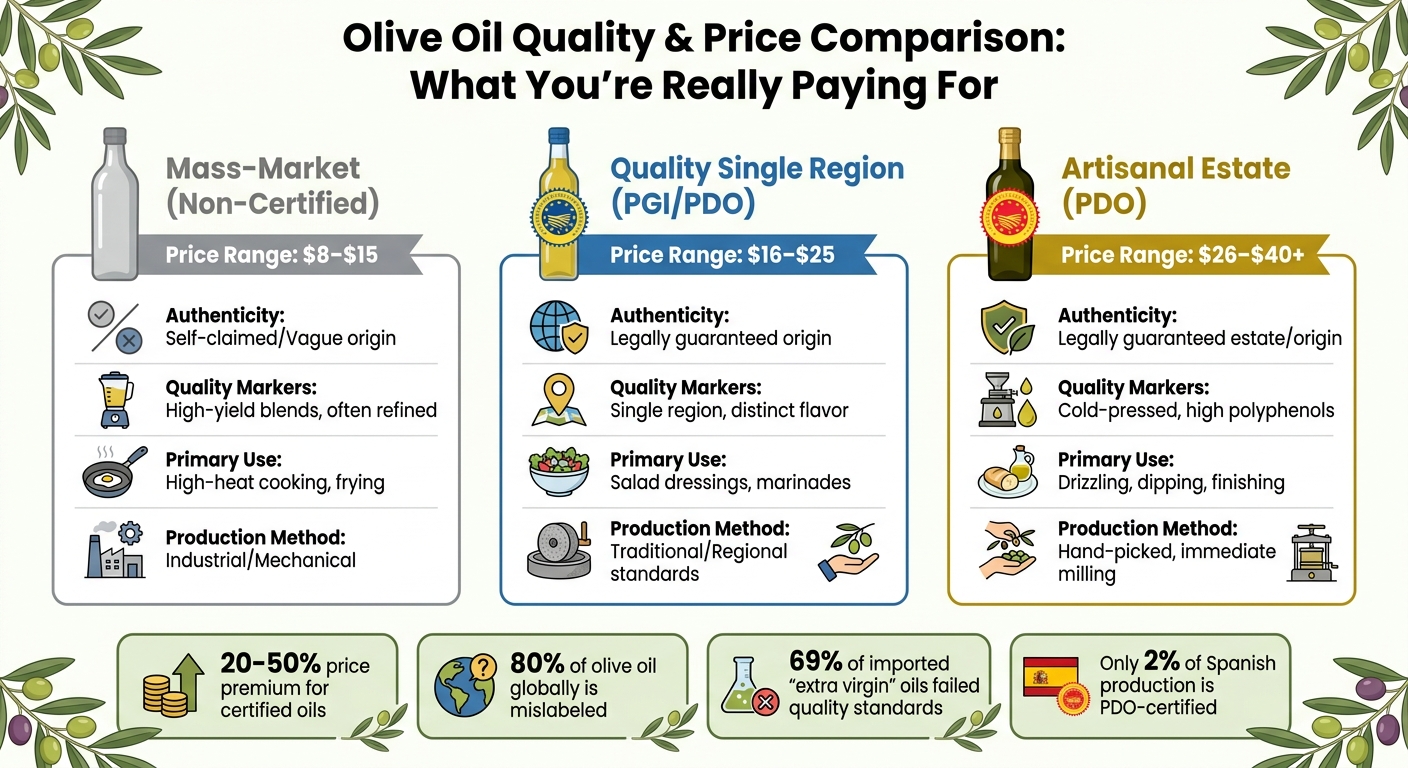
Certified vs Non-Certified Olive Oil: Price and Quality Comparison Guide
PDO (Protected Designation of Origin) and PGI (Protected Geographical Indication) certifications transform olive oil from a bulk commodity into a premium product. These seals give producers - especially smaller mills - a way to stand out by emphasizing authenticity and geographic origin rather than competing purely on volume. For example, in 2022, Spanish PDO-certified oils accounted for just 2% of Spain's total olive oil production but fetched significantly higher prices. This limited availability, paired with stringent quality standards, creates the foundation for premium pricing. It’s a clear departure from mass-market oils, as demonstrated in the comparison below.
The price gap between certified and non-certified oils reflects real differences in production methods and quality. PDO-certified oils, for instance, often cost 20–50% more because they rely on labor-intensive practices designed to preserve polyphenols, even if it means sacrificing higher yields. For smaller producers, PDO certification provides the credibility and consumer trust needed to position their oils in the premium market.
"The average market price of PDO-certified oils can significantly exceed that of non-certified oils, reinforcing the argument that PDOs can provide substantial added value to a product." - SpringerOpen
This pricing model aligns with a growing consumer preference for health-focused, high-quality oils over generic blends. Oils rich in polyphenols, often a hallmark of PDO-certified products, benefit from the meticulous standards set by these certifications. Even with global olive oil production expected to rise by 32% in the 2024/25 harvest to around 3,375,500 tonnes, certified oils remain a niche market that supports premium pricing.
Price and Quality Comparison: Certified vs. Non-Certified Oils
The table below highlights how certified oils stand apart in terms of price, quality, and intended use:
| Feature | Mass-Market (Non-Certified) | Quality Single Region (PGI/PDO) | Artisanal Estate (PDO) |
|---|---|---|---|
| Price Range (USD) | $8 – $15 | $16 – $25 | $26 – $40+ |
| Authenticity | Self-claimed/Vague origin | Legally guaranteed origin | Legally guaranteed estate/origin |
| Quality Markers | High-yield blends, often refined | Single region, distinct flavor | Cold-pressed, high polyphenols |
| Primary Use | High-heat cooking, frying | Salad dressings, marinades | Drizzling, dipping, finishing |
| Production Method | Industrial/Mechanical | Traditional/Regional standards | Hand-picked, immediate milling |
Certified oils, priced between $16 and $40+, justify their cost with traceable origins, traditional production methods, and exceptional flavor profiles. On the other hand, mass-market blends, typically priced between $8 and $15, focus on affordability and high-volume production, often blending oils from multiple regions without the rigorous oversight required for PDO and PGI certifications.
Consumer Guide: Finding Certified Olive Oils for Better Value
How to Recognize Real PDO and PGI Labels
Certified olive oils carry specific seals that indicate authenticity. PDO (Protected Designation of Origin) labels feature a red and yellow sunburst, confirming that every stage of production occurs in a specific region using time-honored methods. On the other hand, PGI (Protected Geographical Indication) labels use a blue and yellow sunburst, signifying that at least one major production step, like cultivation, took place in the designated area.
When examining labels, look for precise regional names like "DOP Val di Mazara" or "Kalamata." Avoid vague terms such as "Product of Italy" or "Packed in Italy", which can sometimes mask blends of lower-quality oils sourced from various countries. A study even revealed that 69% of imported olive oils in major markets were mislabeled and failed to meet EVOO (Extra Virgin Olive Oil) standards.
"Seeing 'Imported from Italy' is not a certification. Often, large corporations buy cheap oil from Spain, Tunisia, Greece, and Turkey, ship it to Italy, bottle it there, and label it 'Imported from Italy.'" - O-Liv
For U.S.-produced oils, check for the COOC (California Olive Oil Council) seal. This certification requires oils to pass blind taste tests and meet strict harvest year standards, surpassing the requirements of the International Olive Oil Council. Another trustworthy label is the NAOOA (North American Olive Oil Association) Quality Seal, which confirms oils are tested directly from retail shelves to ensure they meet the producer's quality claims.
Once you've confirmed the authenticity of a label, it's time to evaluate other quality markers on the bottle.
What to Look for in High-Quality Certified Olive Oils
The harvest date is a key indicator of freshness. Skip oils labeled only with a "Best By" date and choose ones harvested within the past 12 months. Even under ideal conditions, olive oils can lose up to 40% of their beneficial phenols after 18 months.
"The Harvest Date is the ultimate truth-teller on an olive oil label. It's a non-negotiable mark of quality that no flashy slogan can fake." - Learn Olive Oil
Packaging matters, too. High-quality oils are often stored in dark, opaque bottles or tins to protect them from light. Look for bottles that include a Certificate of Analysis listing lab results, such as Free Fatty Acids (FFA), Peroxide Value (PV), and polyphenol levels. While standard EVOO allows up to 0.8% acidity, many PDO-certified oils enforce stricter limits, often below 0.5% or even 0.3%.
A quick sensory test can also help. Fresh, high-quality EVOO often has a peppery kick or causes a slight cough in the back of the throat. This sensation comes from oleocanthal, a natural anti-inflammatory compound. For maximum health benefits, choose oils with a polyphenol count of at least 250 mg/kg; 500 mg/kg or higher is considered ideal. Studies have linked high-polyphenol olive oils to a 15% lower risk of heart disease and a 23% reduction in cardiovascular-related deaths.
Big Horn Olive Oil: Premium Certified EVOO
These tips make it easier to identify authentic, high-quality olive oils. Big Horn Olive Oil (https://bhooc.com) is a standout example, offering Ultra Premium Extra Virgin Olive Oils that meet the strict standards outlined here. Their oils are cold-pressed within two hours of harvest and delivered fresh within three months, ensuring optimal polyphenol levels and robust flavor.
Big Horn Olive Oil specializes in single-source varieties like Picual and Coratina Extra Virgin Olive Oils, priced at $8.99, making certified quality accessible. Their Estate Reserve Ultra Premium EVOO combines traditional production techniques with globally recognized quality benchmarks. Each bottle highlights freshness, antioxidant richness, and distinct flavor profiles, reflecting the care and precision behind PDO and PGI certifications.
For those seeking olive oils that deliver on both quality and transparency, Big Horn Olive Oil exemplifies the benefits of choosing certified, premium options backed by rigorous standards.
Conclusion: Why Quality Seals Matter for Buyers and the Market
PDO and PGI seals provide a legal guarantee of origin and safeguard against fraud. With 127 PDOs and 29 PGIs registered globally, these certifications act as a trusted third-party verification system, addressing concerns over mislabeling. Regulatory Councils carefully audit every step of production, ensuring the label matches the fresh extra virgin olive oil inside the bottle.
The higher price of certified oils reflects their genuine worth. These oils adhere to stricter standards and rely on time-honored production methods, which justify their premium pricing. In Spanish markets, certified oils hold considerable economic significance. This pricing ensures that consumers get oils crafted with care and precision.
For buyers, PDO and PGI labels signify more than just quality - they establish a verified connection between the oil's origin and its production standards. Choosing certified olive oil means embracing transparency, traditional craftsmanship, and the confidence of knowing exactly what you're purchasing.
FAQs
Are PDO and PGI seals hard to fake?
PDO (Protected Designation of Origin) and PGI (Protected Geographical Indication) seals are tough to counterfeit due to the rigorous certification processes involved. These processes include:
- Chemical tests: Used to verify the composition of the product, ensuring it aligns with the specific regional and production standards.
- Sensory evaluations: Experts assess factors like taste, aroma, and texture to confirm the product's quality and authenticity.
- Traceability checks: Every product must be traceable back to its origin, guaranteeing it comes from the designated region.
These steps ensure that products not only meet strict quality criteria but also preserve their regional identity and reputation.
Can olive oil be real extra virgin without PDO or PGI?
Yes, olive oil can still be classified as genuine extra virgin even without PDO (Protected Designation of Origin) or PGI (Protected Geographical Indication) certification. These certifications focus on regional and traditional production methods, but the true quality of extra virgin olive oil comes down to its chemical composition, sensory characteristics, and certifications that confirm its purity and freshness. To ensure you're getting high-quality olive oil, look for trusted seals or labels that guarantee rigorous quality standards.
What label details matter most besides the seal?
In addition to the seal, key label details to look for are the geographic origin, certification codes, and specific regional names. These details help verify the olive oil’s origin and ensure it meets established production standards.