

Smoked Olive Oil Recipes for Grilling
If you want more smoke from the grill without adding wood chips or a smoker box, smoked olive oil is the shortcut. I’d use it in three ways: a short marinade, a light brush during cooking, or a small drizzle after the food comes off the grill.
Here’s the core idea in plain terms:
- Steak and pork can handle a bit more smoke
- Chicken does best with smoke plus acid and a little sweetness
- Seafood needs a light hand and short marinating time
- Vegetables taste best with a thin coat before grilling and a little more at the end
- Medium to medium-high heat helps keep the oil from turning bitter
- A two-zone fire helps control flare-ups and finish thick cuts without burning
I’d also keep these timing rules in mind:
- Seafood: about 10 to 20 minutes max in a marinade
- Chicken: about 30 minutes to 4 hours
- Steak: about 30 minutes to 2 hours, or just oil before grilling
- Pork chops: about 30 minutes to 12 hours
- Vegetables: just enough time to coat, or about 15 to 20 minutes
The recipes in this guide cover 6 grill options:
- A smoked olive oil and balsamic base
- NY strip steak
- Balsamic honey chicken
- Mixed grilled vegetables
- Salmon or shrimp
- Pork chops
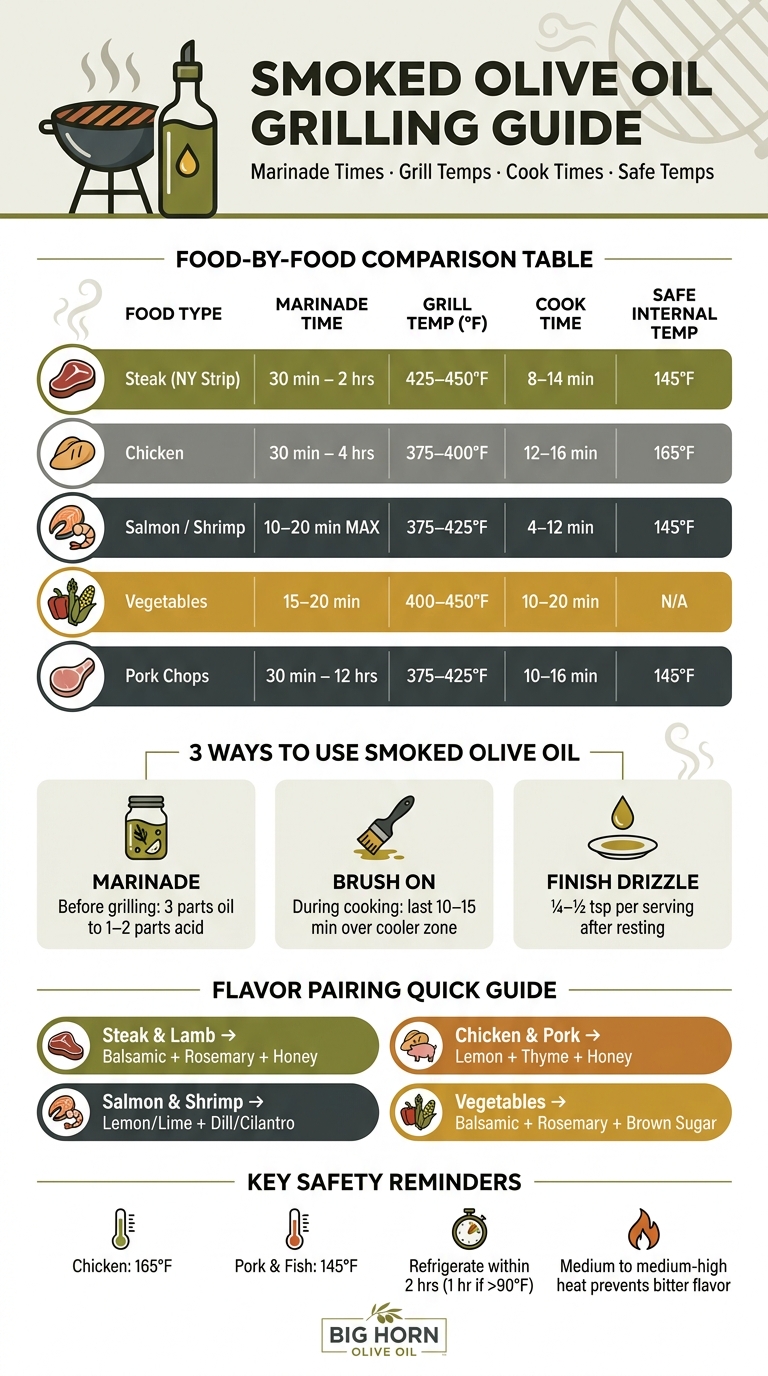
Smoked Olive Oil Grilling Guide: Marinade Times, Temps & Tips by Food
Smoked Olive Oil Grilled Ribeye Steak with the BEST Roasted Vegetables | Cooking With Carolyn
sbb-itb-4066b8e
Quick Comparison
| Recipe | Best Use of Smoked Olive Oil | Grill Heat | Cook Time | Best Flavor Match |
|---|---|---|---|---|
| Base marinade | Marinade, drizzle, baste | N/A | N/A | Balsamic, garlic, herbs |
| NY strip steak | Light pre-coat + finish | 425–450°F | 8–14 min | Rosemary, balsamic |
| Chicken | Marinade + glaze + finish | 375–400°F | 12–16 min | Honey, garlic, lemon |
| Vegetables | Toss before grilling + finish | 400–450°F | 10–20 min | Lemon, herbs, feta |
| Salmon or shrimp | Light coat + finish | 375–425°F | 4–12 min | Lemon or lime, dill, cilantro |
| Pork chops | Short marinade + late glaze | 375–425°F | 10–16 min | Apple cider vinegar, balsamic, rosemary |
A few food-safety numbers matter too: chicken should reach 165°F, pork 145°F, and fish/shrimp 145°F by USDA guidance. Also, leftovers should go in the fridge within 2 hours, or 1 hour if it’s above 90°F outside.
So if I had to sum up the whole article in one line, it would be this: use smoked olive oil lightly, match the timing to the food, and save some for the finish.
How to Use Smoked Olive Oil on the Grill
Smoked olive oil works best when you use it at the right point in the cook. Get the timing right, and it adds a clean smoky note instead of taking over the whole dish. The method you use should match the cut and how long it stays on the grill.
Use Smoked Olive Oil in Marinades
A smoked olive oil marinade is a good fit for steak, chicken, pork, seafood, and sturdy vegetables headed for the grill. A solid starting ratio is 3 parts smoked olive oil to 1–2 parts acid, like lemon juice or balsamic vinegar, plus salt, pepper, and aromatics.
Here’s one easy mix: combine ¼ cup smoked olive oil with 2 tablespoons balsamic vinegar, 2 cloves minced garlic, 1 teaspoon chopped rosemary, and 1–1½ teaspoons kosher salt. Then marinate in the refrigerator for 1–4 hours. Seafood needs only a short soak, and vegetables just need enough time to get coated.
If the food cooks fast, skip the longer marinade and brush the oil on during grilling or use it at the end.
Brush Smoked Olive Oil on During Grilling
Brushing smoked olive oil on while the food cooks adds flavor without burning it off. Put it on over the cooler side of the grill or right after you flip the food. For chicken and pork, start in the last 10–15 minutes, once the sear is already set. Use a silicone brush and apply only a light coat.
Finish Grilled Food with a Light Drizzle
Take the food off the grill, let it rest, then drizzle ¼–½ teaspoon per serving over the top right before plating. Adding it after resting helps the flavor stay bright.
Avoid Bitter Flavor and Flare-Ups
Stick with medium to medium-high heat, and move food to a cooler zone if flare-ups begin. It helps to set up a two-zone grill: one hot side for searing and one cooler side for finishing. If you’re using a sugary glaze or a honey-based baste, wait until the last 5–10 minutes. Put it on too early, and the crust can burn.
Next, use acid, herbs, and a little sweetness to keep the smoke balanced.
Pair Smoked Olive Oil with Acids, Herbs, and Sweet Notes
The table below is a quick match guide for the upcoming recipes.
| Food | Best Acid | Best Herbs | Sweet Note |
|---|---|---|---|
| Steak or lamb | Balsamic vinegar | Rosemary, black pepper | Small amount of honey |
| Chicken or pork | Lemon juice | Thyme, garlic | 1–2 tsp honey per ¼ cup oil |
| Salmon or shrimp | Lemon juice | Thyme, parsley | Light honey or maple syrup |
| Vegetables | Balsamic or sherry vinegar | Rosemary, thyme, garlic | Honey or brown sugar |
1. Big Horn Olive Oil Smoked Olive Oil Base and Balsamic Pairing
Start with a smoke-forward balsamic marinade when you want a fast, go-with-almost-anything grill base.
Big Horn Olive Oil's smoked Chipotle Olive Oil and Serrano Honey Balsamic Vinegar make a balanced mix for steak, chicken, pork chops, shrimp, and vegetables.
Whisk 3 parts smoked olive oil with 1 part balsamic vinegar, then add hickory smoked sea salt, black pepper, garlic, and herbs. Pour the marinade over the food in a zip-top bag and chill it in the fridge. Ribeye or strip steaks need 30 minutes to 2 hours, chicken works well with 30 minutes to 4 hours, and shrimp or fish need just 15 to 20 minutes.
Grill over medium-high heat, then move thicker cuts to indirect heat to finish cooking.
2. Smoked Olive Oil NY Strip Steak
An NY strip has enough marbling to hold onto smoke flavor, especially when the steak is 1¼ to 1½ inches thick. That fat does a lot of the work here. Use smoked olive oil as a light coat before grilling, then finish with acid and herbs so the steak doesn't feel too heavy.
Pat the steak dry, salt both sides, and dry-brine it uncovered for 40 minutes to 24 hours. Then rub it with 1 to 2 teaspoons of smoked olive oil about 15 to 30 minutes before it hits the grill.
Sear it over high heat, then move it to medium indirect heat to finish. Pull it 5°F below your target temp, then let it rest for a short time before slicing.
| Doneness | Pull-off Temp | Final Temp After Rest |
|---|---|---|
| Medium-rare | 130–135°F | ~135–140°F |
| Medium | 140–145°F | ~145–150°F |
| Medium-well | 150–155°F | ~155–160°F |
After resting, add a quick finishing drizzle: stir 1 tablespoon of smoked olive oil with 1 teaspoon of balsamic vinegar and 1 teaspoon of chopped fresh rosemary or parsley, then spoon it over the steak just before serving. The balsamic adds a little brightness, and the herbs keep the finish clean.
3. Smoked Olive Oil Balsamic Honey Grilled Chicken
This grilled chicken uses smoked olive oil in three smart ways: in the marinade, as a glaze, and again right at the end for extra depth.
For 4 servings, use 1½–2 pounds of boneless, skinless chicken thighs or breasts. Trim off any excess fat and pat the chicken dry. In a bowl, mix ¼ cup smoked olive oil, 3 tablespoons balsamic vinegar, 2–3 tablespoons honey, 2–3 cloves minced garlic, 1–2 teaspoons kosher salt, and ½ teaspoon black pepper. If you like, add thyme or rosemary to round things out. Before the chicken goes in, set aside 1–2 tablespoons of the mixture for glazing.
Marinate the chicken in the refrigerator for at least 30 minutes. Thighs can sit longer, up to 4–6 hours, while breasts do better with less time. Before the chicken hits the grill, pat off any excess marinade so you get fewer flare-ups.
Heat your grill to 375–400°F. Start the chicken over direct heat and cook for about 5–7 minutes per side. This helps build color and gives the honey-balsamic mixture time to caramelize. If the pieces are thick and need more time, move them to the indirect zone to finish more gently. Keep the lid closed between flips to help control flare-ups.
During the last 2–3 minutes of cooking, brush on the reserved glaze. Discard any marinade that touched the raw chicken. Cook until the thickest part reaches 165°F.
Let the chicken rest for 5–10 minutes before slicing. Then finish it with 1–2 teaspoons smoked olive oil, a squeeze of lemon juice, and a little parsley.
4. Smoked Olive Oil Grilled Vegetable Platter
This recipe keeps the smoke in check by using smoked olive oil twice: once before the vegetables hit the grill, and again right at the end. That works well here. Smoked olive oil has a lot of personality, so a light coat before grilling and a final drizzle after cooking gives you that smoky note without taking over the whole plate.
Build the platter with vegetables that give you different textures and slightly different cook times: zucchini, squash, peppers, onion, asparagus, mushrooms, eggplant, and cherry tomatoes. Cut everything into even pieces, about 1/4 to 1/2 inch thick, so they cook at about the same pace. Eggplant and onion rounds can take a bit more heat, while asparagus and mushrooms only need a couple of minutes per side. Toss the vegetables with smoked olive oil, salt, pepper, and oregano or thyme. Then let them rest for 15 to 20 minutes so the seasoning clings better and the oil helps limit flare-ups.
Preheat the grill to medium-high, about 400 to 450°F. Grill asparagus, mushrooms, and tomatoes for 2 to 3 minutes per side. Grill zucchini, peppers, and onions for 3 to 5 minutes per side, until they're tender and nicely marked.
Move everything to a platter and finish with smoked olive oil, lemon juice, and parsley or basil. Add a pinch of flaky salt, then top with feta or a little balsamic glaze to balance the char.
Next, the same smoky approach moves to seafood, where short grill time matters even more.
5. Smoked Olive Oil Grilled Salmon or Shrimp
After vegetables, seafood is one of the fastest ways to put smoked olive oil to work on the grill. It cooks fast, so you don’t need much. In most cases, smoked olive oil does its best work as a light coating before cooking or a finish right after.
For salmon, go with skin-on fillets that weigh about 6–8 oz each and measure 1 to 1½ inches thick. Mix 3 tablespoons smoked olive oil with 1 teaspoon kosher salt, ½ teaspoon black pepper, 1 teaspoon smoked paprika, 1 grated garlic clove, and the zest of 1 lemon. Brush the fillets lightly, then let them sit for 15 minutes.
Heat the grill to 400–425°F, lightly oil the grates, and set the salmon skin-side down over direct heat. Grill for about 5–6 minutes, flip once, then cook for another 3–4 minutes. You’re aiming for 125–130°F in the thickest part if you want moist, medium salmon. USDA guidance sets salmon at 145°F. Let the fish rest for 3–5 minutes before serving.
Shrimp is even simpler and cooks in a flash. Toss 1½ pounds of large shrimp (16–20 per pound), peeled and deveined, with 2 tablespoons smoked olive oil, 1 teaspoon kosher salt, ½ teaspoon black pepper, 1 teaspoon smoked paprika, 1 teaspoon cumin, and ½ teaspoon garlic powder. Marinate for 10–15 minutes max. Any longer, and the texture can start to go the wrong way.
Grill the shrimp over direct heat at about 375–425°F for 1–2 minutes per side, just until they turn opaque. Then pull them off right away. With shrimp, timing is everything. One extra minute can be the difference between tender and rubbery.
For the finish, keep it simple:
- Salmon goes well with fresh lemon and chopped dill or parsley
- Shrimp goes well with lime juice and cilantro
A light drizzle of smoked olive oil after grilling adds more smoke flavor without making the dish feel heavy. For salmon, a small splash of aged balsamic also works well with its richness. Just keep these finishing touches off the heat so the smoke stays clean and the seafood keeps that bright, just-cooked flavor.
6. Smoked Olive Oil Pork Chops
Pork chops do best with a short marinade and a glaze added near the end. That keeps the smoke clean instead of muddy. Use bone-in center-cut chops that are 1 to 1½ inches thick. They hold onto more juice and are less likely to dry out over direct heat than thin, boneless chops.
For the marinade, whisk together 3 tablespoons of Big Horn Olive Oil smoked olive oil, 2 tablespoons apple cider vinegar, 2 teaspoons kosher salt, 1 teaspoon smoked paprika, 1 teaspoon garlic powder, and 1 teaspoon fresh rosemary. Coat the chops, refrigerate for 30 minutes to 12 hours, then pat them dry before grilling.
Set up a two-zone grill at 375–425°F. Sear the chops over direct heat for 2–3 minutes per side, then move them to indirect heat and cook until they hit 145°F. Let them rest for 3 minutes before cutting.
For the finishing glaze, reduce ¼ cup of Big Horn balsamic over low heat until it turns syrupy. Brush it lightly over the chops during the last 2 minutes of grilling. After the chops rest, add one more light balsamic brush, then drizzle 1–2 teaspoons smoked olive oil per chop.
Top with chopped fresh rosemary or thyme and a pinch of flaky sea salt. A squeeze of lemon or a little honey helps balance the pork and smoke.
The table below compares the recipes by heat, time, and finish.
Quick Recipe Comparison Table
This quick chart lines up each recipe by oil use, grill heat, and cook time, so you can pick the one that fits what’s on your grill.
| Recipe | Main Ingredient | Smoked Olive Oil Use | Prep Time | Grill Temp (°F) | Approx. Cook Time | Flavor Profile |
|---|---|---|---|---|---|---|
| 1. Smoked Olive Oil and Balsamic Base | Smoked olive oil and balsamic | Base for dipping, drizzling, or basting | None | None | None | Smoky, tangy, rich |
| 2. Smoked Olive Oil NY Strip Steak | NY strip steak | Marinade and finishing drizzle | Dry-brine: 40 min–24 hrs; oil: 15–30 min before grilling | 425–450°F | 8–14 min total | Smoky, bold, peppery |
| 3. Smoked Olive Oil Balsamic Honey Grilled Chicken | Chicken thighs or breasts | Marinade and baste | 30 min–4 hrs | 400–450°F | 12–16 min total | Smoky-sweet, balsamic-tangy |
| 4. Smoked Olive Oil Grilled Vegetable Platter | Mixed vegetables | Tossed with smoked olive oil before grilling | 15–30 min (optional) | 375–425°F | 10–20 min | Bright, herbaceous, savory |
| 5. Smoked Olive Oil Grilled Salmon or Shrimp | Salmon fillet or shrimp | Light marinade and finishing drizzle | Salmon: 15 min; shrimp: 10–15 min | 375–425°F | Salmon: 8–12 min / Shrimp: 4–8 min | Smoky, citrusy, fresh |
| 6. Smoked Olive Oil Pork Chops | Pork chops | Marinade and finishing drizzle | 30 min–12 hrs | 375–425°F | 10–16 min total | Rich, savory, smoky-sweet |
Use the chart to match smoke level, heat, and finish to the cut you’re grilling. Once you choose a recipe, use the grilling tips below to help keep the heat even and the smoke clean.
Grilling Tips and Food Safety Notes
Use these quick checks to keep the recipes above safe, clean, and evenly cooked.
Preheat the Grill and Set Up Heat Zones
Preheat your grill all the way before adding food. A hot grill sears the surface fast, helps prevent sticking, and lets the smoked olive oil flavor the food without burning. Use direct heat for the sear, then move food to indirect heat to finish cooking without scorching the oil.
Oil the Food, Not Just the Grates
Brush meat, seafood, or vegetables with a thin, even layer of smoked olive oil before they go on the grill. Let any extra oil or marinade drip off first so it doesn't hit the heat source and trigger flare-ups. That small step helps with browning and keeps the smoky flavor where you want it: on the food.
Use 1–2 tablespoons per pound, just enough to coat.
Skip oiling the grates. Lightly coat the food instead, and keep extra oil away from the heat.
Use Indirect Heat for Thick Cuts
For thick pork chops, strip steaks, and chicken quarters, sear first, then finish over indirect heat with the lid closed.
Rest Meat Before Serving
Let meat rest after grilling so the juices can settle before slicing.
| Cut | Resting Time |
|---|---|
| NY strip steak | 5–10 minutes |
| Pork chops | 5–10 minutes |
| Chicken thighs or breasts | 5–10 minutes |
| Larger chicken pieces | Up to 15 minutes |
Safe Internal Temperatures in °F
Use a food thermometer to check doneness. Insert the probe into the thickest part of the food, away from bone or large fat pockets.
| Food | Safe Minimum Temp | Notes |
|---|---|---|
| Chicken (all parts) | 165°F | Check the thickest part |
| Pork chops | 145°F | Rest 3 minutes before slicing |
| Beef steaks | 145°F | Rest 3 minutes; cook higher if preferred |
| Salmon and fin fish | 145°F | Flesh should be opaque and flake easily |
| Shrimp | 145°F | Look for opaque, firm shrimp |
Store Leftover Marinades and Cooked Food Safely
Wrap up with safe storage. Set aside a separate portion of the marinade before adding raw protein. Use that reserved portion for basting or finishing drizzles, and never reuse marinade that touched raw meat, poultry, or seafood.
Refrigerate cooked leftovers within 2 hours of grilling - or within 1 hour if outdoor temperatures are above 90°F. Store them in shallow, airtight containers and use within 3–4 days for meat, poultry, and vegetables, or 3 days for fish and shrimp. Reheat leftovers to 165°F before serving.
Conclusion
Smoked olive oil is a simple way to add depth and that grilled flavor people love. You can use it as a light coating, a finishing drizzle, or a brief brush-on while food cooks. The right amount comes down to the cut.
Go a bit heavier with smoke on steak and pork. Keep it balanced on chicken and vegetables. Use the lightest touch on seafood. Then pair that smoke with acid or herbs instead of piling on more smoke.
A little sweetness can help too. It keeps the flavor clean and stops the smoke from taking over. A clean, high-quality EVOO and balsamic base also helps the flavor stay sharper.
Start with one recipe. Cook it once. Then adjust the smoke level and the finish until it tastes right to you.
FAQs
Can I use smoked olive oil on a gas grill?
Yes. You can use smoked olive oil on a gas grill.
For the best result, brush a thin, even layer directly onto the food instead of the grates. That helps cut down on flare-ups and burning. Keep the grill between 300°F and 500°F so the oil keeps its flavor and helps form a smoky crust.
How do I keep smoked olive oil from turning bitter?
Manage the heat with care. For infusions, keep smoked olive oil below 200°F. On the grill, stay within its smoke point, which is usually 375°F to 410°F for premium extra virgin olive oil.
Go easy on the oil, too. A heavy coating can drip into the flames, burn, and leave behind a bitter, charred taste. If your grill climbs past 425°F, switch to a lighter or refined olive oil instead.
Which foods taste best with smoked olive oil?
Smoked olive oil shines with grilled red meats like ribeye, where it adds a bold, smoky layer of flavor. It also works nicely with chicken and pork, whether you use it in a marinade or brush it on as a finishing glaze.
With vegetables, it’s a great match for cauliflower, eggplant, zucchini, and bell peppers. It gives them a savory, lightly charred taste that feels right at home next to anything off the grill.