

How to Spot PDO and PGI Labels on Bottles
When shopping for olive oil or balsamic vinegar, look for PDO (Protected Designation of Origin) and PGI (Protected Geographical Indication) labels. These certifications guarantee the product meets strict production standards tied to specific regions. Here's what you need to know:
- PDO (Red & Yellow Seal): Ensures all production steps (growing, processing, bottling) occur in one region. Example: Kalamata Olive Oil PDO.
- PGI (Blue & Yellow Seal): Requires only one production step in the designated area, offering more flexibility. Example: Speck Alto Adige PGI.
Quick Tips:
- Look for the EU Logo: Red and yellow for PDO, blue and yellow for PGI.
- Check Regional Names: Names like "Modena" or "Kalamata" must match the certification.
- Verify Certification Codes: These codes confirm authenticity.
- Avoid Misleading Terms: Phrases like "Mediterranean Blend" lack legal guarantees.
By understanding these labels, you can confidently choose products that meet high standards of quality and origin.
New PDO & PGI Labeling Rules: What Changes in 2026
sbb-itb-4066b8e
What PDO and PGI Certifications Mean
Both PDO and PGI certifications are European Union quality schemes aimed at protecting regional foods and traditional production methods. They ensure intellectual property rights are upheld, preventing the misuse or unauthorized copying of product names. In essence, they guarantee that what’s in the bottle matches what’s promised on the label - a critical factor when identifying authentic products.
"EU quality policy aims to protect the names of specific products to promote their unique characteristics, linked to their geographical origin as well as traditional know-how." – European Commission
These certifications are especially important in industries like olive oil and balsamic vinegar, where fraud can be an issue. Common scams include diluting extra virgin olive oil with cheaper seed oils, mislabeling refined oils as "Extra Virgin", or falsely claiming a product originates from a specific region. By providing independent verification, these labels help bridge the trust gap between producers and consumers.
On May 13, 2024, the EU introduced Regulation (EU) 2024/1143, further strengthening protections. The updated rules extend to online sales and ingredient use in processed foods. Additionally, producers can now incorporate mandatory sustainability practices into their product specifications.
Let’s take a closer look at what PDO certification entails.
PDO: Protected Designation of Origin
PDO certification represents the strictest standard, ensuring that every step of production - from growing to processing and preparation - happens within a specific region using approved methods. For olive oil, this means the olives must be grown, pressed, and bottled entirely within the designated area.
"Product names registered as PDO are those that have the strongest links to the place in which they are made." – European Commission
A great example is Kalamata Olive Oil PDO from Greece. The entire process, from cultivating specific olive varieties to pressing and bottling, occurs in the Kalamata region. This ensures the oil reflects the unique microclimate and traditional methods of the area. Similarly, for PDO wines (used as a base for authentic balsamic vinegars), 100% of the grapes must come from the specified geographical region. PDO standards often include stricter chemical requirements as well. For instance, while standard Extra Virgin Olive Oil permits acidity levels of up to 0.8%, many PDO regions limit acidity to below 0.5% or even 0.3%.
PGI: Protected Geographical Indication
PGI certification, while still safeguarding regional quality and reputation, allows for more flexibility. Only one stage of production, processing, or preparation needs to occur in the designated region, rather than all stages.
"PGI emphasizes the relationship between the specific geographic region and the name of the product, where a particular quality, reputation or other characteristic is essentially attributable to its geographical origin." – European Commission
For PGI wines, at least 85% of the grapes must originate from the specified region. A good example is Speck Alto Adige PGI, a dry-cured ham from South Tyrol, Italy. While the production follows regional techniques monitored by the Südtiroler Speck Consortium, the meat itself doesn’t have to come exclusively from animals born and raised in the region. The same principle applies to PGI-certified balsamic vinegars and olive oils - the connection to the region is important, but the requirements are less stringent compared to PDO.
Main Differences Between PDO and PGI Labels
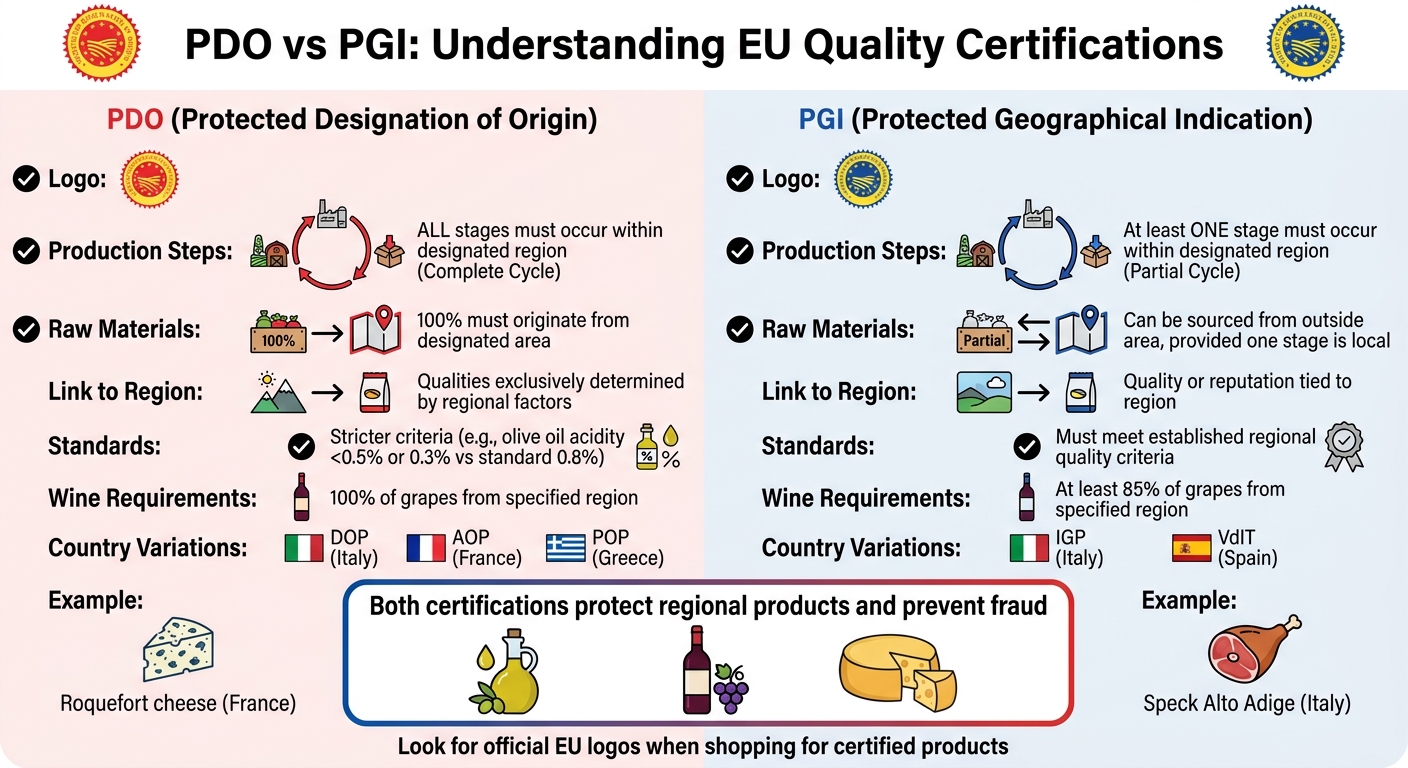
PDO vs PGI Certification Comparison: Key Differences in Food Quality Labels
Both PDO (Protected Designation of Origin) and PGI (Protected Geographical Indication) certifications protect regional products, but they differ in how much of the production process must occur locally. PDO products owe all their defining qualities to specific local factors, such as soil, climate, and traditional methods. PGI products, on the other hand, only need a clear connection to the region.
"To receive the PDO status, the entire product must be traditionally and entirely manufactured (prepared, processed and produced) within the specific region and thus acquire unique properties." – Wikipedia
One major distinction lies in where raw materials come from. PDO requires that 100% of the raw materials originate from the designated region. PGI allows for raw materials to come from outside the region, as long as at least one significant production step happens locally. Take Roquefort cheese, for example - it must use milk from a specific sheep breed and be aged in the natural caves of Roquefort-sur-Soulzon, France, to earn PDO status. Meanwhile, Comber Earlies potatoes, which received PGI recognition in 2012, only need to be grown near Comber, Northern Ireland, and harvested between May and July.
PDO vs. PGI Comparison Table
| Feature | PDO (Protected Designation of Origin) | PGI (Protected Geographical Indication) |
|---|---|---|
| Production Steps | All stages must occur within the designated region | At least one stage must occur within the designated region |
| Raw Materials | Must originate entirely from the designated area | Can be sourced from outside the area, provided one stage is local |
| Link to Region | Qualities are exclusively determined by regional factors | Quality or reputation is tied to the region |
| Logo Color | Red and yellow seal | Blue and yellow seal |
| Quality Standards | Stricter criteria (e.g., lower acidity thresholds for olive oil) | Must meet established regional quality criteria |
| Example | Roquefort cheese (France) | Comber Earlies potatoes (Northern Ireland) |
Now that you know the difference, you can start spotting these labels on your favorite products, like an authentic Italian balsamic vinegar!
How to Find PDO Labels on Bottles
These visual markers help confirm that the product meets the strict standards required for PDO certification.
Find the PDO Logo or Label
Start by looking for the official EU PDO logo on the bottle. This is a circular red and yellow symbol that signifies the product has the highest level of geographical protection. It's a reliable first step when verifying olive oil or balsamic vinegar.
Keep in mind that the PDO certification is labeled differently depending on the country. For example:
- Italian products use DOP (Denominazione di Origine Protetta)
- French products display AOP (Appellation d'Origine Protégée)
- Greek items use POP (Prostatevomeni Onomasia Proelefsis)
These terms are simply regional translations of PDO.
"The PDO label is the padlock on the authenticity. It creates a closed loop that is incredibly difficult to penetrate with fake oil." - O-Liv
Pay attention to the logo's color. A red and yellow logo indicates PDO certification, while a blue and yellow logo signifies PGI (Protected Geographical Indication). After spotting the logo, double-check that the regional name and seal on the label match the PDO registration.
Check Regional Names and Official Seals
In addition to the logo, the protected regional name on the label is crucial. Names such as "Modena", "Reggio Emilia", "Kalamata", or "Sitia Lasithi" are legally protected, meaning only products from these regions can use them, regardless of how similar another product might be in taste or quality.
Authentic PDO products will also feature a unique alpha-numeric certification code on the packaging. This code acts as an audit trail, proving that the product underwent official inspection. You’ll usually find this code on the back label alongside other key details like the harvest date and the specific olive variety used (e.g., Koroneiki or Tsounati for Greek olive oils).
Be cautious of vague origin claims that lack PDO certification. Phrases like "Product of the Mediterranean", "Packed in Italy", or "100% Italiano" might sound convincing but hold no legal weight. In fact, studies show that 69% of imported olive oils in certain major markets were mislabeled and failed to meet Extra Virgin standards. The certification code is your strongest tool to confirm authenticity beyond these generic claims.
How to Find PGI Labels on Bottles
Identifying PGI-certified products is straightforward if you know what to look for. While PGI (Protected Geographical Indication) uses a different system than PDO (Protected Designation of Origin), it’s just as reliable. Here’s how to verify these products through their logos and certification details.
Find the PGI Logo or Label
The PGI logo is easy to recognize - it features a blue and yellow sun-like design, which sets it apart from PDO's red and yellow seal. For food and agricultural products, this logo is mandatory, but wine producers have the choice to include it or not.
In some countries, PGI may appear under different names, such as IGP in Italian or VdlT in Spanish. What makes PGI distinct is that it requires only one key production stage to occur within the specified region.
"The blue and yellow seal is slightly less restrictive than PDO but still very valuable. It guarantees that at least one stage of production (usually the cultivation) took place in the designated region." - O-Liv
Also, look for a unique alpha-numeric certification code on the packaging. This code confirms the product has passed official inspections and meets PGI standards.
Check for Regional Area Indicators
After spotting the PGI logo, take a closer look at the label for regional details. PGI certifications typically cover larger geographical areas, as their production requirements are more flexible. For example, wines must source at least 85% of their grapes from the specified region, compared to PDO's stricter 100% requirement. The same applies to products like fresh harvest olive oils and balsamic vinegars.
Often, the product’s name will directly reference the region, such as "Terra di Bari" or "Alto Adige". Be cautious of vague terms like "Product of Italy" or "Mediterranean Blend", which do not indicate official certification. To further confirm authenticity, check the back label for mentions of a specific consortium or control institute responsible for verifying the product's regional origin. These details add an extra layer of assurance.
Step-by-Step Guide to Finding PDO and PGI Labels
If you're ready to identify PDO and PGI certifications with confidence, here's a straightforward guide to help you verify these labels.
Step 1: Check the Front Label
Start by looking at the front of the bottle for the official EU logos. The PDO logo is red and yellow, while the PGI logo is blue and yellow. These logos confirm the product meets strict European standards. Keep an eye out for local terms like DOP or IGP, depending on the language. Be cautious of marketing terms that aren't tied to regulatory standards - they can be misleading.
Step 2: Match the Regional Name with the Certification Type
After spotting a certification logo, confirm that the regional name aligns with the certification. For instance, a product labeled "Kalamata" should have a PDO seal because all production steps occur in that specific Greek region. On the other hand, if a bottle says "Product of the Mediterranean" but lacks an official seal, it’s likely a blend from multiple locations. Genuine certified products will always specify a particular region, village, or estate. Once you've verified the regional name, move on to the back label for further confirmation.
Step 3: Review the Back Label
Flip the bottle around and examine the back label for essential details like harvest dates and certification codes. Look for a recent harvest date, ideally within the past 12 to 18 months, as olive oil can lose up to 40% of its healthful phenols after that time. Additionally, check for a unique certification code, the producer's name, and proper storage instructions. These details are key indicators of authenticity and quality.
Step 4: Watch for Misleading Labels
Be wary of labels with vague or misleading claims. For example, steer clear of products that don’t specify a precise regional origin. Similarly, avoid terms like "Pure Olive Oil" or "Light Olive Oil." These typically refer to refined oils that have lost much of their flavor and nutritional value. It’s worth noting that a study revealed 69% of imported olive oils in certain major markets were mislabeled and failed to meet Extra Virgin standards. Trust the details and certifications to guide your choice.
Why Buy Certified Products from Reliable Suppliers
Recognizing PDO and PGI labels is just one part of the equation. The other, equally important, part is choosing the right place to buy. Even certified products can lose their integrity if they come from unreliable sources. For instance, a 2010 UC Davis study revealed that only 27% of imported extra virgin olive oil samples met the actual standards for "extra virgin" quality. This highlights how crucial it is to buy from trustworthy suppliers to ensure you're getting genuine certified products.
Reliable suppliers go above and beyond to verify the authenticity of their products. They source directly from certified producers, conduct purity tests, and provide clear, transparent labeling. This extra diligence significantly reduces the risk of adulteration, which is a real concern since up to 69% of extra virgin olive oils in the U.S. fail to meet international quality standards. Established suppliers consistently offer products that are tested for quality, delivering better taste and health benefits.
Choosing PDO and PGI-certified products also means you're getting more nutritional value. For example, consumer reports show that PDO-certified olive oils contain 30-50% more polyphenols compared to uncertified oils. These antioxidants are known for their anti-inflammatory properties and heart health benefits. Similarly, PGI-certified balsamic vinegars from Modena ensure proper aging and a grape-based composition, resulting in the rich flavors and balanced acidity (6-8%) that uncertified vinegars can't replicate. These nutritional and quality perks make sourcing from trusted suppliers a must.
Big Horn Olive Oil: Certified Quality Products
Reliable suppliers not only ensure authenticity but also deliver consistently high-quality products. Big Horn Olive Oil is a prime example, adhering to strict certification standards by sourcing directly from PDO and PGI regions. Their specialty lies in Ultra Premium Extra Virgin Olive Oils and Modena Balsamic Vinegars that meet rigorous international quality benchmarks. Their balsamic vinegars, for instance, carry PGI certification from Modena, including traditionally aged varieties with complex, rich flavors, as well as infused options like garlic or raspberry. Their extra virgin olive oils come from PDO regions, boasting low acidity (under 0.3%), recent harvest dates, and high polyphenol content.
Big Horn Olive Oil has earned a stellar reputation, with a 4.9/5 rating on Google from over 250 reviews. Customers frequently praise the "authentic Modena balsamic taste" and "fresh, peppery EVOO". The company has also received accolades, including a 2023 NYIOOC Gold award for several of their oils. By focusing on small-batch imports and offering detailed product information - such as certification seals and origin details - Big Horn Olive Oil ensures you’re getting verified quality in every bottle. You can explore their offerings at https://bhooc.com, where all products come with the transparency and traceability that certified labels demand.
Conclusion
Take a moment to review the steps outlined earlier to verify the certification details on any olive oil bottle.
Recognizing PDO and PGI labels not only helps you avoid fraud but also ensures you're purchasing authentic, high-quality olive oil. Unfortunately, olive oil is one of the most tampered-with foods, with some producers cutting premium oils with cheaper seed oils, mislabeling quality grades, or even falsifying origins.
Knowing the distinction between PDO and PGI certifications can guide you toward smarter buying decisions. PDO certifications represent the highest standard, requiring every step - from cultivation and pressing to bottling - to happen within a specific region, adhering to time-honored methods. On the other hand, PGI certifications ensure that at least one stage of production occurs in the designated area, preserving a connection to its local character. Additionally, PDO-certified oils adhere to stricter acidity limits compared to standard extra virgin oils.
When browsing, ignore flashy marketing terms like "Premium", "Pure", "Light", or "Natural", as these phrases lack any official regulation. Instead, focus on finding the official certification logos, steering clear of ambiguous labels that might disguise blends from various sources.
"Certifications act as a shield against fraud, protecting both the honest farmer and the health-conscious buyer." – O-Liv
FAQs
Are PDO and PGI labels harder to fake than other claims?
PDO and PGI labels are tough to counterfeit because they are official certifications granted by the European Union. These labels guarantee both authenticity and quality by enforcing strict regional production standards and traceability requirements. This thorough process ensures they are far more dependable than many other claims.
Can a real PDO or PGI product still be low quality or old?
PDO and PGI certifications confirm a product's origin and adherence to traditional production methods. However, they don't necessarily ensure freshness or overall quality. To enjoy the best experience, choose products that combine these certifications with a focus on high-quality standards, such as those from reputable sources known for premium olive oils and balsamic vinegars.
Where can I verify a PDO/PGI certification code online?
You can check a PDO or PGI certification code online using the EU's eAmbrosia database or by visiting the website of the appropriate certification authority. These platforms offer official details to help verify the legitimacy of PDO and PGI labels.