

Stakeholder Roles in Olive Oil Traceability Systems
Olive oil traceability ensures every bottle's journey - from grove to shelf - is documented and verified. This system combats fraud, improves quality assurance, and meets consumer demand for transparency. Key stakeholders include:
- Producers & Mill Operators: Record harvest details, milling data, and oil quality metrics.
- Distributors: Maintain lot-level tracking and monitor transport conditions.
- Bottlers: Ensure accurate labeling, lot reconciliation, and traceability from tank to retail.
- Retailers: Share product history with customers and manage inventory records.
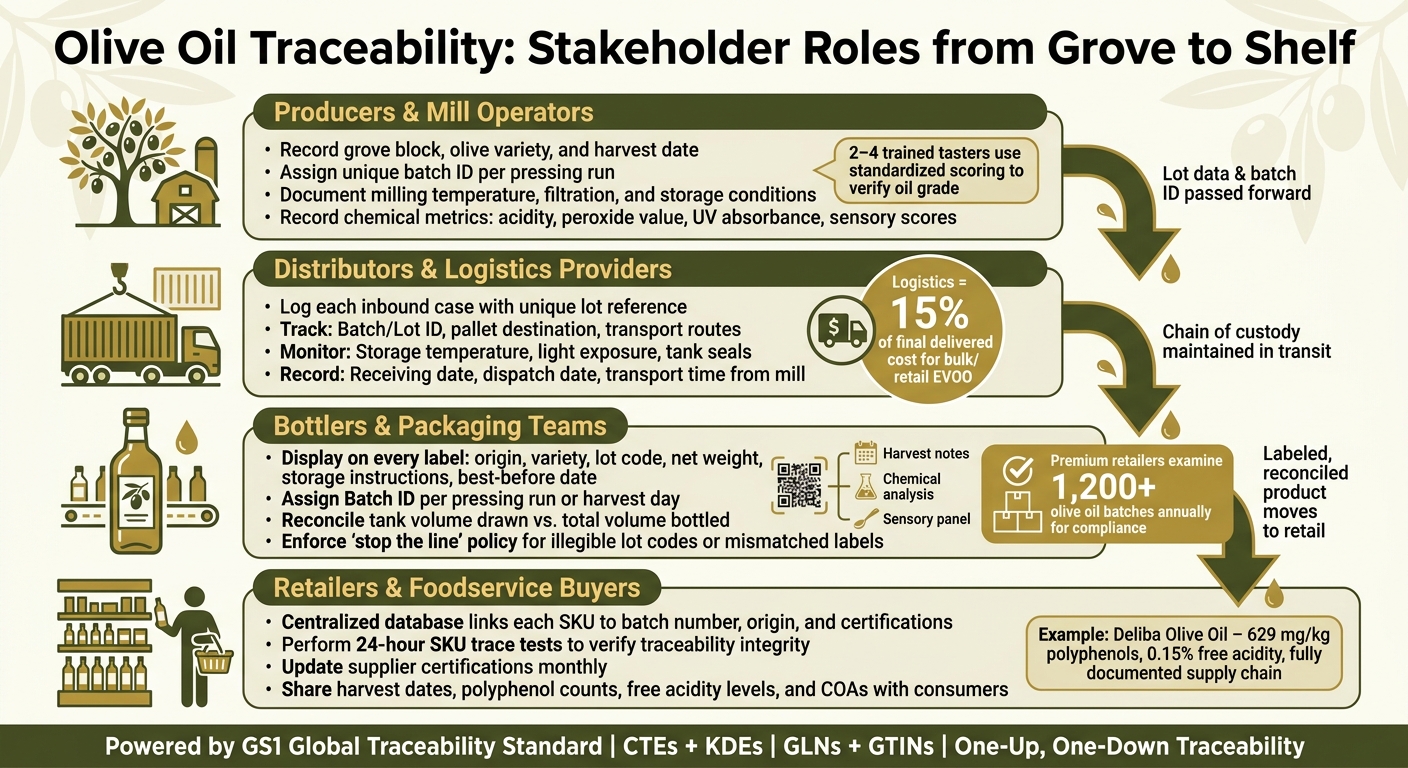
Olive Oil Traceability: Stakeholder Roles from Grove to Shelf
How Producers and Mill Operators Support Traceability
Producers play a key role in starting the traceability process, setting the tone for everything that follows. The quality of the source data they provide is critical to ensuring the entire system works as intended.
Data Collection at the Source
Producers are responsible for recording critical production details that form the backbone of traceability. These include the specific grove block, olive variety, harvest date, and the time between harvesting and delivery to the mill. It's especially important to track any milling delays, as these can impact the quality of the oil.
At the mill stage, each pressing run is assigned a unique batch ID. Operators also document key details like milling temperature, whether the oil was filtered, and storage conditions. This ongoing record ensures traceability from the grove all the way to the final product.
Additionally, chemical analysis is a key part of this process. Metrics such as acidity, peroxide value, UV absorbance, and sensory scores are recorded to confirm the oil's grade and authenticity. To maintain consistent quality, two to four trained tasters use a standardized scoring system to identify any defects before the oil reaches consumers.
Operational Controls for Record Accuracy
Recording data is just the first step - ensuring its accuracy is equally important. Without strict operational controls, even the most detailed records lose their value. For instance, batch separation is a critical practice: oils from different groves, varieties, or harvest dates should never be mixed unless the lot record is updated. Mixing without proper documentation breaks the traceability chain.
Mills must also maintain logs for cleaning schedules, equipment calibration (such as thermometers, scales, and sensors), and HACCP records. These records track critical control points like heat exposure during extraction and storage tank conditions. These aren't just regulatory requirements - they're proof that a specific lot was handled correctly.
To keep records consistent and reliable, mills can designate a dedicated data steward and adopt standardized digital tools. This ensures accountability and prevents records from becoming outdated or inconsistent across different team members.
"A traceable product is easier to defend, easier to recall if needed, and easier to sell into premium channels." - Amelia Grant, Senior SEO Content Strategist
For producers not ready to invest in enterprise software, simpler solutions like structured cloud folders or spreadsheets can work effectively. The key is to use standardized formats and maintain them consistently, ensuring certificates, test reports, and batch logs are always accessible and up to date.
sbb-itb-4066b8e
How Distributors and Logistics Providers Maintain Traceability in Transit
Once olive oil leaves the mill, the responsibility for traceability shifts to distributors and logistics providers. Their role is critical: they must preserve the product's identity from pickup to delivery, ensuring the chain of custody remains intact. This careful documentation during transit mirrors the stringent controls at the production stage, reinforcing the goal of uninterrupted traceability.
Maintaining Lot Integrity During Transport
The cornerstone of transit traceability lies in lot-level tracking. Monitoring at the supplier level alone isn’t enough - each inbound case must be logged with its unique lot reference. This ensures that no unrecorded units slip into the system without a clear link to their origin.
"Lot-level information matters because it is the smallest unit that links product, processing, and time." - Alexandra Mercer, Senior SEO Content Strategist
For instance, if a bulk catering tin is repackaged into smaller deli containers or bottles during distribution, the original lot code must follow each new unit. Ignoring this step creates gaps that can complicate audits or recalls. With logistics and distribution accounting for 15% of the final delivered cost for bulk and retail-bottled extra virgin olive oil (EVOO), any documentation lapses can lead to serious financial and legal challenges.
Once lot integrity is secured, the next step involves capturing detailed transit data to further strengthen traceability.
Tracking Shipment Data
Documenting environmental conditions is just as important as tracking location data.
"Dark, cool, stable storage is not a luxury; it is a quality control system." - Amelia Grant, Senior SEO Content Strategist
To ensure audit readiness, logistics teams must record data across several categories, as outlined below:
| Data Category | Fields to Track | Why It Matters |
|---|---|---|
| Product Identity | Batch/Lot ID, Product Name, Variety | Links the product to its specific production run |
| Transit Logistics | Pallet destination, delivery notes, transport routes | Establishes accountability during movement |
| Environmental | Storage temperature, light exposure, tank seals | Protects oil quality and reduces oxidation risks |
| Temporal | Receiving date, dispatch date, transport time from mill | Builds an audit-ready timeline |
Test your system by tracing a finished product back to its source and forward to the customer. If your team encounters gaps or has to manually search for records, that’s a sign of a weak point that needs fixing. Keeping an up-to-date audit pack - including receiving records, storage logs, and batch logs - ensures you’re ready when inspectors or buyers request documentation.
These measures during transit help maintain a seamless traceability chain, setting the stage for bottlers to connect raw materials to finished goods.
How Bottlers and Packaging Teams Connect Raw Materials to Finished Products
When it comes to bottling, the focus shifts from managing raw materials to delivering consumer-ready products. Bottlers and packaging teams play a crucial role in maintaining a seamless traceability chain, ensuring that every step - from bulk oil to finished product - is accurately documented.
Labeling and Identification Systems
Labels are more than just a way to identify a product on the shelf. They serve as a bridge between the physical product and its database record. As one expert explains:
"Labels are one of the simplest data governance tools you have. They connect the physical item to the database record. If the label and the record disagree, trust falls apart." - Natural Olives Co.
Every bottle must display critical details such as origin, variety, lot code, net weight, storage instructions, and best-before date. These details are tied to a master record, which must be updated promptly if there are changes in harvest location or processing methods.
Many bottlers are now incorporating QR codes into labels. These codes provide instant access to essential data like harvest notes, chemical analysis, and sensory evaluations, turning what might seem like a regulatory formality into a chance to enhance the brand. As Amelia Grant notes:
"A QR code on the label can link to harvest notes, chemical analysis, sensory panel findings and storage guidance. Done well, this turns compliance into a premium brand experience." - Amelia Grant, Senior SEO Content Strategist
To avoid costly errors, packaging teams enforce a "stop the line" policy for issues like illegible lot codes or mismatched labels. While a brief halt in production may seem inconvenient, it’s far less costly than correcting mislabeled batches that have already shipped. This attention to detail ensures accurate record reconciliation in the next stages of the process.
Reconciling Input and Output Records
Accurate reconciliation of input and output records builds on detailed labeling to further reinforce traceability. Bottlers must document the tank batch number and the exact volume drawn from each tank, verifying that the total volume bottled aligns with what was extracted. Any discrepancies should be investigated immediately.
Here’s a breakdown of the key components of an effective bottling traceability system:
| Traceability Component | Bottling/Packaging Action | Purpose |
|---|---|---|
| Batch ID | Assigned per pressing run or harvest day | Links lab results and tank records to the final bottle |
| Traceability Sheet | Logs tank ID, bottling date, and pallet destination | Enables quick recalls and maintains inventory accuracy |
| Structured Labeling | Encodes origin, variety, and lot code | Provides data transparency for consumers and auditors |
| Lot Reconciliation | Tracks the source lot during repacking | Maintains custody from bulk oil to retail bottles |
| Mock Audit | Traces finished goods back to raw materials | Tests system reliability and identifies data gaps |
A great way to test the system is to pull a finished bottle from the shelf and trace it back to its source ingredients - and forward to the end customer. If this process takes more than a few minutes or requires manual searching, it highlights a gap that needs addressing. Considering that premium retailers examine over 1,200 olive oil batches annually for sensory and physicochemical compliance, bottlers must ensure their systems can handle this level of scrutiny.
For those dealing with infused or flavored oils, keeping separate storage and records for each variety is critical. Mixing records between flavored and unflavored batches isn’t just a traceability issue - it can compromise the product’s authenticity and create challenges during a recall. Precision in these systems is non-negotiable.
How Retailers and Foodservice Buyers Provide Transparency to Customers
Retailers and foodservice buyers play a key role in ensuring traceability by maintaining and sharing detailed product histories. As the final stop in the supply chain, they are responsible for making this information accessible to consumers. To achieve this, they rely on precise product storage, identification systems, and clear communication of data.
Inventory Management and Product Identity
To manage inventory effectively, retailers need a centralized database that links each SKU to its batch number, origin, supplier certifications, and shelf-life details. This system not only helps avoid labeling mistakes but also ensures accurate tracking of products.
One way to test the strength of traceability systems is by performing a 24-hour SKU trace test. This involves generating a full origin and evidence pack for a randomly selected SKU. If the test fails, it indicates a gap in the system. For foodservice buyers juggling numerous SKUs from various suppliers, these periodic checks are essential to prevent traceability from becoming a mere formality.
Another important step is keeping supplier certifications up-to-date, ideally on a monthly basis. This protects claims made on product labels and reinforces trust between suppliers and retailers. Together, these practices ensure that the hard work of earlier stakeholders in the supply chain isn’t undone.
Once internal systems are running smoothly, the next step is sharing this information with customers. Transparency at this stage is vital for building consumer trust.
Sharing Traceability Information with Customers
Modern consumers expect more than vague assurances - they want proof. For instance, while phrases like "Product of Italy" are legally permissible, they can be misleading if the product contains ingredients from multiple countries. Retailers that go the extra mile, offering details like harvest dates, polyphenol counts, free acidity levels, and batch-specific Certificates of Analysis (COAs), provide customers with verifiable data rather than just marketing claims.
"A label can say 'Product of Italy' while the oil inside comes from six or seven different countries. This is legal. It is also the exact problem this framework was designed to make visible." - Gianfranco Cosmano, Producer, Deliba Olive Oil
Take Deliba Olive Oil as an example. During the 2025/26 production season, they introduced a "Transparency Framework" for their Ottobratico batch harvested in October 2025. Their COA revealed 629 mg/kg total polyphenols and 0.15% free acidity. The entire supply chain was documented, showing a closed loop from their family farm in Molochio, Italy, to their U.S. distribution center in New Jersey. This level of detail transforms traceability into a tool for trust, rather than a mere regulatory requirement.
"Trust is a commercial asset that needs governance, measurement and periodic challenge." - Alex Mercer, Senior SEO Content Strategist
Big Horn Olive Oil (bhooc.com) offers another example of how transparency can support a brand’s mission. Known for sourcing Ultra Premium Extra Virgin Olive Oils and Balsamic Vinegars from Modena, Italy, the company shares batch-level data with customers through QR codes, digital lab reports, and staff education. This approach reinforces the brand’s commitment to quality and ensures customers feel confident in every purchase.
Data Standards and Shared Systems in Traceability
Ensuring transparency in retail hinges on consistent, compatible data from all participants in the supply chain. When stakeholders rely on different formats, terms, or systems, the data can quickly become unreliable. To address this, standardized data frameworks provide a shared "language" for everyone involved.
The GS1 Global Traceability Standard (GTS) is a widely used framework that organizes traceability around five key dimensions: Who, What, Where, When, and Why. Within this framework, two essential components stand out: Critical Tracking Events (CTEs) and Key Data Elements (KDEs). CTEs refer to recorded events like harvesting, milling, or bottling, while KDEs are the specific details that describe these events. For instance, in olive oil production, a CTE might involve transferring oil from a storage tank to the bottling line, with KDEs capturing details like the tank ID, transfer date, and acidity level.
"GS1's approach to enabling supply chain traceability is focused on the use of open standards to provide visibility of objects that are relevant to supply chains." - GS1 Global Traceability Standard
Interoperability doesn’t require everyone to use the same software. Instead, it relies on standardized identifiers. For example, Global Location Numbers (GLNs) identify locations and parties, while Global Trade Item Numbers (GTINs) uniquely identify products. By using these identifiers consistently across systems - whether in ERP platforms, shipping documents, or retail databases - data becomes verifiable throughout the supply chain.
Core Data Types by Stakeholder
Different stakeholders in the olive oil supply chain handle various types of data. Here's a breakdown of their roles:
| Data Type | Description | Created By | Verified By | Received By |
|---|---|---|---|---|
| Origin Data | Harvest location, olive variety, grove ID | Producer/ Grower | Mill Operator | Mill/ Bottler |
| Process Data | Extraction temperature, milling date, acidity levels | Mill Operator | Quality Control | Bottler/ Distributor |
| Shipment Data | Lot numbers, SSCC (Serial Shipping Container Code), transit times | Logistics Provider | Receiver | Distributor/ Retailer |
| Sale Data | Point of sale, timestamp, batch ID | Retailer | Consumer (via scan) | End Customer |
A basic yet effective standard in traceability is the "one-up, one-down" approach. This means every stakeholder should be able to trace back to their direct supplier and forward to their direct recipient. This method ensures continuity of data across every stage of the supply chain.
Digital Tools for Data Sharing
Digital tools like EPCIS, EDI, and GDSN play a crucial role in sharing standardized event and transactional data. These tools allow stakeholders to quickly verify details such as product origin, harvest dates, and lab results.
AI-powered provenance dashboards are also becoming more common. These tools consolidate scattered records - like scanned invoices, handwritten notes, and lab reports - into searchable, machine-readable formats.
"A well-designed provenance dashboard turns scattered records into a living trust layer, showing where the fruit was grown, how it was milled, tested, blended, packaged, and shipped." - Daniel Mercer, Senior SEO Content Strategist
Blockchain technology further enhances trust by creating immutable records. However, as Daniel Mercer points out, "If you do not standardize inputs first, AI merely accelerates confusion". In other words, no matter the technology, standardizing data inputs is the foundation for effective traceability.
These standardized systems form the backbone of reliable governance and enable swift responses during supply chain crises.
Governance, Accountability, and Crisis Response
When standardized data and digital tools are paired with strong governance, every stakeholder in the traceability chain becomes accountable, ensuring the system operates effectively.
Defining Accountability Across Stakeholders
In olive oil traceability, governance is shaped by international and regional organizations. Bodies like the International Olive Council (IOC), the Codex Alimentarius Commission, and the European Union establish the analytical standards that stakeholders must adhere to. A key example is EU Regulation (EEC) 2568/91 and its amendment Reg. 1348/2013, which define the chemical criteria for Extra Virgin Olive Oil (EVOO). These include a free fatty acidity limit of 0.8% and specific spectrophotometric values (K232 ≤ 2.5, K270 ≤ 0.22, ΔK ≤ 0.01).
To reinforce traceability, contracts, certifications, and audits are essential. Procurement teams use quality release and downgrade clauses in supplier agreements to ensure they aren't paying for EVOO when a batch fails sensory or oxidation thresholds. Suppliers are categorized by their risk of authenticity issues: Tier 1 suppliers face routine checks, while higher-risk tiers are subject to more rigorous testing, stricter documentation requirements, and shorter contracts. These measures integrate seamlessly with digital traceability systems, ensuring that every recorded data point is backed by clear accountability.
"Actionable governance beats 'better negotiating': set market-band guardrails, define downgrade/acceptance terms, tier suppliers by authenticity risk, and pre-qualify alternates before allocation hits." - Team Tridge
A study of Italian supply chains found that only 30% of firms had fully implemented traceability systems. As researchers from Sciety explain, "Digital traceability is not only a technical solution but a governance innovation whose success depends on the alignment between technology, actor roles, and institutional arrangements".
This structured approach to accountability becomes even more critical during crises, where rapid and reliable traceability can make all the difference.
Traceability During Recalls and Contamination Events
In times of recalls or contamination, the governance protocols already in place allow stakeholders to quickly address the problem. Data such as harvest locations, milling dates, lot numbers, and transit logs become indispensable for identifying and isolating affected batches. These records enable stakeholders to trace the issue both backward to the source and forward to the end consumer.
Biomarkers are especially valuable in these situations. When advanced lab equipment isn't available, stigmastadienes and sterolic profiles serve as reliable indicators to confirm authenticity and trace lot origins. These markers can expose whether an oil has been diluted with cheaper alternatives or mislabeled as EVOO. According to Lozano-Castellón et al. from the University of Barcelona, such fraudulent practices pose a direct risk to consumers: "Fraudulent production practices need to be detected to preserve the beneficial health effects of EVOO and to avoid the potential risks associated with ingesting substandard oil".
To maintain continuity during crises, it’s critical to pre-qualify alternative suppliers from at least two sourcing regions. Additionally, any unusually low prices compared to market norms should automatically trigger verification workflows and authenticity checks before the oil is accepted into the supply chain.
Why Stakeholder Collaboration Matters in Olive Oil Traceability
No single stakeholder can guarantee the integrity of olive oil on their own. While producers may carefully document every detail of a harvest, those efforts mean little if a distributor mishandles lot integrity during transit. Collaboration is what ties these efforts together, turning disconnected data into a seamless chain of evidence.
Working together also strengthens the connection between commercial and technical teams. For instance, procurement and quality teams need to stay in sync to avoid compliance issues. Imagine a buyer finalizing a new supply agreement without consulting the quality team on origin statements or chemical specifications - this could lead to compliance gaps. Aligning commercial decisions with technical reviews helps avoid these pitfalls.
Standardized data formats play a big role too. Inconsistent entries - like "Macedo Foods" versus "Macedo Ltd." - can disrupt audit trails and make tracing unreliable. Using consistent formats minimizes errors and ensures that only approved vendors are part of the process.
Collaboration becomes even more critical during a crisis. Simulated traceability tests that track products from source to customer can uncover bottlenecks. When records are aligned, digital systems can confirm a product’s origin within 24 hours. This speed and accuracy are only possible when all stakeholders maintain compatible records.
"A simple system that everyone uses is usually better than a powerful system that only one person understands." - Alexandra Mercer, Senior SEO Content Strategist
For brands like Big Horn Olive Oil, which source Ultra Premium Extra Virgin Olive Oil and adhere to internationally recognized quality standards, this cross-stakeholder alignment isn’t just about meeting regulations. It’s the foundation for making quality claims that are both credible and verifiable throughout the entire supply chain.
FAQs
What data must each stakeholder capture to maintain traceability?
Each stakeholder should document critical information to maintain traceability. This includes details like the product's origin, harvest date, batch numbers, and handling procedures. Such records play a crucial role in ensuring transparency and protecting the integrity of the olive oil supply chain.
How can a small producer set up traceability without expensive software?
Small producers can achieve traceability without breaking the bank by tapping into open data sources, maintaining clear labeling records, and using straightforward supply chain documentation. Pulling together information like customs trade data, certification registries, and producer disclosures can help create a dependable record of their products' journey. Additionally, simple digital tools - think QR codes or RFID tags - make it easier to track product origins and details. These affordable methods not only improve transparency but also help build trust with consumers.
What should I look for on a label or QR code to verify an olive oil’s lot and origin?
When buying olive oil, take a moment to examine the label or scan the QR code. Look for important details such as the harvest date, geographic origin, and batch number. QR codes can often provide access to traceability records and certifications, giving you a clearer picture of the oil’s origin and ensuring its quality.